
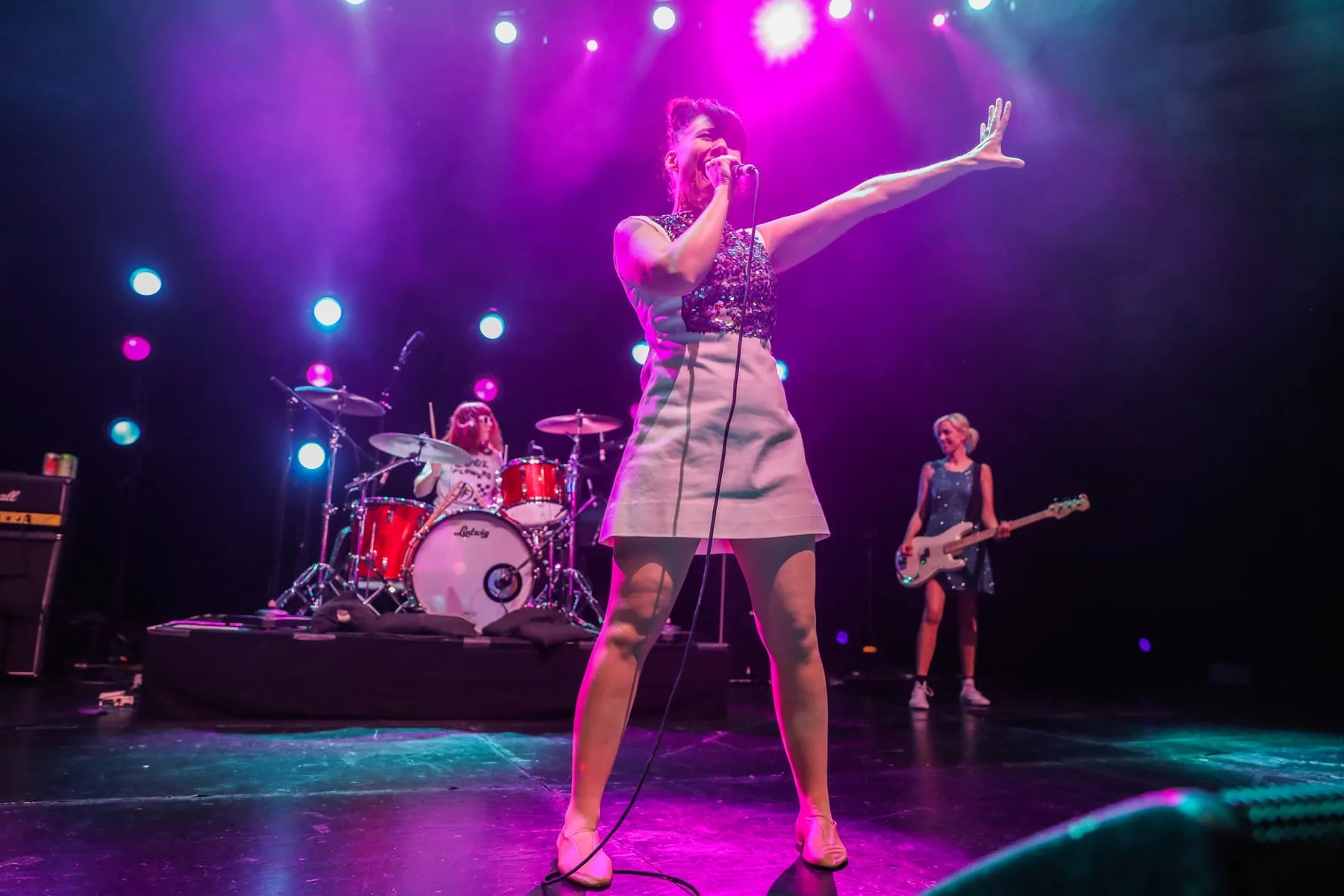
Photo by Nfopollenz , licensed under CC BY-SA 4.0 · Wikimedia Commons
Rank #406
Bikini Kill
Olympia band who launched the riot grrrl movement.
From Wikipedia
Bikini Kill is an American punk rock band formed in Olympia, Washington, in October 1990. The group originally consisted of singer and songwriter Kathleen Hanna, guitarist Billy Karren, bassist Kathi Wilcox, and drummer Tobi Vail. The band pioneered the riot grrrl movement with feminist lyrics and fiery performances. Their music is characteristically abrasive and hardcore-influenced.
Members
- Billy Karren
- Kathi Wilcox
- Kathleen Hanna
- Tobi Vail
Studio Albums
- 1992 Yeah Yeah Yeah Yeah / Our Troubled Youth
- 1993 Pussy Whipped
- 1996 Reject All American
Source: MusicBrainz
Deep Dive
Overview
Bikini Kill was an American punk rock band formed in Olympia, Washington, in October 1990. The group stands as the founding engine of the riot grrrl movement—a grassroots feminist punk insurgency that reshaped punk rock’s politics and aesthetics throughout the 1990s. Their abrasive, hardcore-influenced sound paired with explicitly feminist lyrics and confrontational live performance created a blueprint for how punk could function as explicit political and cultural activism rather than mere sonic rebellion.
Formation Story
Bikini Kill crystallized in Olympia in October 1990 around four core musicians: Kathleen Hanna on vocals and songwriting, Billy Karren on guitar, Kathi Wilcox on bass, and Tobi Vail on drums. Olympia, Washington’s small but artistically fertile punk and indie scene provided the crucible for their formation. The city, home to independent record label K Records and a thriving DIY ethos, offered both audience and infrastructure for a band willing to fuse punk aggression with uncompromising political messaging. Hanna and the band emerged not from a desire to craft polished pop-punk but to weaponize punk’s raw energy and accessibility toward confronting gender inequality, sexual violence, and the male-dominated structures of punk itself.
Breakthrough Moment
Bikini Kill’s first studio statement arrived in 1992 with Yeah Yeah Yeah Yeah / Our Troubled Youth, released on the independent label Kill Rock Stars. The record announced their arrival with unvarnished intensity: distorted guitars, urgent rhythm section, and Hanna’s unpolished, declarative vocals cutting through lyrics that named sexism, misogyny, and abuse with unflinching directness. The album circulated initially through zine networks and college radio, building a devoted underground following. By 1993, the band had become the public face of riot grrrl, a movement that coalesced in the Pacific Northwest and spread nationally through DIY networks of zines, all-ages shows, and word-of-mouth fervor that predated internet virality but functioned according to similar peer-to-peer logic.
Peak Era
Bikini Kill’s peak creative and cultural moment spanned 1992 to 1996. Their second album, Pussy Whipped (1993), deepened their sonic and lyrical assault, solidifying their position as riot grrrl’s most visible and commercially reaching band. The album’s explicit title and unapologetic feminist rage made them targets for conservative cultural criticism while simultaneously drawing mainstream media attention—the very exposure that complicated their DIY ethos but amplified their message. By their third studio album, Reject All American (1996), Bikini Kill had navigated the strange position of being both underground icons and something approaching mainstream punk crossover artists. Despite tensions between their anti-capitalist messaging and their growing visibility, the band maintained their sonic and political integrity through the era, using platforms not to soften their message but to reach wider audiences.
Musical Style
Bikini Kill’s sound was deliberately unpolished and confrontational. The band’s music drew from hardcore punk’s velocity and aggression, layered atop indie rock’s willingness to experiment with song structure and arrangement. Karren’s guitar work combined distortion, feedback, and angular rhythmic figures that prioritized texture and disruption over melodic catchiness. Wilcox and Vail locked into propulsive, often unconventional rhythm patterns that kept songs propulsive without yielding to punk’s typical simplicity. Hanna’s vocal performance rejected the technical polish of professional singers; instead, her delivery was declarative, sometimes shouted, often rhythmically conversational rather than singerly. This aesthetic choice—refusing traditional femininity in vocal presentation or appearance—became central to riot grrrl’s cultural work. Lyrically, Hanna wrote with specificity about desire, consent, bodily autonomy, and the everyday violence of patriarchy, topics rarely addressed in punk with such directness and without irony or distance.
Major Albums
Yeah Yeah Yeah Yeah / Our Troubled Youth (1992)
Bikini Kill’s debut announced their arrival with raw intensity and uncompromising political commitment, establishing the sonic and lyrical template that would define riot grrrl.
Pussy Whipped (1993)
Their second album deepened both sonic sophistication and lyrical explicitness, reaching wider audiences while maintaining unrelenting feminist critique and hardcore urgency.
Reject All American (1996)
Their final studio album consolidated their sound and message, produced as the band navigated the strange territory of punk icons in an increasingly commercialized alternative rock landscape.
Signature Songs
- “Rebel Girl” — An anthem of feminist solidarity and queer desire that became riot grrrl’s most recognizable song, distilling the movement’s politics into unforgettable form.
- “Demirep” — A fierce indictment of sexual coercion delivered with abrasive urgency and specificity.
- “Sloppy Seconds” — An explicit examination of desire and pleasure from a female perspective, typical of Hanna’s willingness to address sexuality as political terrain.
- “New Radio” — A call for feminist networks and communication outside traditional media channels, central to riot grrrl’s DIY infrastructure ideology.
Influence on Rock
Bikini Kill’s influence on rock and punk music extended far beyond their commercial footprint. They demonstrated that punk’s original political energy could be reclaimed and redirected toward feminist activism and gender politics—not as addition or modification to punk, but as punk’s true inheritance. The band proved that uncompromising political messaging and abrasive, hardcore-influenced music could build devoted audiences through DIY networks. Bands across multiple genres—punk, indie rock, alternative metal—absorbed their model of feminist critique married to aggressive sound. More broadly, Bikini Kill helped establish the template for how rock bands could function as explicitly political collectives, using their platform to organize and build movements rather than treating politics as lyrical ornament. The riot grrrl movement they anchored influenced punk and rock discourse around gender, consent, and band dynamics for decades.
Legacy
Bikini Kill disbanded in 1997 after a final show, their seven-year run already mythic in punk and feminist circles. The band reunited occasionally in the 2000s and beyond, playing festivals and special shows that found new audiences while cementing their status as touchstones of 1990s punk and feminist activism. Their albums remain widely available and continue to circulate among punk musicians and feminist listeners, their politics and aesthetics undiminished by the decades since their formation. Bikini Kill’s insistence that punk could be explicitly, unapologetically feminist—that personal politics and collective action were inseparable from musical form—reshaped how subsequent generations understood punk’s political possibilities. They remain central to any accounting of 1990s rock history and the genres’ relationship to gender, power, and social change.
Fun Facts
- Bikini Kill distributed their music and message through photocopied zines and DIY networks, embodying riot grrrl’s anti-capitalist distribution ethos while simultaneously building a national movement predating internet-era viral culture.
- The band’s name itself was provocative and strategic, reclaiming language and imagery associated with female objectification and reframing them as sites of feminist assertion and refusal.
- Kill Rock Stars, the independent label that released their albums, became synonymous with riot grrrl and the broader Olympia punk and indie scene, releasing work by bands central to the movement’s sonic and cultural development.
Discography & Previews
Click any album to expand its track list. Each track plays a 30-second preview streamed from Apple Music. Tap the link icon next to a track to open it in Apple Music for full playback.
