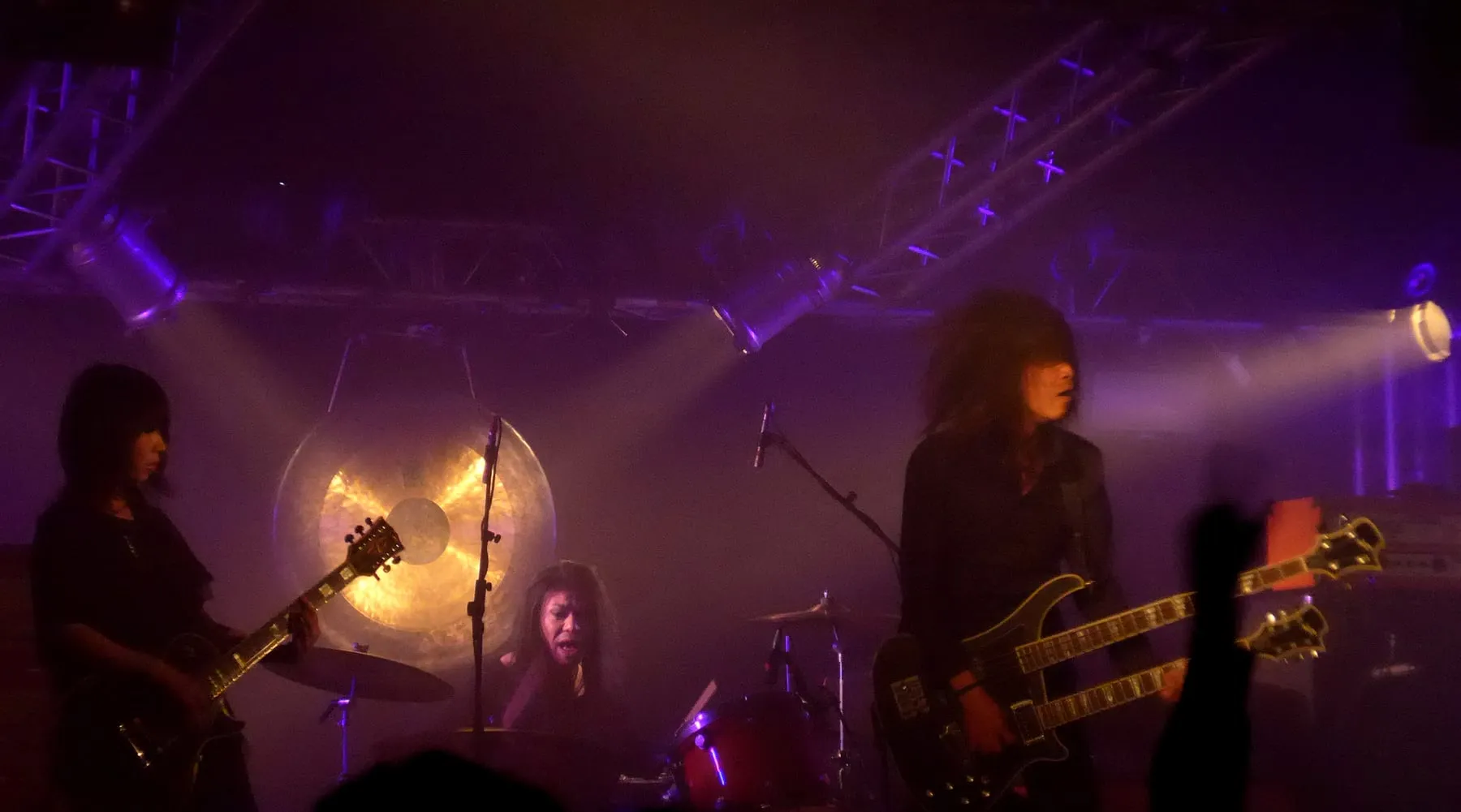
Photo by deepskyobject , licensed under CC BY-SA 2.0 · Wikimedia Commons
Rank #495
Boris
Tokyo experimental band fluent across drone, doom, J-pop, and ambient.
From Wikipedia
Boris is a Japanese rock band that draws variously from styles such as sludge metal, drone, noise, psychedelia, and minimalism. Formed in 1992 in Tokyo, the band is composed of drummer Atsuo, guitarist/bassist Takeshi, and guitarist/keyboardist Wata. All three members sing. Boris has released more than 20 studio albums on various labels around the world, as well as a variety of live albums, compilations, EPs, singles, and collaborative albums. They have collaborated with acts such as Sunn O))), Merzbow, Keiji Haino, and guitarist Michio Kurihara.
Members
- Atsuo
- Nagata
- Takeshi
- Wata
Studio Albums
- 1996 Absolutego
- 1998 Amplifier Worship
- 1999 More Echoes, Touching Air Landscape
- 2000 flood
- 2002 Megatone
- 2002 Heavy Rocks
- 2003 boris at last –feedbacker–
- 2003 あくまのうた
- 2004 目をそらした瞬間 –the thing which solomon overlooked–
- 2005 dronevil
- 2005 PINK
- 2005 マブタノウラ sound track from film “mabuta no ura”
- 2005 Sun Baked Snow Cave
- 2006 目をそらした瞬間 3 –the thing which solomon overlooked 3–
- 2006 Rainbow
- 2006 vein
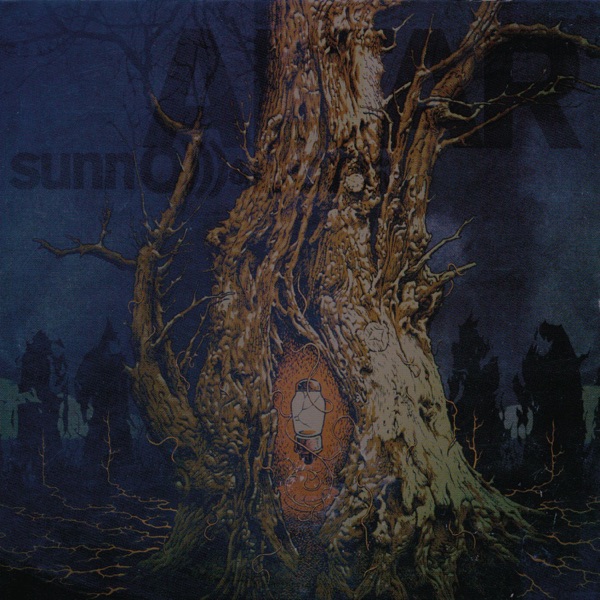
- 2006 Altar
- 2006 目をそらした瞬間 2 –the thing which solomon overlooked 2–
- 2008 Cloud Chamber
- 2008 SMILE
- 2011 New Album
- 2011 Klatter
- 2011 Attention Please
- 2011 Heavy Rocks
- 2012 Boris / Joe Volk
- 2013 präparat
- 2014 NOISE
- 2014 目をそらした瞬間 extra –the thing which solomon overlooked extra–
- 2015 asia
- 2015 urban dance
- 2015 warpath
- 2016 Gensho
- 2017 Dear
- 2018 Secrets
- 2019 1985
- 2019 LΦVE & EVΦL
- 2020 2R0I2P0
- 2020 NO
- 2020 リフレイン
- 2021 New Album 2009
- 2022 W
- 2022 Heavy Rocks
- 2022 fade
- 2022 Rocky & The Sweden / Boris
- 2023 Bright New Disease
- 2024 hello there
- 2024 Twins of Evil
Source: MusicBrainz
Deep Dive
Overview
Boris is a Japanese rock band formed in Tokyo in 1992 that operates across a spectrum of heavy and experimental styles—drone, doom, sludge metal, noise, psychedelia, and minimalism. Composed of drummer Atsuo, guitarist/bassist Takeshi, and guitarist/keyboardist Wata, all three members contribute vocals. The band’s prolific output—more than 20 studio albums alongside live recordings, EPs, and collaborations—has established them as one of the most artistically restless and influential acts in post-1990s experimental rock, operating largely outside mainstream commercial structures while commanding deep respect among musicians and listeners who value sonic exploration without genre boundaries.
Formation Story
Boris emerged from Tokyo’s underground rock scene in 1992, initially a project of Takeshi and Wata. The band solidified its three-piece core with the addition of Atsuo on drums, creating the lineup that would remain intact through their career. Tokyo in the early 1990s was a nexus for experimental music and noise culture; Boris positioned themselves within this ecosystem but pursued a distinctly heavier, riff-based approach than much of the city’s avant-garde art-rock scene. From the outset, the trio’s shared approach to songwriting—all three members composing and singing—meant that Boris would never crystallize into a fixed sound or hierarchical creative structure.
Breakthrough Moment
Boris’s international breakthrough came through the late 1990s with albums Amplifier Worship (1998) and More Echoes, Touching Air Landscape (1999), which showcased their ability to blend crushing heavy-metal riffs with droning textures and psychedelic atmosphere. Amplifier Worship in particular resonated with audiences in North America and Europe who were discovering that heavy music could absorb influences from minimalism and electronic ambient music. The band’s early work on Southern Lord Records—the experimental heavy-music label—provided a platform that connected them to a global audience of listeners already primed for Sunn O)))‘s orchestral drone and related underground movements. By the early 2000s, Boris had become known not just as a heavy-rock act but as a boundary-pushing experimental ensemble willing to release multiple albums in a single year, each exploring different sonic territories.
Peak Era
The mid-2000s through the early 2010s marked Boris’s most intensely creative period. Albums like Pink (2005), Altar (2006), Rainbow (2006), Cloud Chamber (2008), and New Album (2011) demonstrated a band at the height of its exploratory powers, moving fluidly between monolithic doom, ethereal drone passages, noise-rock intensity, and even pop-influenced melodicism. Pink in particular showed the band’s willingness to embrace psychedelic color and accessibility without sacrificing heaviness; Rainbow built on that warmth with layered guitar textures and vocal harmonies. This era also saw Boris engage in a series of high-profile collaborations with figures such as Sunn O))), Merzbow, and Keiji Haino—partnerships that reinforced the band’s status as artists equally at home in extreme metal, Japanese experimental music, and the broader experimental-sound world. The sheer rate of their releases—sometimes multiple albums in a single year—suggested a creative confidence and work ethic unusual even for prolific bands.
Musical Style
Boris’s sound defies easy categorization. At its foundation lies heavy guitar riffing rooted in doom and stoner metal, but those riffs are frequently submerged in layers of drone, distortion, and atmospheric effects. Wata’s guitar work often emphasizes texture over technical display—thick, billowing clouds of sound that can occupy space as an instrument in themselves. Takeshi’s bass-guitar work provides both deep harmonic foundation and melodic interplay, while Atsuo’s drumming ranges from thunderous, sludgy grooves to intricate, jazz-influenced patterns depending on the song’s architecture. The band’s three-part vocal approach—each member singing, sometimes in harmony, sometimes in conversation—creates a choral quality that distinguishes them from the male-dominated-vocals convention of heavy rock. Over their career, Boris have absorbed J-pop melodicism, minimalist composition strategies, noise aesthetics, and electronic production, making each album feel like a deliberate pivot in method rather than a formula repeated. Their use of synthesizer and keyboard, often handled by Wata, adds further textural complexity, allowing them to shift from crushingly loud to whisper-soft within the same piece.
Major Albums
Amplifier Worship (1998)
A watershed moment that introduced Boris’s core sound: heavy, sludging riffs wrapped in psychedelic haze and droning atmosphere. This album established the template for how the band could marry doom-metal brutality with experimental textures and hypnotic repetition.
Pink (2005)
A career-defining statement that revealed the band’s pop-influenced melodic side without sacrificing heaviness, featuring warmer guitar tones and layered vocal harmonies alongside crushing riffs.
Rainbow (2006)
A companion to Pink that deepens the exploration of color and atmosphere, showcasing the band’s ability to sustain mood across long-form compositions while maintaining emotional engagement.
Cloud Chamber (2008)
Demonstrates the band’s mastery of extended instrumental passages, minimal structures, and the use of silence as a compositional tool, placing them firmly in avant-garde territory while retaining heavy-rock roots.
New Album (2011)
A return to distortion-heavy, riff-driven territory that reaffirmed the band’s commitment to pure heaviness after years of textural experimentation.
Signature Songs
- Amplifier Worship — The title track from their breakthrough album, a droning, feedback-laden monument that encapsulates the band’s fusion of metal and experimental drone.
- Pink — A sprawling, psychedelic piece demonstrating the band’s ability to merge pop sensibility with crushing heaviness.
- My Name Is Boris — An anthemic, hook-laden composition that became one of their most accessible yet unmistakably heavy works.
Influence on Rock
Boris’s influence operates on multiple levels. Within heavy music, they demonstrated that doom and stoner rock could absorb minimalism, ambient music, and electronic production without losing power. For experimental musicians, they showed that extreme heaviness and noise could coexist with melodicism and accessibility. The band’s prolific, unflinching approach to releasing music—refusing to wait for marketing cycles or industry validation—influenced a generation of underground metal and experimental acts to trust their instincts and maintain artistic autonomy. Their collaborations with figures across experimental and metal worlds helped dissolve unnecessary boundaries between those communities. Boris also played a significant role in establishing Tokyo as a center for heavy experimental music, challenging the Anglo-American dominance of doom and drone discourse.
Legacy
Boris remains actively recording and performing more than three decades after their formation. Their discography now exceeds 20 studio albums, with continued output in the 2020s (W, fade, Bright New Disease, hello there, Twins of Evil) demonstrating undiminished creative drive. The band has become a touchstone for musicians and listeners who value artistic consistency, sonic bravery, and refusal to be pinned down by genre expectations. Their body of work—spanning the spectrum from pure drone to heavy riffing to melodic pop-influenced songs—stands as a comprehensive artistic statement about the possibility of experimental music rooted in rock instrumentation. Boris’s influence extends across metal, electronic, and avant-garde communities, and their albums have become standard references for understanding how 21st-century heavy music could evolve beyond thrash and death metal into more textural, meditative, and conceptually ambitious territory.
Fun Facts
- Boris released multiple studio albums in a single calendar year on several occasions (notably 2005 and 2006), a pace that underscores their prolific creative appetite and working method.
- The band has recorded albums with titles in Japanese as well as English, reflecting Tokyo’s bilingual artistic culture and their resistance to adopting a single language for communication.
- Boris’s collaborations span unusual partnerships: work with Sunn O))) placed them in conversation with drone-drone’s most monumental practitioners, while collaborations with figures like Merzbow and Keiji Haino connected them to Japan’s own experimental and noise-music traditions.
- The band’s use of the three-singer model—with Atsuo, Takeshi, and Wata all contributing vocals—remains unusual in heavy rock, giving their work a distinctive choral and democratic quality compared to bands built around a single frontperson.
Discography & Previews
Click any album to expand its track list. Each track plays a 30-second preview streamed from Apple Music. Tap the link icon next to a track to open it in Apple Music for full playback.