
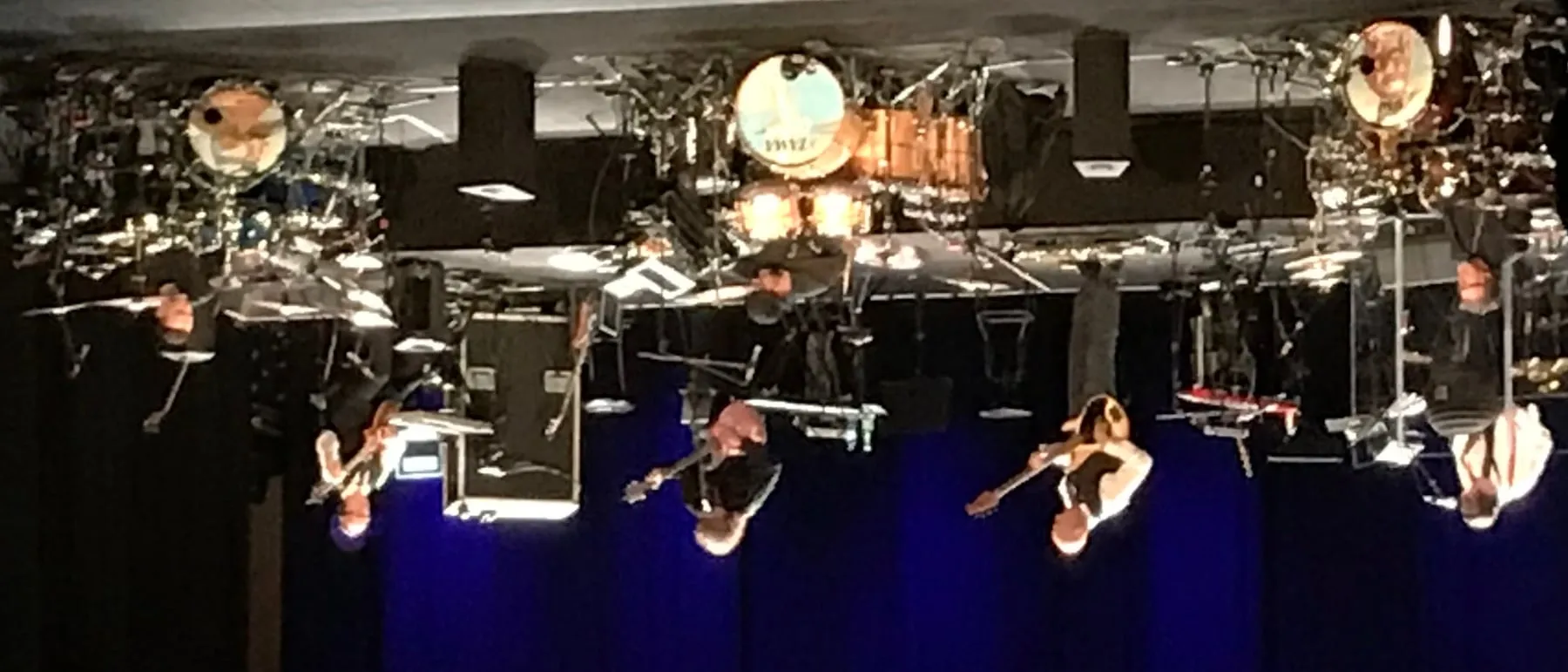
Photo by Ted Potters , licensed under Public domain · Wikimedia Commons
Rank #97
King Crimson
Robert Fripp's restless prog institution and a touchstone of the genre.
From Wikipedia
King Crimson are an English progressive rock band formed in London in 1968 by Robert Fripp, Michael Giles, Greg Lake, Ian McDonald and Peter Sinfield. Guitarist and leader Fripp has remained the only constant member throughout the band's long history. The band drew inspiration from a wide variety of music, incorporating elements of classical, jazz, folk, heavy metal, gamelan, blues, industrial, electronic, and experimental music. They also exerted a strong influence on the early 1970s progressive rock movement, including on contemporaries such as Yes and Genesis, and continue to inspire subsequent generations of artists across multiple genres. The band has earned a large cult following, especially in the 21st century.
Members
- Adrian Belew
- Bill Bruford
- Robert Fripp
- Tony Levin
Studio Albums
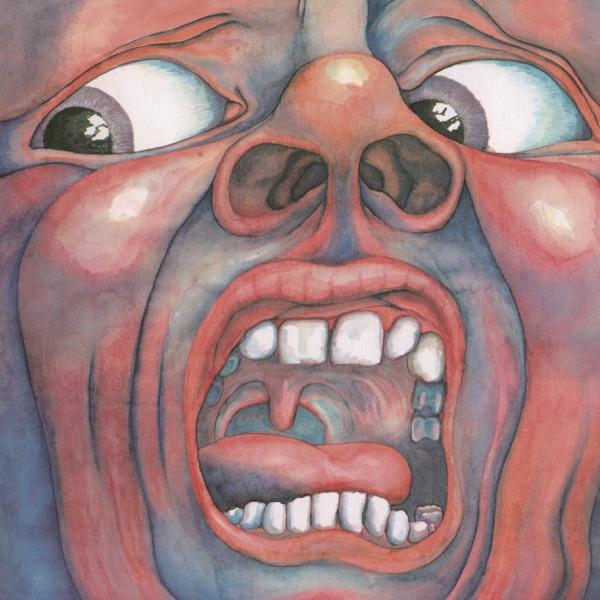
- 1969 In the Court of the Crimson King
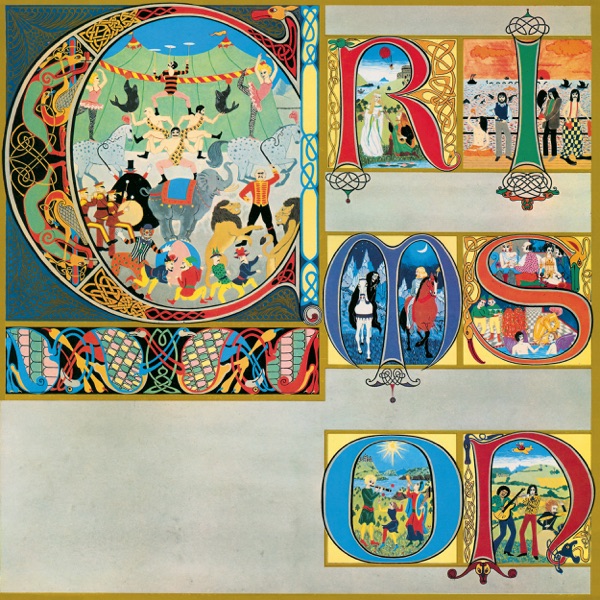
- 1970 Lizard
- 1970 In the Wake of Poseidon
- 1971 Islands
- 1973 Larks’ Tongues in Aspic
- 1974 Red
- 1974 Starless and Bible Black
- 1981 Discipline
- 1982 Beat
- 1984 Three of a Perfect Pair
- 1995 THRAK
- 2000 The ConstruKction of Light
- 2003 The Power to Believe Tour Box
- 2003 The Power to Believe
Source: MusicBrainz
Deep Dive
Overview
King Crimson stands as one of progressive rock’s foundational institutions and its most intellectually restless. Formed in London in 1968, the band emerged as the invention of guitarist and composer Robert Fripp, who assembled a lineup of virtuosi around a vision of rock music that absorbed classical composition, jazz harmony, folk instrumentation, heavy metal amplification, gamelan percussion, blues tonality, industrial textures, and electronic processing into a single, turbulent whole. Fripp has remained the sole continuous member through the band’s five-decade trajectory, making King Crimson less a fixed ensemble and more a conceptual project that reinvents itself with each iteration. Their influence on early 1970s progressive rock—reaching contemporaries such as Yes and Genesis—proved immediate and durable; their ongoing presence in rock music, especially since the 21st century, has cemented them as a touchstone for artists across multiple genres.
Formation Story
King Crimson crystallized in London in 1968 around Fripp’s precise vision and ambitious instrumental palette. The founding lineup included Michael Giles on drums, Greg Lake on bass and vocals, Ian McDonald on woodwinds and keyboards, and Peter Sinfield as lyricist and conceptual architect. This quintet arrived at a moment when rock music was actively absorbing the harmonic and structural complexity of classical music; King Crimson’s early sound reflected that convergence directly, fusing the raw energy of heavy rock with the counterpoint and orchestration of 20th-century composition. The band’s emergence in London situated them within a broader British progressive rock ferment, though their approach proved distinctly uncompromising from the start.
Breakthrough Moment
King Crimson’s debut album, In the Court of the Crimson King, arrived in 1969 and established the template for their entire career: sprawling compositions that rejected conventional song structure, virtuosic instrumental command, and a willingness to interrupt beauty with dissonance. The album announced the band as a major force in rock, drawing immediate attention from musicians and critics alike. Its success did not lead to consolidation but rather to the band’s characteristic restlessness; rather than tour extensively or repeat the formula of the debut, Fripp and his collaborators pushed into new terrain with each subsequent release over the following five years. This refusal to solidify around a signature sound became King Crimson’s defining trait, distinguishing them from their prog-rock peers and ensuring that their career would resist easy categorization.
Peak Era
The early 1970s, from 1969 through 1974, represented King Crimson’s most prolific and conceptually adventurous period. Successive albums—In the Wake of Poseidon (1970), Lizard (1970), Islands (1971), Larks’ Tongues in Aspic (1973), Red (1974), and Starless and Bible Black (1974)—saw the band cycle through personnel while maintaining a commitment to structural complexity and timbral richness. Each record introduced new formal experiments: extended instrumental passages, complex time signatures, the integration of acoustic folk elements alongside electronic processing, and a compositional approach that treated rock and jazz harmony with equal seriousness. By the mid-1970s, King Crimson had achieved both cult status and a degree of commercial success unusual for such uncompromising music, establishing themselves as the intellectual center of the progressive rock movement.
Musical Style
King Crimson’s sound is defined by Robert Fripp’s classical training and modernist sensibility applied to the rock ensemble. Their music typically features dense, contrapuntal writing in which multiple instrumental lines—guitar, bass, keyboards, woodwinds, and drums—operate independently yet coherently, producing a polyphonic texture more akin to chamber music or orchestral composition than to conventional rock. Fripp’s guitar technique emphasizes both fingerstyle precision and heavily distorted, heavily processed tones that blur the boundary between traditional and electronic sound; his solos often prioritize intervallic complexity and harmonic tension over speed or blues-based vocabulary. The band’s rhythm section operates with jazz-derived flexibility, moving fluidly between metric regularity and polyrhythmic instability. Vocally, when voices appear—most prominently in Greg Lake’s early contributions—they serve as another instrumental texture rather than as the song’s emotional center. Across the band’s evolution, this core aesthetic has persisted: an uncompromising commitment to instrumental sophistication, harmonic density, and the primacy of composition over performance virtuosity for its own sake.
Major Albums
In the Court of the Crimson King (1969)
The band’s debut established the template for progressive rock ambition: a five-song album featuring the 13-minute title track, with classical orchestration, jazz harmonies, and heavy rock dynamics colliding in carefully structured form. This album alone justified King Crimson’s existence and instantly positioned them as a major force in the genre.
Larks’ Tongues in Aspic (1973)
A watershed moment that deepened the band’s integration of African gamelan influences, electronic texture, and what appeared to be increasing abstraction in composition. The title track became one of the band’s signature pieces, balancing delicate mellotron passages with thunderous electric sections.
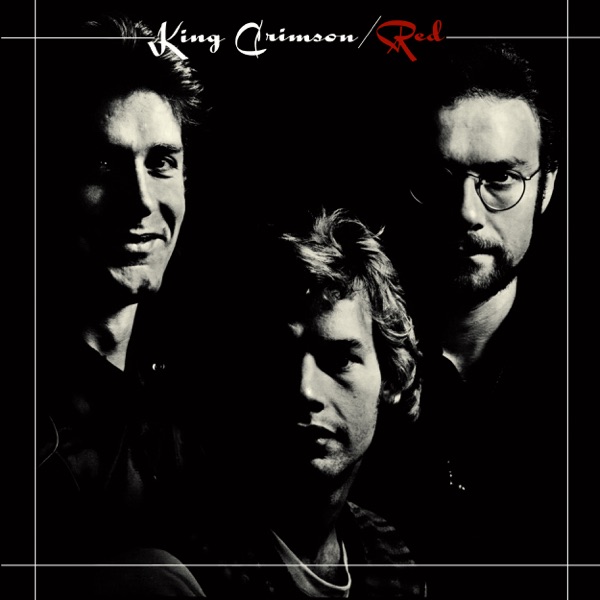
Red (1974)
The heaviest and most viscerally powerful of the early albums, Red showcased Fripp’s most aggressive guitar tones alongside compositional sophistication, proving that King Crimson’s complexity need not preclude rawness or immediate sonic impact.
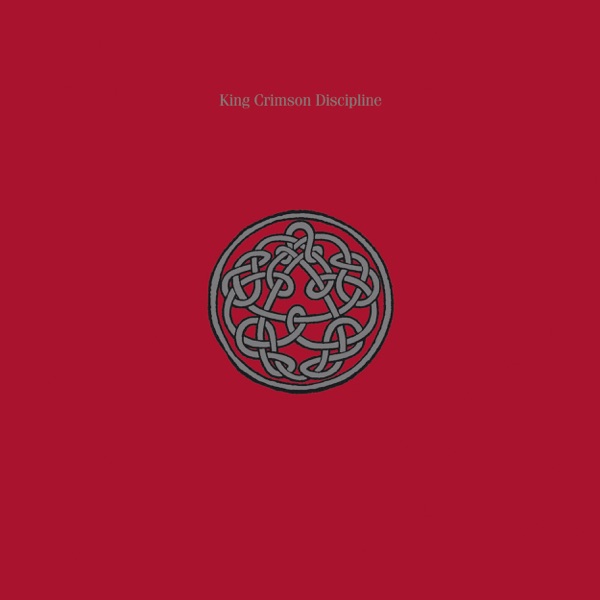
Discipline (1981)
Following a seven-year hiatus, Discipline found Fripp working with a new configuration centered on Adrian Belew’s inventive guitar work and Tony Levin’s fretless bass. The album reintroduced the band to a new generation while maintaining the group’s commitment to rigorous composition and timbral variety.
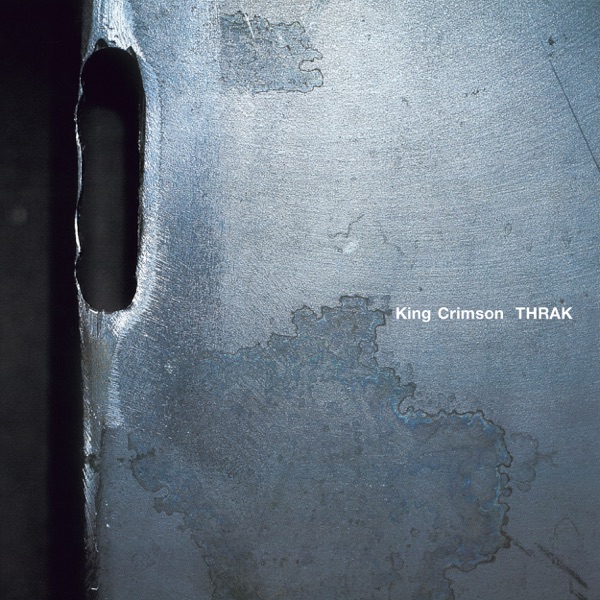
THRAK (1995)
A return to the band’s earlier density and rhythmic complexity, THRAK demonstrated that King Crimson remained capable of innovation decades into their existence, synthesizing their classical roots, jazz inflection, and modern production techniques.
Signature Songs
- “21st Century Schizoid Man” — The explosive opening track from In the Court of the Crimson King, featuring Fripp’s heavily distorted guitar riff and establishing the band’s willingness to merge abrasive rock with compositional sophistication.
- “Larks’ Tongues in Aspic (Part One)” — A masterwork of dynamics and orchestration, moving from delicate mellotron textures to overwhelming electric intensity, defining the band’s approach to formal contrast.
- “Red” — The title track of the 1974 album, a showcase for Fripp’s most aggressive electric guitar work alongside complex harmonic movement and rhythmic unpredictability.
- “Elephant Talk” — From Discipline (1981), a rhythmically intricate piece featuring Belew’s melodic guitar work and demonstrating the band’s capacity for evolution and accessibility without compromise.
- “Thela Hun Ginjeet” — A highlight of THRAK (1995) displaying the band’s continued commitment to polyrhythmic complexity and the layering of multiple tonal palettes into coherent composition.
Influence on Rock
King Crimson’s influence on rock music operates at multiple levels. They provided the initial template upon which much of 1970s progressive rock was constructed: the notion that rock could absorb the harmonic complexity, formal ambition, and orchestral layering of classical music without surrendering electrical power or rhythmic groove. Their coexistence with Yes and Genesis—bands who adopted similar ambitions but with different emphases—shaped the entire progressive rock movement’s trajectory. Beyond the 1970s, King Crimson’s uncompromising approach to composition, their integration of non-Western instruments and concepts, their embrace of electronic texture before it became standard, and their refusal to simplify or repeat themselves established a model of artistic autonomy that influenced jazz-rock musicians, experimental composers, and subsequent generations of progressive and avant-garde rock artists. Their specific harmonic language and approach to guitar tone—particularly Fripp’s processing and interval selection—became reference points for musicians across genres seeking to move beyond blues-based rock vocabulary.
Legacy
King Crimson’s status in rock has only grown since the 21st century, as streaming and digital culture have made their entire catalog perpetually accessible and as progressive and experimental rock have achieved renewed cultural relevance among younger audiences. The band’s dissolution and reformation phases, their release of live recordings and archival material, and Robert Fripp’s ongoing creative work have maintained a continuous presence without the pressure of commercial viability that constrained many progressive rock acts in the 1980s and 1990s. Their influence extends across rock, jazz, metal, and experimental electronic music—artists as diverse as tool, Mastodon, and contemporary experimental composers cite King Crimson as foundational to their approach. The band’s commitment to musical integrity, their refusal to calcify around early commercial success, and their integration of global musical traditions into a coherent artistic vision have ensured that they remain not merely a historical artifact of the 1970s but an active point of reference for musicians and listeners seeking rock music of genuine intellectual and aesthetic substance.
Fun Facts
- Robert Fripp’s use of the Frippertronics system—a tape loop technique he developed in the late 1970s—became a signature production method that influenced both the band’s own later work and broader experimental music practice.
- The band’s incorporation of gamelan instrumentation and tuning concepts, particularly evident in Larks’ Tongues in Aspic, predated the broader Western engagement with non-Western musical systems by years and established King Crimson as conceptually and sonically adventurous.
- Adrian Belew, who joined in the early 1980s as part of the Discipline-era lineup, had previously worked as a guitarist with Frank Zappa, representing the band’s ongoing ability to attract musicians of the highest technical and conceptual caliber.
- King Crimson disbanded multiple times across their five-decade history—most notably between 1974 and 1981—a pattern that reinforced Fripp’s position as the sole consistent creative force and the band’s resistance to the logic of rock as perpetual touring enterprise.
Discography & Previews
Click any album to expand its track list. Each track plays a 30-second preview streamed from Apple Music. Tap the link icon next to a track to open it in Apple Music for full playback.
- 1 21st Century Schizoid Man (Including "Mirrors") ↗ 7:23
- 2 I Talk to the Wind ↗ 6:06
- 3 Epitaph (Including "March for No Reason" and "Tomorrow and Tomorrow") ↗ 8:47
- 4 Moonchild (Including "The Dream" and "The Illusion") ↗ 12:13
- 5 The Court of the Crimson King (Including "The Return of the Fire Witch" and "The Dance of the Puppets") ↗ 10:03
- 6 21st Century Schizoid Man (Radio Version) ↗ 6:41
- 7 I Talk to the Wind (Duo Version) ↗ 4:45
- 8 A Man a City (Live at the Fillmore West) ↗ 11:44
- 1 Cirkus (Including "Entry of the Chameleons") ↗ 6:27
- 2 Indoor Games ↗ 5:38
- 3 Happy Family ↗ 4:23
- 4 Lady of the Dancing Water ↗ 2:47
- 5 Lizard: Prince Rupert Awakes / Bolero / The Battle of Glass Tears / Big Top ↗ 23:20
- 6 Studio Sessions: Cirkus (Runthrough) / Lady of the Dancing Water (Alternate Take) [Bonus Track] ↗ 10:05
- 7 Bolero (Remix from "Frame By Frame") [Bonus Track] ↗ 6:45

- 1 Peace - A Beginning ↗ 0:50
- 2 Pictures of a City ↗ 8:01
- 3 Cadence and Cascade ↗ 4:38
- 4 In the Wake of Poseidon ↗ 7:57
- 5 Peace - A Theme ↗ 1:15
- 6 Cat Food ↗ 4:53
- 7 The Devils Triangle ↗ 11:37
- 8 Peace - An End ↗ 1:57
- 9 Cat Food (Single Version) [Bonus Track] ↗ 2:47
- 10 Groon (Single B-Side) [Bonus Track] ↗ 3:35
- 11 Cadence and Cascade (Greg Lake Guide Vocal) [Bonus Track] ↗ 4:33

- 1 The Great Deceiver ↗ 4:02
- 2 Lament ↗ 4:05
- 3 We'll Let You Know ↗ 3:40
- 4 The Night Watch ↗ 4:42
- 5 Trio ↗ 5:39
- 6 The Mincer ↗ 4:09
- 7 Starless and Bible Black ↗ 9:11
- 8 Fracture ↗ 11:14
- 9 The Law of Maximum Distress (Including "The Mincer") [Bonus Track] ↗ 12:49
- 10 Dr. Diamond (Live 23 June, 1973) [Bonus Track] ↗ 4:03
- 11 Guts On My Side (Live Audience Recording 19 March, 1973) [Bonus Track] ↗ 4:31
- 1 Elephant Talk ↗ 4:42
- 2 Frame By Frame ↗ 5:08
- 3 Matte Kudasai ↗ 3:49
- 4 Indiscipline ↗ 4:33
- 5 Thela Hun Ginjeet ↗ 6:27
- 6 The Sheltering Sky ↗ 8:22
- 7 Discipline ↗ 5:13
- 8 Matte Kudasai (Alternate Version) [Bonus Track] ↗ 3:52
- 9 The Terrifying Tale of Thela Hun Ginjeet (Bonus Track) ↗ 8:04
- 10 Studio Sessions (Bonus Track) ↗ 11:06


- 1 Three of a Perfect Pair ↗ 4:11
- 2 Model Man ↗ 3:50
- 3 Sleepless ↗ 5:24
- 4 Man with an Open Heart ↗ 3:05
- 5 Nuages (That Which Passes, Passes Like Clouds) ↗ 4:47
- 6 Industry ↗ 7:05
- 7 Dig Me ↗ 3:17
- 8 No Warning ↗ 3:29
- 9 Larks' Tongues In Aspic, Pt. 3 ↗ 6:05
- 10 The King Crimson Barber Shop (Bonus Track) ↗ 1:37
- 11 Industrial Zone A (Bonus Track) ↗ 1:44
- 12 Industrial Zone B (Bonus Track) ↗ 4:33
- 13 Sleepless (Tony Levin Mix) [Bonus Track] ↗ 7:29
- 14 Sleepless (Bob Clearmountain Mix) [Bonus Track] ↗ 5:24
- 15 Sleepless (Francois Kevorkian Dance Mix) [Bonus Track] ↗ 6:19
- 1 VROOOM ↗ 4:38
- 2 Coda: Marine 475 ↗ 2:41
- 3 Dinosaur ↗ 6:38
- 4 Walking On Air ↗ 4:38
- 5 B'Boom ↗ 4:13
- 6 THRAK ↗ 3:59
- 7 Inner Garden I ↗ 1:47
- 8 People ↗ 5:54
- 9 Radio I ↗ 0:43
- 10 One Time ↗ 5:22
- 11 Radio II ↗ 1:04
- 12 Inner Garden II ↗ 1:16
- 13 Sex Sleep Eat Drink Dream ↗ 4:51
- 14 VROOOM VROOOM ↗ 5:49
- 15 VROOOM VROOOM: Coda ↗ 3:06
- 16 Dinosaur (Single Edit) [Bonus Track] ↗ 3:44

- 1 ProzaKc Blues ↗ 5:29
- 2 The ConstruKction of Light ↗ 8:40
- 3 Into the Frying Pan ↗ 6:54
- 4 FraKctured ↗ 9:06
- 5 The World's My Oyster Soup Kitchen ↗ 6:24
- 6 Larks' Tongue In Aspic, Pt. 4 ↗ 13:03
- 7 Heaven and Earth (ProjeKct X) ↗ 7:51
- 8 Rome Improv: Mastellotticus SS Blacticus (Bonus Track) ↗ 10:38
- 9 The ConstruKction of Light (Live) [Bonus Track] ↗ 8:24

- 1 The Power to Believe, Pt. 1 ↗ 0:43
- 2 Level Five ↗ 7:15
- 3 Eyes Wide Open ↗ 4:11
- 4 Elektrik ↗ 8:00
- 5 Facts of Life (Intro) ↗ 1:38
- 6 Facts of Life ↗ 5:06
- 7 The Power to Believe, Pt. 2 ↗ 7:43
- 8 Dangerous Curves ↗ 6:43
- 9 Happy With What You Have to Be Happy With ↗ 3:17
- 10 The Power to Believe, Pt. 3 ↗ 4:11
- 11 The Power to Believe, Pt. 4 ↗ 2:29