Photo by MCA Records , licensed under Public domain · Wikimedia Commons
Rank #68
Lynyrd Skynyrd
Florida southern-rock standard-bearers whose anthems define the genre.
From Wikipedia
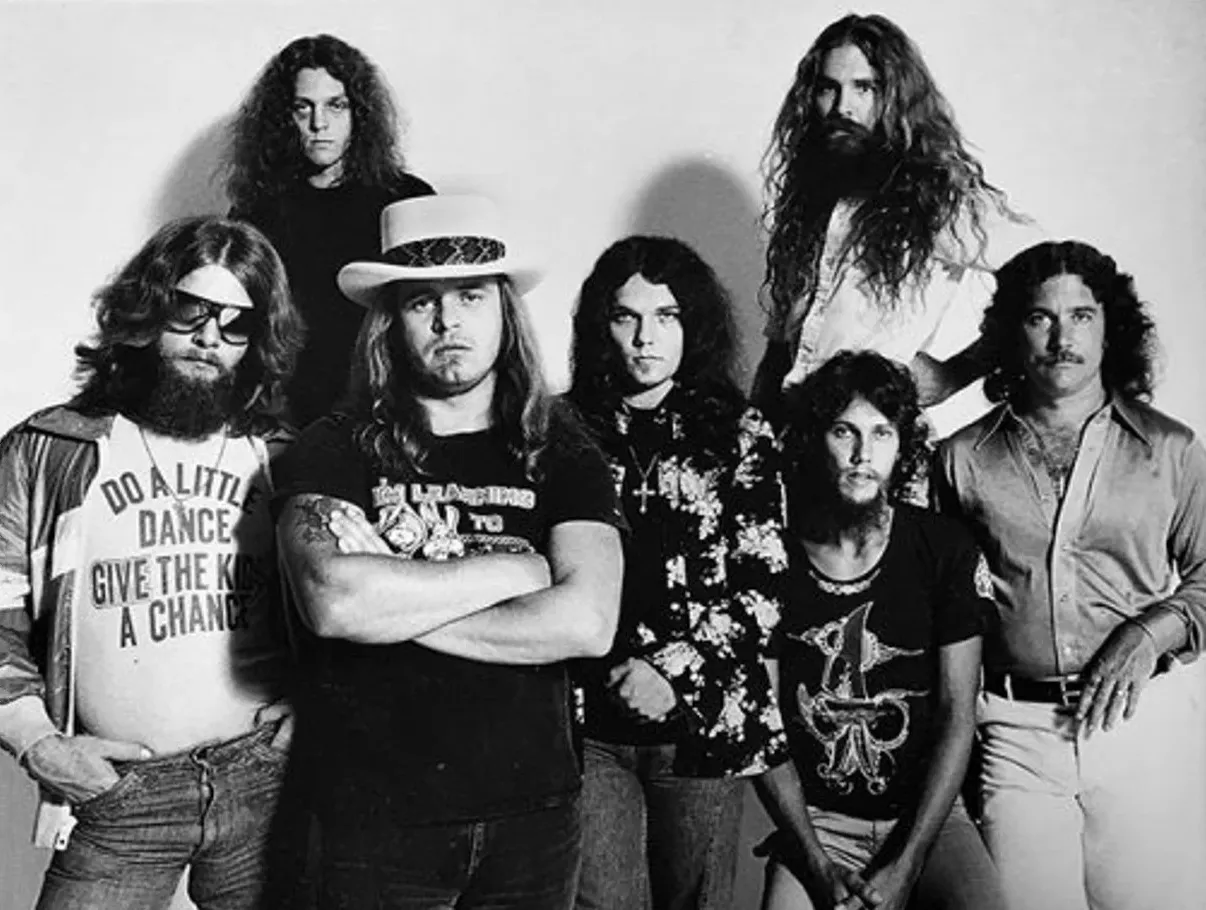
Lynyrd Skynyrd is an American rock band formed in Jacksonville, Florida, in 1964. The group originally formed as My Backyard and comprised Ronnie Van Zant (vocals), Gary Rossington (guitar), Allen Collins (guitar), Larry Junstrom (bass), and Bob Burns (drums). The band spent four years touring small venues under various names and with several lineup changes before deciding on "Lynyrd Skynyrd" in 1968. The band released its first album, (Pronounced 'Lĕh-'nérd 'Skin-'nérd), in 1973. By then, they had settled on a lineup that included bassist Leon Wilkeson, keyboardist Billy Powell, and guitarist Ed King. Burns left and was replaced by Artimus Pyle in 1974. King left in 1975 and was replaced by Steve Gaines in 1976. At the height of their fame in the 1970s, the band popularized the Southern rock genre with songs such as "Sweet Home Alabama" and "Free Bird". After releasing five studio albums and one live album, the band's career was abruptly halted on October 20, 1977, when their chartered airplane crashed, killing Van Zant, Steve Gaines, and backup singer Cassie Gaines, and seriously injuring the rest of the band.
Members
- Allen Collins (1966–1979)
- Gary Rossington (1966–present)
- Ronnie Van Zant (1966–1977)
- Rickey Medlocke (1971–1972)
- Billy Powell (1973–2009)
- Cassie Gaines (1975–1977)
- Steve Gaines (1976–1977)
- Johnny Van Zant (1987–present)
- Owen Hale (1994–1998)
- Michael Cartellone (1999–present)
- Mark Matejka (2006–present)
- Peter Keys (2009–present)
- Johnny Colt (2012–present)
- Artimus Pyle
- Bob Burns
- Ean Evans
- Ed King
- Greg T. Walker
- Hughie Thomasson
- Kenny Aronoff
- Larry Junstrom
- Robert Kearns
Studio Albums
- 1973 (pronounced ’lĕh-’nérd ’skin-’nérd)
- 1974 Second Helping
- 1975 Nuthin’ Fancy
- 1976 Gimme Back My Bullets
- 1977 Street Survivors
- 1991 1991
- 1993 The Last Rebel
- 1994 Endangered Species
- 1997 Twenty
- 1999 Edge of Forever
- 2000 Christmas Time Again
- 2003 Vicious Cycle
- 2009 God & Guns
- 2012 Last of a Dyin’ Breed
- — Karaoke in the Style of Lynyrd Skynyrd
Source: MusicBrainz
Deep Dive
Overview
Lynyrd Skynyrd stands as the defining act of Southern rock, the Florida band that transformed regional blues-inflected hard rock into a national phenomenon. Formed in Jacksonville in 1964 and reaching their commercial and creative apex in the mid-1970s, they anchored the genre with a sound built on dual lead guitars, working-class lyrical directness, and a defiant regional pride that extended far beyond the American South. Their catalog—five studio albums released between 1973 and 1977—established the template for Southern rock and produced two songs, “Sweet Home Alabama” and “Free Bird,” that transcended rock radio to become permanent fixtures of American popular culture.
Formation Story
The band’s origins trace to Jacksonville in 1964, when Ronnie Van Zant, Gary Rossington, and Allen Collins first played together under the name My Backyard. The lineup also included bassist Larry Junstrom and drummer Bob Burns. For four years the group toured small venues across Florida and the Southeast, cycling through various names and membership changes as they refined their sound. By 1968, they had settled on “Lynyrd Skynyrd”—a deliberately misspelled homage to Leonard Skinner, a high school gym teacher who had punished the band members for their long hair. The name stuck, and with it came a growing reputation in the regional rock circuit. Not until 1973, when they signed and released their debut album, did the band achieve the stable lineup and national platform that would define their era.
Breakthrough Moment
Lynyrd Skynyrd’s breakthrough came swiftly with their first two albums. (Pronounced ‘Lĕh-‘nérd ‘Skin-‘nérd) landed in 1973 with a lineup now featuring bassist Leon Wilkeson, keyboardist Billy Powell, and guitarist Ed King alongside Van Zant, Rossington, and Collins. The album’s commercial success opened doors; more importantly, it announced a fully formed artistic vision. The follow-up, Second Helping (1974), consolidated that success and featured “Sweet Home Alabama,” a three-minute anthem that would become the band’s signature song. The track’s unapologetic celebration of the Deep South, its deceptively simple three-chord structure, and Van Zant’s raw vocal delivery made it an instant classic and brought Lynyrd Skynyrd into mainstream consciousness. By the mid-1970s, they were touring arenas and headlining festivals, their position as the South’s premier rock export firmly cemented.
Peak Era
The period from 1974 to 1977 represented Lynyrd Skynyrd’s most fertile and commercially successful years. Second Helping (1974) established them as hitmakers; Nuthin’ Fancy (1975) and Gimme Back My Bullets (1976) sustained momentum while allowing the band to explore deeper catalog cuts and extended arrangements on stage. During this span, the classic touring lineup solidified around Van Zant’s vocals, the twin-guitar interplay of Rossington and Collins (and briefly Ed King before his 1975 departure), Wilkeson’s anchoring bass, Powell’s organ textures, and the rhythm section of drummer Artimus Pyle (who joined in 1974, replacing Burns) and Powell. Pyrotechnic live shows, radio-friendly singles, and album tracks with extended jamming capability made them one of the most consistent touring acts in rock. Their final studio album before the tragedy, Street Survivors (1977), arrived in August and proved they remained creatively vital despite relentless touring schedules.
Musical Style
Lynyrd Skynyrd synthesized blues-rock guitar heroics with the country and gospel influences native to the Deep South, producing a style that was harder and more electric than country rock but never strayed far from recognizable melodic anchors. The dual-lead-guitar approach—Rossington and Collins locking into counterpoint lines or trading solos—became the band’s sonic signature and a template countless Southern rock acts would emulate. Van Zant’s voice, rough-edged and unpretentious, conveyed working-class authenticity without technical virtuosity; his lyrics dealt in straightforward emotion, regional pride, and storytelling. Billy Powell’s organ added soul and church-rooted warmth, bridging the gap between hard rock swagger and deep Southern musical tradition. The rhythm section laid down a groove-oriented pocket that owed as much to soul and R&B as to rock, distinguishing Lynyrd Skynyrd from the tighter, more technically precise hard rock of their northern contemporaries. Over their 1973–1977 run, they moved from relatively compact rock songs toward longer, more exploratory arrangements, particularly on album tracks like “Free Bird,” which became a live staple and showcased the band’s ability to sustain tension and release across six minutes or more.
Major Albums
(Pronounced ‘Lĕh-‘nérd ‘Skin-‘nérd) (1973)
The debut introduced Lynyrd Skynyrd’s core sound and established their identity as unadorned Southern rock practitioners. With the classic lineup of Van Zant, Rossington, Collins, Wilkeson, Powell, and King, the album balanced radio-friendly rockers with longer tracks that hinted at their ambitious live arrangements.
Second Helping (1974)
The album that made Lynyrd Skynyrd household names, built largely on the strength of “Sweet Home Alabama.” The band’s commercial peak and proof that they could merge arena-rock ambition with regional storytelling.
Nuthin’ Fancy (1975)
Released as the band’s popularity crested, Nuthin’ Fancy showcased their ability to sustain quality across multiple albums. Drum replacement Artimus Pyle’s arrival added a more dynamic rhythmic presence to complement the guitar-driven arrangements.
Street Survivors (1977)
Lynyrd Skynyrd’s final studio album before the October plane crash, arriving in August to strong commercial reception. It remains their last recording with the classic lineup including Steve Gaines (who had replaced Ed King in 1976) and represented no drop-off in songwriting or performance quality.
Signature Songs
- “Sweet Home Alabama” — The three-chord anthem that defined Southern rock and became the band’s most recognizable song worldwide.
- “Free Bird” — An extended guitar showcase and live-show centerpiece that demonstrated Lynyrd Skynyrd’s capacity for instrumental sophistication and emotional restraint.
- “Simple Man” — A slower, more reflective track that showcased Van Zant’s lyrical directness and the band’s ability to succeed outside the hard-rock framework.
- “Gimme Three Steps” — An early staple that captured the band’s storytelling gift and working-class perspective through a narrative of narrow escape.
Influence on Rock
Lynyrd Skynyrd did not invent Southern rock, but they codified it into a genre template that has endured for nearly five decades. Their synthesis of blues-rock guitar with regional identity and working-class narrative became the blueprint for countless Southern and country-rock acts that followed. The dual-lead-guitar approach influenced generations of rock musicians and became a standard in hard rock and metal. Beyond direct stylistic imitation, their success demonstrated that rock audiences would embrace unironic regional pride and that commercial success did not require either coastal gatekeeping or technical complexity. Their influence extended across genre boundaries: country rock, jam bands, and mainstream rock radio all trace lines of descent through Lynyrd Skynyrd’s body of work.
Legacy
The plane crash of October 20, 1977, which killed Ronnie Van Zant, Steve Gaines, and backup vocalist Cassie Gaines, severed Lynyrd Skynyrd at their creative peak and transformed them into a rock tragedy. The surviving members—notably Gary Rossington, who has remained the sole continuous link to the original band—eventually reunited in 1987, with Johnny Van Zant (Ronnie’s brother) stepping into the vocal role. Multiple reunions, touring lineups, and studio albums across the 1990s and 2000s kept the band’s catalog and name in circulation. Subsequent studio efforts including 1991 (1991), The Last Rebel (1993), Endangered Species (1994), Twenty (1997), Edge of Forever (1999), Vicious Cycle (2003), God & Guns (2009), and Last of a Dyin’ Breed (2012) maintained their presence if not their original commercial force. The canonical 1973–1977 catalog remains central to Southern rock history and classic rock radio staples. Their influence on rock music—from their contemporaries through subsequent generations of country-rock, Southern rock, and mainstream hard rock acts—solidified their position among rock music’s foundational figures.
Fun Facts
- Gary Rossington is the sole surviving original member and has remained with the band continuously since 1966, making him one of rock music’s longest-serving guitarists in an unbroken tenure.
- The band’s name originated from Leonard Skinner, a Jacksonville high school gym teacher who disciplined the band members for their long hair; the deliberate misspelling was a playful jab at him.
- Billy Powell, the band’s keyboardist from 1973 to 2009, was serving a prison sentence for armed robbery when the band discovered him and brought him into the fold—a decision that proved creatively crucial to their signature sound.
- The plane crash that killed Ronnie Van Zant, Steve Gaines, and Cassie Gaines occurred just three days after the release of Street Survivors, their final studio album with the classic lineup.
Discography & Previews
Click any album to expand its track list. Each track plays a 30-second preview streamed from Apple Music. Tap the link icon next to a track to open it in Apple Music for full playback.


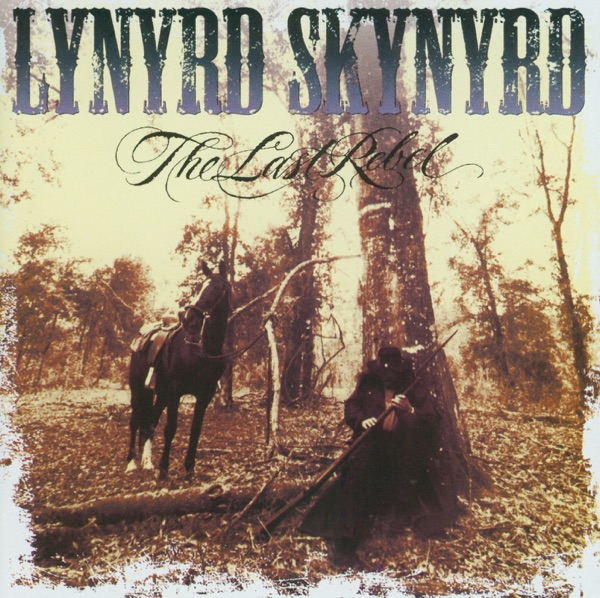
- 1 Good Lovin's Hard to Find (LP Version) ↗ 3:54
- 2 One Thing (LP Version) ↗ 5:14
- 3 Can't Take That Away (LP Version) ↗ 4:20
- 4 Best Things In Life (LP Version) ↗ 3:55
- 5 The Last Rebel (LP Version) ↗ 6:46
- 6 Outta Hell In My Dodge (LP Version) ↗ 3:47
- 7 Kiss Your Freedom Goodbye (LP Version) ↗ 4:46
- 8 South of Heaven (LP Version) ↗ 5:15
- 9 Love Don't Always Come Easy (LP Version) ↗ 4:35
- 10 Born to Run (LP Version) ↗ 7:24
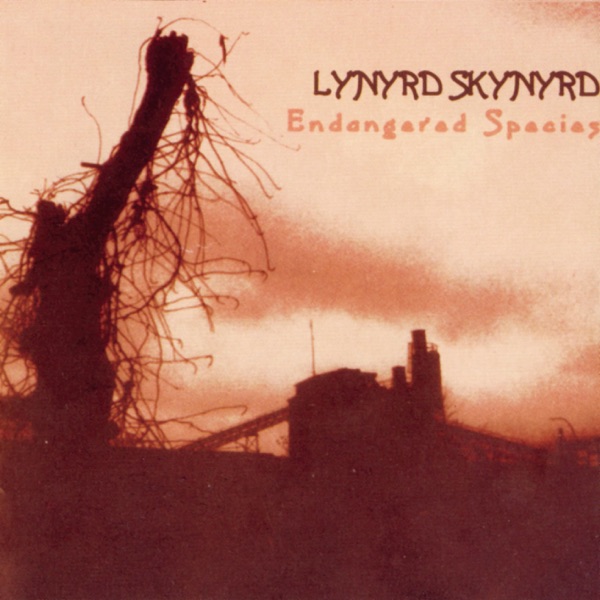
- 1 Down South Jukin' ↗ 2:38
- 2 Heartbreak Hotel ↗ 4:00
- 3 Devil In the Bottle ↗ 3:35
- 4 Things Goin' On ↗ 3:00
- 5 Saturday Night Special ↗ 3:53
- 6 Sweet Home Alabama ↗ 4:01
- 7 I Ain't the One ↗ 3:25
- 8 Am I Losin' ↗ 4:06
- 9 All I Have Is a Song ↗ 3:22
- 10 Poison Whiskey ↗ 2:47
- 11 Good Luck, Bad Luck ↗ 3:23
- 12 The Last Rebel ↗ 5:43
- 13 Hillbilly Blues ↗ 3:42

- 1 We Ain't Much Different ↗ 3:44
- 2 Bring It On ↗ 4:56
- 3 Voodoo Lake ↗ 4:38
- 4 Home Is Where the Heart Is ↗ 5:27
- 5 Travelin' Man ↗ 4:06
- 6 Talked Myself Right Into It ↗ 3:25
- 7 Never Too Late ↗ 5:18
- 8 O.R.R. ↗ 4:17
- 9 Blame It On a Sad Song ↗ 5:35
- 10 Berneice ↗ 4:01
- 11 None of Us Are Free ↗ 5:22
- 12 How Soon We Forget ↗ 4:51


- 1 Santa's Messin' With the Kid ↗ 3:15
- 2 Rudolph the Red Nosed Reindeer ↗ 2:31
- 3 Christmas Time Again ↗ 4:33
- 4 Greensleeves ↗ 2:18
- 5 Santa Claus Is Coming to Town ↗ 3:07
- 6 Run, Run Rudolph ↗ 3:33
- 7 Mama's Song ↗ 3:52
- 8 Santa Claus Wants Some Lovin' ↗ 3:38
- 9 Classical Christmas (Instrumental) ↗ 2:09
- 10 Hallelujah! It's Christmas ↗ 4:01
- 11 Skynyrd Family ↗ 3:00

- 1 That's How I Like It ↗ 4:33
- 2 Pick 'Em Up ↗ 4:20
- 3 Dead Man Walkin' ↗ 4:29
- 4 The Way ↗ 5:32
- 5 Red White & Blue ↗ 5:32
- 6 Sweet Mama ↗ 4:00
- 7 All Funked Up ↗ 3:33
- 8 Hell or Heaven ↗ 5:14
- 9 Mad Hatter ↗ 5:37
- 10 Rockin' Little Town ↗ 3:36
- 11 Crawl ↗ 5:08
- 12 Jake ↗ 3:42
- 13 Life's Lessons ↗ 5:59
- 14 Lucky Man ↗ 5:30
- 15 Gimme Back My Bullets (feat. Kid Rock) ↗ 3:42