
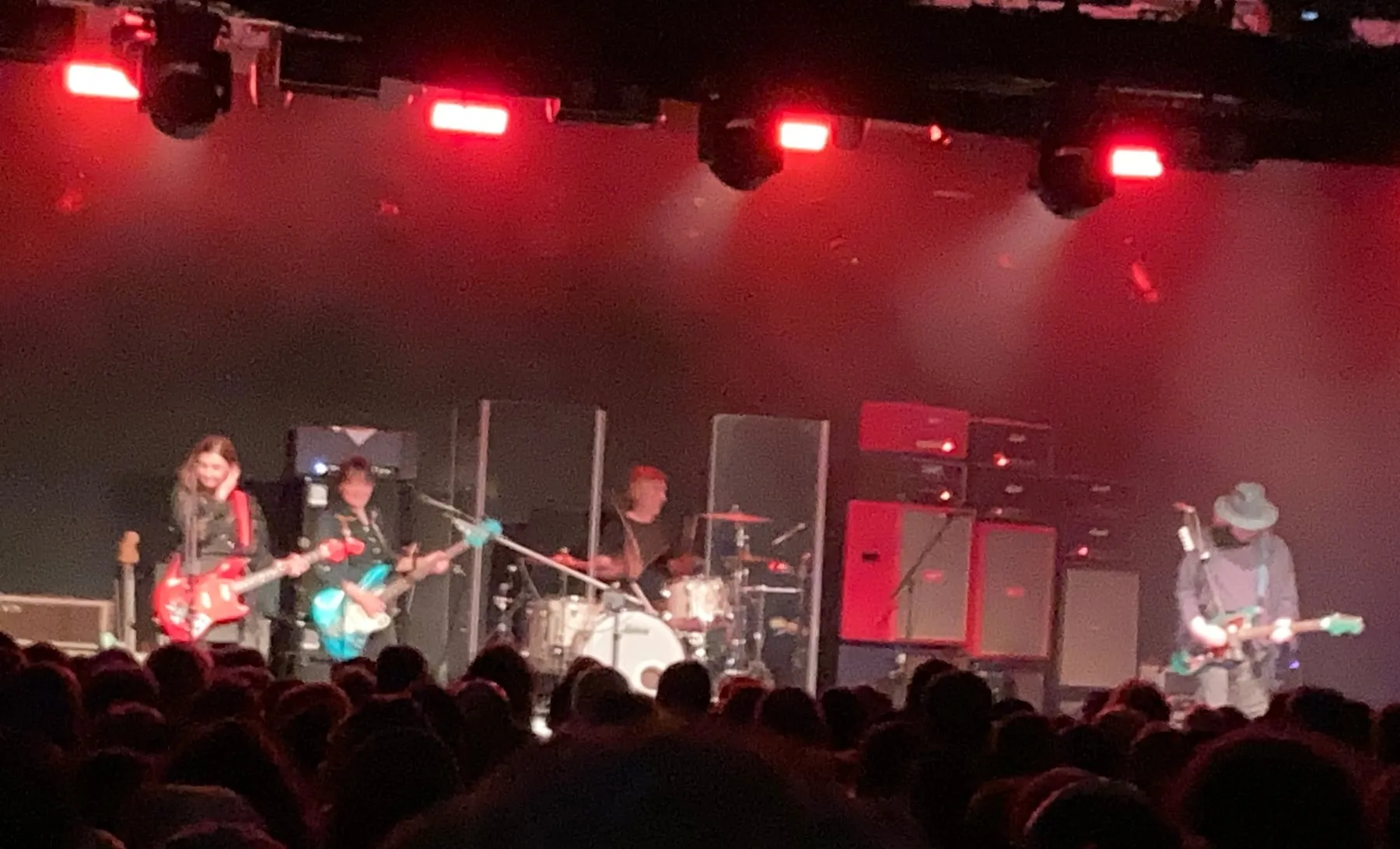
Photo by Ceoil , licensed under CC BY-SA 4.0 · Wikimedia Commons
Rank #112
My Bloody Valentine
The genre-defining shoegaze band whose 'Loveless' remains untouchable.
From Wikipedia
My Bloody Valentine are an Irish rock band formed in Dublin in 1983. The lineup of the band comprises Kevin Shields, Colm Ó Cíosóig (drums), Debbie Googe (bass) and Bilinda Butcher. They are widely regarded as pioneers of the shoegaze genre. Their work is characterised by distorted guitar textures, subdued androgynous vocals, and unorthodox production techniques.
Members
- Bilinda Butcher
- Colm Ó Cíosóig
- Debbie Googe
- Kevin Shields
Studio Albums
- 1988 Isn’t Anything
- 1991 Loveless
- 2013 m b v
- — Flood of Beautiful Sound
Source: MusicBrainz
Deep Dive
Overview
My Bloody Valentine emerged from Dublin in 1983 as an Irish rock band that would eventually redefine the sonic boundaries of rock music in the early 1990s. Fronted by Kevin Shields, the band comprises Bilinda Butcher, Colm Ó Cíosóig, and Debbie Googe, whose collaborative work became the definitive statement of the shoegaze genre. Operating across experimental rock, dream pop, gothic rock, and noise pop, their music is distinguished by distorted guitar textures, subdued androgynous vocals, and unorthodox production techniques that challenged conventional notions of how rock songs should be structured and recorded.
Formation Story
Formed in Dublin in 1983, My Bloody Valentine coalesced around Kevin Shields’s vision of merging punk-influenced energy with increasingly abstract production and arrangement ideas. The classic lineup—Shields, Bilinda Butcher, Colm Ó Cíosóig, and Debbie Googe—solidified during the band’s early years, establishing the foundational chemistry that would define their sound. Rather than adhering to the post-punk aesthetic that had dominated Irish rock in the early 1980s, the band began experimenting with layered guitars, effects processing, and compositional structures that owed more to texture than traditional verse-chorus songcraft.
Breakthrough Moment
My Bloody Valentine’s transition from cult Dublin act to global influence crystallized with the release of Loveless in 1991. Following their debut Isn’t Anything in 1988—a promising but still-emerging statement of their aesthetic—Loveless arrived as a fully realized artistic vision that seemed to arrive from another dimension of rock music. The album synthesized the band’s fragmented, effect-laden guitar approach, Bilinda Butcher’s ethereal vocal delivery, and a production methodology so elaborate and immersive that it essentially rewrote the rulebook for what a rock record could be. The critical and commercial momentum from Loveless transformed them from respected cult innovators into the architects of an entirely new genre framework that other emerging bands immediately began to inhabit.
Peak Era
The period spanning Isn’t Anything (1988) through the early 1990s represented My Bloody Valentine’s most creatively vital and historically consequential period. Loveless, released in 1991, stands as the zenith of this creative arc—an album whose influence expanded exponentially across the 1990s as new generations of listeners and musicians encountered its revolutionary approach to guitar texture, vocal layering, and studio manipulation. The album’s success established the template for shoegaze as a dominant alternative rock subgenre, with countless bands adopting variations of Shields’s vocabulary of distortion, delay, and harmonic density. Though the band maintained lower visibility in the decades following Loveless, their creative and cultural footprint remained undiminished.
Musical Style
My Bloody Valentine’s sound operates at the intersection of dream pop’s ethereal melodic sensibility and experimental rock’s willingness to deploy instruments and vocal production as abstract textures rather than straightforward songwriting tools. Shields’s guitar approach eschews traditional lead-and-rhythm separation in favor of heavily processed, chorus-laden washes of distorted sound that blur melody and noise into a unified wall of tremolo and harmonic shimmer. Bilinda Butcher’s vocals float across the mix as one more textural element rather than assuming the conventional role of lead instrument, creating an androgynous, subdued vocal presence that invites rather than demands attention. Colm Ó Cíosóig’s drumming and Debbie Googe’s bass anchor these textures in rhythm while often disappearing into the dense production landscape. The band’s compositional approach privileges sustained moods and evolving sonic states over traditional song structures, with unorthodox production techniques applied at every stage of the recording process to achieve a sound that feels simultaneously intimate and vastly expansive.
Major Albums
Isn’t Anything (1988)
The band’s debut established the foundational elements of their aesthetic—heavily textured guitars, processed vocals, and an experimental approach to rock songcraft—while still maintaining stronger connections to traditional song structure than later work would allow.
Loveless (1991)
The definitive shoegaze statement, Loveless captured the band at peak creative ambition, transforming distorted guitars, layered vocals, and studio production into an immersive, genre-defining sonic landscape that influenced countless subsequent alternative rock acts and essentially codified shoegaze as a generational sound.
m b v (2013)
Following more than two decades of near-silence, the band returned with m b v, demonstrating that their creative vision remained intact and uncompromised, offering a contemporary meditation on the textures and compositional approaches that had defined their legacy.
Signature Songs
- “Sometimes” — A crystallization of the band’s dream pop sensibility, built on shimmering, heavily chorused guitars and Bilinda Butcher’s floating vocal delivery.
- “Loveless” — The album’s opening statement, establishing the sonic immersion and textural density that defines the record’s revolutionary approach.
- “When the Sun Hits” — A showcase for Shields’s guitar production vocabulary, layering harmonies and effects into a sublimely distorted wash of sound.
- “Only Shallow” — One of Loveless’s most immediate moments, balancing melodic accessibility with the album’s characteristically dense and abstract production framework.
Influence on Rock
My Bloody Valentine’s impact on 1990s rock and alternative music cannot be overstated. They did not invent shoegaze, but Loveless functioned as the genre’s definitive document, establishing a sonic vocabulary and production methodology that influenced an entire generation of British and American alternative rock bands. The album’s success legitimized textural experimentation and production-as-composition in rock contexts, demonstrating that commercial viability and radical sonic ambition were not mutually exclusive. Beyond shoegaze proper, their work influenced dream pop, gothic rock, and experimental rock practitioners across subsequent decades. The band’s emphasis on studio manipulation and unorthodox guitar processing broadened rock’s understanding of what the guitar could communicate beyond traditional lead work, establishing precedent for subsequent generations of artists working at the intersection of melody and noise.
Legacy
My Bloody Valentine’s legacy rests primarily on the enduring power of Loveless, an album that has grown in critical esteem and cultural influence with the passing of decades. The 2013 return with m b v signaled that the band remained creatively vital and uninterested in nostalgia or retrospective positioning, instead continuing to develop their established aesthetic into contemporary contexts. The band’s influence permeates contemporary indie rock, dream pop, and experimental rock contexts, with the shoegaze template they defined remaining a reference point for artists seeking to explore texture, harmony, and production-based songwriting. Their Irish origins and Dublin formation also positioned them as a key entry point in the long history of Irish rock innovation, building on and diverging from the post-punk legacy established in earlier decades. My Bloody Valentine’s continued presence and occasional touring activity ensures their work remains accessible to new listeners, maintaining their position as essential figures in late twentieth-century rock music.
Fun Facts
- Kevin Shields’s guitar work on Loveless employed a technique of detuning and heavily processing instruments that made live reproduction initially impossible, requiring a complete rethinking of how to transpose the album’s textures to concert stages.
- The band’s name derives from an Irish low-budget horror film, reflecting the group’s willingness to draw cultural reference from unexpected sources.
- My Bloody Valentine remained largely inactive during the 2000s, with the anticipation surrounding m b v’s eventual release becoming one of contemporary rock’s most extended waits for new material from an influential act.
Discography & Previews
Click any album to expand its track list. Each track plays a 30-second preview streamed from Apple Music. Tap the link icon next to a track to open it in Apple Music for full playback.
