
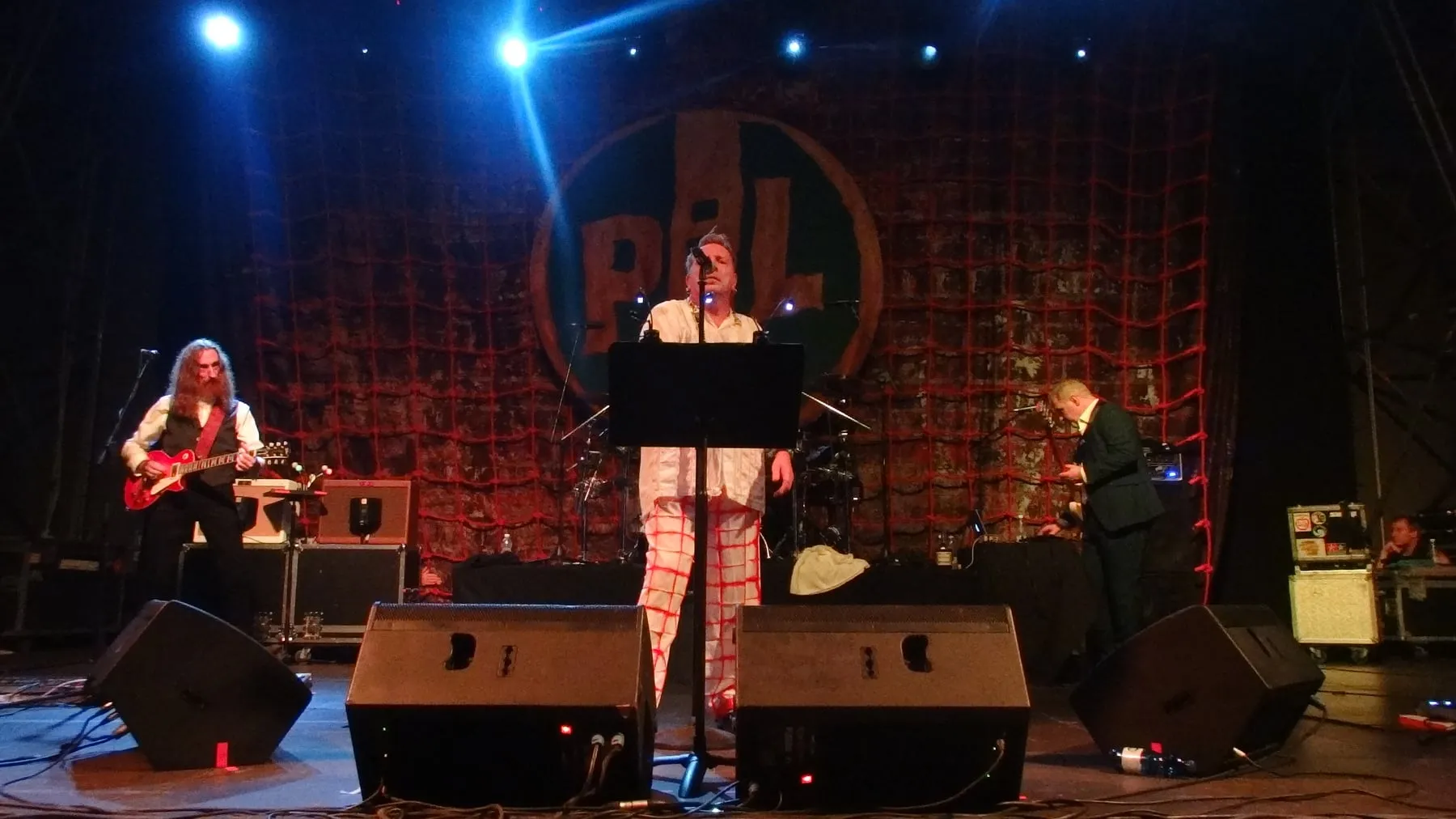
Photo by Σπάρτακος , licensed under CC BY-SA 3.0 · Wikimedia Commons
Rank #220
Public Image Ltd
John Lydon's post-Pistols project, a foundational post-punk band.
From Wikipedia
Public Image Ltd are an English post-punk band formed by lead vocalist John Lydon, guitarist Keith Levene, bassist Jah Wobble, and drummer Jim Walker in June 1978. The group's line-up has changed frequently over the years; Lydon has been the sole constant member.
Members
- Keith Levene
Studio Albums
- 1978 First Issue
- 1979 Metal Box
- 1981 The Flowers of Romance
- 1983 Commercial Zone
- 1984 This Is What You Want… This Is What You Get
- 1985 Album
- 1987 Happy?
- 1989 9
- 1992 That What Is Not
- 2012 This is PiL
- 2015 What the World Needs Now…
- 2023 End of World
Source: MusicBrainz
Deep Dive
Overview
Public Image Ltd stands as one of post-punk’s most uncompromising and influential projects. Formed in June 1978 by John Lydon in the wake of the Sex Pistols’ dissolution, the band emerged as a direct challenge to punk’s three-chord orthodoxy and stadium-rock ambitions. Where the Pistols had wielded shock value and tabloid notoriety as primary weapons, Public Image Ltd positioned itself as an art-rock collective bent on sonic experimentation, textural abstraction, and confrontational aesthetics. Lydon, credited as “Johnny Rotten” during his Pistols years, reclaimed his birth name and steered the band toward a sound that privileged dub reggae influence, electronic processing, and unconventional song structures over punk’s traditional guitar-bass-drums hierarchy.
Formation Story
Public Image Ltd coalesced in London during the spring and summer of 1978, assembling around Lydon’s vocal presence and conceptual vision. The founding lineup paired Lydon with guitarist Keith Levene, bassist Jah Wobble, and drummer Jim Walker. Each member brought distinct technical and aesthetic priorities: Levene’s guitar work frequently eschewed traditional rhythm playing in favor of textural and atmospheric layering; Wobble’s bass lines derived as much from reggae and dub as from rock convention; Walker’s drumming emphasized space and restraint. The band’s name itself—Public Image Ltd—reflected both corporate irony and art-world concealment, a shield against the celebrity machinery that had consumed the Pistols. The group’s emergence occurred in a London post-punk scene already energized by bands like Wire and the Gang of Four, yet Public Image Ltd positioned itself as deliberately oblique and formally challenging even within that avant-garde context.
Breakthrough Moment
The band’s debut album, First Issue, arrived in December 1978 and immediately signaled a radical departure from both punk convention and mainstream rock expectation. Sparse, angular, and dominated by Lydon’s distinctive vocal delivery—alternately sneering, introspective, and abstract—the record announced that Public Image Ltd would not trade on the Pistols’ notoriety or revisit familiar punk tropes. The true commercial and critical breakthrough came with the 1979 release of Metal Box, an album that redefined the band’s sound and secured their place in post-punk’s canonical works. Metal Box synthesized dub reggae’s spatial and rhythmic experiments with post-punk’s angular aggression, positioning Wobble’s bass lines as the dominant compositional and textural element. The album’s packaging—released in a metal film canister rather than a conventional LP sleeve—reinforced the band’s commitment to challenging presentation as integral to artistic statement. Critical reception and expanding influence across college radio and alternative venues established Public Image Ltd as architects of a genuinely distinctive post-punk vision, neither a continuation of punk orthodoxy nor an easy assimilation into art-rock establishment.
Peak Era
Public Image Ltd’s most creatively fertile and commercially significant period spanned the early-to-mid 1980s, encompassing the albums The Flowers of Romance (1981), Commercial Zone (1983), and This Is What You Want… This Is What You Get (1984). During these years, the band continued to evolve its sonic palette, incorporating synthesizers and electronic production techniques without abandoning the dub-reggae and post-punk fundamentals that defined their early work. The frequent reconfiguration of the band’s lineup—with Lydon maintaining his role as sole constant member—allowed for successive experiments in instrumental balance and textural approach. Album (1985) marked a further iteration in the band’s ongoing formal investigations, while the late 1980s saw Public Image Ltd navigating the broader shift in alternative rock and electronic music that would define the decade’s cultural landscape.
Musical Style
Public Image Ltd’s sound emerged from the intersection of punk’s energy and formal rejection of rock convention, dub reggae’s spatial and rhythmic sophistication, and post-punk’s embrace of angular guitar work and lyrical abstraction. The band’s most distinctive trait lay in its subordination of guitar to bass and vocal texture as primary compositional elements. Jah Wobble’s bass lines—deep, syncopated, often functioning as the track’s harmonic and rhythmic spine—provided the band’s foundation across their best-known work. Levene’s guitar playing rarely occupied the soloistic or driving role that tradition assigned to the instrument; instead, it served as textural punctuation, atmospheric embellishment, or deliberate abstraction. Lydon’s vocal delivery combined the aggressive urgency of his Pistols-era performances with increasing experimentation in tone, register, and rhythmic placement. The band’s production aesthetic favored clarity and space rather than compression and density, allowing individual instrumental lines to maintain distinct spatial and timbral identity. This approach aligned Public Image Ltd with the broader post-punk world of the late 1970s and early 1980s, wherein conventional rock instrumentation was deconstructed and reassembled according to avant-garde and experimental principles.
Major Albums
First Issue (1978)
The debut established Public Image Ltd’s fundamental aesthetic: sparse, angular post-punk refracted through dub reggae’s spatial and rhythmic vocabulary, with Lydon’s vocals serving as primary textural element rather than conventional lead instrument.
Metal Box (1979)
Conceived as an integrated artistic statement and released in a metal film canister, Metal Box cemented the band’s critical reputation by foregrounding Wobble’s bass work and dub-reggae influence while maintaining post-punk’s formal abstraction and Lydon’s distinctive vocal presence.
The Flowers of Romance (1981)
Continuing the band’s sonic evolution, this album demonstrated Public Image Ltd’s willingness to incorporate electronic production and synthesizer textures without abandoning the foundational dub and post-punk grammar that defined the project.
This Is What You Want… This Is What You Get (1984)
Reflecting the band’s mid-1980s moment, this album showcased further integration of electronic and synthesizer-based approaches while maintaining the textural and rhythmic sophistication that had characterized their earlier canonical works.
Signature Songs
- “Public Image” — The band’s manifesto statement, articulating their rejection of punk celebrity and embrace of formal artistic challenge.
- “Death Disco” — A haunting reinterpretation of grief and public spectacle, showcasing Lydon’s emotional vocal range and the band’s capacity for genuine pathos.
- “Careering” — Metal Box’s opening track, establishing the album’s dub-reggae sonic priorities and Wobble’s role as primary compositional voice.
- “Graveyard” — A demonstration of the band’s capacity for sustained atmospheric tension and Lydon’s more introspective vocal approach.
Influence on Rock
Public Image Ltd’s influence on post-punk and alternative rock extended far beyond the band’s commercial success, establishing a template for art-rock experimentation that prioritized formal innovation over conventional songwriting. The band’s synthesis of dub reggae and post-punk proved foundational to subsequent electronic and alternative movements; artists ranging from industrial acts to synth-pop projects traced lineage through Public Image Ltd’s formal investigations. The band’s commitment to frequent lineup reconfiguration and stylistic evolution influenced later art-rock and post-punk revival projects, suggesting that institutional and commercial stability mattered less than creative restlessness. Lydon’s role as a highly visible and often controversial public figure—marked by his willingness to engage in confrontational rhetoric and conceptual provocation—established a model for alternative-rock leadership that emphasized artistic autonomy and formal challenge over the professionalization and consolidation that characterized mainstream rock.
Legacy
Public Image Ltd’s long-term legacy rests on their foundational contributions to post-punk and art-rock aesthetics, established decisively across their late 1970s and early 1980s catalogue. While commercial success remained modest relative to the band’s critical influence, their formal innovations and refusal to accommodate mainstream rock convention established them as architects of alternative rock’s intellectual and experimental traditions. The band’s continued activity into the 2010s and beyond—releasing This is PiL (2012), What the World Needs Now… (2015), and End of World (2023)—testified to Lydon’s sustained commitment to the project’s foundational vision of formal challenge and artistic autonomy. Their influence circulates through alternative and experimental rock traditions, where their integration of dub reggae, post-punk abstraction, and electronic production remains a reference point for artists seeking to challenge rock’s conventional instrumental and formal hierarchies.
Fun Facts
- Metal Box was released in a metal film canister rather than a standard record sleeve, making the album’s physical presentation an integral part of its artistic statement and creating significant production and distribution challenges.
- John Lydon has remained the sole constant member throughout Public Image Ltd’s entire history, allowing him to function as the project’s primary creative voice while surrounding himself with frequently rotating collaborators.
- The band’s name, Public Image Ltd, functioned as a direct ironic commentary on celebrity and corporate branding, positioning the band as simultaneously embracing and critiquing the mechanisms of fame and commercial presentation.
Discography & Previews
Click any album to expand its track list. Each track plays a 30-second preview streamed from Apple Music. Tap the link icon next to a track to open it in Apple Music for full playback.


