
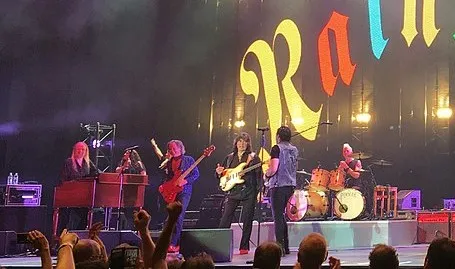
Photo by kitmasterbloke , licensed under CC BY 2.0 · Wikimedia Commons
Rank #92
Rainbow
Ritchie Blackmore's post-Purple project bridging hard rock and neoclassical metal.
From Wikipedia
Rainbow were a British hard rock band formed in Hertford in 1975 by guitarist Ritchie Blackmore. Established in the aftermath of Blackmore's first departure from Deep Purple, they originally featured four members of the American rock band Elf, including their singer Ronnie James Dio, but after their self-titled debut album, Blackmore fired these members, except Dio, recruiting drummer Cozy Powell, bassist Jimmy Bain, and keyboardist Tony Carey. This line-up recorded the band's second album Rising (1976), while Long Live Rock 'n' Roll (1978) saw Bob Daisley and David Stone replace Bain and Carey, respectively. Long Live Rock 'n' Roll was also the last album with Dio before he left the band to join Black Sabbath in 1979.
Members
- Jack Green
- John Miceli
Studio Albums
- 1975 Ritchie Blackmore’s Rainbow
- 1976 Rising
- 1978 Long Live Rock ’n’ Roll
- 1979 Down to Earth
- 1981 Difficult to Cure
- 1982 Straight Between the Eyes
- 1983 Bent Out of Shape
- 1995 Stranger in Us All
Source: MusicBrainz
Deep Dive
Overview
Rainbow were a British hard rock band formed in Hertford in 1975 by guitarist Ritchie Blackmore in the aftermath of his first departure from Deep Purple. The project emerged as Blackmore’s vehicle for exploring the intersection of hard rock intensity and instrumental virtuosity, particularly through the incorporation of neoclassical and progressive influences. Across two decades and eight studio albums, Rainbow functioned as a showcase for Blackmore’s guitar-driven compositions, supporting a rotating cast of vocalists and musicians that lent the band its signature sound: massive, layered arrangements anchored by Blackmore’s distinctive guitar tone and architectural song construction.
Formation Story
Rainbow’s genesis lay in Blackmore’s break with Deep Purple and his recruitment of four members from the American rock band Elf for his new project. The original lineup included Elf’s singer Ronnie James Dio, whose powerful, classically-trained voice would become the primary vocal identity for the band’s early and most celebrated period. Formed in Hertford in 1975, Rainbow released their self-titled debut, Ritchie Blackmore’s Rainbow, that same year, establishing the band’s core aesthetic of technically demanding compositions supported by dramatic, operatic vocals. However, this initial lineup proved unstable; Blackmore soon dismissed the Elf members save for Dio, restructuring the band with drummer Cozy Powell, bassist Jimmy Bain, and keyboardist Tony Carey—a reformation that would yield the band’s most enduring work.
Breakthrough Moment
Rainbow’s breakthrough arrived with their second album, Rising (1976), a record that solidified the partnership between Blackmore and Dio and introduced the template the band would refine across the decade. Rising demonstrated that hard rock and neoclassical metal were not incompatible; Blackmore’s baroque guitar passages, executed with the precision and velocity of a classical virtuoso, proved compatible with Dio’s soaring, operatic delivery and the band’s preference for lengthy, multi-part compositions. The album’s artistic and commercial success established Rainbow as a significant force within heavy metal, a status they cemented with Long Live Rock ‘n’ Roll (1978), which saw bassist Jimmy Bain and keyboardist Tony Carey replaced by Bob Daisley and David Stone respectively, yet maintained the band’s creative momentum and appeal.
Peak Era
Rainbow’s creative and commercial peak extended from 1975 through the late 1970s, encompassing Ritchie Blackmore’s Rainbow, Rising, and Long Live Rock ‘n’ Roll. This three-album run established the band as architects of a distinctive branch of heavy metal that prioritized instrumental complexity and vocal drama over simplicity or immediacy. The period defined Rainbow’s reputation: ambitious, technically proficient, and unapologetically theatrical. When Dio departed in 1979 to join Black Sabbath, a chapter closed, and the band’s direction fundamentally shifted. Subsequent albums—Down to Earth (1979), Difficult to Cure (1981), Straight Between the Eyes (1982), and Bent Out of Shape (1983)—saw continued commercial viability but signaled a gradual movement away from the neoclassical intensity and vocal dramatics that had defined their initial run. A lengthy hiatus preceded Stranger in Us All (1995), a late-career effort that attempted to recapture earlier energies but arrived in a cultural moment that had largely moved beyond the band’s aesthetic.
Musical Style
Rainbow’s sound was fundamentally defined by the contrast and synthesis of two seemingly opposing forces: the raw power and groove of hard rock and the precision and complexity of neoclassical composition. Ritchie Blackmore’s guitar work served as the band’s central organizing principle, combining heavy, distorted riffing with rapid, intricately fingered passages that drew inspiration from classical music and the technical vocabulary of rock’s emerging shred guitar movement. His approach was not merely ornamental; neoclassical passages functioned as essential structural and melodic elements within songs that might run five, six, or more minutes. The rhythm section—anchored by the thunderous drumming of Cozy Powell in the band’s first phase—provided both the groove foundation and, in Powell’s case, the dynamic flexibility to accommodate Blackmore’s compositional ambitions. Ronnie James Dio’s contributions cannot be overstated; his operatic control and power elevated Rainbow beyond instrumental display into the realm of dramatic vocal performance, his voice often functioning as an additional lead instrument capable of soaring above and threading through Blackmore’s dense guitar arrangements. Keyboards, handled first by Tony Carey and later by David Stone, added orchestral weight and harmonic sophistication, creating a wall of sound that balanced drama with instrumental clarity.
Major Albums
Rising (1976)
Rainbow’s artistic and commercial zenith, Rising showcased the Blackmore-Dio partnership at its creative peak, balancing extended instrumental passages with powerful vocal moments and establishing the neoclassical metal template that influenced countless subsequent bands.
Ritchie Blackmore’s Rainbow (1975)
The band’s self-titled debut introduced Blackmore’s post-Purple project and the distinctive guitar-forward hard rock sound, marking the first appearance of this particular fusion of classical precision and metal power.
Long Live Rock ‘n’ Roll (1978)
The third and final studio album featuring Ronnie James Dio, Long Live Rock ‘n’ Roll maintained the band’s artistic ambitions while emphasizing heavier, riff-driven compositions alongside the instrumental virtuosity that had become their hallmark.
Difficult to Cure (1981)
Recorded with a new vocal lineup following Dio’s 1979 departure, this album represented Rainbow’s attempt to sustain their commercial presence and creative credibility in the post-Dio era, demonstrating the band’s core instrumental identity remained viable.
Straight Between the Eyes (1982)
Continuing the band’s 1980s work with adjusted personnel, this album maintained the hard rock foundation and neoclassical instrumental approach while adapting to the sonic expectations of the decade.
Signature Songs
- All Night Long — An extended showcase for Ronnie James Dio’s vocal range and Ritchie Blackmore’s neoclassical guitar sensibilities, epitomizing the band’s early theatrical approach to hard rock.
- Stargazer — A landmark track combining operatic vocals, baroque guitar passages, and progessive composition structure, representing Rainbow’s artistic ambitions at their most concentrated.
- Long Live Rock ‘n’ Roll — The title track from their third album, demonstrating the band’s ability to balance straightforward hard rock power with technical instrumental passages.
- Man on the Silver Mountain — An early defining composition that introduced the Blackmore-Dio partnership and the band’s signature fusion of metal riffing and neoclassical guitar work.
Influence on Rock
Rainbow occupied a crucial position in heavy metal’s development, proving that technical virtuosity and classical music influences could coexist with power and accessibility rather than existing in opposition. The band’s example, particularly during their early and mid-1970s run, influenced the emerging neoclassical metal movement and provided a template for subsequent metal guitarists interested in expanding their technical vocabulary. Ritchie Blackmore’s approach to lead guitar—combining speed, precision, and dramatic structural sense—influenced a generation of metal shredders who emerged in the 1980s. The band’s insistence on extended compositions and complex arrangements, at a moment when punk and hard rock’s simplification were dominant cultural forces, provided an alternative path for metal’s development, one that prioritized compositional ambition and technical display. Ronnie James Dio’s dramatic, classically-influenced vocal approach similarly influenced metal vocalists who followed, demonstrating that power metal vocals could be precisely executed and theatrically delivered simultaneously.
Legacy
Rainbow’s long-term cultural position rests primarily on their early work and their significance as a bridge between Deep Purple’s blues-rock foundation and the emerging neoclassical metal movement of the 1980s. The band’s commercial success and artistic credibility during the 1970s—particularly the achievement of Rising—secured their place within heavy metal’s historical canon, even as changing tastes and the band’s post-1979 shifts diminished their commercial relevance. Ritchie Blackmore’s continued work with the band, including the 1995 reunion album Stranger in Us All, maintained a low but persistent presence within metal culture. The band’s recorded legacy remains accessible through standard streaming platforms and continues to circulate within metal communities, a testament to the durability of their most celebrated work. While Rainbow never achieved the mainstream cultural penetration of Deep Purple or Black Sabbath, their influence on metal’s technical and compositional development ensures ongoing historical recognition and continued appreciation among musicians and devoted fans.
Fun Facts
- The original 1975 lineup drew four members from the American band Elf, effectively transplanting an entire existing ensemble into Ritchie Blackmore’s new British project.
- Cozy Powell, the band’s drummer during their most celebrated period, was a drumming virtuoso whose technical abilities matched Blackmore’s guitar complexity, making him essential to the band’s sound despite his later departure.
- Ronnie James Dio’s 1979 departure to Black Sabbath ended one of hard rock’s most potent vocalist-guitarist partnerships and marked the beginning of the band’s gradual shift away from the neoclassical metal aesthetic that defined their initial reputation.
- Rainbow recorded across three decades, with their 1995 album Stranger in Us All arriving sixteen years after their previous studio work, reflecting both the band’s sporadic recording schedule and Ritchie Blackmore’s continued involvement in other projects.
Discography & Previews
Click any album to expand its track list. Each track plays a 30-second preview streamed from Apple Music. Tap the link icon next to a track to open it in Apple Music for full playback.


