Photo by Jonas Rogowski , licensed under CC BY-SA 3.0 · Wikimedia Commons
Rank #190
Rammstein
Berlin Neue Deutsche Härte titans of pyro spectacle and martial riffs.
From Wikipedia
Rammstein is a German Neue Deutsche Härte band formed in Berlin in 1994. The band's lineup—consisting of lead vocalist Till Lindemann, lead guitarist Richard Kruspe, rhythm guitarist Paul Landers, bassist Oliver Riedel, drummer Christoph Schneider, and keyboardist Christian "Flake" Lorenz—has remained unchanged throughout their history, along with their approach to songwriting, which consists of Lindemann writing and singing the lyrics over instrumental pieces the rest of the band has completed beforehand. Prior to their formation, some members were associated with the punk rock acts Feeling B and First Arsch.
Members
- Christoph Schneider
- Flake Lorenz
- Oliver Riedel
- Paul Landers
- Richard Kruspe
- Till Lindemann
Studio Albums
- 1995 Herzeleid
- 1997 Sehnsucht
- 2001 Mutter
- 2004 Zeitreise - Reisezeit
- 2004 Reise, Reise
- 2005 Rosenrot
- 2009 Liebe ist für alle da
- 2019 [Rammstein]
- 2022 Zeit
- 2024 Rare Tracks and Singles Vol. 2
Source: MusicBrainz
Deep Dive
Overview
Rammstein is a German industrial metal band formed in Berlin in 1994 that became the defining act of Neue Deutsche Härte—a movement blending heavy metal riffs, electronic production, and Germanic martial aesthetics. The six-piece ensemble, consisting of Till Lindemann (vocals), Richard Kruspe (lead guitar), Paul Landers (rhythm guitar), Oliver Riedel (bass), Christoph Schneider (drums), and Flake Lorenz (keyboards), built a career on the principle that music should be experienced as total spectacle: thunderous instrumental arrangements paired with Lindemann’s distinctive vocal delivery and, increasingly, elaborate pyrotechnic stage production that became their visual trademark.
Formation Story
Rammstein emerged from Berlin’s post-Cold War underground in the mid-1990s, a period when the reunified city was reasserting itself as a cultural capital. Several members had roots in punk rock acts that preceded the band—Feeling B and First Arsch—creating a bridge between punk’s raw energy and the heavier, more synthesizer-informed sound they would develop together. The band’s core lineup solidified around 1994 and has remained intact throughout the band’s three decades of activity, a stability that would become increasingly rare in the metal world. This continuity allowed the six musicians to develop a deeply integrated compositional method: Lindemann would craft lyrics and vocal melodies after Kruspe, Landers, Riedel, Schneider, and Lorenz had completed the instrumental arrangements, a workflow that locked the band’s identity into place from the outset.
Breakthrough Moment
Rammstein’s first two studio albums, Herzeleid (1995) and Sehnsucht (1997), established their sound within the European metal underground, but it was Mutter (2001) that catalyzed their breakthrough into mainstream consciousness. The album’s combination of melodic hooks, distorted guitars, and Lindemann’s percussive vocal approach gained significant traction beyond Germany, introducing international audiences to a metal band that sounded like nothing in the Anglo-American heavy metal canon. Mutter’s success transformed Rammstein from a regional phenomenon into a globally touring act, a transition that coincided with the band’s escalating commitment to live performance spectacle—a marriage of sound and vision that would define their reputation for the next two decades.
Peak Era
The decade following Mutter represented Rammstein’s commercial and creative zenith. The albums Reise, Reise (2004), Rosenrot (2005), and Liebe ist für alle da (2009) cemented their status as Europe’s preeminent industrial metal act. This period saw the band working within a highly developed formula—massive, synth-heavy arrangements, Lindemann’s distinctive vocal presence, and song structures that balanced heaviness with accessibility—while avoiding the trap of simple repetition. The visual component of their concerts expanded dramatically, with pyrotechnic displays becoming central to the Rammstein brand in ways that influenced metal and rock touring across the genre. By the end of the 2000s, Rammstein had become a stadium-level act in Europe and increasingly elsewhere, demonstrating that a band singing in German with overtly electronic instrumentation could achieve scale without compromising their aesthetic.
Musical Style
Rammstein’s sound is anchored in the dual attack of Kruspe’s heavily distorted lead guitar work and Lorenz’s driving synthesizer arrangements, creating a thick, quasi-orchestral texture that distinguishes them from traditional guitar-dominant metal bands. The rhythm section of Riedel’s bass and Schneider’s drums provides industrial-strength propulsion, often emphasizing repetitive, march-like patterns that reinforce the Germanic aesthetic the band has cultivated. Lindemann’s vocal approach—part sung melody, part rhythmic declamation, delivered with flattened affect and precise articulation—treats his voice as an instrument rather than a vehicle for traditional melodic virtuosity. The songwriting consistently privileges atmosphere and hypnotic grooves over conventional rock verse-chorus structures, though the songs remain memorable and relatively concise. This combination—synth-heavy production, martial percussion, distorted guitar layers, and Lindemann’s distinctive delivery—places Rammstein within industrial metal and shock rock lineages while remaining entirely their own sonic entity.
Major Albums
Herzeleid (1995)
The debut established Rammstein’s core sound and working method, introducing Lindemann’s vocal character and the band’s synthesis of punk rawness and industrial precision to a German audience primed for a new kind of heavy music.
Sehnsucht (1997)
The follow-up refined the formula and expanded the band’s European reach, demonstrating that their debut was not a one-off but a sustainable artistic vision with room for development.
Mutter (2001)
The album that broke Rammstein internationally, Mutter balanced compositional sophistication with immediate impact, becoming their commercial turning point and establishing them as a touring powerhouse.
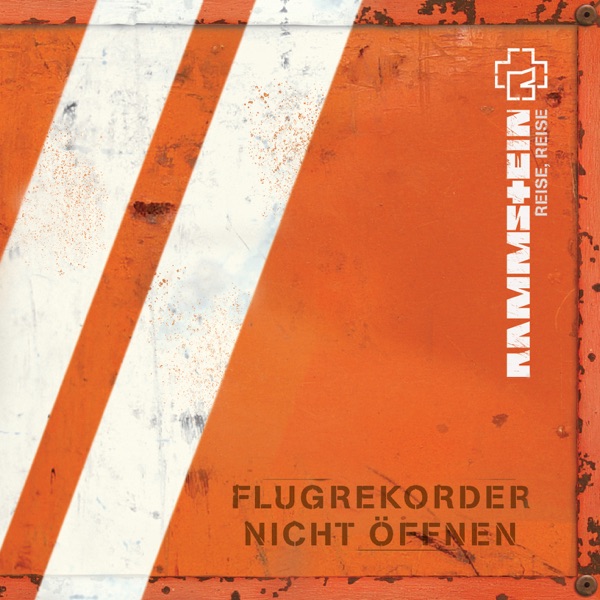
Reise, Reise (2004)
Released during the band’s peak creative period, Reise, Reise showcased a band in full command of their orchestral industrial sound and live spectacle, featuring some of their most enduring songs.
Liebe ist für alle da (2009)
The final album of Rammstein’s first major cycle, this record maintained the band’s commercial momentum while suggesting certain artistic plateaus had been reached, making it a natural pause point before their extended hiatus.
Signature Songs
- “Sonne” — A Mutter standout with a hypnotic riff and Lindemann’s most immediately memorable vocal hook, it exemplifies the band’s ability to create infectious industrial metal.
- “Du Hast” — Perhaps the band’s most recognizable song globally, the track’s propulsive synth-guitar interplay became synonymous with Rammstein’s live spectacle.
- “Feuer Frei” — A driving industrial march that showcases Schneider’s rhythm work and the band’s gift for building momentum through repetition and layering.
- “Spieluhr” — A mid-period composition demonstrating the band’s range, combining electronic production with moments of melodic vulnerability.
- “Ich Tu Dir Weh” — From Liebe ist für alle da, the song’s aggressive dynamics and Lindemann’s forceful delivery represent the band at maximum heaviness.
Influence on Rock
Rammstein demonstrated that industrial metal could achieve massive popular success without compromising its aesthetic severity or its linguistic and cultural specificity. Their influence rippled across European metal and rock, offering a template for bands seeking to integrate electronic production, martial sensibilities, and provocative imagery into heavy music. The emphasis on the live show as a total artwork—where pyrotechnics, choreography, and visual design were as essential as the music—influenced touring practices across metal and rock. Within the broader context of German rock and metal, Rammstein became the international face of Neue Deutsche Härte, giving the movement and its aesthetic concerns genuine mainstream currency in a world dominated by English-language rock and Anglo-American metal traditions.
Legacy
Following Liebe ist für alle da in 2009, Rammstein entered a lengthy period of relative inactivity, with members pursuing solo projects and the band taking nearly a decade away from recording. The self-titled album Rammstein (2019) marked their return to the studio and demonstrated that the band retained both their stylistic identity and their ability to command attention. Zeit (2022) confirmed that the extended absence had not diminished their relevance or creative vitality. The band’s influence on industrial metal, shock rock, and European heavy music remains substantial, with their touring generating significant revenue and their live shows remaining architecture-scale productions. Their three-decade stability as a six-member unit—unique in an industry marked by constant flux—has become part of their identity, a testament to a clearly articulated creative vision that all six members have remained committed to executing.
Fun Facts
- The band’s compositional method—Lindemann writing vocals and lyrics to completed instrumental pieces rather than developing songs from initial ideas—has remained unchanged since formation, creating an unusual but deeply integrated workflow.
- Several band members were associated with punk rock acts prior to Rammstein’s formation, creating a continuity between punk’s DIY ethos and the band’s elaborate industrial spectacle.
- Rammstein’s 2019 self-titled album marked the band’s return to recording after a nine-year hiatus, demonstrating their ability to re-establish relevance after extended absence from the studio.
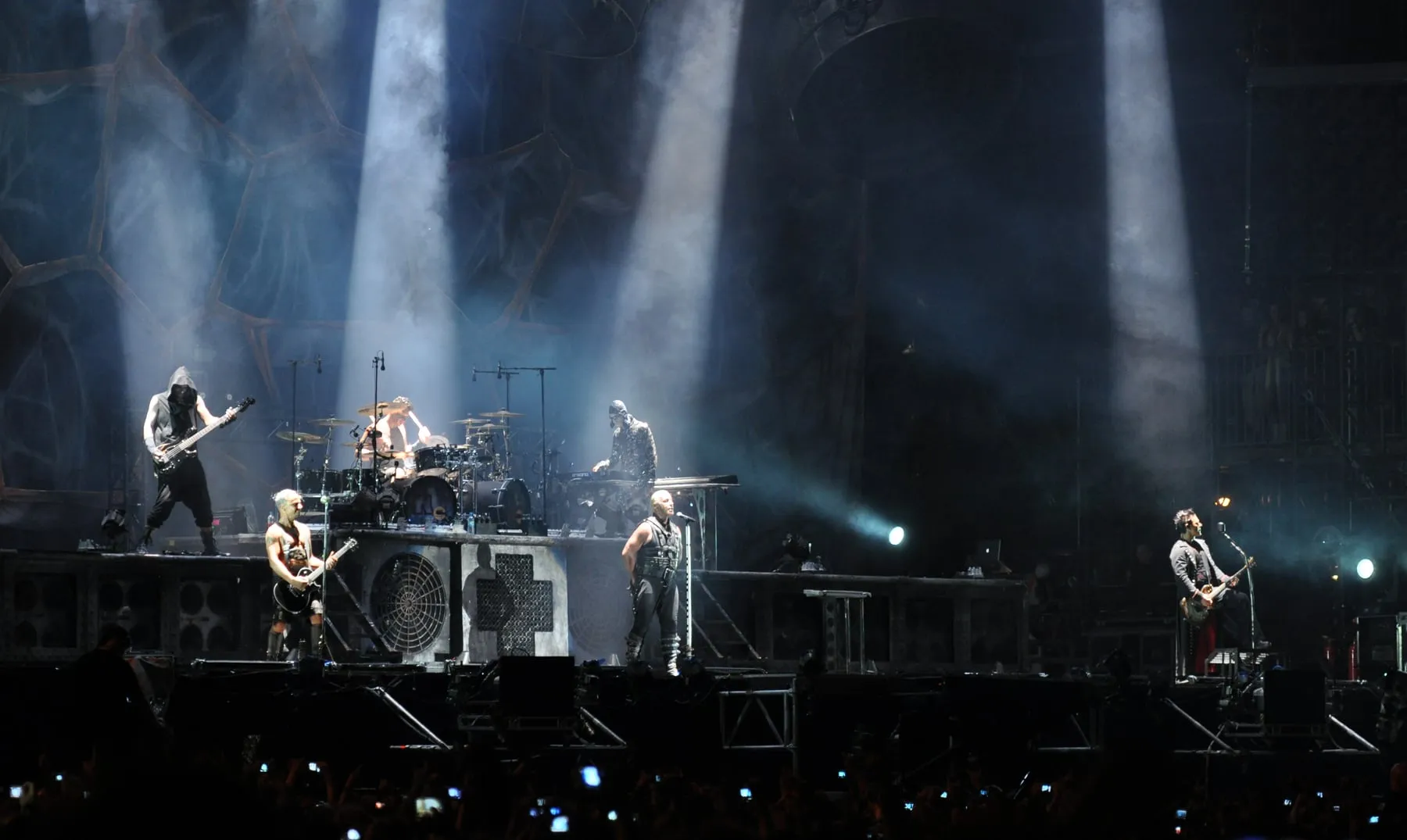
- The band’s live performances have become increasingly famous for their pyrotechnic displays and elaborate stage design, making Rammstein concerts major production events rather than traditional rock shows.
Discography & Previews
Click any album to expand its track list. Each track plays a 30-second preview streamed from Apple Music. Tap the link icon next to a track to open it in Apple Music for full playback.