
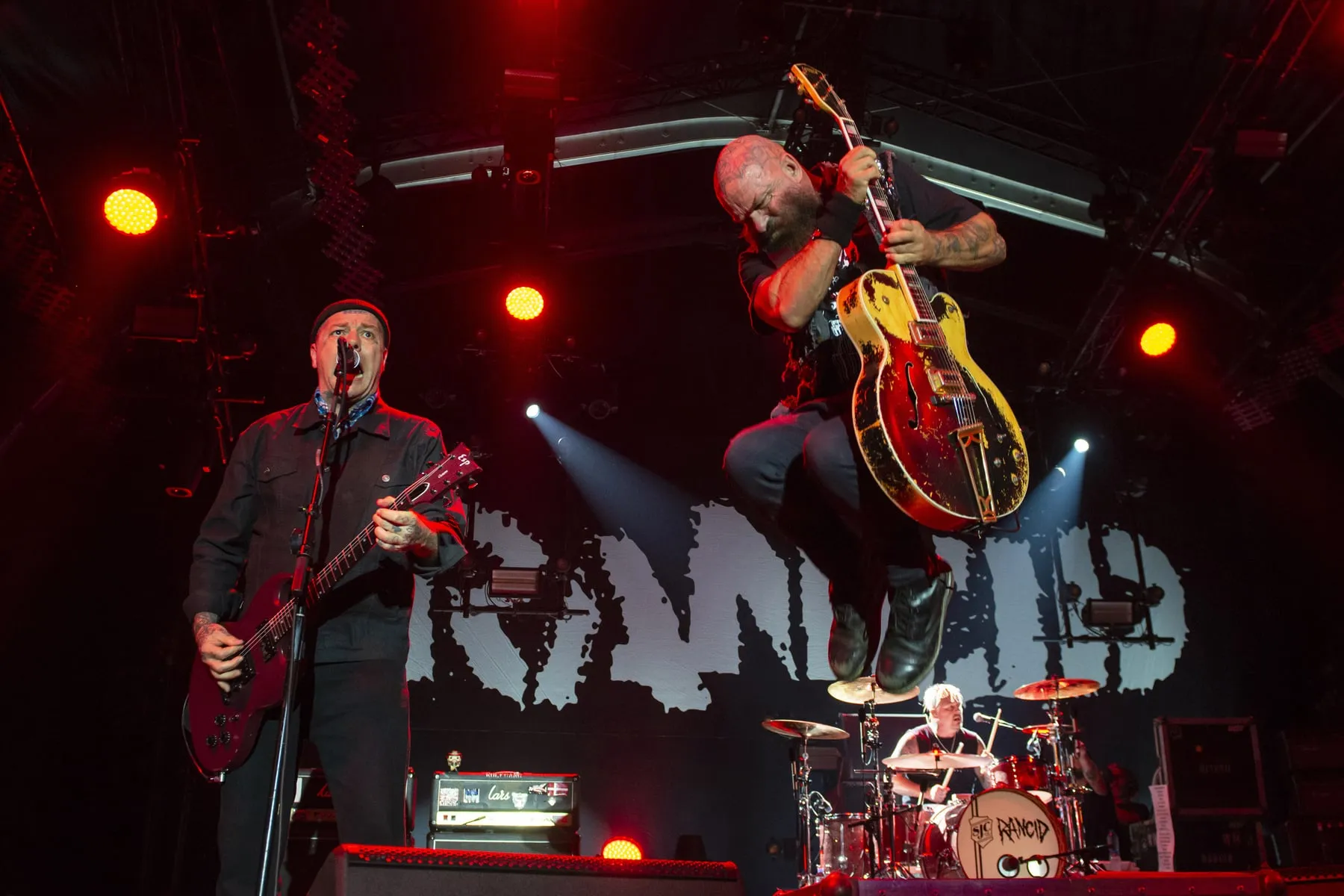
Photo by Selbymay , licensed under CC BY 4.0 · Wikimedia Commons
Rank #150
Rancid
Bay Area street-punk torchbearers carrying the Clash's spirit forward.
From Wikipedia
Rancid is an American punk rock band formed in Berkeley, California, in 1991. Founded by Tim Armstrong and Matt Freeman, former members of the band Operation Ivy, Rancid is often credited as being among the wave of bands that revived mainstream interest in punk rock in the United States during the mid-1990s. Over its 35-year career, Rancid has retained much of its original fan base, most of which was connected to its underground musical roots.
Members
- Brett Reed
Deep Dive
Overview
Rancid is an American punk rock band formed in Berkeley, California, in 1991 by Tim Armstrong and Matt Freeman, both former members of the influential ska-punk outfit Operation Ivy. Operating continuously from their inception through the present day, Rancid stands among the most significant torchbearers of street-level punk ethos in the post-1980s era. The band’s sustained mainstream visibility during the mid-1990s punk resurgence—at a moment when punk rock had retreated into underground obscurity—marked a turning point in American rock radio and alternative culture. Where many 1990s bands borrowed punk’s surface aesthetics, Rancid maintained the genre’s rootedness in working-class imagery, DIY ethics, and melodic songwriting discipline inherited from forebears like the Clash.
Formation Story
Tim Armstrong and Matt Freeman came together in the East Bay in 1991, drawing on their shared experience in Operation Ivy, a Berkeley-based ska-punk band that had built a fervent cult following before dissolving in the late 1980s. From the outset, Rancid positioned itself as a street-punk unit rather than a ska revival project, though ska’s rhythmic and harmonic vocabulary remained threaded through their approach. Brett Reed completed the core lineup as drummer. Berkeley’s punk scene provided both the geographic and cultural foundation for the band’s emergence: a city with deep roots in punk and independent music, where the transition from 1980s hardcore to 1990s alternative rock played out with particular intensity. The band’s formation in 1991 placed them at the threshold of a wider American cultural moment—grunge was about to dominate alternative rock radio, yet punk itself remained largely consigned to college radio and independent record stores.
Breakthrough Moment
Rancid’s breakthrough came swiftly with their self-titled debut in 1993, followed by the far more consequential Let’s Go in 1994. The latter album, arriving as mainstream rock was beginning to fracture beyond the grunge dominance of 1992–1993, articulated a punk-rock ideology that felt both retro and contemporary. Songs on Let’s Go moved with the speed and economy of punk but incorporated melodic hooks and production clarity that made them accessible to rock radio programmers. The album’s success—and the band’s increasingly visible presence on MTV and in alternative rock publications—signaled that punk rock could reclaim cultural oxygen without sacrificing its essential character. By 1995, when …And Out Come the Wolves arrived, Rancid had become a focal point for the mid-1990s punk renaissance, a period during which Green Day, The Offspring, and others similarly reaped mainstream benefits from the genre’s underground revival.
Peak Era
Rancid’s most creatively fertile and commercially significant years spanned the mid-to-late 1990s, anchored by …And Out Come the Wolves (1995) and extending through Life Won’t Wait (1998). During this window, the band refined a signature sound: propulsive two-minute-to-three-minute punk songs with tight, repetitive guitar riffs, vocals that balanced singing and shouting, and production values sufficiently polished to reach rock radio without sacrificing the rawness of punk tradition. Albums released across this period demonstrated both consistency and an expanding sonic palette. A second self-titled record arrived in 2000, suggesting the band’s willingness to periodically reset and rework their foundational material. Throughout the subsequent two decades, Rancid maintained continuous recording and touring activity, releasing Indestructible (2003), Let the Dominoes Fall (2009), …Honor Is All We Know (2014), Trouble Maker (2017), and most recently Tomorrow Never Comes (2023), demonstrating remarkable longevity and an ability to retain their original fanbase while engaging successive generations of listeners.
Musical Style
Rancid’s sound represents a synthesis of punk rock’s melodic and rhythmic foundations with ska’s harmonic texture and offbeat emphasis. The band operates within the traditional punk framework of drums, bass, guitar, and vocals, but their guitar work frequently incorporates the skittering, upstroke-heavy approach characteristic of ska, creating a rhythmic elasticity that distinguishes them from straightforward hardcore or street-punk peers. Tim Armstrong’s vocals occupy a central position in the band’s identity: a raw, shouted delivery that rarely strays far from the song’s root melody, preserving punk’s vocal tradition of directness and clarity over technical virtuosity. Matt Freeman’s bass playing sits deep in the mix, anchoring songs with melodic counterlines that often rival the guitar hook in terms of memorability—an approach that traces back to punk’s foundational texts but also to reggae and ska’s emphasis on the bass as a lead instrument. Lyrically, Rancid maintained punk’s characteristic preoccupations: street life, urban landscapes, social alienation, working-class identity, and anti-establishment sentiment. The band’s imagery and album artwork consistently referenced punk’s visual lexicon—distressed typography, street photography, graffiti aesthetics—reinforcing their identification with punk’s subcultural roots rather than its commercial mainstream adaptations.
Major Albums
Let’s Go (1994)
The second album and first true statement of purpose, Let’s Go crystallized Rancid’s sound and introduced songs that would define their radio presence. The album’s commercial breakthrough opened punk rock to mainstream listeners who might otherwise have dismissed the genre as dated or marginal.
…And Out Come the Wolves (1995)
Rancid’s third album solidified their position at the center of the mid-1990s punk revival. The record balanced the band’s street-punk roots with increasingly sophisticated production and songwriting, yielding several of their most enduring tracks.
Life Won’t Wait (1998)
Arguably the band’s most expansive and experimental album, Life Won’t Wait expanded their sonic palette while maintaining the core identity established in earlier work. The record demonstrated Rancid’s capacity to evolve without abandoning their foundational punk sensibility.
Indestructible (2003)
Following the early-2000s self-titled reset, Indestructible reasserted Rancid’s punk-rock authority in a post-9/11 climate. The album maintained the band’s melodic discipline while addressing the era’s political and social turbulence.
Let the Dominoes Fall (2009)
Released more than a decade into the band’s career, this album demonstrated that Rancid had successfully navigated the transition from 1990s relevance to long-term cultural institution. The record balanced retrospective consistency with contemporary production approaches.
Signature Songs
- “Roots Radicals” — A cornerstone of Rancid’s identity, emphasizing the band’s connection to punk’s underground heritage and street-level authenticity.
- “Ruby Soho” — One of the band’s most commercially successful tracks, Let’s Go’s lead single that brought Rancid to MTV and mainstream rock radio.
- “Time Bomb” — A later-period anthem that exemplifies the band’s ability to craft explosive, immediately memorable punk-rock moments.
- “Maxwell Murder” — A showcase for Matt Freeman’s melodic bass work, the track became a fan favorite and live staple.
- “Dope Sick Girl” — A song addressing substance abuse and urban decay, exemplifying Rancid’s lyrical concerns and street-punk perspective.
Influence on Rock
Rancid’s impact on 1990s and 2000s rock cannot be separated from the broader mid-1990s punk revival, yet their specific contribution centers on legitimizing punk rock as a sustainable, creatively vital, and commercially viable genre rather than a historical relic. At a moment when punk could have remained confined to aging veterans and boutique underground circuits, Rancid demonstrated that punk’s essential values—urgency, melodic economy, street-level imagery, and anti-establishment ideology—retained power for young audiences raised on grunge and alternative rock. The band’s influence flows particularly through subsequent ska-punk and pop-punk acts who drew on their model of sonic eclecticism married to punk’s core identity. Beyond punk proper, Rancid’s success helped establish East Bay as a crucial geographic nexus for American punk and alternative rock, elevating the region’s independent labels and musicians to wider visibility. The band’s steady touring and recording presence over three decades has made them a reference point for punk rock’s capacity for longevity, artistic relevance, and audience loyalty.
Legacy
Rancid remains an active and touring entity, their presence extending from initial 1990s breakthrough through the streaming era and beyond. The band’s 2023 album Tomorrow Never Comes confirmed their status not as heritage acts trading on past achievements, but as contemporary musicians engaged with the ongoing project of punk rock. Their catalog has been subject to repeated streaming plays, reissues, and discovery by audiences born well after the band’s formation. Among punk rock fandom, Rancid occupies a position of particular respect: neither revered as untouchable pioneers (they came too late for that designation) nor dismissed as period artifacts, they are regarded as exemplars of punk rock’s essential balance between underground authenticity and broad cultural resonance. The band’s founding members Tim Armstrong and Matt Freeman remain central to Rancid’s identity, a fact that distinguishes them from acts that underwent personnel upheaval; continuity has reinforced both credibility and creative coherence. Rancid’s trajectory offers a template for how punk-rooted bands can sustain relevance across changing fashions in popular music, maintaining a devoted fanbase while welcoming new listeners to their particular synthesis of street punk, ska energy, and melodic discipline.
Fun Facts
- Rancid released their self-titled debut in 1993, only two years after the band’s formation, a remarkably quick trajectory from formation to recorded output.
- The band’s association with Epitaph Records and later Hellcat Records connected them to broader independent punk networks and helped establish East Bay as a center of punk label activity throughout the 1990s and 2000s.
- Rancid maintained their original core lineup of Tim Armstrong, Matt Freeman, and Brett Reed across their entire 35-year span as of 2024, a degree of stability unusual in punk rock’s often turbulent band-member dynamics.
- The band’s visual aesthetic—featuring distressed typography, street photography, and graffiti-influenced artwork—became virtually synonymous with 1990s punk rock visual culture, influencing how subsequent punk bands approached album design and band imagery.