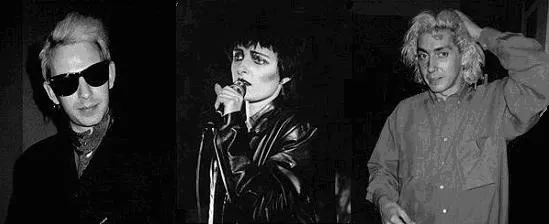
Photo by Andwhatsnext Mantaray100 , licensed under CC BY-SA 3.0 · Wikimedia Commons
Rank #108
Siouxsie and the Banshees
Trailblazing post-punks whose icy art-rock paved goth's path.
From Wikipedia
Siouxsie and the Banshees were a British rock band formed in London in 1976 by vocalist Siouxsie Sioux and bassist Steven Severin. They are considered one of the pioneering groups of post-punk. The Times called the group "one of the most audacious and uncompromising musical adventurers of the post-punk era".
Members
- Marco Pirroni (1976–1976)
- Sid Vicious (1976–1976)
- Budgie
- Peter Fenton (?–1977)
- Siouxsie Sioux
- Steven Severin
Studio Albums
- 1978 The Scream
- 1979 Join Hands
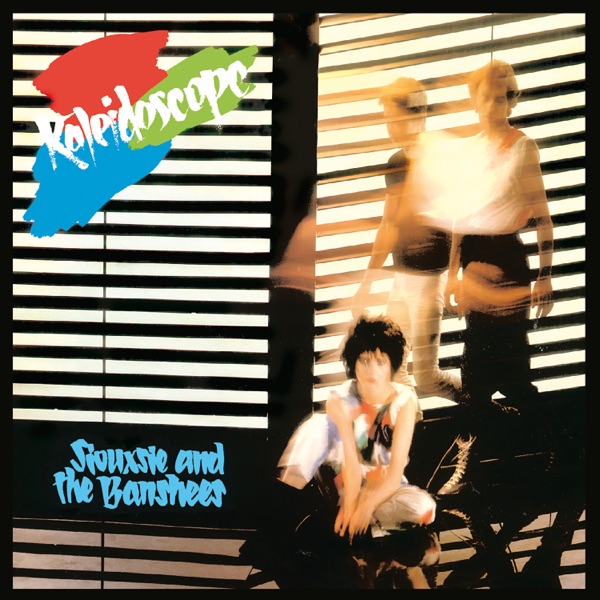
- 1980 Kaleidoscope
- 1981 Juju
- 1982 A Kiss in the Dreamhouse
- 1984 Hyæna
- 1986 Tinderbox
- 1987 Through the Looking Glass
- 1988 Peepshow
- 1991 Superstition
- 1995 The Rapture
Source: MusicBrainz
Deep Dive
Overview
Siouxsie and the Banshees emerged from London in 1976 as one of post-punk’s most audacious acts, forging a distinctly icy and theatrical sound that bridged post-punk’s angular intellectualism with the emerging aesthetics of gothic rock. Fronted by vocalist Siouxsie Sioux and bassist Steven Severin, the band sustained two decades of artistic ambition, moving through stylistic transformations while maintaining an uncompromising stance toward commercial convention. Their influence rippled across alternative rock, goth, and new wave, establishing visual and sonic templates that would be absorbed into mainstream alternative culture by the 1990s.
Formation Story
Siouxsie Sioux and Steven Severin formed the Banshees in London in 1976, initially enlisting punk guitarist Marco Pirroni and drummer Peter Fenton to complete the early lineup. The band’s genesis occurred at the intersection of the dying punk movement and the emerging post-punk underground—a moment when punk’s energy was fracturing into more experimental and art-school directions. The initial membership proved fluid; Pirroni and Fenton departed within the first year, leading to a reconfiguration that would see drummer Budgie join as a long-term member and anchor of the group’s rhythm section. This early instability paradoxically sharpened the band’s musical identity rather than undermining it.
Breakthrough Moment
Siouxsie and the Banshees’ debut album The Scream arrived in 1978, announcing the band as a fully formed creative force despite their short existence. The album’s dense, guitar-driven arrangements and Siouxsie’s distinctive vocal approach—brittle, commanding, and deeply atmospheric—signaled that the band occupied conceptual territory distinct from their punk forebears. This debut established the template for their sustained career: albums that rejected stylistic stasis, layering post-punk’s jagged guitars with increasingly elaborate production and arrangement. By the release of Join Hands in 1979, the band had cultivated a devoted following within the post-punk underground, though mainstream recognition remained distant.
Peak Era
The early 1980s marked the band’s creative and commercial apex. Kaleidoscope (1980) and Juju (1981) demonstrated the group’s capacity to deepen and refine their sound without abandoning the unsettling intelligence that defined their earliest work. A Kiss in the Dreamhouse (1982) extended this momentum, solidifying the Banshees as architects of post-punk’s most aesthetically sophisticated strain. Throughout this period, the band maintained fierce independence while working within the commercial infrastructure of major labels—a balancing act that allowed their vision to reach broader audiences without compromising the fundamental unease and formal ambition of their music. This three-album run positioned them as leaders of the post-punk movement at the precise moment when that movement was fragmenting into new wave, goth, and early alternative rock.
Musical Style
Siouxsie and the Banshees cultivated a sound rooted in post-punk’s dissonant guitar vocabulary but informed by a theatrical sensibility that owed as much to art-rock and cabaret as to punk’s primal energy. Siouxsie Sioux’s vocals—pitched between spoken word and sung melody, often abstract in their lyrical content—functioned as an instrument in themselves, capable of both icy reserve and visceral intensity. Steven Severin’s bass lines moved between melodic anchor and textural abstraction, while Budgie’s drumming combined post-punk’s percussive sparseness with an increasing complexity that allowed the band to explore jazz and world-music influences without diluting their core aesthetic. Across their career, the band’s production values evolved from the raw textures of The Scream toward the more layered and synthetic arrangements of their mid-1980s work, yet the fundamental tension between beauty and unease—between catchy melodies and dissonant instrumentation—remained their artistic core.
Major Albums
The Scream (1978)
The debut announced the band as a major creative force, its dense guitars and Siouxsie’s commanding vocals establishing the template for post-punk intelligence and theatrical menace that would define the band’s trajectory.
Juju (1981)
A masterwork of refined post-punk songwriting, Juju balanced compositional sophistication with visceral emotional impact, becoming the band’s most cohesive and influential statement of the early 1980s.
A Kiss in the Dreamhouse (1982)
This album represented the pinnacle of the band’s early creative period, expanding their sonic palette while maintaining the formal rigor and emotional complexity that set them apart from their contemporaries.
Hyæna (1984)
A turn toward darker, more experimental territory, Hyæna showcased the band’s willingness to evolve beyond the post-punk template they had helped establish, incorporating electronic textures and increasingly abstract songwriting.
Superstition (1991)
After a relative lull in the mid-to-late 1980s, Superstition marked a creative renewal, demonstrating that the band retained their capacity for sophisticated and unsettling art-rock composition.
Signature Songs
- Hong Kong Garden — A post-punk anthem driven by skittering guitars and Siouxsie’s detached vocal melody, exemplifying the band’s capacity to make unease feel hypnotic.
- Spellbound — A showcase for the band’s ability to merge gothic sensibility with dance-like rhythmic propulsion, becoming one of their most enduring compositions.
- Christine — Demonstrates the band’s gift for merging the personal and the theatrical, with Siouxsie’s vocals ranging across registers as the arrangement builds from relative restraint to full baroque intensity.
- Cities in Dust — A haunting meditation on historical loss and apocalypse, built on synthesizer textures that represented the band’s 1980s production philosophy.
Influence on Rock
Siouxsie and the Banshees’ influence extended across the many genres that coalesced from post-punk in the 1980s and beyond. Their aesthetic—icy, theatrical, formally ambitious—became foundational to gothic rock’s emergence as a distinct subgenre, with bands like The Cure, Bauhaus, and later acts absorbing lessons from the Banshees’ uncompromising stance toward songwriting and production. Their influence on alternative rock’s mainstream emergence in the 1990s proved equally significant; the art-rock sophistication and visual presentation that became hallmarks of 1990s alternative culture bore the imprint of the Banshees’ career trajectory. The band demonstrated that post-punk need not abandon melody or emotional accessibility to maintain artistic uncompromise, a lesson absorbed by generations of musicians working at the intersection of accessibility and formal experimentation.
Legacy
Siouxsie and the Banshees disbanded in 1996 after two decades at the forefront of alternative rock’s most intellectually ambitious regions. Their catalog has remained consistently available through reissue programs, and their influence over subsequent waves of goth, alternative, and art-rock music remains evident in the work of contemporary artists operating in those spaces. The band’s visual aesthetic—Siouxsie’s distinctive makeup and fashion choices—proved as influential as their sonic innovations, establishing templates for post-punk and goth presentation that persist across subcultures decades after the band’s initial emergence. The Times’ assessment of the group as “one of the most audacious and uncompromising musical adventurers of the post-punk era” remains the definitive characterization of their historical significance.
Fun Facts
- Sid Vicious of the Sex Pistols appeared on early Siouxsie and the Banshees recordings before his death in 1979, though his tenure with the group lasted only briefly in 1976.
- The band’s name was inspired by Siouxsie’s childhood fascination with Native American imagery, though the connection was largely aesthetic and evolved quickly into the band’s broader artistic concerns.
- Despite their post-punk origins, the band’s work across the 1980s incorporated influences from jazz, world music, and electronic production, demonstrating a restless creative appetite that resisted genre categorization.
Discography & Previews
Click any album to expand its track list. Each track plays a 30-second preview streamed from Apple Music. Tap the link icon next to a track to open it in Apple Music for full playback.


- 1 Happy House ↗ 3:52
- 2 Tenant ↗ 3:42
- 3 Trophy ↗ 3:18
- 4 Hybrid ↗ 5:32
- 5 Clockface ↗ 1:53
- 6 Lunar Camel ↗ 3:02
- 7 Christine ↗ 3:00
- 8 Desert Kisses ↗ 4:15
- 9 Red Light ↗ 3:22
- 10 Paradise Place ↗ 4:33
- 11 Skin ↗ 3:46
- 12 Christine (Demo Version) ↗ 1:59
- 13 Eve White Eve Black ↗ 1:57
- 14 Arabia - Lunar Camel ↗ 2:52
- 15 Sitting Room ↗ 1:22
- 16 Paradise Place (Demo Version) ↗ 2:27
- 17 Desert Kisses (Demo Version) ↗ 4:22
- 18 Hybrid (Demo Version) ↗ 5:42
- 19 Happy House (Demo Version) ↗ 5:25
- 20 Israel (7" Single Version) ↗ 5:00

- 1 Cascade ↗ 4:26
- 2 Green Fingers ↗ 3:33
- 3 Obsession ↗ 3:51
- 4 She's a Carnival ↗ 3:40
- 5 Circle ↗ 5:22
- 6 Melt! ↗ 3:48
- 7 Painted Bird ↗ 4:16
- 8 Cocoon ↗ 4:29
- 9 Slowdive ↗ 4:18
- 10 Fireworks (12" Version) ↗ 4:30
- 11 Slowdive (12" Version) ↗ 5:46
- 12 Painted Bird (Workhouse Demo) ↗ 3:44
- 13 Cascade (Workhouse Demo) ↗ 4:33

- 1 Candyman ↗ 3:44
- 2 Sweetest Chill ↗ 4:07
- 3 This Unrest ↗ 6:21
- 4 Cities In Dust ↗ 3:52
- 5 Cannons ↗ 3:14
- 6 Party's Fall ↗ 4:57
- 7 92 Degrees ↗ 6:03
- 8 Lands End ↗ 6:06
- 9 Cities In Dust (Extended Version) ↗ 6:49
- 10 Sweetest Chill (Chris Kimsey 12" Version) ↗ 5:55
- 11 Song from the Edge of the World (JVC Version) ↗ 4:00
- 12 Starcrossed Lovers ↗ 4:07

- 1 This Town Ain't Big Enough For Both of Us ↗ 3:10
- 2 Hall of Mirrors ↗ 5:02
- 3 Trust In Me ↗ 4:06
- 4 This Wheel's On Fire ↗ 5:16
- 5 Strange Fruit ↗ 3:51
- 6 You're Lost Little Girl ↗ 2:58
- 7 The Passenger ↗ 5:09
- 8 Gun ↗ 5:06
- 9 Sea Breezes ↗ 4:15
- 10 Little Johnny Jewel ↗ 5:07
- 11 She Cracked ↗ 3:07
- 12 Song From the Edge of the World ↗ 3:45
- 13 This Wheel's On Fire (Incendiary Mix) ↗ 7:27
- 14 The Passenger (Loco-Motion Mix) ↗ 8:05

- 1 Peek-A-Boo ↗ 3:13
- 2 The Killing Jar ↗ 4:05
- 3 Scarecrow ↗ 5:06
- 4 Carousel ↗ 4:26
- 5 Burn-Up ↗ 4:31
- 6 Ornaments of Gold ↗ 3:49
- 7 Turn To Stone ↗ 4:06
- 8 Rawhead and Bloody Bones ↗ 2:33
- 9 The Last Beat of My Heart ↗ 4:31
- 10 Rhapsody ↗ 6:33
- 11 El Dia de los Muertos (Espiritu Mix) ↗ 5:37
- 12 The Killing Jar (Lepidopteristic Mix / Remastered 2014) ↗ 8:06
- 13 The Last Beat of My Heart (Live) ↗ 5:33

- 1 Kiss Them For Me ↗ 4:38
- 2 Fear (Of the Unknown) ↗ 4:11
- 3 Cry ↗ 3:33
- 4 Drifter ↗ 4:44
- 5 Little Sister ↗ 3:21
- 6 Shadowtime ↗ 4:28
- 7 Silly Thing ↗ 4:42
- 8 Got To Get Up ↗ 3:17
- 9 Silver Waterfalls ↗ 4:24
- 10 Softly ↗ 6:00
- 11 The Ghost In You ↗ 5:13
- 12 Face To Face ↗ 4:26
- 13 Kiss Them For Me (feat. Talvin Singh) [Snapper Mix] ↗ 6:25
- 14 Kiss Them For Me (Kathak #1 Mix) ↗ 8:56