
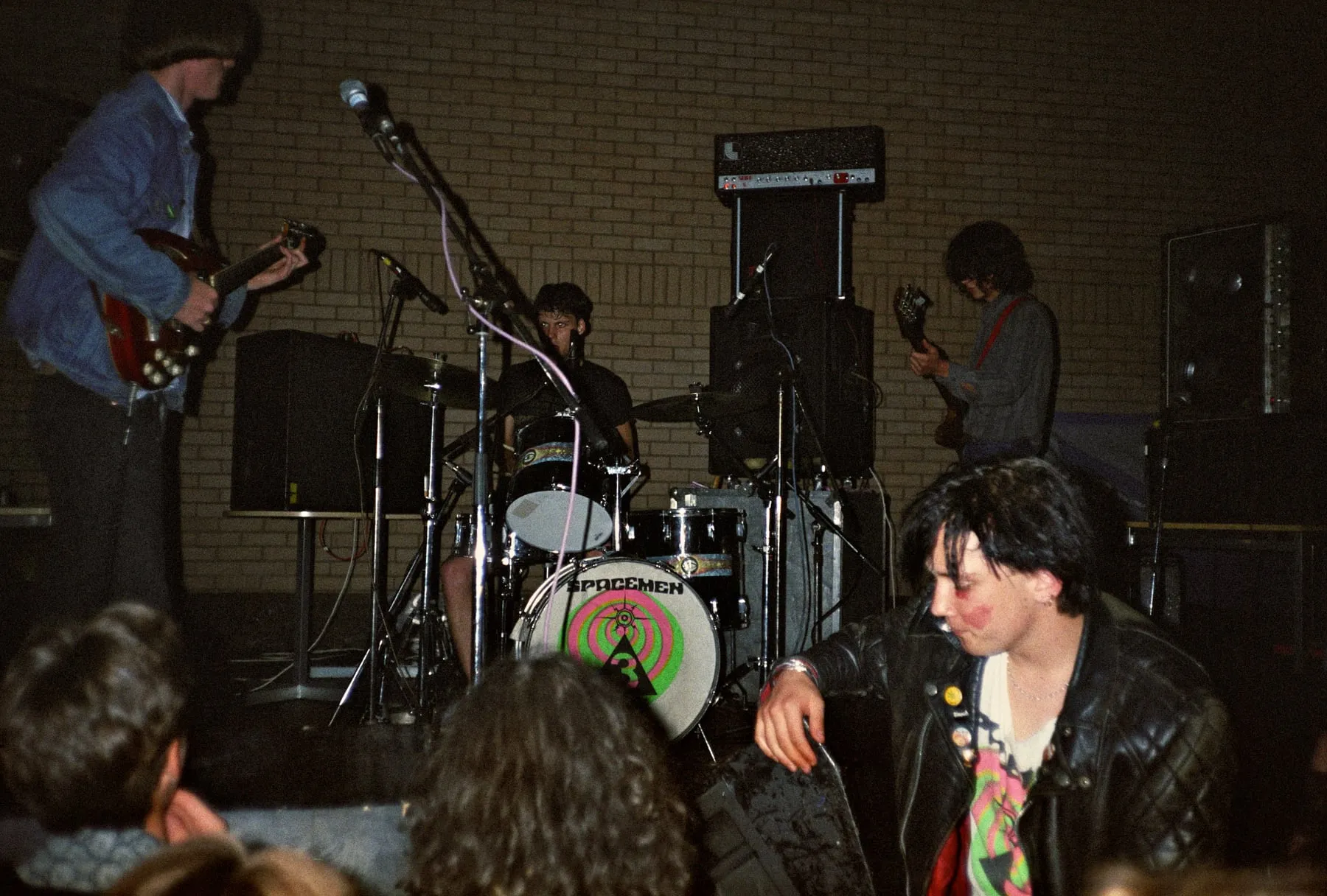
Photo by Greg Neate , licensed under CC BY 2.0 · Wikimedia Commons
Rank #461
Spacemen 3
Rugby drone-rock duo whose riff-and-repetition aesthetic shaped indie psych.
From Wikipedia
Spacemen 3 were an English rock band formed in 1982 in Rugby, Warwickshire, by Peter Kember and Jason Pierce, known respectively under their pseudonyms Sonic Boom and J Spaceman. Their music is known for its brand of "trance-like neo-psychedelia" consisting of heavily distorted guitar, synthesizers, and minimal chord or tempo changes.
Members
- Jason Pierce (1982–1990)
- Peter Kember (1982–1990)
- Will Carruthers (1988–1999)
- Pete Bain
Studio Albums
- 1986 Sound of Confusion
- 1987 The Perfect Prescription
- 1988 Playing With Fire
- 1990 Recurring
- 1990 Taking Drugs to Make Music to Take Drugs To
- 1991 Losing Touch With Your Mind
- 1995 For All the Fucked-Up Children of the World, We Give You Spacemen 3
- 2003 Forged Prescriptions
- — Recurring Demos
Source: MusicBrainz
Deep Dive
Overview
Spacemen 3 were an English rock band formed in 1982 in Rugby, Warwickshire, by Peter Kember (known as Sonic Boom) and Jason Pierce (known as J Spaceman). Over their initial nine-year run through 1990, they forged a distinctive aesthetic of heavily distorted guitar, synthesizers, and minimal chord or tempo changes—a sound they termed “trance-like neo-psychedelia.” Emerging from the industrial Midlands rather than London or Manchester, Spacemen 3 occupied a liminal space between psychedelic rock ancestry and the drone experimentalism that would influence shoegaze and indie psych for decades to come.
Formation Story
Spacemen 3 crystallized in Rugby in 1982 when Kember and Pierce began collaborating on a vision of rock music stripped down to hypnotic essentials. The band’s name itself signaled their ambitions: space-age psychedelia filtered through minimalist composition and trance induction rather than conventional verse-chorus structures. Their early lineup coalesced gradually, with the core partnership of Kember and Pierce remaining the constant creative force. By the latter half of the 1980s, Will Carruthers joined the ensemble (appearing from 1988 onward), solidifying a three-piece configuration that would define their most celebrated recordings. Rugby, far removed from the media infrastructure and established rock venues of larger cities, positioned them as outsiders even within the UK alternative rock ecosystem—a isolation that seemed to deepen their commitment to an uncompromising sonic vision.
Breakthrough Moment
Spacemen 3’s debut, Sound of Confusion (1986), introduced their drone-heavy aesthetic on a commercial platform via Glass Records. The album established the band’s core identity: propulsive, repetitive riffs layered with synthesizer drones and distorted guitars that prioritized texture over traditional melody. The Perfect Prescription arrived in 1987, expanding on that blueprint and earning them growing recognition within UK independent rock circles. By 1988, with Playing With Fire, Spacemen 3 had solidified a following among listeners seeking alternatives to both post-punk formalism and the stadium-rock orthodoxy of the mainstream. These three albums marked their transition from regional curiosity to a band with genuine influence across the emerging indie and experimental rock networks.
Peak Era
Spacemen 3’s most creatively intense and commercially visible period spanned 1988 to 1991, marked by the release of Playing With Fire (1988), Recurring (1990), Taking Drugs to Make Music to Take Drugs To (1990), and Losing Touch With Your Mind (1991). The final two albums arrived in rapid succession, suggesting a band at the height of prolific output. Taking Drugs to Make Music to Take Drugs To, in particular, crystallized their philosophy: a title that foregrounded the drug-altered listening experience, an album that doubled down on trance repetition and hallucinogenic texturing. By 1991, however, tensions within the partnership had become untenable, and Kember and Pierce dissolved the original lineup. The band briefly reunited in 1995 with For All the Fucked-Up Children of the World, We Give You Spacemen 3, but the creative and personal gulf had widened irreparably.
Musical Style
Spacemen 3’s sound rested on a foundation of hypnotic repetition and drone. Kember’s guitar work centered on heavily distorted, often single-note or two-note riffs that repeated with meditative insistence, accompanied by synthesizer washes that thickened the sonic field without necessarily adding harmonic complexity. Minimal chord changes and locked tempos—sometimes maintained across entire song lengths with near-mechanical precision—created a trance-inducing effect that aligned them with drone music and space rock traditions while departing sharply from the narrative song structures of mainstream rock. Pierce’s vocal delivery, when present, often functioned as another texture rather than a storytelling device. The band’s production favored saturation and haze: distortion not as occasional punctuation but as a foundational tonal character. This aesthetic—experimental rock at the intersection of psychedelia’s sensory assault and minimalism’s reductive focus—proved influential precisely because it suggested a direction rock could take that owed nothing to punk or new wave precedent.
Major Albums
Sound of Confusion (1986)
The debut announced Spacemen 3’s uncompromising commitment to drone and distortion, establishing the band as practitioners of psych-adjacent experimentalism rather than conventional alternative rock.
The Perfect Prescription (1987)
Expanding on their debut’s foundations, this album refined their trance-like methodology and earned them growing respect within independent rock communities for their unwavering aesthetic vision.
Playing With Fire (1988)
The third album consolidated their maturity as composers of hypnotic, texture-dense soundscapes and signaled their arrival as a significant force in UK experimental rock.
Taking Drugs to Make Music to Take Drugs To (1990)
A statement of purpose disguised as an album title, this record epitomized their peak creative confidence, weaving together their drone minimalism with a growing sense of psychedelic density.
Losing Touch With Your Mind (1991)
Their final studio work with the original lineup, marked by an almost valedictory intensity as the Kember-Pierce partnership approached dissolution.
Signature Songs
- “Walkin’ with Jesus” — An early signature piece that showcased the band’s ability to marry heavy distortion with an almost gospel-inflected emotional undercurrent.
- “Take Me to the Other Side” — A trance-rock excursion that exemplified their use of repetitive structure to generate meditative rather than aggressive impact.
- “Transparent Radiation (She Feeds Me Light)” — Demonstrated the band’s talent for combining minimal melodic content with synthesizer atmospherics to create hallucinogenic depth.
- “Catch the Breeze” — Among their most overtly psychedelic moments, featuring layered distortion and drone interplay that defined their late-period work.
Influence on Rock
Spacemen 3’s trance-rock and drone-minimalism aesthetic proved foundational for multiple post-1990 indie and alternative rock movements. Their emphasis on repetition, texture, and hypnotic immersion—rather than conventional songcraft—provided a template for shoegaze bands navigating walls of distortion and synthesizer, and they remained touchstones for neo-psychedelia and space rock revival movements well into the 2000s. The band demonstrated that rock music could be simultaneously experimental and immersive, that abstraction and listener experience need not conflict. Their work on experimental rock and drone music proved that independent labels and regional scenes outside London could produce aesthetically sophisticated output that influenced far larger cultural movements. Sonic Boom’s production philosophy and the band’s overall sonic architecture influenced a generation of producers and musicians working in psych, shoegaze, and experimental indie contexts.
Legacy
Spacemen 3 disbanded in 1991, but the shadow they cast lengthened as shoegaze and neo-psychedelia became increasingly central to alternative rock discourse in the 1990s and 2000s. A brief reunion in 1995 with For All the Fucked-Up Children of the World, We Give You Spacemen 3 offered a coda but did not reverse the original dissolution. The band’s catalog has aged remarkably well, with their uncompromising aesthetic now recognized as prescient rather than merely obscure. Subsequent reissues and archival releases, including Forged Prescriptions (2003), ensured their recordings remained accessible to new generations discovering drone and experimental rock. Their influence on contemporary psych and shoegaze artists remains substantial, and they retain a devoted following among listeners seeking psychedelic rock that prioritizes altered consciousness over commercial appeal. Rugby’s Spacemen 3 remains proof that geographic isolation and artistic stubbornness could produce work of lasting cultural weight.
Fun Facts
- Spacemen 3 recorded an album titled Recurring Demos, reflecting their interest in revisiting and refining instrumental ideas across multiple iterations.
- The band signed to both Glass Records and Fire Records during their initial run, spanning the mid-to-late 1980s and early 1990s.
- Will Carruthers’ tenure with the band extended beyond their original 1991 dissolution, appearing on releases through 1999 as the group explored reunion and archival projects.
- The provocative album title Taking Drugs to Make Music to Take Drugs To reflected the band’s willingness to foreground the psychedelic listening experience as central to their artistic intent rather than incidental context.
Discography & Previews
Click any album to expand its track list. Each track plays a 30-second preview streamed from Apple Music. Tap the link icon next to a track to open it in Apple Music for full playback.


- 1 Take Me to the Other Side ↗ 4:38
- 2 Walkin' with Jesus ↗ 5:10
- 3 Ode to Street Hassle ↗ 4:00
- 4 Ecstasy Symphony / Transparent Radiation (Flashback) ↗ 9:51
- 5 Feel so Good ↗ 5:32
- 6 Things'll Never Be the Same ↗ 6:04
- 7 Come Down Easy ↗ 6:49
- 8 Call the Doctor ↗ 3:50
- 9 Soul 1 ↗ 5:41
- 10 That's Just Fine ↗ 6:48

- 1 Honey ↗ 3:03
- 1 Honey (Demo) ↗ 3:25
- 2 Come Down Softly to My Soul ↗ 3:47
- 2 Let Me Down Gently (Drum Mix) ↗ 4:51
- 3 How Does It Feel ↗ 7:58
- 3 How Does It Feel? (Alternate Version) ↗ 8:25
- 4 I Believe It ↗ 3:20
- 4 Lord Can You Here Me? (Demo Vocal) ↗ 4:41
- 5 Revolution ↗ 5:57
- 5 I Believe It (Alternate Mix) ↗ 3:20
- 6 Let Me Down Gently ↗ 4:29
- 6 Ché (Maracas Mix) ↗ 4:38
- 7 So Hot (Wash Away All of My Tears) ↗ 2:38
- 7 Any Way That You Want Me (Demo) ↗ 3:21
- 8 Suicide ↗ 11:03
- 8 Girl on Fire (Demo) ↗ 2:06
- 9 Lord Can You Hear Me ↗ 4:34
- 10 Suicide (Live) ↗ 12:25
- 11 Repeater (How Does It Feel?) [Live] ↗ 5:32
- 12 Chè ↗ 4:31
- 13 May the Circle Be Unbroken ↗ 3:46
- 14 Suicide (Alternate Mix) ↗ 11:51

- 1 Big City (Everybody I Know Can Be Found Here) ↗ 10:51
- 2 Just to See You Smile (Orchestral Mix) ↗ 3:19
- 3 I Love You ↗ 5:32
- 4 Set Me Free / I've Got the Key ↗ 5:12
- 5 Set Me Free (Reprise) ↗ 1:51
- 6 Why Couldn't I See ↗ 6:37
- 7 Just to See You Smile (Instrumental) ↗ 3:20
- 8 When Tomorrow Hits ↗ 4:27
- 9 Feel so Sad (Reprise) ↗ 2:46
- 10 Hypnotized ↗ 5:57
- 11 Sometimes ↗ 6:36
- 12 Feelin' Just Fine (Head Full of Shit) ↗ 4:33
- 13 Billy Whizz / Blue 1 ↗ 7:34
- 14 Drive / Feel so Sad ↗ 5:35
- 15 Feelin' Just Fine (Alternative Mix) ↗ 4:31

- 1 The Sound of Confusion ↗ 5:55
- 2 2.35 (Version 1) ↗ 3:52
- 3 Losing Touch with My Mind ↗ 5:17
- 4 Amen ↗ 4:55
- 5 That's Just Fine (Vocal Version) ↗ 7:36
- 6 Come Down Easy ↗ 6:59
- 7 Mary Anne ↗ 4:19
- 8 Feel so Good ↗ 5:05
- 9 2.35 (Feedback Version) ↗ 3:51
- 10 Hey Man ↗ 4:50
- 11 It's Allright ↗ 7:42
- 12 2.35 (Version 2) ↗ 3:40
- 13 Things'll Never Be the Same ↗ 6:10
- 14 Transparent Radiation (Organ Version) ↗ 4:13

- 1 Things'll Never Be the Same ↗ 5:54
- 1 Transparent Radiation ↗ 7:53
- 2 Walking with Jesus ↗ 5:13
- 2 Come Down Easy ↗ 6:43
- 3 Come Down Easy (Demo Version) ↗ 6:03
- 3 Walking with Jesus (Demo Version) ↗ 3:57
- 4 Transparent Radiation (Single Version) ↗ 4:12
- 4 Things'll Never Be the Same (Demo Version) ↗ 5:54
- 5 Ode to Street Hassle ↗ 4:46
- 5 We Sell Soul ↗ 4:55
- 6 Call the Doctor ↗ 4:12
- 6 Starship (Demo Version) ↗ 5:01
- 7 Ecstacy Symphony ↗ 9:06
- 7 Take Me to the Other Side (Demo Version) ↗ 3:49
- 8 Feel so Good ↗ 5:27
- 8 Velvet Jam ↗ 4:46
- 9 Soul 1 ↗ 5:42
- 9 I Want You Right Now ↗ 6:09