
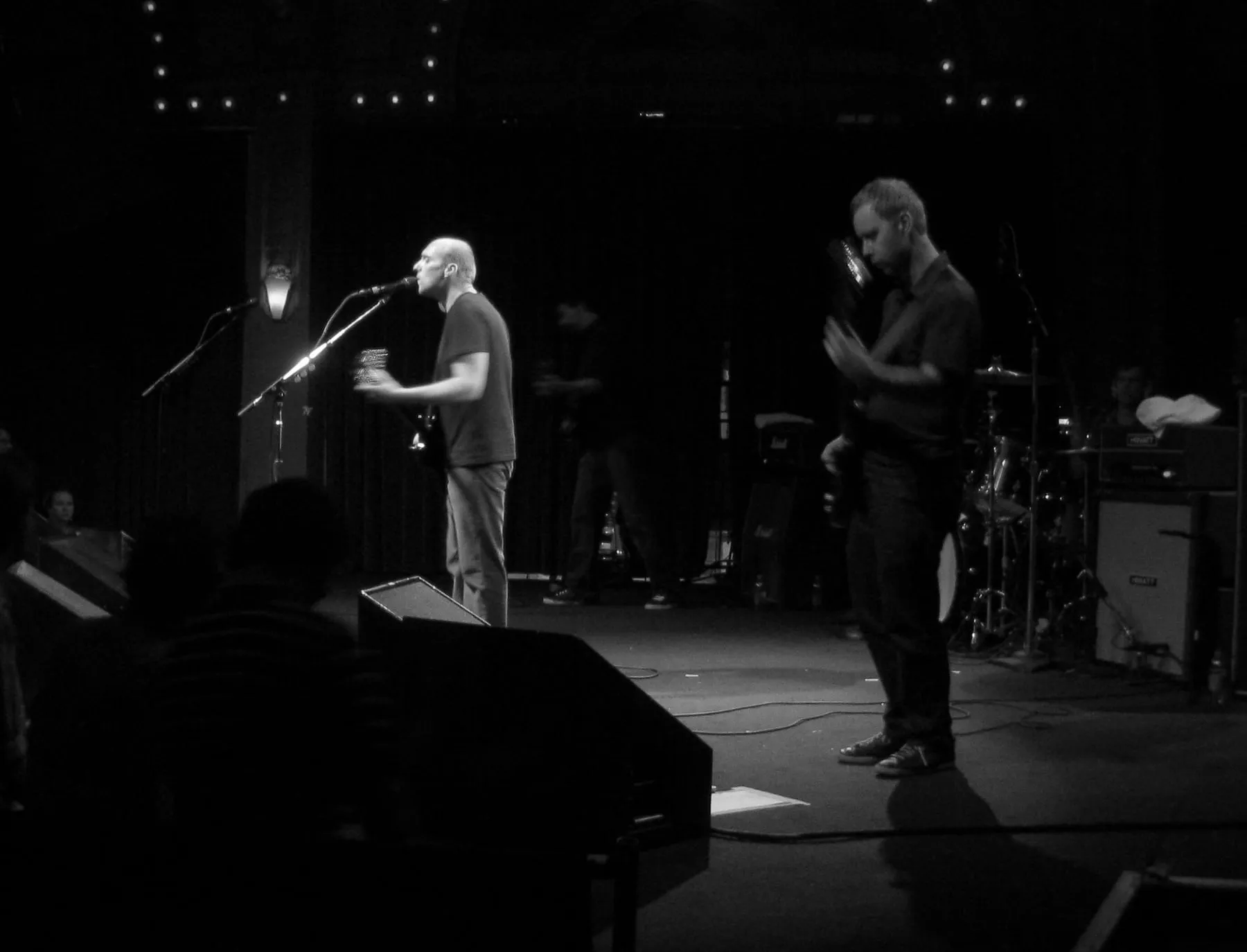
Photo by Incase Designs , licensed under CC BY 2.0 · Wikimedia Commons
Rank #491
Sunny Day Real Estate
Seattle emo originators whose 'Diary' shaped second-wave emo.
From Wikipedia
Sunny Day Real Estate is an American rock band from Seattle, Washington, formed in 1992. The band currently consists of founding members Jeremy Enigk, Dan Hoerner (guitar) and William Goldsmith (drums), alongside Greg Suran (guitar), who originally played with the band between 2000 and 2001, and Chris Jordan (bass), who joined the band in 2022. Founding bass guitarist Nate Mendel was a member of the band during three of its four incarnations.
Members
- Jeremy Enigk
Studio Albums
- 1994 Diary
- 1995 LP2
- 1998 How It Feels to Be Something On
- 2000 The Rising Tide
Source: MusicBrainz
Deep Dive
Overview
Sunny Day Real Estate is an American rock band from Seattle, Washington, formed in 1992. Emerging from the Pacific Northwest during the grunge era, they became foundational architects of emo in its second-wave form, proving that emotionally direct, introspective rock could achieve both critical and popular resonance. Their 1994 debut, Diary, stands as one of the defining emo records of the decade, establishing a template for how post-hardcore instrumentation could serve deeply personal lyricism.
Formation Story
Sunny Day Real Estate coalesced in Seattle in 1992, a moment when the city’s rock identity was already crystallizing around grunge’s heavy, blues-rooted sound. The band’s core lineup consisted of Jeremy Enigk, Dan Hoerner on guitar, William Goldsmith on drums, and Nate Mendel on bass—musicians working in the margins of a scene dominated by flannel and distortion. Rather than chase the heaviness that had made Seattle internationally visible, they carved a distinct path: intricate guitar interplay, dynamic range, and emotionally naked vocal delivery became their signature. The combination of post-hardcore’s technical restlessness with confessional songwriting proved immediately distinctive within their regional context.
Breakthrough Moment
Sunny Day Real Estate’s breakthrough arrived with their 1994 debut Diary, released on Sub Pop. The album became the band’s definitive statement and a touchstone for emo as a movement. Diary demonstrated that rock music could be simultaneously guitar-driven and emotionally vulnerable, combining intricate instrumental passages with Jeremy Enigk’s anguished, soaring vocals. The record’s success positioned the band not merely as Seattle locals but as architects of an emerging alternative to grunge’s dominance, one rooted in melody and emotional clarity rather than sonic weight.
Peak Era
The mid-to-late 1990s constituted Sunny Day Real Estate’s creative zenith. Following Diary with their 1995 release LP2, the band proved they could sustain their vision across multiple records. Their third studio album, How It Feels to Be Something On (1998), showed a band refining rather than retreating from their established sound—tighter songwriting, more assured production, and continued growth as arrangers. The 2000 release The Rising Tide further developed their textural approach. Across these albums, they maintained a steady presence within underground and college rock circles, building a devoted audience that extended beyond Seattle.
Musical Style
Sunny Day Real Estate’s sound emerged from the intersection of post-hardcore and indie rock, distinguished by its emphasis on dynamics and emotional transparency. Dan Hoerner’s guitar work featured both angular, interlocking passages and sweeping melodic lines, often deployed in call-and-response patterns with Enigk’s vocal melody. William Goldsmith’s drumming moved between restrained, pocket-conscious playing and explosive fills, serving the emotional arc of songs rather than dominating the mix. Jeremy Enigk’s voice—capable of both fragile vulnerability and powerful projection—became the emotional center; his lyrics dwelt on loss, confusion, and the search for meaning with a directness that influenced countless emo and alternative rock singers to follow. The band’s influence traced through post-punk and math rock, but their primary contribution was demonstrating how those genres’ technical vocabulary could enhance rather than obscure emotional content.
Major Albums
Diary (1994)
The band’s debut and emo’s breakthrough statement, Diary balanced intricate instrumentation with intimate songwriting, establishing the template for second-wave emo that would dominate the late 1990s and 2000s.
LP2 (1995)
A direct follow-up demonstrating the band’s consistency, LP2 solidified their sound and proved Diary was not a one-off achievement but the foundation of a sustained artistic vision.
How It Feels to Be Something On (1998)
Refined and expansive, this third album showcased the band’s growth as arrangers and producers, deepening the textural sophistication that had emerged on earlier records.
The Rising Tide (2000)
The band’s fourth studio album continued their evolution, further cementing their role as Seattle’s primary emo architects during a decade when the genre was accelerating toward mainstream visibility.
Signature Songs
- “Seven” — A Diary standout featuring cascading guitar lines and Enigk’s most vulnerable vocal delivery.
- “In Circles” — Demonstrates the band’s mastery of dynamic range, building from whispered verses to anthemic choruses.
- “Phony” — A Diary highlight capturing the band’s gift for melodic hooks layered atop post-hardcore complexity.
- “How It Feels” — Title track from their 1998 album, exemplifying their continued refinement of emotional emo songwriting.
Influence on Rock
Sunny Day Real Estate’s influence on rock music, particularly on emo’s development, proved fundamental and lasting. By proving that post-hardcore’s technical apparatus could serve emotionally direct songs, they provided a crucial bridge between the underground and the alternative mainstream. Their emphasis on lyrical vulnerability and melodic clarity directly influenced the wave of emo bands that emerged in the 2000s—musicians who cited Diary as a foundational text. Beyond emo proper, their approach to arrangement and emotional transparency influenced indie rock and alternative rock more broadly, demonstrating that introspection and technical ambition need not be in tension.
Legacy
Sunny Day Real Estate’s status as Seattle’s primary emo originators remains secure decades after their formation. The band has remained active through multiple incarnations, with the current lineup consisting of founding members Jeremy Enigk, Dan Hoerner, and William Goldsmith, alongside Greg Suran (who originally played with the band from 2000 to 2001) and Chris Jordan (bass, who joined in 2022). Their albums remain touchstones for emo musicians and listeners, with Diary in particular continuing to shape how new generations understand the genre’s possibilities. The band’s reunion and ongoing activity speaks to both their enduring creative partnership and the persistent cultural interest in 1990s emo and post-hardcore.
Fun Facts
- Nate Mendel, the band’s founding bassist, was part of the band during three of its four incarnations, demonstrating remarkable longevity within the group’s rotating membership.
- The band maintained their official website at sunnydayrealestate.fm, a notably specific domain extension that reflected their commitment to direct fan engagement before streaming platforms dominated music discovery.
- Seattle’s grunge dominance meant Sunny Day Real Estate initially operated in the shadow of heavier bands, allowing them to develop their distinctive emo sound with relative creative freedom from mainstream expectations.
Discography & Previews
Click any album to expand its track list. Each track plays a 30-second preview streamed from Apple Music. Tap the link icon next to a track to open it in Apple Music for full playback.

- 1 Seven (2009 Remastered Version) ↗ 4:46
- 2 In Circles (2009 Remastered Version) ↗ 4:58
- 3 Song About an Angel (2009 Remastered Version) ↗ 6:15
- 4 Round (2009 Remastered Version) ↗ 4:09
- 5 47 (2009 Remastered Version) ↗ 4:34
- 6 The Blankets Were the Stairs (2009 Remastered Version) ↗ 5:28
- 7 Pheurton Skeurto (2009 Remastered Version) ↗ 2:33
- 8 Shadows (2009 Remastered Version) ↗ 4:46
- 9 48 (2009 Remastered Version) ↗ 4:45
- 10 Grendel (2009 Remastered Version) ↗ 4:53
- 11 Sometimes (2009 Remastered Version) ↗ 5:47
- 12 8 (2009 Remastered Version) [Bonus Track] ↗ 5:15
- 13 9 (2009 Remastered Version) [Bonus Track] ↗ 6:03


