
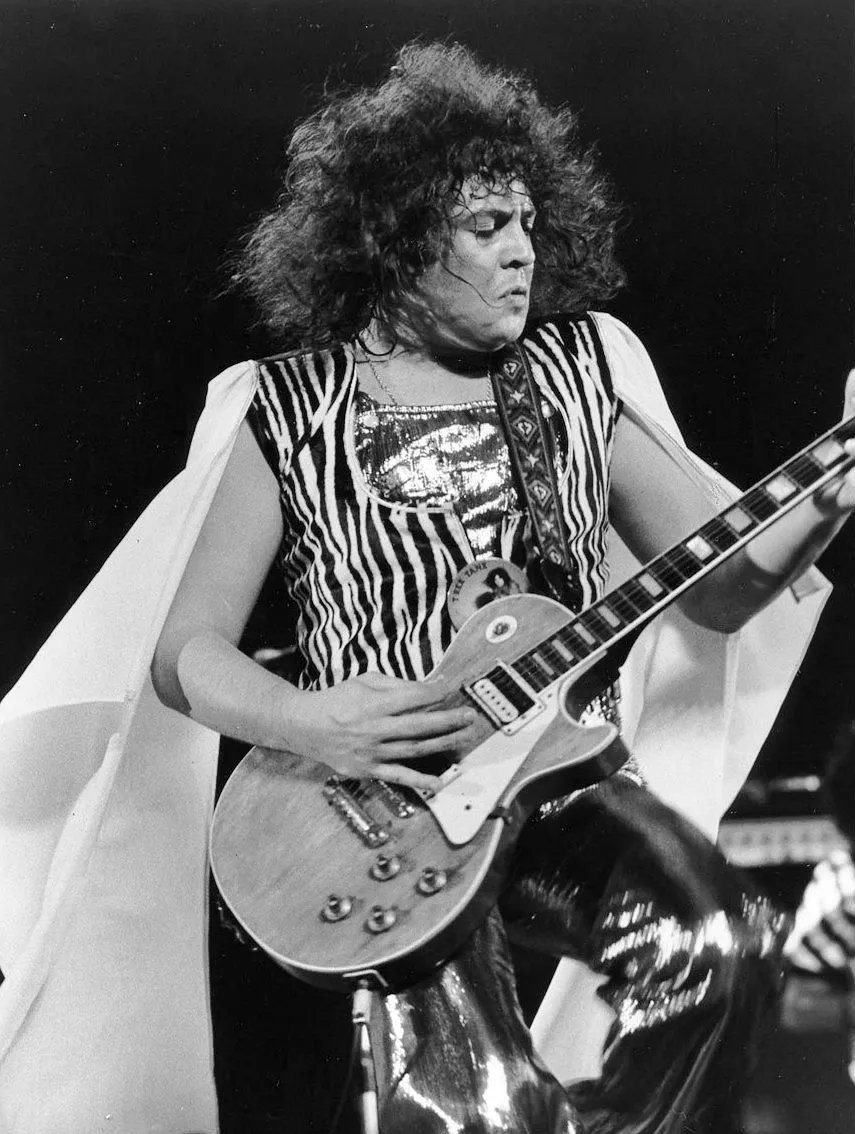
Photo by ABC Television , licensed under Public domain · Wikimedia Commons
Rank #231
T. Rex
Marc Bolan's glam-rock band who turned boogie riffs into chart gold.
From Wikipedia
T. Rex, originally Tyrannosaurus Rex, were an English rock band formed in London in 1967 by singer-songwriter and guitarist Marc Bolan, who was their leader, frontman and only consistent member. Originally an acoustic psychedelic folk band, Bolan began to change the band's style towards electric rock with their fourth album, 1970's A Beard of Stars, and shortened their name to T. Rex by the time their self-titled fifth album was released later that same year. This development culminated with their first significant hit single "Ride a White Swan", and the group soon became pioneers of the glam rock movement.
Members
- Jack Green
- Marc Bolan
Deep Dive
Overview
T. Rex were an English rock band formed in London in 1967, originally under the name Tyrannosaurus Rex. Led by singer-songwriter and guitarist Marc Bolan, the band underwent a decisive artistic transformation in the early 1970s, shifting from acoustic psychedelic folk toward electric rock and emerging as one of the defining acts of the glam rock movement. Their ability to channel boogie-inflected guitar riffs into accessible, chart-dominating singles made them a commercial force during the 1970s, and their visual aesthetic—glitter, androgyny, and theatrical presentation—became inseparable from the glam rock brand.
Formation Story
Marc Bolan assembled T. Rex in London in 1967 as an acoustic project, one of the few consistent threads in a music landscape increasingly dominated by electric amplification and psychedelic experimentation. The band’s earliest albums—My People Were Fair and Had Sky in Their Hair… But Now They’re Content to Wear Stars on Their Brows and Prophets, Seers & Sages: The Angels of the Ages, both released in 1968, and Unicorn in 1969—positioned them firmly within the acoustic folk-rock and psychedelic canon. Bolan remained the creative and commercial anchor throughout the band’s existence, serving as its only truly consistent member, a distinction that underscored the essentially mercurial nature of the project.
Breakthrough Moment
The turning point arrived with the fourth album, A Beard of Stars (1970), where Bolan began steering the band away from their folk roots toward electric instrumentation and more rhythmically propulsive arrangements. This stylistic recalibration accelerated with the self-titled T. Rex (1970), released after the band had officially shortened their name from Tyrannosaurus Rex. The single “Ride a White Swan,” lifted from this album, became their first significant hit and marked the moment when Bolan’s glam-rock vision reached mainstream audiences. The song’s strutting confidence and glittering mystique announced a new era not just for the band but for rock music’s presentation and commercial strategy.
Peak Era
T. Rex’s most creatively fertile and commercially dominant period spanned from 1971 to 1973. Electric Warrior (1971) and The Slider (1972) represent the apex of their catalog, both albums achieving substantial chart success and spawning multiple singles that dominated British radio. During these years, Bolan cultivated an image as firmly rooted in visual spectacle and androgynous glamour as in musical substance, helping establish glam rock’s cultural vocabulary. The subsequent albums—Tanx (1973), Zinc Alloy and the Hidden Riders of Tomorrow (1974), and Bolan’s Zip Gun (1975)—maintained commercial output and continued to chart, though the band’s cultural moment had begun to shift by the mid-1970s. Futuristic Dragon (1976) and Dandy in the Underworld (1977) closed out the band’s original run as punk and new wave were displacing glam rock’s dominance.
Musical Style
T. Rex’s sound evolved from fingerpicked acoustic folk-rock into electric boogie built around distorted, percussive guitar riffs and strutting, often androgynous vocal delivery. Bolan’s guitar style emphasized rhythmic chording and percussive attack rather than extended soloing; his riffs functioned almost as percussion instruments, driving forward with relentless momentum. The production across their early-1970s albums favored clarity and directness—drums, bass, and guitar were sharply defined, with minimal reverb or psychedelic processing, allowing the boogie grooves to land with immediate force. Lyrically, Bolan drew on mythology, fantasy, and cosmic imagery, creating a lyrical landscape that complemented glam rock’s theatrical presentation. His vocal performance ranged from conversational to soaring, often colored by echo and double-tracking, lending an otherworldly quality that matched the visual spectacle. The band’s reliance on Bolan’s songwriting and charisma meant that arrangements and instrumentation could shift album to album without losing a core identity.
Major Albums
Electric Warrior (1971)
T. Rex’s masterpiece and the album that crystallized their glam-rock identity. Electric Warrior fuses boogie-rock rhythms with lyrical grandeur and polished production, establishing the template that would define their commercial peak and influence countless glam and hard-rock acts.
The Slider (1972)
A follow-up that sustained the commercial and creative momentum of Electric Warrior, The Slider deepened Bolan’s exploration of rhythm-driven rock underpinned by mythological and fantastical lyrical content.
A Beard of Stars (1970)
The album that initiated T. Rex’s transformation from folk-rock purveyors to electric rock architects. A Beard of Stars captures the band in transition, marking the point at which Bolan began electrifying the project.
T. Rex (1970)
Released shortly after A Beard of Stars, this self-titled album announced the band’s new identity with the breakthrough single “Ride a White Swan,” signaling Bolan’s creative direction and introducing T. Rex to a mass audience.
Tanx (1973)
The third successive album to achieve chart success, Tanx maintained the glam-rock formula while the cultural moment that had elevated glam-rock to its peak was beginning to shift.
Signature Songs
- “Ride a White Swan” (1970) — The breakthrough single that introduced T. Rex to mainstream audiences and launched the glam-rock era into commercial orbit.
- “Bang a Gong (Get It On)” (1971) — Electric Warrior’s defining moment, a strutting, hook-laden rocker that became one of glam rock’s most enduring songs.
- “Jeepster” (1971) — A mid-tempo glam-rock number showcasing Bolan’s ability to construct radio-friendly rock songs without sacrificing theatrical presentation.
- “20th Century Boy” (1973) — A confident, chest-thumping anthem from Tanx that captured Bolan’s persona as a cosmically aware rock frontman.
Influence on Rock
T. Rex and Marc Bolan fundamentally reshaped how rock bands conceived of presentation, image, and commercial strategy. By combining accessible, rhythm-driven rock with visual spectacle and androgynous aesthetics, Bolan legitimized glam rock as a serious commercial and artistic force. The band’s influence cascaded through hard rock, heavy metal, and punk; acts from David Bowie to Mott the Hoople to Gary Glitter built upon the template that T. Rex had established. The equation of rock authenticity with visual reinvention—the idea that a rock star’s image was as central to their artistic statement as the music itself—traces directly through T. Rex. Their success demonstrated that mainstream rock audiences would embrace the theatrical and the androgynous, paving the way for artists who otherwise might have faced commercial resistance.
Legacy
T. Rex disbanded in 1977, their commercial moment having passed as punk and new wave supplanted glam rock’s dominance. Marc Bolan’s death in 1977 closed the chapter decisively, though retrospective reissues and anthologies have kept the band’s music in circulation. Their 1970–1973 catalog remains the foundation of glam-rock history, with Electric Warrior and The Slider regarded as essential documents of 1970s rock. Bolan’s influence endured through the 1980s and beyond, with his visual presentation and songwriting approach affecting new-wave and alternative-rock artists who drew from glam rock’s legacy. Streaming platforms and reissue campaigns have ensured that new generations can access T. Rex’s work, cementing their position as architects of glam rock and transitional figures between 1960s psychedelia and 1970s hard rock.
Fun Facts
- Marc Bolan was T. Rex’s only consistent member throughout the band’s entire 1967–1977 run, making the band almost a solo project in personnel terms despite the band-name designation.
- The band’s earliest albums, recorded under the Tyrannosaurus Rex name, were released in 1968, before the widespread adoption of electric rock instrumentation across the industry.
- “Ride a White Swan” arrived in late 1970, at a cultural moment when glam rock itself was still coalescing, making the single’s success an early signal of the movement’s commercial potential.