
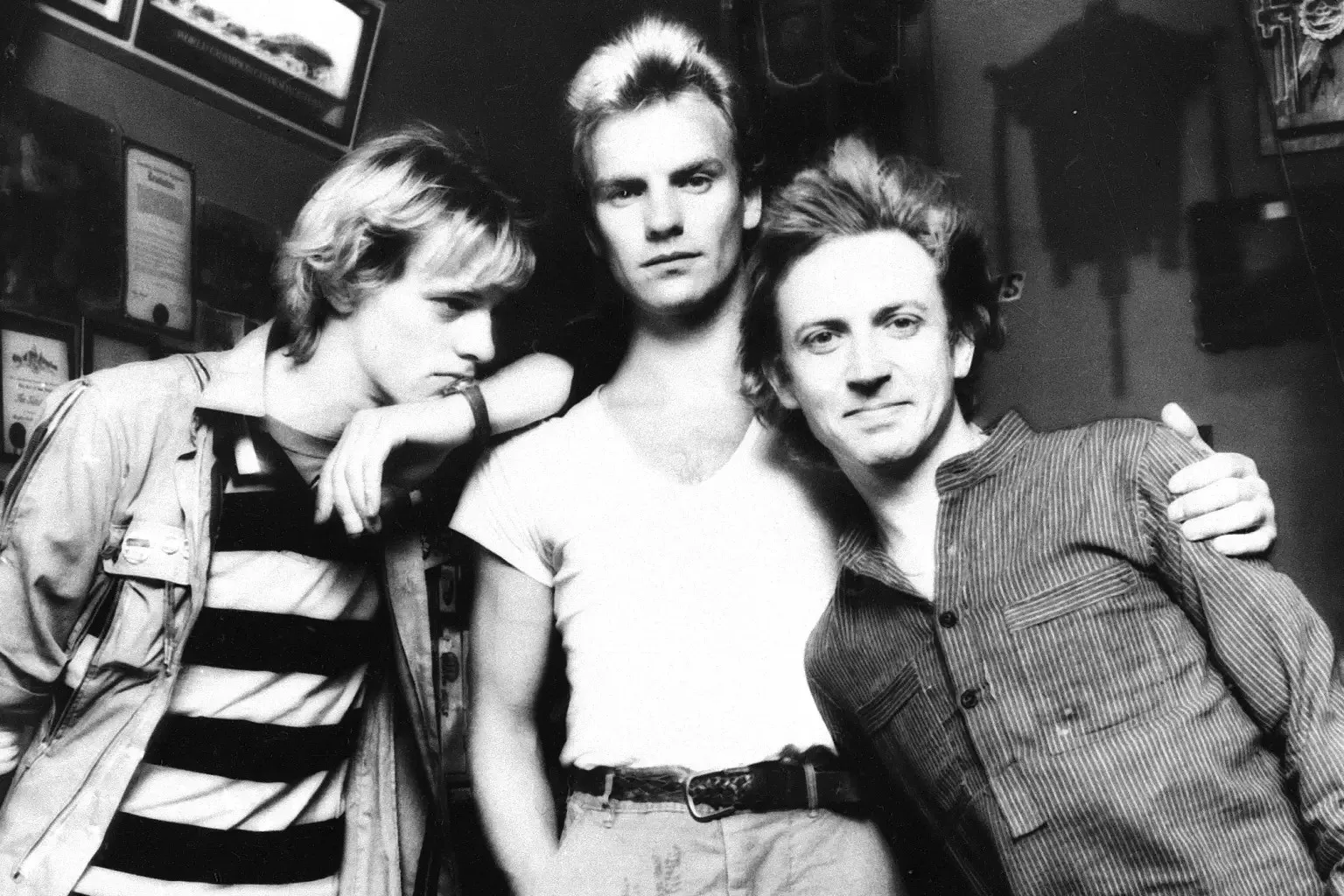
Photo by Distributed by A&M Records , licensed under Public domain · Wikimedia Commons
Rank #101
The Police
Reggae-tinged New Wave trio whose tight songwriting topped charts globally.
From Wikipedia
The Police were an English rock band formed in London in 1977. Their core line-up comprised Sting, Andy Summers (guitar) and Stewart Copeland. The Police became globally popular from the late 1970s to the mid-1980s. Emerging in the British new wave scene, they played a style of rock influenced by punk, reggae, and jazz.
Members
- Andy Summers (1977–present)
- Henry Padovani (?–1977)
- Stewart Copeland
- Sting
Studio Albums
- 1978 Outlandos d’Amour
- 1979 Reggatta de Blanc
- 1980 Zenyattà Mondatta
- 1981 Ghost in the Machine
- 1983 Synchronicity
Source: MusicBrainz
Deep Dive
Overview
The Police were an English rock band formed in London in 1977 that became one of the defining acts of the 1980s. Comprising Sting, Andy Summers, and Stewart Copeland, they emerged from the British new wave scene but carved out a distinctive sonic identity by blending punk energy with reggae rhythms, jazz harmonics, and pop sensibility. Over a nine-year span, they evolved from post-punk newcomers into one of the world’s biggest rock acts, their tight three-piece arrangements and inventive songwriting earning them global chart dominance and lasting influence across multiple genres.
Formation Story
The Police coalesced in London in 1977, recruiting Andy Summers as guitarist alongside the rhythm section of Stewart Copeland on drums and Sting on bass and vocals. Henry Padovani departed early, leaving the trio that would define the band’s sound and era. The three musicians brought complementary sensibilities: Summers arrived with experience in diverse rock and art contexts, Copeland brought jazz-inflected rhythmic sophistication to the drum chair, and Sting—the band’s primary songwriter and frontman—supplied melodic acuity and lyrical intelligence. This lean lineup meant that each member bore significant responsibility for shaping arrangements and production; there was no room for passengers.
Breakthrough Moment
The Police’s debut album Outlandos d’Amour (1978) introduced their core sound to the world—sparse, reggae-influenced, and laced with post-punk tension. The album’s success, particularly in the United Kingdom, established them as more than a passing new wave novelty. They consolidated this breakthrough with Reggatta de Blanc (1979), which deepened their exploration of reggae-tinged rhythms and showcased their growing commercial reach. By the early 1980s, a combination of tight touring, innovative music videos, and radio-friendly songwriting positioned them for unprecedented commercial ascent.
Peak Era
The Police reached their creative and commercial zenith between 1980 and 1983. Zenyattà Mondatta (1980) and Ghost in the Machine (1981) found the band refining their formula—still rooted in reggae and new wave but increasingly sophisticated in production and arrangement. The release of Synchronicity in 1983 marked their apotheosis. This album became a global phenomenon, dominating charts worldwide and selling in vast quantities. During this period, the Police were simultaneously a critically respected art-rock band and an unambiguous pop juggernaut, a feat achieved through meticulous production, distinctive sonic signatures, and Sting’s ability to craft songs that balanced emotional depth with immediate melodic impact. Their combination of musicianship and pop accessibility made them virtually inescapable in the early-to-mid 1980s.
Musical Style
The Police’s signature sound rested on the interplay between reggae’s offbeat rhythmic sensibility and new wave’s angular attack. Summers’ guitar playing was economical and textural rather than flashy—he favored sparse fills, delayed effects, and countermelodic lines that wove around Copeland’s intricate, jazz-informed drumming. Copeland’s rhythmic vocabulary, drawn partly from jazz and partly from reggae’s syncopation, proved central to their appeal; his drumming was active and present without overwhelming the sparse arrangements. Sting’s bass lines were melodically sophisticated, often functioning as quasi-lead instruments rather than purely rhythmic anchors. The band’s reggae influence stemmed not from traditional Caribbean production but from a reframing of reggae’s rhythmic principles through a new wave lens—their reggae was filtered, abstracted, and married to pop structure. As they progressed through the early 1980s, orchestral and synthesizer elements entered their production palette, but the three-piece’s core identity remained intact: tight, clever, and built on restraint rather than excess.
Major Albums
Outlandos d’Amour (1978)
The Police’s debut announced their distinctive approach: reggae-influenced new wave with jazz touches and art-rock sensibilities, establishing the template they would refine throughout the decade.
Reggatta de Blanc (1979)
Their second album deepened the reggae experimentation and demonstrated the band’s growing songwriting sophistication, cementing their position within the UK new wave scene.
Zenyattà Mondatta (1980)
Released as punk’s initial wave was cresting, this album showed the Police expanding their sonic palette while maintaining their signature sparseness and reggae-derived rhythmic sensibility.
Ghost in the Machine (1981)
Their most overtly experimental work, incorporating synthesizers and conceptual frameworks while preserving their fundamental three-piece aesthetic and tight songwriting.
Synchronicity (1983)
A global blockbuster that synthesized all prior developments into the band’s most polished and commercially dominant statement, cementing their status as one of the decade’s premier rock acts.
Signature Songs
- “Message in a Bottle” — A propulsive new wave-reggae hybrid that became one of their most recognizable compositions, built on Summers’ ringing guitar figure and Copeland’s syncopated drumming.
- “Walking on the Moon” — A spaced-out, reggae-inflected track that showcased the band’s ability to pair pop hooks with experimental production choices.
- “Every Little Thing She Does Is Magic” — A melodically direct pop song that demonstrated Sting’s gift for crafting emotionally resonant, radio-friendly material.
- “Roxanne” — An early track that combined angular new wave guitar work with reggae undertones and Sting’s distinctive vocal delivery.
- “Every Breath You Take” — A sophisticated pop song that achieved global ubiquity and showcased the band’s mature songwriting at its commercial peak.
Influence on Rock
The Police proved that new wave and reggae were not mutually exclusive, fundamentally altering how these genres could intersect. Their success validated the commercial viability of intellectually rigorous, jazz-informed rock music built on restraint and sophistication rather than volume or spectacle. They demonstrated that a three-piece could generate sonically expansive arrangements through meticulous production and arrangement, influencing countless bands in subsequent decades to prioritize songwriting and musicianship over personnel expansion. Their radio dominance in the early 1980s showed that post-punk sensibility and chart success were compatible—a lesson that reshaped rock music’s trajectory through the decade. Bands drawing on reggae and new wave influences, from The Cure to later post-punk revival acts, inherited a template of how these styles could coexist productively.
Legacy
The Police disbanded in 1986, their original run concluding at peak commercial saturation. Their studio albums, particularly Synchronicity, remain staples of 1980s rock and continue to stream widely across all major platforms. The band’s influence extends across genre boundaries—their reggae-derived rhythmic concepts, minimalist production philosophy, and sophisticated songwriting remain touchstones in discussions of 1980s rock and pop. While they have not announced a permanent reformation since their dissolution, the sustained cultural presence of their catalog and the ongoing discovery of their music by new audiences underscore their position as one of the decade’s most consequential acts. Their commercial ascent and artistic coherence over their nine-year original span solidified their place among rock’s most successful and influential groups.
Fun Facts
- The Police signed to Illegal Records, an independent label, before securing a major-label deal with A&M Records, a path that allowed them creative autonomy during their crucial early years.
- Stewart Copeland’s drumming was influenced by jazz and other genres beyond punk and new wave, giving the band a rhythmic sophistication uncommon in contemporary new wave acts.
- The band’s sparse three-piece arrangement meant that each member bore responsibility for textural and harmonic complexity, requiring exceptional musicianship from all three members.
Discography & Previews
Click any album to expand its track list. Each track plays a 30-second preview streamed from Apple Music. Tap the link icon next to a track to open it in Apple Music for full playback.

- 1 Next To You (Remastered 2003) ↗ 2:52
- 2 So Lonely (Remastered 2003) ↗ 4:50
- 3 Roxanne (Remastered 2003) ↗ 3:14
- 4 Hole In My Life (Remastered 2003) ↗ 4:50
- 5 Peanuts (Remastered 2003) ↗ 3:55
- 6 Can't Stand Losing You (Remastered 2003) ↗ 3:00
- 7 Truth Hits Everybody (Remastered 2003) ↗ 2:55
- 8 Born In The 50's (Remastered 2003) ↗ 3:45
- 9 Be My Girl - Sally (Remastered 2003) ↗ 3:24
- 10 Masoko Tanga (Remastered 2003) ↗ 5:42

- 1 Message In A Bottle (Remastered 2003) ↗ 4:51
- 2 Reggatta De Blanc (Remastered 2003) ↗ 3:06
- 3 It's Alright For You (Remastered 2003) ↗ 3:14
- 4 Bring On The Night (Remastered 2003) ↗ 4:16
- 5 Deathwish (Remastered 2003) ↗ 4:14
- 6 Walking On The Moon (Remastered 2003) ↗ 5:02
- 7 On Any Other Day (Remastered 2003) ↗ 2:58
- 8 The Bed's Too Big Without You (Remastered 2003) ↗ 4:26
- 9 Contact (Remastered 2003) ↗ 2:39
- 10 Does Everyone Stare (Remastered 2003) ↗ 3:52
- 11 No Time This Time (Remastered 2003) ↗ 3:17

- 1 Don't Stand So Close to Me (Remastered 2003) ↗ 4:04
- 2 Driven to Tears (Remastered 2003) ↗ 3:21
- 3 When the World Is Running Down, You Make the Best of What's Still Around (Remastered 2003) ↗ 3:38
- 4 Canary in a Coalmine (Remastered 2003) ↗ 2:27
- 5 Voices Inside My Head (Remastered 2003) ↗ 3:53
- 6 Bombs Away (Remastered 2003) ↗ 3:10
- 7 De Do Do Do, De Da Da Da (Remastered 2003) ↗ 4:10
- 8 Behind My Camel (Remastered 2003) ↗ 2:55
- 9 Man in a Suitcase (Remastered 2003) ↗ 2:20
- 10 Shadows in the Rain (Remastered 2003) ↗ 5:03
- 11 The Other Way of Stopping (Remastered 2003) ↗ 3:22

- 1 Spirits in the Material World (Remastered 2003) ↗ 2:59
- 2 Every Little Thing She Does Is Magic (Remastered 2003) ↗ 4:21
- 3 Invisible Sun (Remastered 2003) ↗ 3:44
- 4 Hungry for You (Remastered 2003) ↗ 2:53
- 5 Demolition Man (Remastered 2003) ↗ 5:57
- 6 Too Much Information (Remastered 2003) ↗ 3:43
- 7 Re-Humanise Yourself (Remastered 2003) ↗ 3:10
- 8 One World (Not Three) [Remastered 2003] ↗ 4:47
- 9 Omegaman (Remastered 2003) ↗ 2:48
- 10 Secret Journey (Remastered 2003) ↗ 3:34
- 11 Darkness (Remastered 2003) ↗ 3:12
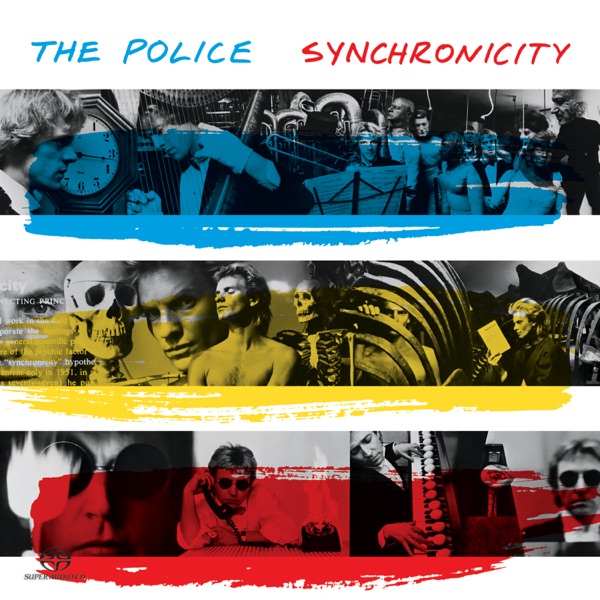
- 1 Synchronicity I (Remastered 2003) ↗ 3:23
- 2 Walking In Your Footsteps (Remastered 2003) ↗ 3:37
- 3 O My God (Remastered 2003) ↗ 4:02
- 4 Mother (Remastered 2003) ↗ 3:06
- 5 Miss Gradenko (Remastered 2003) ↗ 2:00
- 6 Synchronicity II (Remastered 2003) ↗ 5:02
- 7 Every Breath You Take (Remastered 2003) ↗ 4:14
- 8 King Of Pain (Remastered 2003) ↗ 4:59
- 9 Wrapped Around Your Finger (Remastered 2003) ↗ 5:14
- 10 Tea In The Sahara (Remastered 2003) ↗ 4:19
- 11 Murder By Numbers (Remastered 2003) ↗ 4:36