
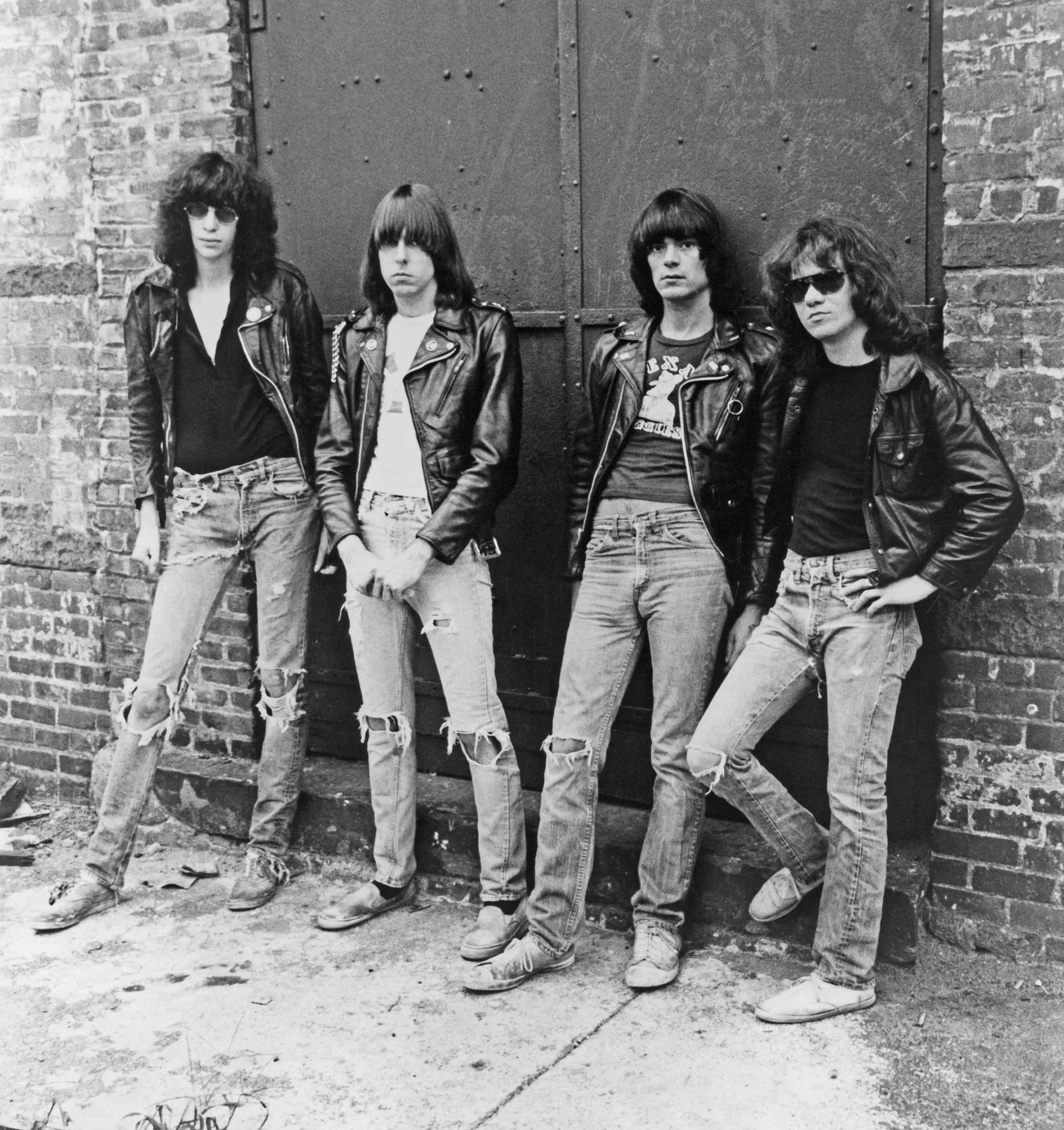
Photo by Danny Fields , licensed under Public domain · Wikimedia Commons
Rank #19
The Ramones
Queens four-piece who invented the blueprint for fast, simple punk.
From Wikipedia
The Ramones were an American punk rock band formed in the New York City neighborhood Forest Hills, Queens in 1974. Known for helping establish the punk movement in the United States and elsewhere, the Ramones are often recognized as one of the first bands of the genre. Although they never achieved significant commercial success during their existence, the band is seen today as highly influential in punk culture.
Members
- Dee Dee Ramone · bass guitar (1974–1989)
- Joey Ramone · voice (1974–1996)
- Johnny Ramone · guitar (1974–1996)
- Tommy Ramone · drum kit (1974–1978)
- Marky Ramone · drum kit (1978–1983)
- Richie Ramone · drum kit (1983–1987)
- C. J. Ramone · bass guitar (1989–1996)
Studio Albums
- 1976 Ramones
- 1977 Leave Home
- 1977 Rocket to Russia
- 1978 Road to Ruin
- 1980 End of the Century
- 1981 Pleasant Dreams
- 1983 Subterranean Jungle
- 1984 Too Tough to Die
- 1986 Animal Boy
- 1987 Halfway to Sanity
- 1989 Brain Drain
- 1992 Mondo Bizarro
- 1993 Acid Eaters
- 1995 ¡Adios Amigos!
Source: MusicBrainz
Deep Dive
Overview
The Ramones were an American punk rock band formed in Forest Hills, Queens in 1974. Over their twenty-two-year span, they became the foundational blueprint for punk rock itself—a four-piece machine built on short, loud, simple songs played with unrelenting energy. Though they never achieved platinum sales or stadium dominance during their existence, their influence on punk culture and rock music at large is uncontested. They stand as one of the first true punk bands, and their legacy has only grown since their 1996 dissolution.
Formation Story
The Ramones emerged from Forest Hills, a working-class neighborhood in Queens, in 1974. The original and longest-enduring core of the band consisted of Joey Ramone (vocals), Johnny Ramone (guitar), Dee Dee Ramone (bass guitar), and Tommy Ramone (drums). All members adopted the surname Ramone, a common stage practice in punk that flattened hierarchy and created a sense of gang-like solidarity. This first lineup, stable from 1974 onward, would establish the musical foundation that defined the band. Tommy Ramone remained on drums until 1978, when Marky Ramone took over the kit and held the position through 1983.
Breakthrough Moment
The Ramones’ path to recognition was gradual and rooted in live performance rather than radio hits. They built their reputation through relentless gigging in New York City clubs, establishing themselves as a raw and magnetic live act. Their very existence as a working punk band—fast, loud, and cheap to book—helped publicize the punk movement across the United States and internationally. While they did not experience the kind of commercial breakthrough that would dominate Billboard charts, their presence in punk’s formative years made them central figures in the genre’s identity and spread. Their recorded output served to codify punk’s simplicity and energy for audiences and musicians alike.
Peak Era
The period from the mid-1970s through the early 1980s represented the Ramones’ most creatively vital and culturally resonant time. During this span, the band established itself as a global reference point for punk rock, touring extensively and releasing records that became foundational texts for the genre. The core lineup—with Johnny Ramone, Joey Ramone, and Dee Dee Ramone joined first by Marky Ramone (1978–1983) and later by Richie Ramone (1983–1987)—delivered the most consistent and influential version of the band’s sound. This era solidified their status not as a commercial force but as the architects of punk’s DNA.
Musical Style
The Ramones’ sound was deliberately stripped-down and direct. Johnny Ramone played sharp, unfussy guitar riffs that eschewed the technical complexity of 1970s rock; his style was all economy and punch. Dee Dee Ramone’s bass lines were thick and simple, locking into the beat rather than wandering into jazz-fusion territory. The drumming—whether Tommy’s or the subsequent drummers—kept time with mechanical precision, creating a propulsive, unchanging pulse. Joey Ramone’s vocals sat high and nasal, often shouted or sung with a delivery that prioritized emotional directness over vocal polish. The formula was fast (songs typically lasted two to three minutes), loud, and repetitive—three chords, one melody, maximum impact. This approach rejected the prog-rock grandeur and the singer-songwriter introspection that dominated 1970s rock radio. Lyrically, the Ramones drew on B-movies, street culture, teenage alienation, and simple, hooky choruses. The band’s pop-punk designation reflects their ability to embed punk’s raw energy within song structures that, beneath the noise, followed recognizable pop templates.
Major Albums
The Ramones (1976)
The band’s debut, released in 1976, established the sonic blueprint that would define punk rock. Its fourteen tracks were short, loud, and immediate—a statement of intent that proved punk rock could be a legitimate studio practice, not just a live phenomenon.
Rocket to Russia (1977)
Following their debut with speed and confidence, this second album solidified the band’s knack for catchy melodies within the punk framework, demonstrating that simplicity and hook-laden songwriting were compatible.
Leave Home (1977)
Released the same year as Rocket to Russia, this record continued the band’s output schedule and further refined their signature style, establishing them as prolific and committed to the punk cause.
Road to Ruin (1978)
This album marked a shift toward slightly more polished production while maintaining the band’s core energy and speed, proving they could evolve within their idiom without abandoning their foundation.
Signature Songs
- Blitzkrieg Bop — An anthemic statement of punk defiance and teenage camaraderie, featuring one of rock’s most memorable gang choruses.
- I Wanna Be Sedated — A three-minute burst of disaffected apathy and hooks, capturing the band’s ability to embed pop sensibility within punk’s constraints.
- Sheena Is a Punk Rocker — A cover-adjacent original that married punk energy to a girl-group melodic structure, showcasing their pop-punk duality.
- Rockaway Beach — A surf-influenced celebration of New York’s beach scene reframed through punk’s aggressive lens.
Influence on Rock
The Ramones’ influence on punk rock is so foundational that it is nearly invisible through familiarity. They codified the four-piece guitar-bass-drums-vocals lineup as punk’s standard. They proved that punk rock could be a studio art form, not merely a live practice. Every punk and post-punk band that followed—from the Sex Pistols’ international impact to the countless garage-rock revivals of the 1990s onward—worked within the template the Ramones established: short songs, loud guitars, emotional directness, and the rejection of technical virtuosity as a prerequisite for rock credibility. They influenced not only punk’s first wave but subsequent waves, from hardcore to grunge. Their approach to songwriting—the idea that a great rock song could be built on two or three chords and a memorable hook—became so dominant that it reshaped how rock musicians thought about composition itself.
Legacy
The Ramones dissolved in 1996, ending a run that had lasted longer than many punk bands but which, by the standards of classic rock acts, was relatively brief. Their commercial trajectory during their active years never matched their cultural importance. Yet in the decades since, their status has only ascended. They are recognized as pioneers in punk rock history, and their records remain in steady rotation on streaming services and college radio alike. The band’s lack of commercial success during their lifetime has, paradoxically, enhanced their credibility as “authentic” punk artists—they were not sell-outs chasing hits, but musicians who stuck to their vision. Dee Dee Ramone (who left the band in 1989, replaced by C.J. Ramone from 1989 to 1996) pursued a solo career after the band’s end. The surviving members have occasionally reunited for performances, and the Ramones’ catalog remains the baseline reference for understanding punk rock as a movement and a sound. Their influence is audible across generations of rock, pop-punk, and alternative music.
Fun Facts
- All four members adopted the surname “Ramone” as a stage name, a practice that created a sense of collective identity and equality within the band, regardless of individual contribution.
- The Ramones recorded dozens of albums over their twenty-two-year career, maintaining a prolific output that kept them visible in the punk and underground rock marketplace throughout the 1970s, 1980s, and 1990s.
- Dee Dee Ramone’s departure in 1989 marked a significant lineup change, with C.J. Ramone taking over bass duties for the band’s final seven years and maintaining the classic quartet format.
- The band recorded across multiple record labels including Sire, Chrysalis, and Beggars Banquet, reflecting their movement through the music industry and their status as a band valued by multiple independent and major-label operations.