
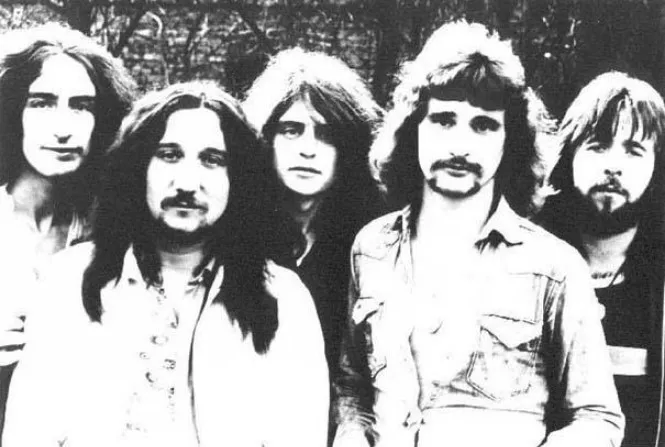
Photo by Mercury Records , licensed under Public domain · Wikimedia Commons
Rank #236
Uriah Heep
London hard-rock veterans of fantasy lyrics and classical-inflected riffs.
From Wikipedia
Uriah Heep are an English rock band formed in London in 1969. Their current lineup consists of guitarist Mick Box, keyboardist Phil Lanzon, lead vocalist Bernie Shaw, drummer Russell Gilbrook, and bassist Dave Rimmer. They have experienced numerous lineup changes throughout their 57-year career, leaving Box as the only remaining original member. Former members of the band are vocalists David Byron, John Lawton, John Sloman and Peter Goalby; bassists Paul Newton, Mark Clarke, Gary Thain, John Wetton, Trevor Bolder and Bob Daisley; drummers Alex Napier, Nigel Olsson, Keith Baker, Iain Clark, Lee Kerslake and Chris Slade; and keyboardists Ken Hensley, Gregg Dechert and John Sinclair.
Members
- Mick Box (1969–present)
- Bernie Shaw (1986–present)
- Davey Rimmer (2013–present)
- David Byron (?–1976)
- Lee Kerslake (?–2007)
Deep Dive
Overview
Uriah Heep are an English rock band formed in London in 1969, and they remain active into the present day. Operating at the intersection of hard rock and progressive rock, the band built their reputation on a sound characterized by fantasy-inflected lyrics, classical-tinged keyboard arrangements, and heavy guitar riffs. Over a career spanning more than five decades, Uriah Heep established themselves as steady practitioners of a particular strain of 1970s hard rock—one that embraced orchestral ambition without abandoning the raw power of amplified rock instrumentation.
Formation Story
Uriah Heep coalesced in London in 1969, emerging from the late-1960s British rock ferment. The band was built around guitarist Mick Box, who would remain the sole continuous thread through all of the group’s numerous lineup shifts. The early ensemble drew together musicians from various London scenes, establishing themselves quickly enough to enter the studio and begin recording within a year of their formation. The founding lineup’s chemistry, though it would not prove durable, set the template for the band’s musical direction: a fusion of hard-rock urgency with the kind of keyboard-driven, classically-influenced arrangements that were beginning to define progressive rock in that era.
Breakthrough Moment
Uriah Heep’s debut album, …Very ‘eavy …Very ‘umble, arrived in 1970 and signaled the arrival of a substantial new force in British hard rock. The record established the band’s core sonic identity and generated enough attention to sustain a touring schedule and press coverage throughout Europe and beyond. Over the next three years, the band released a stream of albums—Salisbury and Look at Yourself in 1971, Demons and Wizards and The Magician’s Birthday in 1972, and Sweet Freedom in 1973—that consolidated their reputation and expanded their audience. By the mid-1970s, Uriah Heep had transcended their initial cult following to become a fixture on the international rock circuit, with a dedicated fanbase particularly strong in continental Europe and Japan.
Peak Era
The period from 1972 to 1976 represents Uriah Heep’s most creatively vital and commercially successful window. Albums like Demons and Wizards and The Magician’s Birthday showcased the band at their most ambitious, with David Byron’s soaring, operatic vocals anchoring sprawling arrangements built on Ken Hensley’s keyboards and Mick Box’s heavily distorted guitar work. Return to Fantasy (1975) and High and Mighty (1976) continued in this vein, proving that the formula retained its commercial appeal even as progressive rock began to yield cultural ground to punk and new wave. The band’s touring schedule remained relentless, and their live performances—which emphasized the classical and fantasy elements of their material—drew large crowds in Europe especially, where hard rock remained a dominant force throughout the decade.
Musical Style
Uriah Heep’s signature sound rested on a particular combination of elements. Mick Box’s guitar work, often heavily distorted and powered by a thick rhythm section, provided the hard-rock foundation, but the band’s defining characteristic was the marriage of that heaviness to keyboards (principally handled by Ken Hensley in the classic lineup) that drew on classical music—baroque counterpoint, symphonic sweeps, organ textures that recalled both rock and concert-hall traditions. Over this instrumental scaffolding, lead vocalists—most prominently David Byron through the mid-1970s—delivered lyrics that embraced fantasy, mythology, and mystical imagery with an earnestness that matched the music’s grandeur. The band’s arrangements grew more elaborate as the 1970s progressed, with layered keyboards and additional orchestral instruments expanding the scope of their records. Lyrically, Uriah Heep’s songwriting consistently drew on sources outside the everyday rock-and-roll canon: medieval legend, fantasy literature, and cosmic or spiritual themes.
Major Albums
Demons and Wizards (1972)
A landmark statement that showcased the band’s ability to construct extended, classically-influenced arrangements without sacrificing hard-rock power. The record confirmed Uriah Heep as major players in the progressive hard-rock space and remains one of their most frequently referenced works.
The Magician’s Birthday (1972)
Released the same year as Demons and Wizards, this album extended the band’s exploration of keyboard-driven arrangements and fantasy-themed songwriting, with particularly elaborate production and orchestration that set it apart even within Uriah Heep’s discography.
Return to Fantasy (1975)
Representing the mid-1970s peak of the band’s international success, this album balanced the symphonic and hard-rock elements that defined their sound while maintaining strong commercial hooks and memorable melodies.
High and Mighty (1976)
The final album to feature David Byron, documenting a band still in command of its creative vision and commercial position, even as the broader rock landscape began to shift beneath their feet.
Abominog (1982)
Released after a period of relative quietude, Abominog announced Uriah Heep’s return to recording with a renewed focus on harder rock textures and a revamped lineup, marking a transitional moment in the band’s long career.
Signature Songs
- “Easy Livin’” — A hard-rock anthem built on a memorable riff and sing-along chorus, crystallizing the band’s ability to pair accessibility with musical ambition.
- “Sweet Freedom” — Showcasing the band’s knack for weaving classical keyboard passages into a rock song structure.
- “The Wizard” — A fantasy-themed narrative that exemplified Uriah Heep’s willingness to embrace mythology and imaginative storytelling as lyrical material.
- “Gypsy” — Demonstrating the band’s skill at constructing extended arrangements with multiple keyboard movements and vocal layers.
Influence on Rock
Uriah Heep’s sustained output over five decades positioned them as influential architects of a particular strain of hard rock that never abandoned the pretensions of progressive music. They helped establish the template for European hard rock in the 1970s, particularly in continental Europe, where the band maintained a stronger commercial foothold than in the United States or United Kingdom. Their willingness to incorporate classical elements, fantasy lyrics, and extended arrangements into a fundamentally hard-rock frame influenced subsequent generations of metal and rock musicians who sought to combine technical ambition with visceral power. The band’s longevity itself became a form of influence: their survival through multiple lineup changes, genre shifts, and commercial fluctuations demonstrated that a band could sustain a career on the strength of a consistent musical identity and devoted international fanbase, even when broader trends moved elsewhere.
Legacy
Uriah Heep remain active, with a touring schedule that continues to draw audiences decades after their commercial peak. The band’s catalog has benefited from the endless archival impulses of streaming platforms and reissue labels, making their 1970s material available to successive generations of rock listeners. Though they never achieved the canonical status in rock historiography accorded to their British hard-rock and progressive-rock peers, Uriah Heep have maintained a place in the broader ecosystem of rock music as reliable custodians of a particular sound—one that balanced hard-rock physicality with classical ambition and fantasy-tinged lyricism. Mick Box’s continued presence as the band’s sole original member and guiding force has allowed Uriah Heep to preserve a connection to their founding vision while remaining responsive to contemporary touring realities and audience expectations. Their persistent touring and recent albums demonstrate that their core audience, particularly in Europe, remains engaged with the band’s work.
Fun Facts
- Mick Box is the sole remaining member from the band’s 1969 formation, having stewarded the group through dozens of lineup changes across more than 50 years.
- The band’s name derives from the Charles Dickens character Uriah Heep from David Copperfield, reflecting the literary and fantastical orientations that shaped their aesthetic.
- Uriah Heep’s European fanbase, particularly in Scandinavia, Germany, and Eastern Europe, has historically been far larger and more devoted than their following in the Anglo-American rock mainstream.