
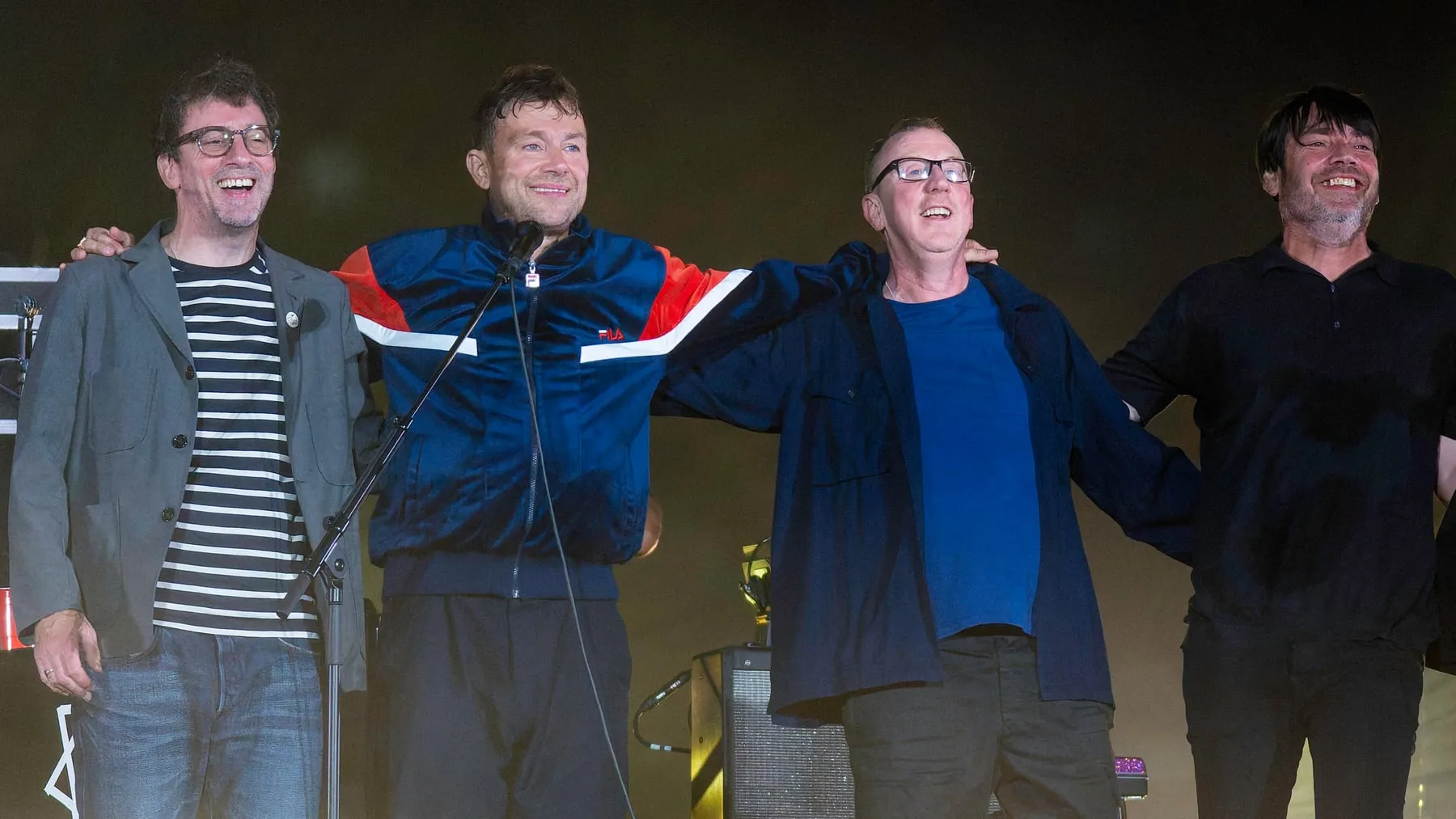
Photo by Raph_PH , licensed under CC BY 2.0 · Wikimedia Commons
Rank #36
Blur
Britpop chameleons whose restless reinventions outlasted the era.
From Wikipedia
Blur are an English rock band formed in London in 1988, consisting of singer Damon Albarn, guitarist Graham Coxon, bassist Alex James, and drummer Dave Rowntree. Their debut album, Leisure (1991), incorporated the sounds of Madchester and shoegaze. Following a stylistic change influenced by British guitar pop groups such as the Kinks, the Beatles, and XTC, Blur released the albums Modern Life Is Rubbish (1993), Parklife (1994), and The Great Escape (1995). Parklife lead single "Girls & Boys" became a hit in the UK and the US, respectively peaking at number 5 on the UK singles chart and number 59 on the Billboard Hot 100. As a result, the band helped to popularise the Britpop genre and achieved mass popularity in the UK, aided by a widely publicised chart battle with rival band Oasis in 1995 dubbed "the Battle of Britpop".
Members
- Alex James
- Damon Albarn
- Dave Rowntree
- Graham Coxon
Deep Dive
Overview
Blur are an English rock band formed in London in 1988, anchoring the Britpop movement of the 1990s while simultaneously resisting categorization within it. The band—Damon Albarn (vocals), Graham Coxon (guitar), Alex James (bass), and Dave Rowntree (drums)—became the public face of a distinctly British reaction against the grunge and alternative rock dominance of American radio, yet their most enduring trait was their refusal to stay in any single musical lane. From shoegaze-inflected debut to art-pop experiments to digitally processed alternative rock, Blur treated genre as something to inhabit, master, and promptly abandon rather than defend. Their chart rivalry with Oasis during the mid-1990s crystallized a generational divide in British rock, but Blur’s long catalogue suggests they had interests that extended far beyond the pageantry of that battle.
Formation Story
Blur coalesced in London during the late 1980s, a period when British guitar music was fragmenting into numerous subgenres and the American grunge explosion was reshaping international rock hierarchy. The four-piece drew from the post-punk and new-wave lineage embedded in London’s musical DNA—groups like the Kinks, the Beatles, and XTC would later inform their songwriting—but their initial sound absorbed the psychedelic undertow of Madchester and the ethereal textures of shoegaze that dominated UK indie circles. By the time they entered the studio for their debut, Blur occupied a transitional moment: old enough to reference British Invasion pop idioms, young enough to absorb contemporary underground aesthetics.
Breakthrough Moment
Blur’s commercial and critical arrival crystallized around the release of Parklife in 1994, an album that arrived as both artistic statement and cultural phenomenon. The album’s lead single, “Girls & Boys,” became the template for their mainstream success: catchy, concisely structured, and suffused with a lyrical wit that invoked everyday British life rather than angst or introspection. The song reached number 5 on the UK singles chart and penetrated the American market, peaking at number 59 on the Billboard Hot 100—a significant achievement for a British rock act in an era still skeptical of post-grunge alternative rock. Parklife itself cemented Blur as the vanguard of Britpop, a movement that had been gestating within independent record shops and music press coverage but lacked a unified commercial breakthrough. The album’s success, amplified by the band’s visual presentation and Albarn’s charisma, positioned Blur as the principal architects of a distinctly British popular rock sound.
Peak Era
The band’s most successful period spanned 1993 to 1995, encompassing Modern Life Is Rubbish, Parklife, and The Great Escape. During these three years, Blur shifted from introspective indie guitar work toward a more direct, pop-influenced songwriting approach, drawing explicitly from 1960s British Invasion templates and music-hall traditions. The shift was partly aesthetic and partly commercial—following the relative underperformance of Leisure (1991), the band recognized that their strongest instincts lay in melody and concise pop structure rather than wall-of-sound textures. The 1995 chart battle with Oasis—dubbed “the Battle of Britpop” and extensively documented across music press and tabloid coverage—elevated both bands into the realm of cultural phenomenon, though Blur’s ability to occupy mainstream and critical spaces simultaneously gave them a breadth that proved more durable than Oasis’s rockist positioning. By The Great Escape (1995), Blur had moved beyond novelty or movement status into genuine household-name territory within the UK, though American chart penetration remained modest compared to their domestic dominance.
Musical Style
Blur’s sonic identity evolved dramatically across their first three studio albums, a trajectory that reflected both artistic restlessness and a conscious reaction against genre orthodoxy. Leisure employed the dreamy, effects-laden guitar textures characteristic of Madchester and shoegaze, with Albarn’s vocals buried beneath layers of production and reverb. Modern Life Is Rubbish and Parklife represented a wholesale stylistic pivot: the guitars became more articulate and jaggedly rhythmic, the bass lines more melodic and prominent, and Albarn’s vocals moved to the foreground with crisp, often conversational delivery. The band’s songwriting began invoking the conciseness and hook-oriented structures of the Beatles and the Kinks, trades that suggested a deliberate engagement with pop tradition rather than post-punk abstraction. Coxon’s guitar work became less textural and more narrative, functioning as a second melodic voice rather than an atmospheric element. By the time of their self-titled 1997 album Blur, the band had begun fragmenting their approach—electronic elements, chopped-up samples, and Albarn’s multi-tracked vocal layering introduced a more experimental dimension, signaling that the Britpop settlement had begun to feel constraining.
Major Albums
Leisure (1991)
The debut amalgamated shoegaze production aesthetics with introspective songwriting, establishing Blur’s early identity as purveyors of ethereal, guitar-driven indie rock influenced by contemporary underground movements.
Modern Life Is Rubbish (1993)
A deliberate stylistic pivot toward British pop tradition, the album introduced the band’s core songwriting voice and proved their ability to craft memorable, hook-laden tracks that engaged with melody rather than texture.
Parklife (1994)
The commercial and critical zenith of Blur’s Britpop era, Parklife synthesized their gift for pop melody with sharply observed lyrical detail about British life, anchored by the hit single “Girls & Boys.”
The Great Escape (1995)
The final album of Blur’s initial stylistic coherence, it extended Parklife’s pop sensibility while hinting at the experimentation to come, maintaining chart dominance even as musical trends began to shift.
Blur (1997)
The self-titled Blur marked a decisive break from Britpop orthodoxy, incorporating electronic production, samples, and a more fragmented songwriting approach that reflected the band’s growing disinterest in the movement that had made them famous.
13 (1999)
A stark departure into spare, digitally processed alternative rock, 13 demonstrated the band’s willingness to pursue introspection and experimental production over commercial accessibility.
Signature Songs
- “Girls & Boys” — The defining hit that announced Blur to mainstream radio and established the template for Britpop-era pop-rock.
- “Parklife” — An art-pop inflected title track that wove talking-vocal elements with melodic pop sensibility, becoming emblematic of the band’s lyrical wit.
- “Song 2” — A stripped-down, distorted rocker that became a stadium fixture despite its deliberate minimalism.
- “Tender” — A later-period ballad that showcased Albarn’s capacity for melodic vulnerability and proved the band’s range extended beyond uptempo pop-rock.
- “Modern Life Is Rubbish” — The declarative title track of their second album, establishing the observational lyrical mode they would refine across the 1990s.
Influence on Rock
Blur’s primary influence on rock lay in their successful codification and then deconstruction of Britpop, a movement that briefly positioned British rock as the dominant force in global alternative radio before the pendulum swung again toward American grunge-influenced heavy rock and emerging electronic genres. By treating genre as contingent rather than essential—moving from shoegaze to pop to electronic experimentation within a five-year span—Blur demonstrated that stylistic consistency was not a prerequisite for sustained commercial and critical success. Their engagement with 1960s British pop idioms legitimized a backwards-looking impulse within 1990s rock, though their simultaneous embrace of electronic and production-based experimentation in 13 and beyond suggested that such retro impulses were compatible with contemporary technological innovation. Later British bands navigating the post-Britpop landscape took note: genre could be a starting point rather than a destination, and American alternative-rock hegemony was not inevitable. Blur’s chart rivalry with Oasis also established a template for music press-amplified band competition that resonated through the decade and beyond.
Legacy
Blur’s long-term legacy rests less on the Britpop moment—which by 2000 had receded into period nostalgia—than on their subsequent refusals to be imprisoned by it. The 2003 album Think Tank continued their electronic and production-based experimentalism, while 2015’s The Magic Whip marked a significant return to studio work after an extended gap, demonstrating the band’s capacity to reclaim relevance without retreding 1990s formulas. Their 2023 album The Ballad of Darren further confirmed Blur as a working concern capable of generating new material decades after their commercial peak. The band’s streaming presence remains substantial within legacy rock demographics, and their 1990s catalogue—particularly Parklife—has become canonical within discussions of 1990s British rock history. Critical reassessment has increasingly positioned Blur not as a Britpop monument but as a band more interested in artistic evolution than commercial stasis, a distinction that has enhanced their reputation among musicians and critics who value restlessness over consistency.
Fun Facts
- The “Battle of Britpop” chart rivalry with Oasis in 1995 was extensively covered by British tabloid press and music media, transforming a commercial competition into generational cultural symbolism that extended far beyond music consumption.
- Blur’s willingness to absorb electronic production and experimental songwriting from 13 onward reflected a broader 1990s shift in rock toward digital manipulation and studio-based experimentation, moving away from the organic, guitar-forward aesthetics that had defined grunge.
- The band’s name originated from a deliberately mundane aesthetic choice, embodying their early investment in the quotidian details of British life that would characterize their songwriting across the 1990s.