
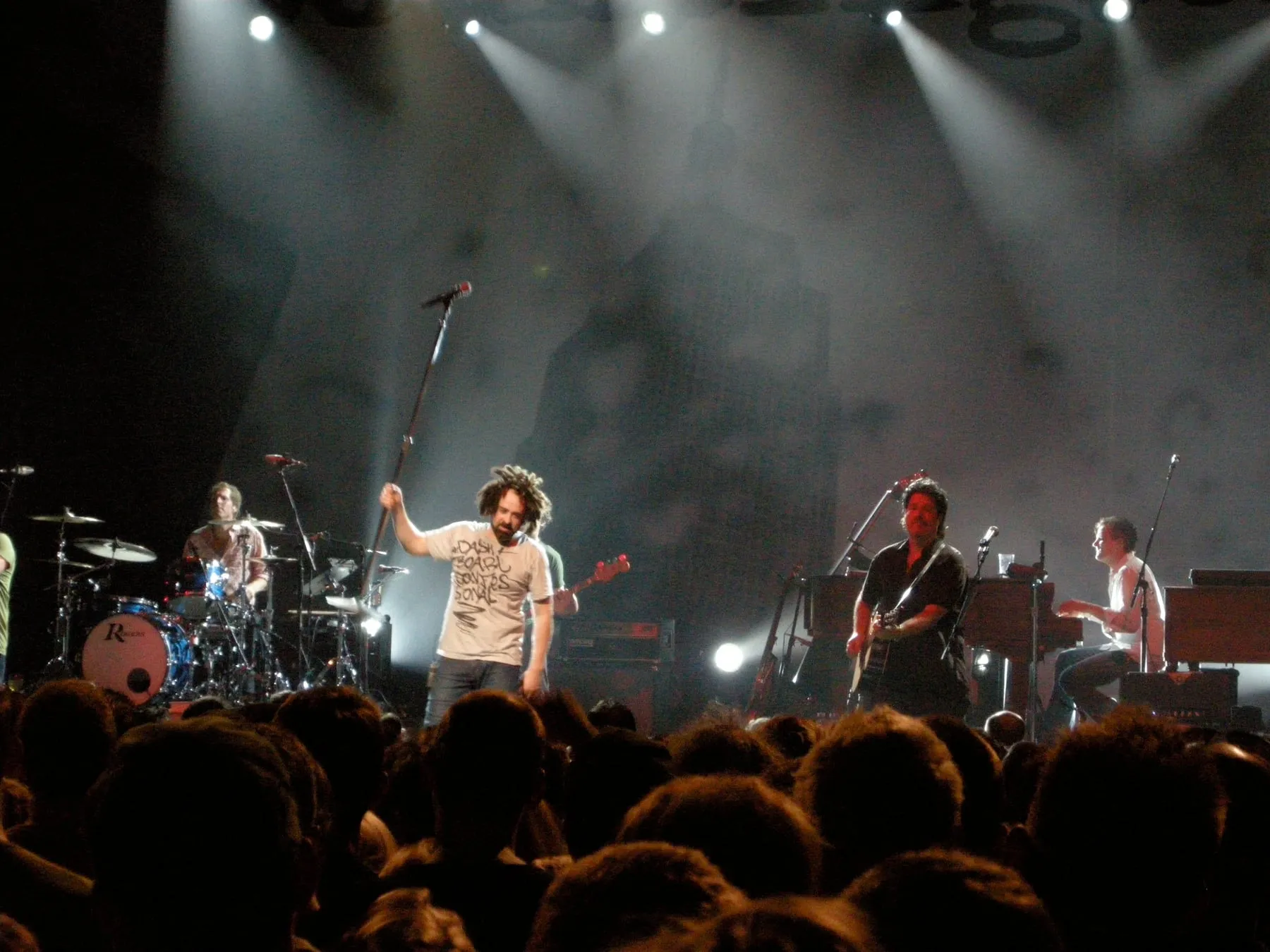
Photo by Rutger Hesseling , licensed under CC BY-SA 2.0 · Wikimedia Commons
Rank #421
Counting Crows
Berkeley band whose 'August and Everything After' became a 90s alt-rock standard.
From Wikipedia
Counting Crows is an American rock band from Berkeley, California. Formed in 1991, the band consists of rhythm guitarist David Bryson, drummer Jim Bogios, vocalist Adam Duritz, keyboardist Charlie Gillingham, multi-instrumentalist David Immerglück, bassist Millard Powers, and lead guitarist Dan Vickrey. Past members include the drummers Steve Bowman (1991–1994) and Ben Mize (1994–2002), and bassist Matt Malley (1991–2005).
Members
- Matt Malley (1991–2005)
- Steve Bowman (1991–1994)
- Ben Mize (1994–2002)
- Jim Bogios (2002–present)
- Millard Powers (2005–present)
- Adam Duritz
- Charlie Gillingham
- Dan Vickrey
- David Bryson
- David Immerglück
Studio Albums
- 1993 August and Everything After
- 1996 Recovering the Satellites
- 1999 This Desert Life
- 2002 Hard Candy
- 2008 Saturday Nights & Sunday Mornings
- 2012 Underwater Sunshine (or What We Did on Our Summer Vacation)
- 2014 Somewhere Under Wonderland
- 2025 Butter Miracle: The Complete Sweets!
Source: MusicBrainz
Deep Dive
Overview
Counting Crows is an American rock band from Berkeley, California, that emerged from the early 1990s alternative rock explosion to become one of the defining acts of the decade. Formed in 1991, the band melded alternative rock foundations with folk and pop sensibilities, creating a sound characterized by introspective lyrics, layered arrangements, and the distinctive tenor of vocalist Adam Duritz. Their debut album, August and Everything After, released in 1993, became an immediate touchstone of 1990s alternative rock and established the band as a significant creative force beyond the grunge-dominated headlines of the era.
Formation Story
Counting Crows coalesced in Berkeley in 1991 around the partnership of Adam Duritz and David Bryson. The band’s founding lineup also included Matt Malley on bass and Steve Bowman on drums, with Charlie Gillingham contributing keyboards and David Immerglück adding multi-instrumental textures. The group emerged from the San Francisco Bay Area’s vibrant alternative music scene, an environment rich with post-punk and indie rock traditions that predated grunge’s mainstream breakthrough. Unlike the Seattle sound that would dominate rock radio in the early 1990s, Counting Crows drew equally from folk-rock lineage and contemporary alternative rock, creating a synthesis that felt distinctly their own from their earliest performances.
Breakthrough Moment
Counting Crows’ breakthrough arrived swiftly with their debut album August and Everything After in 1993. Released on Geffen Records, the album introduced Duritz’s reflective, poetic songwriting and the band’s gift for crafting elaborate, guitar-driven arrangements that felt simultaneously radio-friendly and artistically substantial. The album’s success transformed the band from a promising regional act into a nationally recognized entity, establishing them as leading figures in the alt-rock mainstream alongside acts addressing similar thematic territory. August and Everything After became the commercial and critical foundation upon which the band would build their career, proving that introspective, lyrically dense alternative rock could reach mass audiences without sacrificing artistic integrity.
Peak Era
The period spanning 1993 through the late 1990s represented Counting Crows’ creative and commercial zenith. Following August and Everything After’s success, the band released Recovering the Satellites in 1996, solidifying their position as one of the decade’s significant rock acts. Their third studio album, This Desert Life, arrived in 1999 and continued their exploration of layered production and emotionally direct songwriting. During this window, Counting Crows became one of the most consistently successful alternative rock bands, maintaining critical credibility while achieving substantial commercial success across multiple album cycles. The band’s live presence also became legendary, with Duritz’s engaging stage presence and the ensemble’s tight musicianship drawing devoted audiences to packed venues worldwide.
Musical Style
Counting Crows’ sound emerged at the intersection of alternative rock and folk-rock traditions, distinguishing them from the heavier, blues-based grunge acts dominating the early 1990s. The band’s arrangements typically featured acoustic and electric guitars working in counterpoint, Charlie Gillingham’s layered keyboard textures, and a rhythm section that provided both propulsive drive and subtle dynamics. Adam Duritz’s vocals—expressive, occasionally anguished, but fundamentally melodic—delivered lyrics that examined emotional complexity, urban alienation, and romantic uncertainty with literary ambition. The band’s compositional approach favored structured song development and harmonic sophistication, drawing from both 1970s folk-rock and contemporary alternative sources. By their mid-period work, the band had expanded their sonic palette to incorporate elements of post-grunge production techniques while maintaining their fundamental commitment to melody and lyrical depth.
Major Albums
August and Everything After (1993)
The debut album that established Counting Crows as a major force in 1990s alternative rock, featuring the band’s fully formed sound of intricate guitar work, keyboard arrangements, and Duritz’s emotionally resonant vocals across a collection of substantially crafted songs.
Recovering the Satellites (1996)
The band’s second album consolidated their position in the alternative rock mainstream, demonstrating their ability to sustain creative momentum while exploring deeper production techniques and expanded arrangements.
This Desert Life (1999)
Released at the close of the 1990s, this album maintained Counting Crows’ commitment to sophisticated songwriting and arrangement while capturing the band at a point of established confidence and expanded sonic exploration.
Hard Candy (2002)
The band’s fourth studio album marked a transition point in their career, continuing their evolution while addressing new thematic material and production approaches.
Saturday Nights & Sunday Mornings (2008)
After a gap in studio releases, this album signaled the band’s ongoing creative engagement, reuniting longtime fans with new material and demonstrating their sustained relevance in the post-alt-rock era.
Signature Songs
- “Mr. Jones” — The opening track from August and Everything After, a defining 1990s alternative rock anthem examining urban alienation and fame’s seductive pull.
- “Round Here” — A centerpiece from the debut album showcasing the band’s gift for melancholic melody and introspective lyrical specificity.
- “Rain King” — Featuring the band’s extended instrumental interplay and Duritz’s emotionally direct vocal delivery across a complex arrangement.
- “A Long December” — A contemplative song that exemplified the band’s ability to make substantial artistic statements while maintaining melodic accessibility.
Influence on Rock
Counting Crows’ position in 1990s rock history rests on their demonstration that alternative rock could accommodate folk-rock influences, literary lyricism, and sophisticated arrangement without retreating into indie obscurity. The band helped establish a template for thoughtful, introspectively inclined rock acts working within the alternative mainstream, proving that music addressing emotional complexity could achieve genuine commercial success. Their influence extended through the 1990s and beyond, affecting how subsequent alternative and post-grunge acts approached arrangement, production, and lyrical ambition. The band’s commitment to musicianship and compositional craft in an era sometimes dominated by raw emotional expression or technical minimalism represented an alternative lineage that valued both artistic substance and popular accessibility.
Legacy
Counting Crows remain active recording and touring artists, maintaining an ongoing presence in contemporary rock music. The band’s continued operation—with Adam Duritz as the creative constant alongside longtime members David Bryson, Jim Bogios, Charlie Gillingham, David Immerglück, and Millard Powers—speaks to both the durability of their artistic partnership and the sustained interest in their music. August and Everything After endures as a touchstone of 1990s alternative rock, regularly cited among the decade’s most significant albums. The band’s body of work from the 1990s maintains a presence in streaming platforms and remains a fixture of alternative rock radio, testament to the timeless quality of their compositional approach. Their 2025 album Butter Miracle: The Complete Sweets! marks their continued creative engagement into the contemporary era, demonstrating that the band retains the capacity to produce new material for audiences spanning multiple generations.
Fun Facts
- The band’s lineup underwent significant change during the late 1990s and early 2000s, with Ben Mize replacing original drummer Steve Bowman in 1994 before Jim Bogios took over drumming duties in 2002, while bassist Millard Powers replaced founding member Matt Malley in 2005.
- Counting Crows emerged from the San Francisco Bay Area rather than Seattle, placing them geographically and musically apart from the grunge movement that dominated early 1990s rock radio.
- The band has maintained a long-term relationship with multiple record labels including Geffen Records, Capitol Records, and Cooking Vinyl, reflecting their sustained commercial presence across different eras of the music industry.
- The band’s embrace of folk-rock elements and literary songwriting positioned them as alternatives to the blues-based heaviness of grunge, offering audiences introspective alternative rock that drew from different historical sources.
Discography & Previews
Click any album to expand its track list. Each track plays a 30-second preview streamed from Apple Music. Tap the link icon next to a track to open it in Apple Music for full playback.
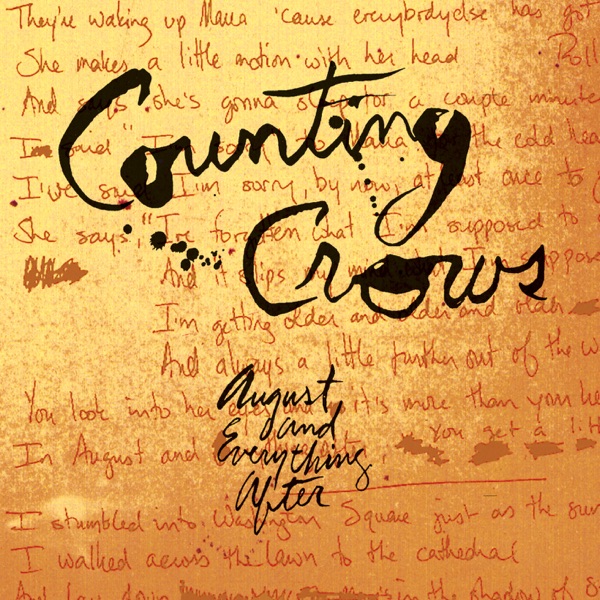

- 1 Catapult ↗ 3:35
- 2 Angels of the Silences ↗ 3:37
- 3 Daylight Fading ↗ 3:50
- 4 I'm Not Sleeping ↗ 4:56
- 5 Goodnight Elisabeth ↗ 5:18
- 6 Children In Bloom ↗ 5:23
- 7 Have You Seen Me Lately? ↗ 4:08
- 8 Miller's Angels ↗ 6:33
- 9 Another Horsedreamer's Blues ↗ 4:32
- 10 Recovering the Satellites ↗ 5:24
- 11 Monkey ↗ 3:01
- 12 Mercury ↗ 2:48
- 13 A Long December ↗ 4:55
- 14 Walkaways ↗ 1:13

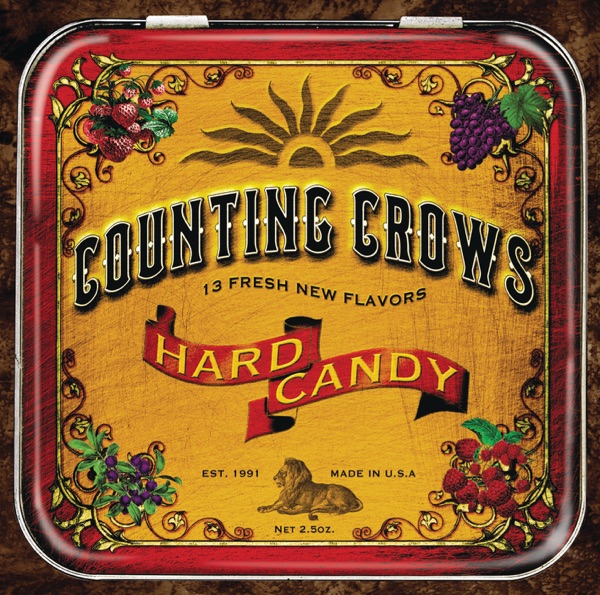
- 1 Hard Candy ↗ 4:21
- 2 American Girls (feat. Sheryl Crow) ↗ 4:32
- 3 Good Time ↗ 4:24
- 4 If I Could Give All My Love -Or- Richard Manuel Is Dead ↗ 3:53
- 5 Goodnight L.A. ↗ 4:17
- 6 Butterfly In Reverse ↗ 2:48
- 7 Miami ↗ 5:01
- 8 New Frontier ↗ 3:50
- 9 Carriage ↗ 4:03
- 10 Black and Blue ↗ 3:53
- 11 Why Should You Come When I Call? ↗ 4:38
- 12 Up All Night (Frankie Miller Goes To Hollywood) ↗ 5:08
- 13 Holiday In Spain ↗ 3:49
- 14 Big Yellow Taxi (feat. Vanessa Carlton) ↗ 3:46

- 1 1492 ↗ 3:50
- 2 Hanging Tree ↗ 3:51
- 3 Los Angeles ↗ 4:41
- 4 Sundays ↗ 4:21
- 5 Insignificant ↗ 4:14
- 6 Cowboys ↗ 5:23
- 7 Washington Square ↗ 4:17
- 8 On Almost Any Sunday Morning ↗ 2:58
- 9 When I Dream of Michelangelo ↗ 3:10
- 10 Anyone But You ↗ 5:25
- 11 You Can't Count On Me ↗ 3:17
- 12 Le Ballet d'Or ↗ 5:02
- 13 On a Tuesday In Amsterdam Long Ago ↗ 4:57
- 14 Come Around ↗ 4:29

- 1 Untitled (Love Song) ↗ 5:06
- 2 Start Again ↗ 3:33
- 3 Hospital ↗ 3:09
- 4 Mercy ↗ 3:31
- 5 Meet on the Ledge ↗ 3:36
- 6 Like Teenage Gravity ↗ 5:11
- 7 Amie ↗ 4:33
- 8 Coming Around ↗ 2:59
- 9 Ooh La La ↗ 4:37
- 10 All My Failures ↗ 4:38
- 11 Return of the Grievous Angel ↗ 4:23
- 12 Four White Stallions ↗ 4:01
- 13 Jumping Jesus ↗ 3:04
- 14 You Ain't Going Nowhere ↗ 4:19
- 15 The Ballad of El Goodo ↗ 4:50

