
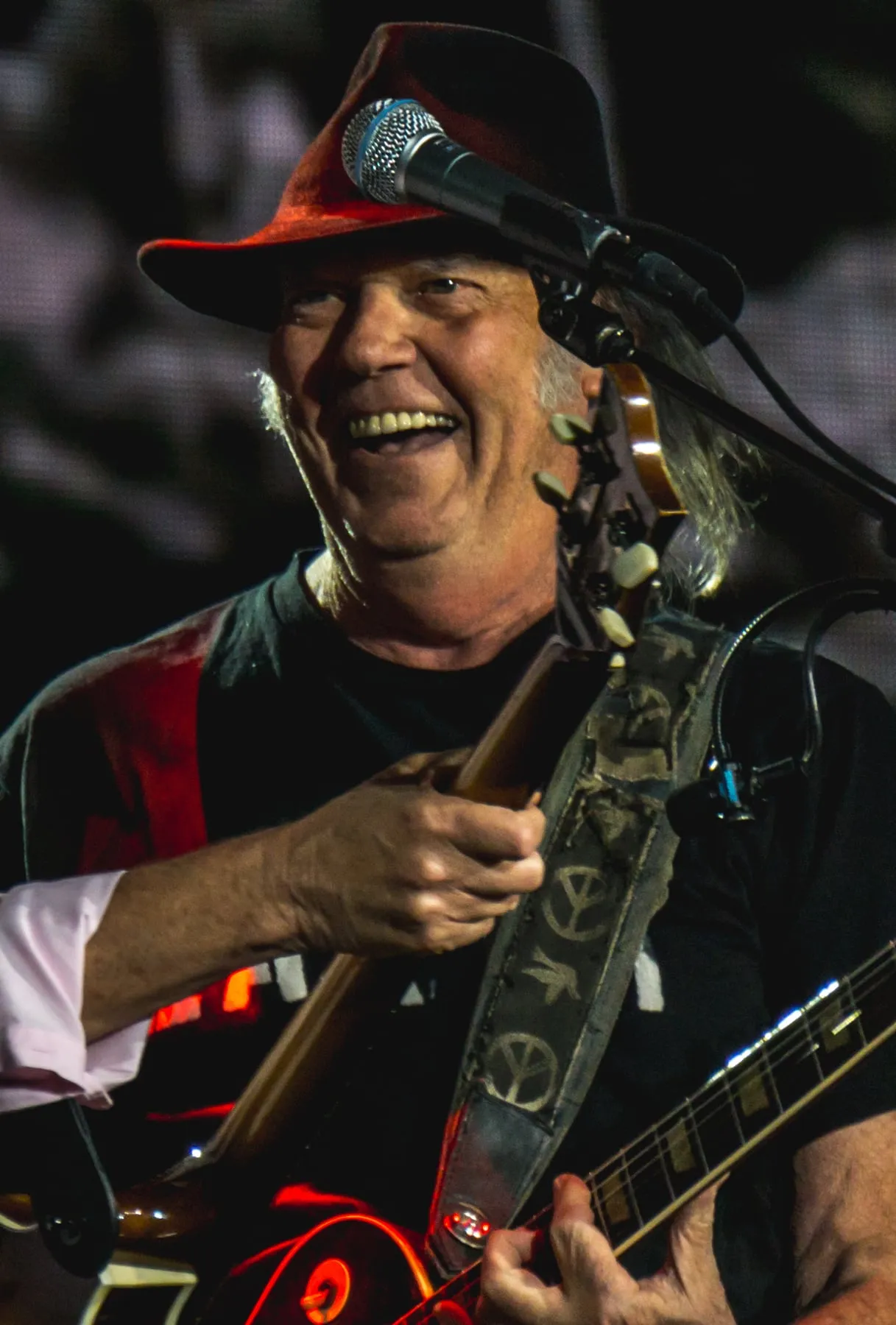
Photo by Raph_PH , licensed under CC BY 2.0 · Wikimedia Commons
Rank #333
Neil Young & Crazy Horse
Young's ragged-glory band of feedback and moonlit Americana.
From Wikipedia
Neil Percival Young is a Canadian and American singer-songwriter. Son of journalist and author Scott Young, Young embarked on a music career in Winnipeg in the 1960s. He then moved to Los Angeles, forming the folk rock group Buffalo Springfield. His solo career, often backed by the band Crazy Horse, includes critically acclaimed albums such as Everybody Knows This Is Nowhere (1969), After the Gold Rush (1970), Harvest (1972), On the Beach (1974), and Rust Never Sleeps (1979). Young was also a part-time member of Crosby, Stills, Nash & Young, with whom he recorded the chart-topping 1970 album Déjà Vu.
Deep Dive
Overview
Neil Young & Crazy Horse represent one of rock music’s most durable and musically restless collaborations. Formed in 1969, the partnership between Canadian singer-songwriter Neil Young and the American hard-rock trio Crazy Horse produced some of the era’s most emotionally direct and sonically unpolished rock music. Where many of Young’s solo efforts pursued folk or country-rock finesse, his work with Crazy Horse embraced feedback, distortion, and a rawness that placed them at the intersection of folk rock’s introspection and hard rock’s physical intensity.
Formation Story
Neil Young had already logged time in the Los Angeles folk-rock scene as a member of Buffalo Springfield before embarking on his solo career in the late 1960s. Crazy Horse, the backing band that would become synonymous with Young’s most guitar-driven work, coalesced around him in 1969. The classic lineup featured Danny Whitten on guitar and vocals, Billy Talbot on bass, and Ralph Molina on drums—a configuration that would define the band’s sound for decades. The chemistry between Young’s compositional voice and Crazy Horse’s unadorned, blues-rooted approach proved immediate and consequential.
Breakthrough Moment
Young’s partnership with Crazy Horse crystallized commercially and creatively with Everybody Knows This Is Nowhere in 1969. That album announced a shift away from the folk-pop polish Young had explored on earlier solo work, replacing it with extended guitar workouts and a band interplay built on mutual musical trust rather than technical polish. The record’s success established that Young’s audience would follow him into harder, more experimental territory. This foundation carried forward through the early 1970s as Young alternated between his solo acoustic or country-rock work and explosive sessions with Crazy Horse, each project amplifying the other’s identity.
Peak Era
The period from 1970 to 1979 constituted Crazy Horse’s era of maximum creative and commercial impact alongside Young. After the Gold Rush (1970) showcased Young’s ability to weave introspection with Crazy Horse’s wall-of-sound guitar approach. Harvest (1972) moved closer to country-rock subtlety, yet reaffirmed Young’s partnership with the band as one of his primary creative outlets. On the Beach (1974) and Rust Never Sleeps (1979) crystallized the band’s signature aesthetic: Young’s tremolo-laden guitar merged with Molina’s thunderous drumming and Talbot’s steady bottom end, all in service of songs that mixed vulnerability with sonic aggression. This decade-long run established Young & Crazy Horse as architects of a distinctly American rock sound, one rooted in folk tradition but electrified by distortion and rhythmic weight.
Musical Style
The Crazy Horse sound derived much of its character from an almost deliberate refusal to sand down its edges. Molina’s drumming sat in a heavy, blues-inflected pocket that emphasized swing and human feel over metronomic precision. Talbot’s bass playing provided a thick, often guitar-like melodic presence rather than simply anchoring the bottom. Young’s guitar work—whether playing lead lines that careened into feedback or comping behind the band—favored texture and emotional directness over virtuosic display. Vocally, Young’s high, reedy tenor maintained an intentional distance from his lyrics’ content, creating a productive tension between vocal fragility and instrumental force. The band’s folk-rock and hard-rock lineage merged country-music’s narrative sensibility with rock music’s capacity for volume and distortion, producing a hybrid that influenced both singer-songwriter traditions and guitar-driven rock for decades.
Major Albums
Everybody Knows This Is Nowhere (1969)
Young’s debut album with Crazy Horse introduced the guitar-centric aesthetic that would define their partnership, moving decisively away from folk-pop conventions toward feedback-laden rock.+
After the Gold Rush (1970)
Combining folk-rock introspection with Crazy Horse’s muscular arrangements, this album balanced Young’s most poignant songwriting with the band’s ability to amplify emotional intensity through sheer sonic weight.
Harvest (1972)
Young’s most commercially successful solo album, featuring fuller production and occasional country-rock textures, yet retaining the band’s core rhythmic and sonic fingerprints in key moments.
On the Beach (1974)
A return to Crazy Horse’s harder edge after Harvest, the album showcased Young’s willingness to confront darker emotional terrain with the band’s unflinching sonic approach.
Rust Never Sleeps (1979)
A career-defining collaboration that merged acoustic vulnerability with electric ferocity, Rust Never Sleeps crystallized Young & Crazy Horse’s ability to move fluidly between intimate and monumental scale, with Crazy Horse’s power married to Young’s folk sensibilities.
Signature Songs
- “Cinnamon Girl” — A Crazy Horse staple from Everybody Knows This Is Nowhere, built on Young’s incisive guitar riff and the band’s locked-groove intensity.
- “Down by the River” — A slow-building blues-rock vehicle that showcased the band’s ability to sustain tension and release over extended durations.
- “Cortez the Killer” — Young’s most elaborate guitar performance in the Crazy Horse catalogue, demonstrating the band’s capacity for lyrical depth paired with instrumental virtuosity.
- “Rockin’ in the Free World” — A late-career anthem from Rust Never Sleeps that became synonymous with Young’s political voice and the band’s straightforward power.
- “Like a Hurricane” — A showcase for Young’s tremolo-driven lead work and Molina’s propulsive drumming, this song epitomized the band’s raw emotional power.
Influence on Rock
Neil Young & Crazy Horse’s impact on rock music extended across multiple genres and decades. Their embrace of feedback and sonic rawness, combined with folk-rock’s narrative depth, provided a template that influenced hard-rock and heavy-metal musicians seeking emotional authenticity alongside volume. Grunge musicians in particular drew inspiration from Young’s willingness to shift between acoustic vulnerability and electric intensity, and from Crazy Horse’s refusal to polish away the human imperfections in their playing. The band’s long-term partnership also underscored an alternative to the rock-star dissolution narrative—Young and Crazy Horse proved that longevity, musical growth, and uncompromising aesthetics could coexist. Their influence on alternative rock, indie rock, and even contemporary folk-influenced rock remained substantial well into the 21st century.
Legacy
Neil Young & Crazy Horse’s partnership has endured in various forms from 1969 to the present, making them one of rock’s most resilient collaborations. Young’s prolific output and willingness to revisit the band across multiple decades ensured that Crazy Horse remained a living creative force rather than a historical artifact. The band’s records have retained critical esteem and a devoted listening audience, their unpolished aesthetic and emotional directness seemingly antithetical to obsolescence. Young’s broader cultural status as a rock elder statesman and political voice amplified the band’s legacy, while the durability of songs like “Rockin’ in the Free World” and “Like a Hurricane” in the popular consciousness testified to the enduring resonance of their catalogue.
Fun Facts
- Neil Young maintained an official archive (neilyoungarchives.com) documenting his extensive catalogue, including detailed documentation of Crazy Horse sessions and performances spanning decades.
- The band’s willingness to record in unconventional settings—from live recordings to basement studios—contributed to the intentional roughness that became their sonic signature.
- Young’s partnership with Crazy Horse coexisted with his simultaneous membership in Crosby, Stills, Nash & Young, a supergroup arrangement that demonstrated his ability to navigate multiple musical contexts without compromising his artistic vision.
- Crazy Horse’s core lineup of Whitten, Talbot, and Molina remained remarkably stable across the band’s most productive decades, a testament to the deep musical understanding between members.