
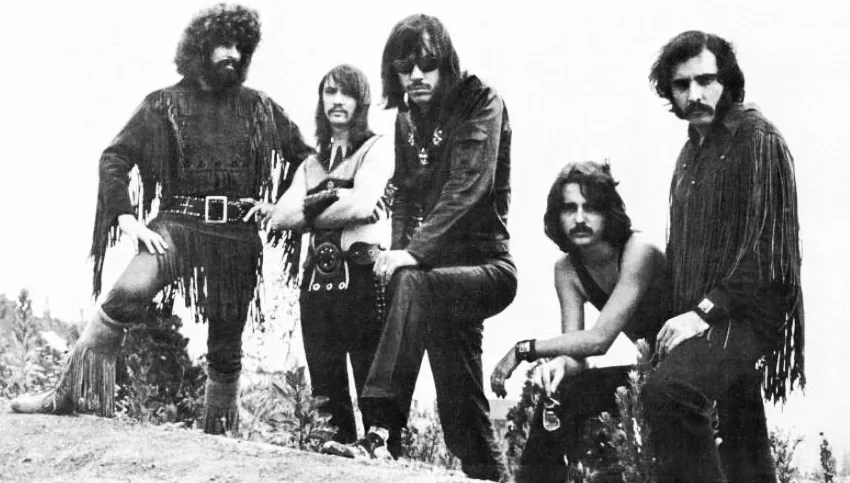
Photo by ABC / Dunhill Records , licensed under Public domain · Wikimedia Commons
Rank #332
Steppenwolf
Toronto-formed band whose 'Born to Be Wild' coined 'heavy metal thunder'.
From Wikipedia
Steppenwolf was a Canadian-American rock band formed in Los Angeles in 1967. The group was founded by singer/rhythm guitarist John Kay, keyboardist Goldy McJohn and drummer Jerry Edmonton, all formerly of the Canadian band the Sparrows. Guitarist Michael Monarch and bassist Rushton Moreve were recruited via notices placed in Los Angeles–area record and musical instrument stores.
Members
- Danny Johnson
- Gary Link
- John Kay
- Larry Byrom
- Michael Wilk
- Ron Hurst
Studio Albums
- 1968 The Second
- 1968 Steppenwolf
- 1969 At Your Birthday Party
- 1969 Monster
- 1970 Steppenwolf 7
- 1971 For Ladies Only
- 1974 Slow Flux
- 1975 Hour of the Wolf
- 1976 Skullduggery
- 1982 Wolftracks
- 1984 Paradox
- 1987 Rock & Roll Rebels
- 1990 Rise & Shine
Source: MusicBrainz
Deep Dive
Overview
Steppenwolf was a Canadian-American rock band that emerged from Los Angeles in 1967 and became one of the defining voices of hard rock and psychedelic music in the late 1960s and early 1970s. Rooted in blues rock and acid rock, the band bridged the gap between underground psychedelia and stadium rock, combining heavy guitar riffs with introspective lyrics and countercultural commentary. Their place in rock history was cemented early: they coined the term “heavy metal thunder” in their breakthrough hit, a phrase that would define a genre’s sonic aesthetic for decades to come.
Formation Story
Steppenwolf was founded in 1967 by three musicians with prior collaboration history: singer and rhythm guitarist John Kay, keyboardist Goldy McJohn, and drummer Jerry Edmonton. All three had been members of the Canadian rock band the Sparrows before relocating to Los Angeles to form their new project. The founding lineup was completed when guitarist Michael Monarch and bassist Rushton Moreve joined the group, both recruited through notices placed in local Los Angeles record and musical instrument stores. This scrappy, grassroots assembly method reflected the band’s DIY ethos and the vibrant Los Angeles rock scene of the mid-1960s, where established industry connections mattered less than raw talent and determination.
Breakthrough Moment
Steppenwolf’s rapid ascent began with their self-titled debut, Steppenwolf, released in 1968, which included the track that would define their career and influence rock music for generations. The song’s combination of a snarling vocal delivery, distorted guitar work, and explicit reference to “heavy metal thunder” resonated with audiences navigating the psychedelic and countercultural landscape of the era. That same year, the band released The Second, demonstrating they could sustain momentum and refine their sound. By 1969, with the release of Monster, Steppenwolf had established themselves as a major commercial and artistic force, moving beyond their initial breakthrough to solidify their place in the hard rock pantheon.
Peak Era
The years from 1968 through 1970 represented Steppenwolf’s most creatively vital and commercially successful period. Following Monster in 1969, the band released Steppenwolf 7 in 1970, continuing to prove their ability to craft compelling hard rock with psychedelic underpinnings. During this window, the band’s raw energy, guitar-driven arrangements, and thematic intensity made them essential voices in the emerging hard rock and heavy metal movements. Their albums charted consistently, their live reputation grew, and they became fixtures on FM radio and in rock clubs across North America. This era established the template by which future hard rock and metal bands would measure themselves.
Musical Style
Steppenwolf’s sound synthesized blues rock foundations with psychedelic textures and hard rock aggression. John Kay’s vocals—gruff, passionate, and often delivered with a snarl—drove the emotional core of their compositions, while Michael Monarch’s lead guitar work combined blues phrasing with the fuzzy, distorted tones that defined acid rock. Goldy McJohn’s keyboard contributions added atmospheric depth and psychedelic wash to otherwise hard-hitting arrangements. The rhythm section of Jerry Edmonton on drums and Rushton Moreve on bass provided the thunderous low-end momentum that anchored the band’s heavier moments. Lyrically, Steppenwolf frequently drew on themes of freedom, social alienation, and countercultural rebellion—concerns that reflected the band’s era and appealed directly to the youth audiences driving rock’s commercial expansion in the late 1960s. The band’s willingness to merge introspection with visceral rock power distinguished them from both lighter psychedelic acts and purely blues-based hard rockers.
Major Albums
Steppenwolf (1968)
The debut arrived fully formed, introducing the band’s hard rock-psychedelic hybrid and containing the signature track that would follow them throughout their career and influence metal terminology forever.
Monster (1969)
Released during the band’s peak creative period, Monster solidified their reputation for combining heavy riffs with socially conscious lyrics and robust production values.
Steppenwolf 7 (1970)
The band’s third album in three years demonstrated sustained quality and commercial appeal, proving the initial breakthrough was no one-hit phenomenon.
For Ladies Only (1971)
Continuing their prolific output, this 1971 release showed Steppenwolf adapting their formula while maintaining the core elements that had won them an audience.
Signature Songs
- “Born to Be Wild” — The 1968 track that gave hard rock one of its defining phrases and established Steppenwolf as architects of a new sonic and cultural language.
- “Magic Carpet Ride” — A psychedelic-tinged hard rock number that showcased the band’s ability to balance accessibility with experimental textures.
- “Monster” — The title track from their 1969 album, exemplifying their knack for socially aware, guitar-heavy rock.
- “The Pusher” — A gritty, blues-influenced composition reflecting the band’s darker thematic interests.
Influence on Rock
Steppenwolf’s most immediate and lasting contribution to rock was lexical and sonic: they provided heavy metal with its defining vocabulary and helped establish the hard rock template of the 1970s. Their fusion of blues rock aggression with psychedelic atmosphere influenced countless bands navigating the space between underground credibility and mainstream appeal. The emphasis on distorted electric guitar, prominent keyboards, and fiercely delivered vocals became standard in hard rock and metal; bands from Black Sabbath to Led Zeppelin operated in a landscape Steppenwolf had helped map. Beyond specific sonic imitation, Steppenwolf’s willingness to address social and philosophical themes within hard rock structures encouraged subsequent rock musicians to view the genre as a vehicle for serious lyrical content, not merely technical display or party music.
Legacy
Steppenwolf remained active through the 1970s with albums including Slow Flux (1974), Hour of the Wolf (1975), and Skullduggery (1976), demonstrating sustained touring and recording presence even as their peak commercial period passed. The band regrouped in the 1980s, releasing Paradox (1984) and continuing into subsequent decades with Rock & Roll Rebels (1987) and Rise & Shine (1990). Though no longer a consistent chart force after the early 1970s, Steppenwolf maintained an active concert schedule and remained culturally relevant through retrospective appreciation and classic rock radio play. The ubiquity of “Born to Be Wild” in film, television, and advertising ensured new generations encountered their music; the song’s use in Easy Rider (1969) cemented its place in American cultural memory. Steppenwolf’s catalog remains a touchstone for understanding how psychedelia transformed into hard rock and metal, and how rock and roll could function simultaneously as entertainment and social commentary.
Fun Facts
- The band was initially formed in Los Angeles but traced its roots to Toronto, with three of the founding members originating from the Canadian rock scene before relocating to California.
- Steppenwolf released four studio albums between 1968 and 1969—The Second, Steppenwolf, At Your Birthday Party, and Monster—demonstrating remarkable prolific output during their formative years.
- The band recorded for Dunhill and ABC Records, labels that provided them with significant industry support during the height of their popularity.
Discography & Previews
Click any album to expand its track list. Each track plays a 30-second preview streamed from Apple Music. Tap the link icon next to a track to open it in Apple Music for full playback.

- 1 Faster Than the Speed of Life ↗ 3:16
- 2 Tighten Up Your Wig ↗ 3:09
- 3 None of Your Doing ↗ 2:54
- 4 Spiritual Fantasy ↗ 3:42
- 5 Don't Step On the Grass, Sam ↗ 5:43
- 6 28 ↗ 3:14
- 7 Magic Carpet Ride ↗ 4:34
- 8 Disappointment Number (Unknown) ↗ 4:54
- 9 Lost and Found By Trial and Error ↗ 2:09
- 10 Hodge, Podge, Strained Through a Leslie ↗ 2:50
- 11 Resurrection ↗ 2:54
- 12 Reflections ↗ 0:45


- 1 Don't Cry ↗ 3:10
- 2 Chicken Wolf ↗ 2:58
- 3 Lovely Meter ↗ 3:08
- 4 Round and Down ↗ 3:18
- 5 It's Never Too Late ↗ 4:06
- 6 Sleeping Dreaming ↗ 1:07
- 7 Jupiter's Child ↗ 3:26
- 8 She'll Be Better ↗ 5:30
- 9 Cat Killer ↗ 1:36
- 10 Rock Me ↗ 3:42
- 11 God Fearing Man ↗ 3:54
- 12 Mango Juice ↗ 3:01
- 13 Happy Birthday ↗ 2:15


- 1 Caroline (Are You Ready for the Outlaw World) ↗ 4:51
- 2 Annie, Annie Over ↗ 4:10
- 3 Two for the Love of One ↗ 3:44
- 4 Just For Tonight ↗ 5:38
- 5 Hard Rock Road ↗ 3:30
- 6 Someone Told a Lie ↗ 5:04
- 7 Another's Lifetime ↗ 4:34
- 8 Mr. Penny Pincher ↗ 6:14
- 9 Caroline (Are You Ready for the Outlaw World) [Single Version] ↗ 3:22
- 10 Angeldrawers (B side to 'Caroline') ↗ 3:46
