
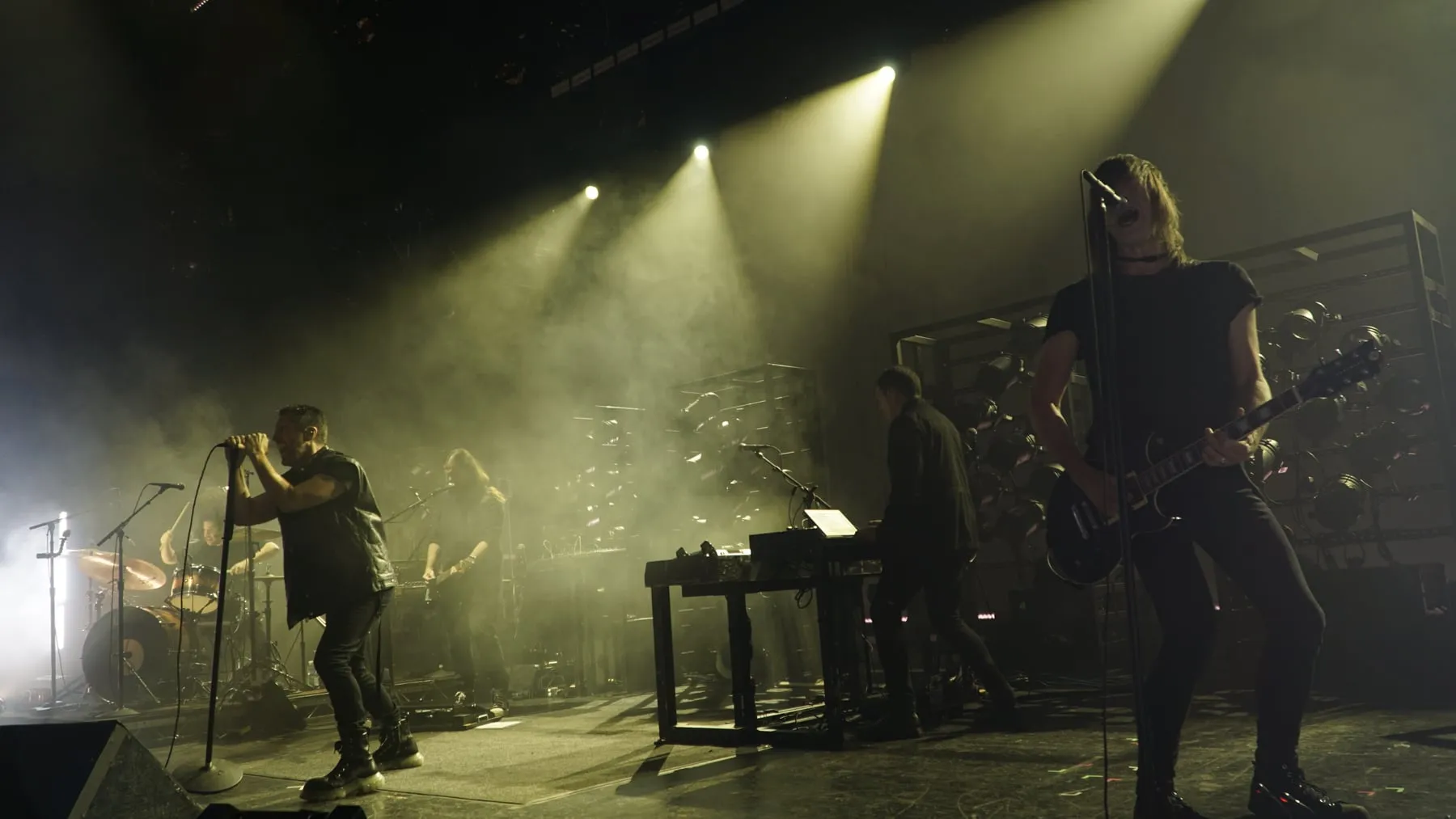
Photo by aliina s. , licensed under CC BY 2.0 · Wikimedia Commons
Rank #192
Nine Inch Nails
Trent Reznor's industrial-rock juggernaut whose 'Downward Spiral' is genre-defining.
From Wikipedia
Nine Inch Nails, commonly abbreviated as NIN, is an American industrial rock band formed by singer, songwriter, multi-instrumentalist, and producer Trent Reznor in 1988 in Cleveland, Ohio. Reznor was the sole permanent member of the band until his frequent collaborator, English musician Atticus Ross, became an official member in 2016. The band's debut album, Pretty Hate Machine (1989), was released via TVT Records. After disagreements with TVT over how the album would be promoted, the band signed with Interscope Records and released the EP Broken (1992), followed by the albums The Downward Spiral (1994) and The Fragile (1999).
Members
- Atticus Ross (2016–present)
Deep Dive
Overview
Nine Inch Nails, commonly abbreviated as NIN, is an American industrial rock band formed by Trent Reznor in 1988 in Cleveland, Ohio. The project emerged as a singular artistic vision: Reznor served as the sole permanent member for nearly three decades, writing, performing, and producing the band’s material across studio albums and live presentations. The band’s fusion of abrasive electronic textures, guitar-driven rock arrangements, and introspective songwriting established industrial rock as a major force in popular music during the 1990s. With the addition of collaborator Atticus Ross as an official member in 2016, the band’s lineup formalized, yet Reznor’s creative direction has remained the defining force throughout Nine Inch Nails’ existence.
Formation Story
Trent Reznor formed Nine Inch Nails in Cleveland in 1988, operating initially as a solo project under his complete artistic control. The band’s genesis coincided with the rise of industrial and post-industrial music in underground scenes across North America and Europe, though Reznor’s approach distinguished itself through an emphasis on pop sensibility and emotional vulnerability alongside harsh sonic textures. Working independently in the late 1980s, Reznor composed and recorded material that would become the band’s debut album, crafting a sound that bridged the gap between the experimental noise of industrial pioneers and the song-driven structure of alternative rock.
Breakthrough Moment
Nine Inch Nails secured its initial recording contract with TVT Records, releasing the debut album Pretty Hate Machine in 1989. The album introduced Reznor’s songwriting to a wider audience and established the band’s aesthetic: synthesizer-driven arrangements layered with distorted guitars, drum machines, and Reznor’s distinctive vocal delivery ranging from whispered vulnerability to anguished shouting. Disagreements with TVT over promotional strategy led the band to pursue a new label deal, signing with Interscope Records—a move that proved pivotal. The 1992 EP Broken marked the beginning of Nine Inch Nails’ ascent in mainstream alternative rock circles, showcasing an evolution toward heavier guitar textures and more aggressive production while retaining the band’s core emotional intensity. The extended play’s darker aesthetic and increased sonic weight signaled Reznor’s growing ambition to merge industrial music with rock radio accessibility.
Peak Era
Nine Inch Nails achieved its commercial and critical apex with the release of The Downward Spiral in 1994, a landmark album that crystallized the industrial-rock sound and became the genre’s defining statement. The album’s exploration of psychological deterioration, supported by meticulously crafted production and visceral instrumentation, resonated with a generation of listeners and established the band as major figures in alternative rock. Following this success, the band released The Fragile in 1999, a double album that expanded the sonic palette with ambient textures, orchestral arrangements, and continued thematic depth. This period from 1994 to 1999 represented the band’s most culturally significant era, during which Nine Inch Nails secured festival headlining slots, achieved platinum certifications, and became a permanent fixture in rock and alternative music discourse.
Musical Style
Nine Inch Nails’ sound represents a deliberate merger of industrial electronic music and alternative rock. The band’s instrumentation typically centers on synthesizers, drum machines, and heavily processed guitar, combined with Reznor’s production techniques that layer distortion, reverb, and dynamic compression to create both delicate and overwhelming sonic moments. The songwriting approach frequently juxtaposes introspective, minimal verses with explosive, maximalist choruses, a structural strategy that heightened emotional impact. Thematically, Nine Inch Nails explores psychological states, existential anxiety, and societal critique, with production choices serving the emotional narrative of each album. Across studio releases from Pretty Hate Machine through The Fragile, the band’s sound evolved from synth-pop-influenced arrangements toward increasingly sophisticated production and orchestration, yet maintained consistency in Reznor’s artistic vision and the fundamental industrial-rock DNA at the project’s core.
Major Albums
Pretty Hate Machine (1989)
The debut album introduced Reznor’s songwriting and the industrial-rock sound to a broader audience, establishing the project’s aesthetic and Reznor’s role as primary architect of Nine Inch Nails’ musical direction. The album’s synth-driven production and introspective lyrics proved influential within underground and alternative rock communities.
The Downward Spiral (1994)
A masterwork of industrial rock, The Downward Spiral achieved both critical acclaim and mainstream commercial success, becoming the genre’s defining album and securing Nine Inch Nails’ position as major figures in alternative rock. The album’s meticulous production, conceptual coherence, and emotional intensity remain touchstones for industrial and electronic music.
The Fragile (1999)
A double album that expanded Nine Inch Nails’ sonic palette with ambient textures, orchestral arrangements, and continued thematic exploration, The Fragile demonstrated Reznor’s compositional ambition beyond the industrial-rock template established by its predecessor. The album’s scale and complexity further solidified the band’s status as art-rock practitioners.
With Teeth (2005)
The band’s first album following a five-year gap, With Teeth marked a return to more guitar-driven arrangements and tighter song structures compared to The Fragile’s expansiveness. The album demonstrated the band’s ongoing evolution within the industrial-rock framework.
Year Zero (2007)
A concept album examining dystopian futures and technological dystopia, Year Zero paired the band’s established sonic vocabulary with ambitious thematic scope, continuing Nine Inch Nails’ integration of production sophistication and conceptual songwriting.
Bad Witch (2018)
Released over a decade after Hesitation Marks, Bad Witch found the band synthesizing earlier industrial-rock approaches with contemporary production techniques, demonstrating the durability of Reznor’s creative vision across changing musical landscapes.
Signature Songs
- “Head” — A Broken track that exemplified the band’s capacity to merge melody with abrasive production and provocative content.
- “Closer” — The Downward Spiral centerpiece featuring minimal, hypnotic instrumentation and explicit thematic content that became one of the band’s most recognizable compositions.
- “Hurt” — A Downward Spiral acoustic-based track showcasing Reznor’s vulnerability and songwriting craft beyond purely electronic arrangements.
- “The Perfect Girl” — A Pretty Hate Machine standout demonstrating the band’s early synthesis of synth-pop sensibility and industrial textures.
- “Terrible Lie” — Another Pretty Hate Machine track that introduced the band’s emotional directness and production sophistication to audiences.
Influence on Rock
Nine Inch Nails fundamentally altered the trajectory of alternative and rock music during the 1990s, establishing industrial rock as a viable mainstream genre while demonstrating that electronic production and extreme sonic aesthetics could coexist with emotional accessibility. The band’s success proved that audiences would embrace music combining dance-floor rhythm structures with rock song dynamics, guitar-based instrumentation with synthesizer-dominant production. Following The Downward Spiral’s massive commercial and critical success, numerous rock and alternative acts adopted industrial production techniques, distorted synthesizers, and Reznor’s songwriting model emphasizing psychological narrative over conventional rock posturing. The band’s influence extended beyond rock into electronic music, darkwave, and industrial genres, establishing templates that subsequent artists across multiple styles have continued to reference and build upon.
Legacy
Nine Inch Nails’ position within rock history remains secure as architects of industrial rock’s mainstream integration and as exemplars of long-form artistic vision maintained across decades. Reznor’s work with the band established him as a producer and composer of major cultural significance, a status further expanded through his film and television score work. The addition of Atticus Ross as an official member in 2016 formalized a long-standing collaborative relationship and signaled the project’s continuation into a new era. The band’s continued release of studio albums—including Ghosts I–IV, The Slip, Hesitation Marks, and subsequent releases through 2020—demonstrates the project’s sustained creative output and relevance. Nine Inch Nails’ catalog maintains consistent presence across streaming platforms, with The Downward Spiral remaining a cultural touchstone and reference point for discussions of 1990s rock and industrial music history.
Fun Facts
- Reznor performed as Nine Inch Nails’ sole member for approximately 28 years before Atticus Ross became an official band member in 2016, despite Ross having collaborated extensively with the project prior to his formal induction.
- The band released two separate albums titled Ghosts followed by Roman numerals—Ghosts I–IV in 2008 and Ghosts V: Together and Ghosts VI: Locusts in 2020—demonstrating Reznor’s use of conceptual sequencing across distinct release cycles.
- Nine Inch Nails operated across multiple record labels throughout its history, including TVT Records, Interscope Records, and The Null Corporation, reflecting the band’s complex contractual history and evolving distribution strategies.