
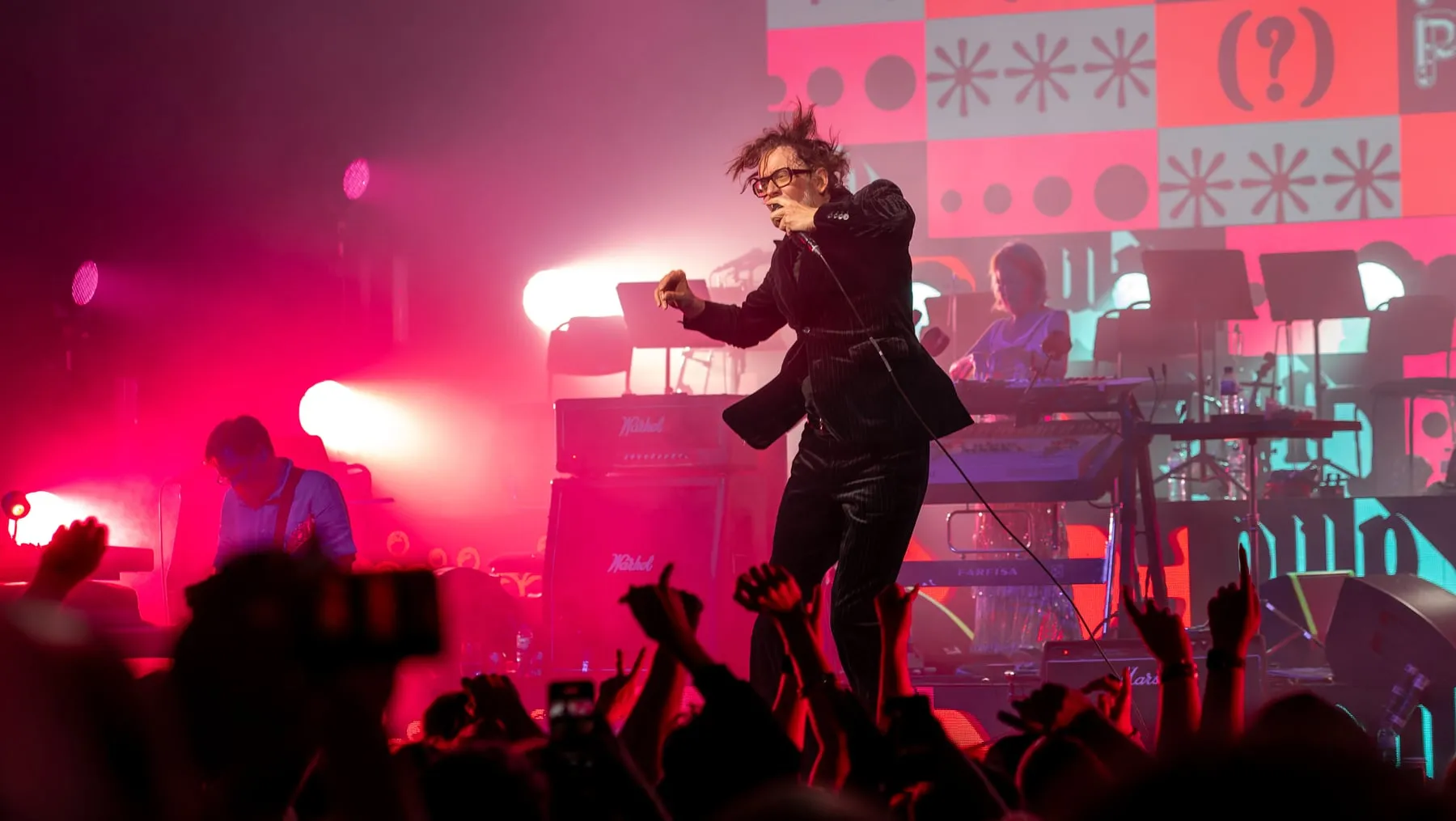
Photo by Raph_PH , licensed under CC BY 2.0 · Wikimedia Commons
Rank #355
Pulp
Sheffield band whose Jarvis Cocker-led wit and class observation defined Britpop.
From Wikipedia
Pulp are an English rock band formed in Sheffield in 1978. At their critical and commercial peak, the band consisted of Jarvis Cocker, Russell Senior, Candida Doyle (keyboards), Nick Banks, Steve Mackey (bass) and Mark Webber. The band's "kitchen sink drama" lyrics, coupled with its references to British culture, led to Cocker and Pulp becoming reluctant figureheads of the Britpop movement.
Members
- Candida Doyle
- Jarvis Cocker
- Leo Abrahams
- Mark Webber
- Nick Banks
- Russell Senior
- Steve Mackey
Studio Albums
- 1983 It
- 1987 Freaks: Ten Stories About Power, Claustrophobia, Suffocation and Holding Hands
- 1992 Separations
- 1994 His ’n’ Hers
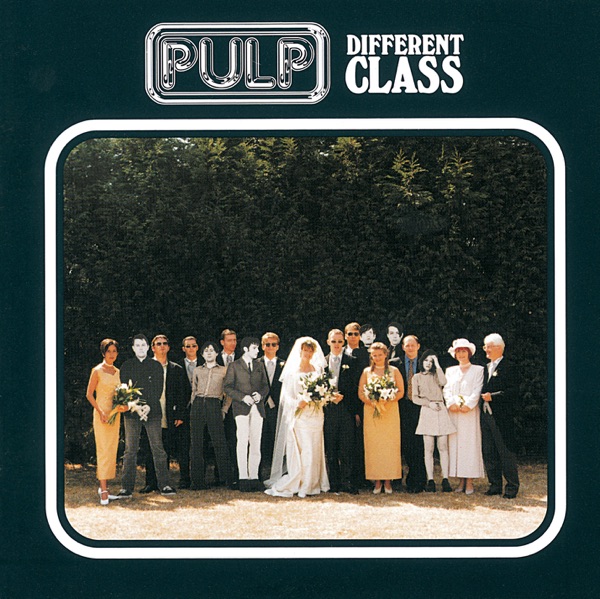
- 1995 Different Class
- 1998 This Is Hardcore
- 2001 We Love Life
- 2025 More.
Source: MusicBrainz
Deep Dive
Overview
Pulp are an English rock band formed in Sheffield in 1978, emerging as one of the defining acts of the Britpop movement two decades after their inception. Led by vocalist and lyricist Jarvis Cocker, the band crafted a distinctive style rooted in observational songwriting that examined class, desire, and British life with sharp wit and narrative precision. While often grouped with the flashier faces of Britpop, Pulp’s approach was more literary and grounded—less about bombast and more about the specifics of ordinary experience rendered extraordinary through detail and melody.
Formation Story
Pulp began in 1978 in Sheffield, the industrial city in Yorkshire that would later nurture other influential acts within the alternative and indie landscape. Jarvis Cocker formed the group during his teenage years, assembling a lineup that would shift and evolve throughout the 1980s before solidifying around the core creative partnership with Russell Senior. The early years were spent in relative obscurity, refining their sound in local venues and building a small but devoted following within Sheffield’s post-punk and indie underground. The band’s persistence during the sparse years of the early 1980s—when punk’s first wave had faded and new wave had fractured into countless regional variations—established them as serious musicians rather than trend-chasers.
Breakthrough Moment
Pulp’s transition from cult concern to mainstream attention occurred across the early-to-mid 1990s. The 1992 album Separations signaled an artistic renaissance, demonstrating a newfound clarity in songwriting and production after years of experimentation. However, it was the 1994 release His ‘n’ Hers that positioned them at the vanguard of the emerging Britpop conversation, introducing their observational style to a wider audience. The subsequent album Different Class (1995) became their defining commercial and critical statement, establishing Jarvis Cocker and the band as reluctant figureheads of the Britpop movement—a role they accepted with ambivalence, conscious that their working-class perspective and narrative approach differed from the lad culture and guitar bombast dominating the scene.
Peak Era
The period from 1994 to 1998 encompassed Pulp’s most successful and artistically ambitious work. His ‘n’ Hers and Different Class represented the band at their commercial and creative height, with Cocker’s lyrics achieving a balance between accessibility and literary sophistication that resonated across demographics. The album This Is Hardcore (1998) continued their exploration of complex emotional and social themes, though its more introspective and darker tone marked a subtle shift away from the confident eclecticism of the mid-1990s. During these years, the band’s live presence became legendary, with Cocker’s theatrical delivery and visible intelligence distinguishing their performances from the often-formulaic stadium rock of their contemporaries.
Musical Style
Pulp’s sound defied easy categorization, blending elements of glam rock, new wave, soul, and indie rock into a sophisticated hybrid. Candida Doyle’s keyboards provided textural richness and melodic counterpoint, while Russell Senior’s guitar work ranged from angular and post-punk influenced to lush and orchestral. Steve Mackey’s bass lines were inventive and propulsive, supporting Nick Banks’s drum patterns, which combined precision with swing. The band’s production evolved across their discography—early work possessed a rawer, more experimental edge, while the 1990s albums featured increasingly polished and diverse arrangements that incorporated strings, synthesizers, and genre influences from soul to punk. Jarvis Cocker’s vocal delivery was distinctive precisely because it was unmarked by the histrionics common to rock frontmen; his flat, conversational phrasing allowed his lyrics’ observational content to take center stage, narrating tales of sexual anxiety, class consciousness, and the comedy inherent in ordinary British life.
Major Albums
His ‘n’ Hers (1994)
A transitional work that introduced Pulp’s observational narrative style to mainstream audiences, establishing the template for their commercial ascendancy with melodic sophistication and lyrical specificity.
Different Class (1995)
Pulp’s masterwork and the definitive Britpop statement from Sheffield, combining accessible hooks with complex arrangements and Cocker’s sharpest class-conscious commentary, marking the band’s critical and commercial peak.
This Is Hardcore (1998)
A darker, more introspective exploration of desire, fame, and alienation, demonstrating the band’s willingness to challenge their own success and deconstruct the fantasy of rock stardom.
Separations (1992)
An early 1990s statement of intent that showcased clearer songwriting and production than the band’s 1980s work, signaling their readiness for the broader audience that would soon follow.
We Love Life (2001)
A return to more optimistic and playful territory after the bleakness of This Is Hardcore, balancing introspection with rhythmic vitality and renewed melodic confidence.
Signature Songs
- “Common People” — The defining Britpop statement, a seven-minute narrative about class performance and romantic desire that became a generational anthem despite its ironic construction.
- “Sorted for E’s & Wizz” — A sardonic portrait of rave culture and working-class leisure, demonstrating the band’s ability to engage with contemporary subcultures through detailed observation.
- “Disco 2000” — A nostalgic and melancholic reflection on youth and reunion, built around an irresistible synthesizer hook and Cocker’s wistful vocal.
- “Pulp” — A straightforward self-assessment that displays the band’s characteristic wit and self-awareness about their own positioning within popular culture.
Influence on Rock
Pulp’s influence on 1990s alternative rock extended beyond Britpop proper, establishing a template for intelligent, lyrically sophisticated rock music that could achieve mainstream success without abandoning artistic integrity. Their emphasis on narrative songwriting and class consciousness influenced subsequent generations of indie and alternative acts who valued specificity and observation over generalized emotion. The band demonstrated that rock frontmen could be intellectual and verbose without sacrificing charisma, opening space within rock music for characters and perspectives historically marginalized by the genre’s emphasis on rebellious machismo. Their example encouraged other British bands to interrogate their own cultural positioning and to address explicitly the question of who rock music was for and what it meant within a stratified society.
Legacy
Pulp’s position within rock history remains secure despite the Britpop movement’s eclipse into the 2000s. The band has maintained an active presence, releasing We Love Life in 2001 and continuing to tour intermittently, with More following in 2025 as a significant return to recording. Their albums remain widely available through streaming platforms and continue to find new listeners interested in 1990s alternative rock and Britpop history. Jarvis Cocker’s visibility in British culture has endured beyond the band’s own output, establishing him as a significant cultural figure whose opinions on music, television, and social questions remain sought after. The band’s refusal to become a straightforward nostalgia act, instead choosing to evolve and occasionally retreat from the spotlight, has paradoxically increased their cultural prestige. Different Class stands as one of the most canonical albums of the 1990s, its cultural observations remaining sharp and its melodies undiminished by time.
Fun Facts
- Pulp’s 1978 formation date makes them significantly older than the Britpop movement they would come to represent, having spent their first 14 years building a cult following before the movement’s mid-1990s ascendancy.
- Jarvis Cocker’s lyrical approach was influenced by the observational traditions of British kitchen sink drama and social realism, setting the band apart from the more romantic or fantastical concerns of many of their Britpop peers.
- The band’s Sheffield origin connected them to a broader tradition of English regional rock music, yet they deliberately resisted the guitar-hero mythology associated with rock’s heritage, preferring emphasis on wit, arrangement, and storytelling.
- Different Class achieved both critical acclaim and genuine mainstream commercial success, a rare combination that cemented the band’s status beyond subcultural significance.
Discography & Previews
Click any album to expand its track list. Each track plays a 30-second preview streamed from Apple Music. Tap the link icon next to a track to open it in Apple Music for full playback.


- 1 Joyriders ↗ 3:25
- 2 Lipgloss ↗ 3:34
- 3 Acrylic Afternoons ↗ 4:10
- 4 Have You Seen Her Lately? ↗ 4:11
- 5 Babies ↗ 4:05
- 6 She's a Lady ↗ 5:49
- 7 Happy Endings ↗ 4:58
- 8 Do You Remember the First Time? ↗ 4:23
- 9 Pink Glove ↗ 4:48
- 10 Someone Like the Moon ↗ 4:19
- 11 David's Last Summer ↗ 7:01
- 12 Razzmatazz ↗ 3:40
- 1 Mis-Shapes ↗ 3:47
- 2 Pencil Skirt ↗ 3:11
- 3 Common People (Full Length Version) ↗ 5:52
- 4 I Spy ↗ 5:55
- 5 Disco 2000 ↗ 4:34
- 6 Live Bed Show ↗ 3:30
- 7 Something Changed ↗ 3:19
- 8 Sorted for E's & Wizz ↗ 3:48
- 9 F.E.E.L.I.N.G.C.A.L.L.E.D.L.O.V.E. ↗ 6:01
- 10 Underwear ↗ 4:06
- 11 Monday Morning ↗ 4:19
- 12 Bar Italia ↗ 3:44


- 1 Weeds ↗ 3:44
- 2 Weeds II (The Origin of the Species) ↗ 4:02
- 3 The Night That Minnie Timperley Died ↗ 4:42
- 4 The Trees ↗ 4:52
- 5 Wickerman ↗ 8:21
- 6 I Love Life ↗ 5:34
- 7 Birds In Your Garden ↗ 4:15
- 8 Bob Lind (The Only Way Is Down) ↗ 4:17
- 9 Bad Cover Version ↗ 4:19
- 10 Roadkill ↗ 4:18
- 11 Sunrise ↗ 5:57
- 12 Yesterday (Bonus Track) ↗ 3:54
- 13 Forever In My Dreams (Bonus Track) ↗ 4:23
