
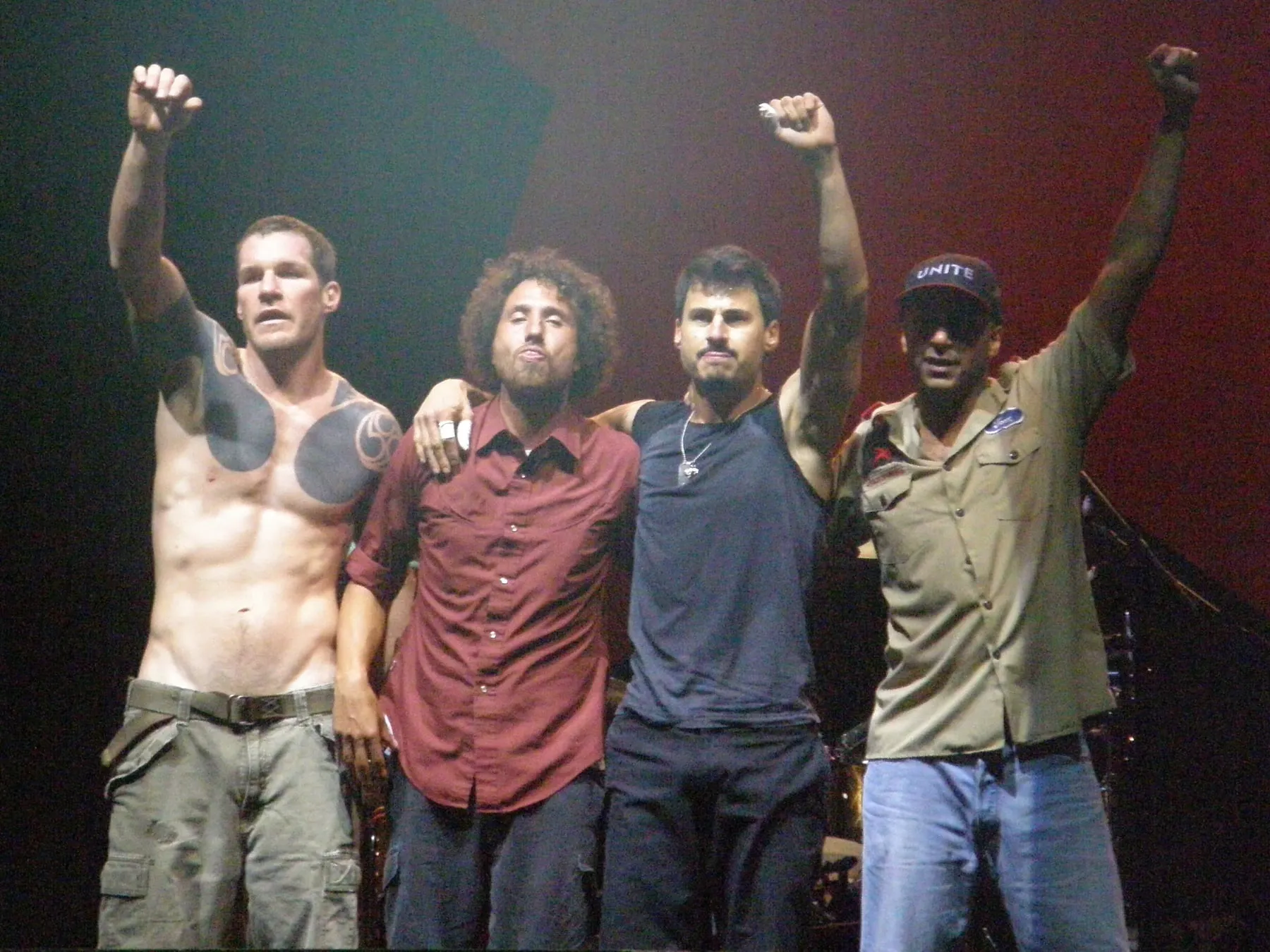
Photo by Penner , licensed under CC BY-SA 4.0 · Wikimedia Commons
Rank #43
Rage Against the Machine
Politically charged rap-rock whose riffs fused funk-metal and protest.
From Wikipedia
Rage Against the Machine was an American rock band formed in Los Angeles, California, in 1991. It consisted of vocalist Zack de la Rocha, bassist and backing vocalist Tim Commerford, guitarist Tom Morello, and drummer Brad Wilk. They melded heavy metal, rap, punk rock, and funk with anti-authoritarian, anti-capitalist, and revolutionary lyrics. As of 2010, they had sold over 16 million records worldwide. They were inducted into the Rock and Roll Hall of Fame in 2023.
Members
- Brad Wilk
- Tim Commerford
- Tom Morello
- Zack de la Rocha
Studio Albums
- 1992 Rage Against the Machine
- 1996 Evil Empire
- 1996 Protest And Survive
- 1999 The Battle of Los Angeles
- 2000 Renegades
Source: MusicBrainz
Deep Dive
Overview
Rage Against the Machine was an American rock band formed in Los Angeles in 1991 that redefined the boundaries between rap, heavy metal, punk, and funk. Built on the foundation of distorted guitars colliding with sampled breaks and spoken-word fury, the band created a sound that was simultaneously aggressive and grooved, politically uncompromising and commercially substantial. By the early 2000s, they had sold over 16 million records worldwide, a figure that underscored the potency of their fusion: a musical and lyrical vocabulary that spoke directly to late-Cold War disillusionment, anti-corporate sentiment, and calls for systemic change.
Formation Story
Rage Against the Machine came together in Los Angeles in 1991, bringing together four musicians with distinct but complementary backgrounds. Vocalist Zack de la Rocha, bassist and backing vocalist Tim Commerford, guitarist Tom Morello, and drummer Brad Wilk formed a unit that would soon become one of the most significant rock bands of the 1990s. Los Angeles in 1991 was a city in flux—economically stratified, culturally diverse, and politically volatile in the aftermath of the 1990 Gulf War and mounting urban inequality. The band’s emergence from this landscape was not accidental; their aesthetic and message were rooted in the specific conditions of their origin city, where neighborhoods had long been sites of tension between corporate expansion and grassroots resistance.
Breakthrough Moment
Rage Against the Machine announced themselves with devastating immediacy through their self-titled debut album in 1992. The record combined Tom Morello’s heavily distorted yet percussive guitar work—influenced by heavy metal but executed with a funk musician’s precision—with Zack de la Rocha’s rapid-fire vocals that sat somewhere between rap delivery and punk aggression. The album immediately distinguished itself in the marketplace by refusing conventional production polish; instead, songs sounded combative and urgent, built on the tension between melody and noise. The record’s commercial success was swift, and the band’s live reputation grew even faster, establishing them as a formidable touring force whose anarchic energy translated powerfully in front of audiences. By the mid-1990s, Rage Against the Machine had become one of the most visible rock acts in America, their imagery and lyrics appearing in college dormitories and activist spaces alike.
Peak Era
The band’s peak creative and commercial period extended from 1996 through the end of the decade. Evil Empire, released in 1996, consolidated the sonic innovations of their debut while deepening their political explicitness. That same year, they issued Protest and Survive, further establishing themselves as a relentless creative force. The Battle of Los Angeles followed in 1999, representing the fullest realization of their sound: intricate arrangements where drum and bass locked into polyrhythmic grooves, Morello’s guitar work incorporated effects and sampling that blurred the line between traditional rock instrumentation and electronic production, and de la Rocha’s vocals alternated between melodic singing and urgent recitation. During this era, the band was at their commercial peak while maintaining artistic integrity that refused compromise. Their touring schedule was grueling and deliberately linked to activist causes, transforming concerts into what felt like collective political gatherings rather than mere entertainment transactions.
Musical Style
Rage Against the Machine’s sound was a deliberate collision of genres—rap rock, funk metal, alternative metal—that had the effect of rendering all those categories simultaneously too narrow and too broad to contain them. Tom Morello’s guitar work was foundational to their identity: he employed heavy distortion and feedback characteristic of heavy metal, but deployed these techniques with the rhythmic sophistication and tonal variation of a funk or R&B musician. His use of the whammy bar, sampling, and effects created a texture that sounded almost vocal at times, allowing him to trade leads with Zack de la Rocha rather than occupy a separate instrumental space. Tim Commerford’s bass lines were equally crucial, often driving the groove with a syncopated precision that owed more to James Brown or Clinton-era Parliament-Funkadelic than to traditional rock bassist vocabularies. Brad Wilk’s drumming provided both the propulsive power of rock and the swing and pocket of funk, allowing songs to breathe rhythmically even when the guitars were at their most aggressive. De la Rocha’s vocal delivery was perhaps the most immediately striking element: his rapid-fire lyrical passages, delivered with a tone that conveyed anger and urgency without sacrificing clarity, drew on hip-hop vocal technique but retained the melodic sensibility of a rock frontman. The overall effect was music that seemed to contain multiple genres simultaneously rather than blend them into homogeneity.
Major Albums
Rage Against the Machine (1992)
The self-titled debut announced the band’s complete sonic identity and political orientation in one devastating statement, establishing the template for rap-rock fusion that would define the decade.
Evil Empire (1996)
Their second album consolidated their debut’s innovations while expanding the sonic palette, demonstrating that their initial impact was not a one-time phenomenon but the beginning of a sustained artistic vision.
The Battle of Los Angeles (1999)
This album represented the apex of their technical prowess and compositional sophistication, with arrangements that achieved remarkable density without sacrificing groove or impact.
Renegades (2000)
A collection of covers that revealed both the breadth of the band’s influences and their ability to recontextualize source material through their distinctive sonic lens.
Signature Songs
- Killing in the Name — An uncompromising attack on racism and police violence that became the band’s most recognizable anthem.
- Sleep Now in the Fire — A searing critique of capitalism and economic injustice delivered with melodic hooks that made the message impossible to ignore.
- Bulls on Parade — A showcase for the band’s rhythmic sophistication, where drum and bass interlocking creates propulsion for Morello’s effects-laden guitar work.
- Guerrilla Radio — A song that paired explicitly political lyrics about media control and resistance with one of Morello’s most memorable guitar hooks.
Influence on Rock
Rage Against the Machine demonstrated that political content and commercial success were not mutually exclusive, that rock music could address systemic critique without sacrificing musicality or energy. They proved that rap and rock could merge not as novelty crossover but as a fundamental stylistic synthesis, influencing countless bands to draw on hip-hop production techniques, sampling, and vocal delivery. Their insistence on connecting music to activism—refusing to perform at events that contradicted their politics, using their platform to amplify social movements—set a template for politically conscious rock bands in subsequent decades. They made it conceptually possible for bands to be simultaneously commercially massive and ideologically uncompromising.
Legacy
Rage Against the Machine’s induction into the Rock and Roll Hall of Fame in 2023 marked official recognition of their status as one of the most significant rock bands of their era. Their sales of over 16 million records worldwide, achieved during an era when rock radio still dominated popular music consumption, underscored the scale of their impact. The band’s influence extended beyond music into activism, with their concerts continuing to serve as galvanizing events for social movements long after their initial commercial peak. Their music remains a touchstone for understanding 1990s political culture and the ways rock music engaged with anti-authoritarian sentiment during that decade.
Fun Facts
- The band emerged from Los Angeles, a city that would become the setting for their acclaimed 1999 album The Battle of Los Angeles, making their geographic origin and artistic subject matter inseparable.
- Tom Morello’s guitar techniques, which created textures that sounded almost synthesized or sampled, were entirely acoustic in origin—achieved through physical manipulation and effects pedals rather than electronic instruments.
- Their commitment to political action was not separate from their music career but integral to it; the band consistently leveraged their commercial platform to amplify causes and movements aligned with their stated politics.
Discography & Previews
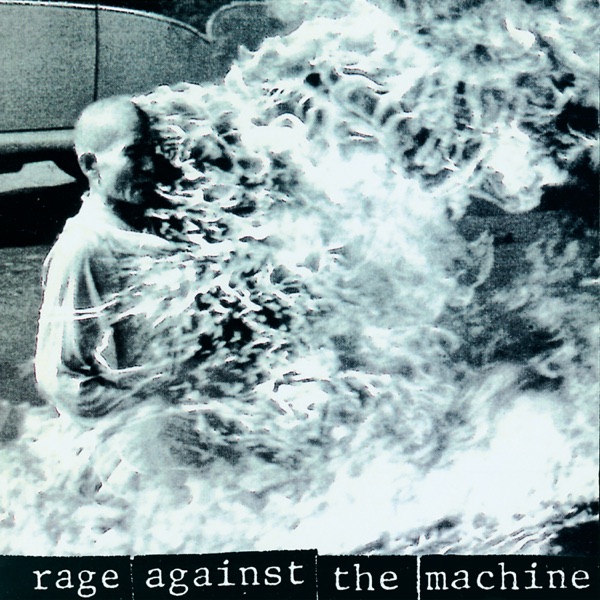
Click any album to expand its track list. Each track plays a 30-second preview streamed from Apple Music. Tap the link icon next to a track to open it in Apple Music for full playback.


- 1 Testify ↗ 3:30
- 2 Guerrilla Radio ↗ 3:26
- 3 Calm Like a Bomb ↗ 4:59
- 4 Mic Check ↗ 3:34
- 5 Sleep Now In the Fire ↗ 3:26
- 6 Born of a Broken Man ↗ 4:41
- 7 Born As Ghosts ↗ 3:22
- 8 Maria ↗ 3:48
- 9 Voice of the Voiceless ↗ 2:32
- 10 New Millennium Homes ↗ 3:45
- 11 Ashes In the Fall ↗ 4:37
- 12 War Within a Breath ↗ 3:36

- 1 Microphone Fiend ↗ 5:02
- 2 Pistol Grip Pump ↗ 3:17
- 3 Kick Out the Jams ↗ 3:11
- 4 Renegades of Funk ↗ 4:34
- 5 Beautiful World ↗ 2:35
- 6 I'm Housin' ↗ 4:56
- 7 In My Eyes ↗ 2:54
- 8 How I Could Just Kill a Man ↗ 4:05
- 9 The Ghost of Tom Joad ↗ 5:38
- 10 Down On the Street ↗ 3:39
- 11 Street Fighting Man ↗ 4:42
- 12 Maggie's Farm ↗ 6:34