
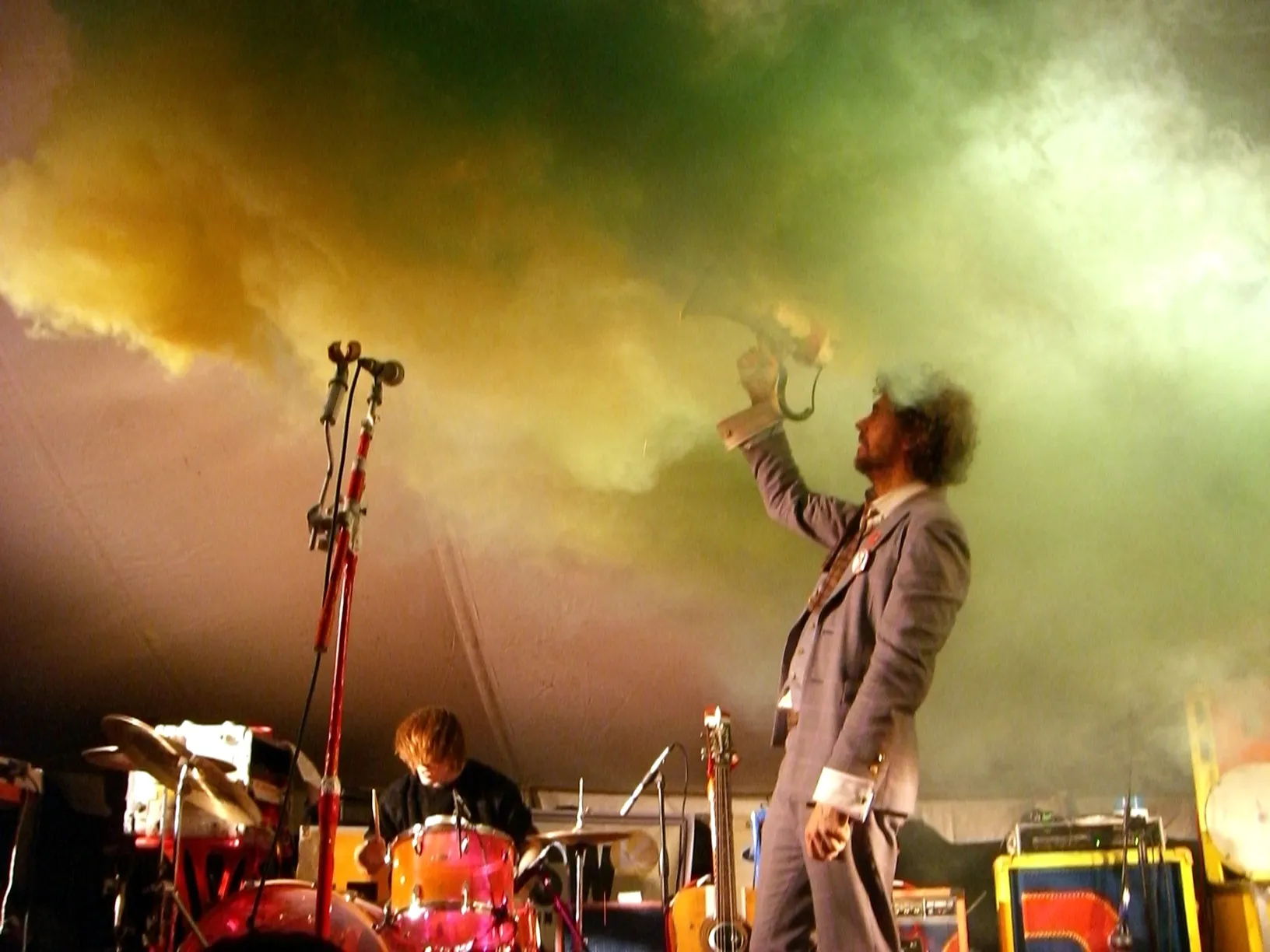
Photo by Flickr user Mrmatt , licensed under CC BY-SA 2.0 · Wikimedia Commons
Rank #458
The Flaming Lips
Oklahoma City psychedelic-rock band of cosmic ballads and confetti-cannon shows.
From Wikipedia
The Flaming Lips are an American psychedelic rock band formed in 1983 in Oklahoma City, Oklahoma. The band currently consists of Wayne Coyne, Derek Brown, Matt Duckworth Kirksey, AJ Slaughter and Tommy McKenzie (bass). Coyne is the only remaining founding member following the departure of bassist and keyboardist Michael Ivins in 2021. From 1991 to 2024, Steven Drozd played a crucial role in the band as co-songwriter and multi-instrumentalist.
Deep Dive
Overview
The Flaming Lips are an American psychedelic rock band formed in Oklahoma City in 1983. Emerging from a region with no established rock infrastructure, they built a career spanning four decades around Wayne Coyne’s production philosophy and the band’s willingness to fold electronic experimentation, orchestral arrangements, and multimedia spectacle into psychedelic rock frameworks. By the late 1990s and early 2000s, they had become one of the most recognizable alternative rock acts in the United States, known equally for intricate studio production and elaborate live shows featuring confetti cannons, giant inflatable structures, and synchronized visual accompaniment.
Formation Story
Wayne Coyne formed The Flaming Lips in Oklahoma City in 1983 during an era when the city offered no significant record label presence or touring infrastructure. The early lineup included Coyne alongside bassist and keyboardist Michael Ivins, establishing the foundational partnership that would shape the band’s sound through three decades. Steven Drozd joined as a multi-instrumentalist and co-songwriter, becoming the second major creative force within the group. The three-man core—Coyne, Ivins, and Drozd—remained largely intact from the early 1990s onward, giving the band unusual creative stability even as peripheral members rotated. Throughout the 1980s, the band issued experimental recordings and performed locally, building a loyal following without major-label support or radio airplay.
Breakthrough Moment
The band’s ascent into broader recognition accelerated with Transmissions From the Satellite Heart in 1993, which introduced their sound to college radio and independent rock audiences. Two years later, Clouds Taste Metallic (1995) solidified their reputation as serious studio craftsmen capable of balancing psychedelic songwriting with sophisticated production. The critical turning point arrived with The Soft Bulletin (1999), an album that married orchestral arrangement, string sections, and Coyne’s distinctive falsetto vocals into a cohesive vision of psychedelic pop. The album’s success positioned them for mainstream breakthrough, which materialized fully with Yoshimi Battles the Pink Robots (2002), a concept album that combined electronic production, childlike wonder, and complex songwriting into a work that transcended indie rock circles and reached audiences far beyond their traditional base.
Peak Era
The band’s most commercially successful and creatively ambitious period stretched from 1999 through the early 2010s. The Soft Bulletin, Yoshimi Battles the Pink Robots, and At War with the Mystics (2006) formed a trilogy of increasingly elaborate productions that defined their work at the highest level of ambition and execution. During this era, they evolved from a three-piece electronic rock group into a full ensemble capable of orchestral arrangements, extended song structures, and conceptual albums that rivaled progressive rock in scope while remaining rooted in psychedelic sensibility. Live performances became increasingly theatrical, with the band’s show design matching the sophistication of the recorded work. Embryonic (2009) continued this trajectory while exploring darker, more abstract sonic territory, demonstrating their refusal to calcify into a signature sound.
Musical Style
The Flaming Lips synthesized psychedelic rock with electronic production, space rock atmospherics, and an unusual openness to orchestral and pop songwriting. Early work leaned heavily into experimental textures and studio effects, with Coyne’s falsetto vocals often treated as an instrument rather than a conventional lead. As production techniques improved and the band’s resources increased, they incorporated live strings, synthesizers, drum machines, and layered vocal harmonies into arrangements that could suggest everything from 1970s progressive rock to contemporary electronic music. The band’s approach to dynamics favored sudden shifts in texture and volume, building from sparse, intimate arrangements to dense, multi-tracked crescendos. Steven Drozd’s multi-instrumental proficiency enabled the band to maintain flexibility in composition and arrangement, preventing the sound from settling into formula. By the 2000s, their studio productions had become notably intricate and laborious, with Coyne and Drozd working through meticulous overdubbing and production refinement to achieve their intended sound.
Major Albums
Transmissions From the Satellite Heart (1993)
Marked the band’s arrival as serious songwriters and producers, introducing the core aesthetic of orchestral psychedelia that would define their future work.
Clouds Taste Metallic (1995)
Demonstrated the band’s capability to balance psychedelic experimentation with accessible songwriting, establishing them as more than a novelty act.
The Soft Bulletin (1999)
An orchestral pop album that married ambitious string arrangements with psychedelic sensibilities, becoming a critical landmark and establishing the band as serious artists capable of sweeping emotional scope.
Yoshimi Battles the Pink Robots (2002)
A concept album that reached beyond indie rock audiences into mainstream success, balancing electronic production with direct, singable melodies and thematic coherence.
At War with the Mystics (2006)
Continued the band’s maximalist approach to production while incorporating more direct songwriting and broader genre influences.
Embryonic (2009)
A darker exploration of electronic textures and abstract compositional approaches, proving the band could evolve stylistically while maintaining their core identity.
Signature Songs
- “A Spoonful Weighs a Ton” — A melodic centerpiece showcasing Coyne’s falsetto and the band’s gift for orchestral arrangement.
- “Do You Realize??” — Perhaps their most widely recognized track, combining intimate lyrics with sweeping string arrangements.
- “A Parking Lot Experiments (With a Optimist)” — An early example of the band’s experimental studio approach and willingness to follow ideas without commercial consideration.
- “Race for the Prize” — A driving pop-psychedelic song demonstrating their ability to write direct, memorable hooks.
- “Waitin’ for a Superman” — A staple of their live shows and an example of their gift for building dynamic tension across a song’s duration.
Influence on Rock
The Flaming Lips demonstrated that psychedelic rock could survive and evolve in the post-grunge 1990s and beyond by embracing studio technology and orchestral arrangement rather than retreating into nostalgia or simplicity. Their use of electronic production alongside psychedelic songwriting influenced alternative rock bands seeking depth without abandoning accessibility. The sophistication of their studio approach—the layering, the orchestration, the conceptual ambition—helped establish that indie and alternative rock music could rival prog rock in complexity and ambition while remaining emotionally direct. Their willingness to make spectacle and visual design integral to their artistic statement influenced how rock bands approached live performance and multimedia integration, encouraging subsequent acts to think beyond conventional stage setups. The band’s longevity and refusal to calcify into a single sound provided a model for alternative rock acts navigating the shift from underground to mainstream visibility without compromising artistic integrity.
Legacy
The Flaming Lips remain active performers and recording artists, maintaining their position as one of the most enduring alternative rock acts from the 1990s. Wayne Coyne continues as the band’s leader and primary public face, with Steven Drozd having departed in 2024 after more than three decades as co-songwriter and multi-instrumentalist. Michael Ivins, the band’s founding bassist and keyboardist, remained a core member until 2021. The band’s studio catalog has remained consistently available and has experienced streaming-era revival as subsequent generations discover their work. Their live shows continue to attract audiences drawn equally to their musical sophistication and theatrical presentation. The band’s ability to maintain relevance across five decades while continuing to release new material distinguishes them from peers who relied more heavily on nostalgia or reunion tours. Their records remain touchstones of 1990s alternative rock and stand as examples of how psychedelic rock could evolve without abandoning its core aesthetic values.
Fun Facts
- The band released The Dark Side of the Moon in 2009, a live interpretation and reimagining of Pink Floyd’s 1973 album, demonstrating their ability to recontextualize canonical rock works through their own aesthetic lens.
- Wayne Coyne is known for his distinctive, quirky public persona and use of social media, maintaining an unusually direct connection with fans compared to peers from their era.
- The band’s live shows have become legendary for elaborate set design and confetti cannons, with the visual presentation of their performances rivaling the musical content in ambition and execution.
- Yoshimi Battles the Pink Robots spawned collaborative relationships with numerous artists and inspired remix versions and reinterpretations, demonstrating the album’s reach beyond traditional rock audiences.