
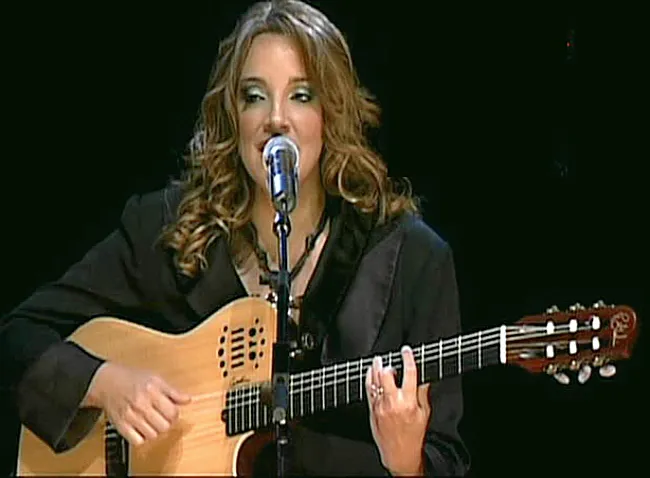
Photo by Ana_Carolina_Show_da_Turne_2_Quartos_em_BH_20_de_setembro_de_2009.JPG : Leonardo Ribeiro (Léééééo) derivative work: Yanguas ( talk ) , licensed under Public domain · Wikimedia Commons
Rank #486
Ana Carolina
From Wikipedia
Ana Carolina Sousa is a Brazilian pop rock singer, songwriter and musician.
Discography & Previews
Browse through and click an album to open and play 30-second previews streamed from Apple Music.
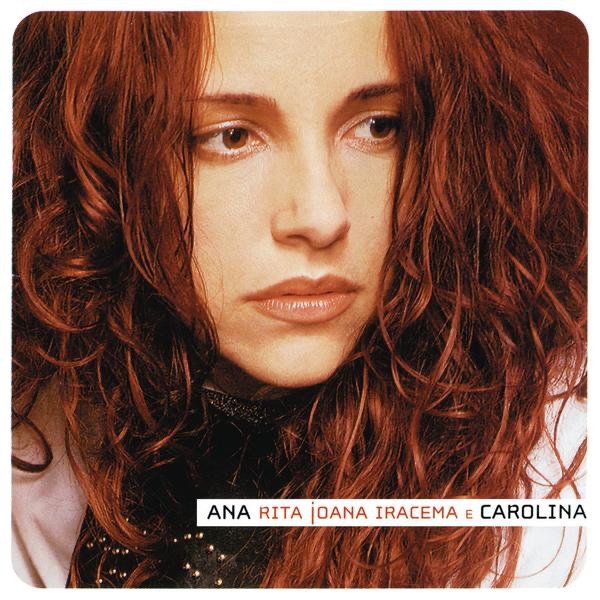
Ana Rita Joana Iracema e Carolina
2001 · 15 tracks
- 1 O Rio ↗ 3:14
- 2 Confesso ↗ 3:29
- 3 Ela é Bamba ↗ 3:06
- 4 Implicante ↗ 3:16
- 5 Quem de Nós Dois (La Mia Storia Tra Le Dita) ↗ 5:06
- 6 Pra Terminar ↗ 4:39
- 7 Que Será ↗ 3:45
- 8 Joana ↗ 3:19
- 9 Violão e Voz ↗ 4:18
- 10 Vê Se Me Esquece ↗ 4:34
- 11 A Câmera Que Filma os Dias ↗ 3:24
- 12 Dadivosa ↗ 3:12
- 13 Que Se Danem os Nós ↗ 3:36
- 14 Eu Nunca Te Amei Idiota ↗ 3:49
- 15 Me Sento na Rua ↗ 2:57
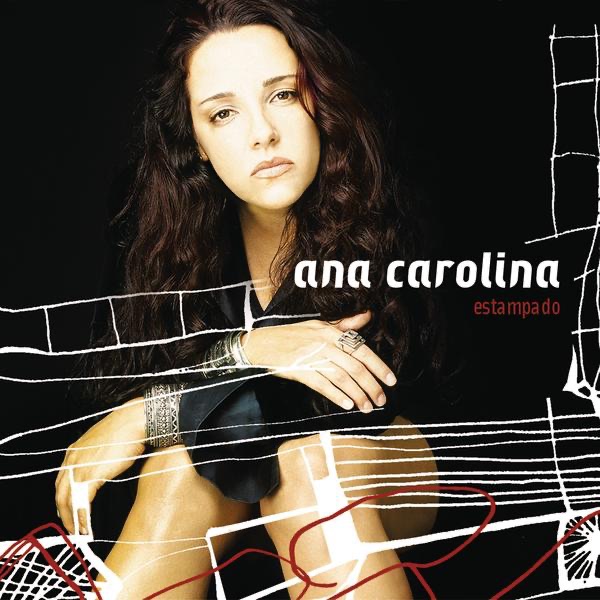
Estampado
2003 · 15 tracks
- 1 Hoje Eu Tô Sozinha ↗ 4:31
- 2 Encostar na Tua ↗ 4:11
- 3 2 Bicudos ↗ 3:57
- 4 Elevador (Livro de Esquecimento) ↗ 3:16
- 5 Só Fala em Mim ↗ 3:46
- 6 É Hora da Virada ↗ 3:08
- 7 Uma Louca Tempestade ↗ 4:31
- 8 Pra Rua Me Levar ↗ 3:50
- 9 É Mágoa ↗ 4:09
- 10 Mais Que Isso ↗ 3:55
- 11 Vox Populi ↗ 2:25
- 12 Vestido Estampado ↗ 3:05
- 13 Nua ↗ 4:04
- 14 Não Fale Desse Jeito ↗ 3:23
- 15 O Beat da Beata ↗ 3:57

Ana E Jorge
2005 · 15 tracks
- 1 São Gonça (Ao Vivo) ↗ 4:57
- 2 Problema Social (Ao Vivo) ↗ 4:14
- 3 Zé do Caroço (Ao Vivo) ↗ 4:12
- 4 Carolina (Ao Vivo) ↗ 4:49
- 5 Comparsas / O Pequenez e o Pit Bull (Ao Vivo) ↗ 4:57
- 6 Tanta Saudade (Ao Vivo) ↗ 3:22
- 7 É Isso Aí (The Blower's Daughter) [Ao Vivo] ↗ 5:18
- 8 Prá Rua Me Levar (Ao Vivo) ↗ 3:42
- 9 Chatterton (Ao Vivo) ↗ 4:22
- 10 Beatriz (Ao Vivo) ↗ 6:41
- 11 Brasil Corrupção (Unimultiplicidade) [Ao Vivo] ↗ 2:50
- 12 Mais Que Isso (Ao Vivo) ↗ 2:29
- 13 Garganta (Ao Vivo) ↗ 4:19
- 14 Vestido Estampado (Ao Vivo) ↗ 3:51
- 15 O Beat da Beata (Ao Vivo) ↗ 5:34

Dois quartos
2006 · 24 tracks
- 1 Nada Te Faltará ↗ 4:37
- 1 La Critique (Instrumental) ↗ 5:21
- 2 Tolerância ↗ 3:47
- 2 Então Vá Se Perder ↗ 5:40
- 3 Ruas de Outono ↗ 3:58
- 3 Carvão ↗ 3:23
- 4 Aqui ↗ 4:18
- 4 Manhã ↗ 5:14
- 5 Rosas ↗ 3:35
- 5 Homens e Mulheres ↗ 4:45
- 6 Um Edifício No Meio do Mundo ↗ 3:22
- 6 Corredores ↗ 4:59
- 7 Vai ↗ 4:36
- 7 Sen.Ti.Mentos (Instrumental) ↗ 4:45
- 8 O Cristo de Madeira ↗ 3:07
- 8 Cantinho ↗ 2:15
- 9 Eu Comi a Madona ↗ 2:17
- 9 Eu Não Paro ↗ 4:29
- 10 1.100,00 (Nega Marrenta) ↗ 2:57
- 10 Claridade ↗ 4:44
- 11 Chevette ↗ 2:02
- 11 Milhares de Sambas ↗ 1:57
- 12 Notícias Populares ↗ 3:09
- 12 Eu Comi a Madona (Remix) ↗ 3:36

#AC
2013 · 13 tracks
- 1 Pole Dance ↗ 3:18
- 2 Esperta ↗ 2:14
- 3 Libido ↗ 3:19
- 4 Combustível ↗ 3:40
- 5 Resposta da Rita (feat. Chico Buarque) ↗ 2:21
- 6 Pelo iPhone ↗ 2:45
- 7 Mais Forte ↗ 3:19
- 8 Bang Bang 2 ↗ 3:31
- 9 Canção Pra Ti ↗ 3:47
- 10 Un Sueño Bajo el Água (feat. Chiara Civello) ↗ 3:23
- 11 Luz Acesa (Bonus Track) ↗ 3:36
- 12 Leveza de Valsa (feat. Guinga) [Bonus Track] ↗ 3:55
- 13 Eu Sei Que Vou Te Amar ↗ 3:17

Fogueira em alto mar
2019 · 11 tracks
- 1 Não Tem no Mapa ↗ 2:40
- 2 Fogueira em Alto Mar ↗ 3:22
- 3 O Tempo se Transforma em Memória ↗ 2:16
- 4 Da Vila Vintém ao Fim do Mundo (feat. Elza Soares) ↗ 3:22
- 5 1296 Mulheres ↗ 2:53
- 6 Canção Antiga ↗ 3:52
- 7 Tudo e Mais Um Pouco ↗ 3:14
- 8 Dias Roubados ↗ 3:42
- 9 Outra Vez Você ↗ 3:29
- 10 Com Vista para Amar ↗ 2:35
- 11 O Que É Que Há? ↗ 3:41
-
 Ana Rita Joana Iracema e CarolinaAna Carolina200115 tracks
 -
 EstampadoAna Carolina200315 tracks
 -
 Ana E JorgeAna Carolina200515 tracks
 -
 Dois quartosAna Carolina200624 tracks
 -
 #ACAna Carolina201313 tracks
 -
 Fogueira em alto marAna Carolina201911 tracks
Deep Dive
Overview
Ana Carolina Sousa stands as a significant figure in Brazilian pop rock, a solo artist whose career spans from the late 1990s into the present day. Her work synthesizes multiple currents in Brazilian popular music—the harmonic and lyrical traditions of música popular brasileira (MPB), the contemporary energy of rock music, and the accessibility of pop songwriting. As both a performer and songwriter, she has maintained a steady recording presence and recording relationship with Sony Music, establishing herself as a durable voice in a music landscape where Brazilian rock and pop-rock remain vital if often internationally underrecognized genres.
Formation Story
Ana Carolina’s emergence as a recording artist came in the late 1990s, a moment when Brazilian pop rock was consolidating its foothold in the country’s mainstream music industry. Her solo debut, Ana Carolina, arrived in 1999 and marked the beginning of a recording career that would span multiple decades. Unlike artists who emerged from a specific regional scene or moment of cultural ferment, Carolina established herself through album releases on a major label, building her audience through the standard mechanisms of the contemporary music industry—studio recordings, performance, and the gradual accumulation of songs in the popular repertoire. Her background in songwriting and musicianship positioned her not merely as a vocalist but as a creative author of her material, a distinction that would define her trajectory.
Breakthrough Moment
Carolina’s initial period of recording activity saw the release of three albums across four years: the self-titled debut in 1999, followed by Ana Rita Joana Iracema e Carolina in 2001, and Estampado in 2003. This concentrated burst of output established her name and songwriting voice in Brazilian popular music. The early 2000s represented a period of consolidation in her career, as she worked to build recognition beyond her initial audience and prove the durability of her artistic approach. By the time of Estampado, Carolina had moved beyond the status of a new artist and was becoming known as a consistent recording presence in Brazilian pop rock.
Peak Era
The mid-2000s through early 2010s constituted Carolina’s most prolific and visible period. She released Ana E Jorge in 2005, a collaborative project that expanded her range, followed by Dois quartos in 2006, which demonstrated her continued focus on songwriting and pop-rock sensibility. The 2009 album N9ve marked another step forward, while 2013’s #AC showed her adapting to contemporary marketing and digital-era release strategies. Throughout this period, Carolina maintained her recording contract with Sony Music and continued to perform, remaining a working musician in the Brazilian music industry during decades when international attention to Brazilian rock remained limited.
Musical Style
Ana Carolina’s music draws from multiple Brazilian and international sources. The foundation lies in música popular brasileira—a tradition emphasizing sophisticated lyrical content, harmonic complexity, and a songwriter’s sensibility. Atop this foundation, she places rock music’s drive and contemporary pop music’s accessibility and song structures. Her approach as a solo artist emphasizes songwriting and vocal delivery rather than band dynamics or a single signature sound. Her work sits in the landscape where MPB meets contemporary pop and rock, a space occupied by various Brazilian artists who reject the division between traditional and modern, national and international influences. The emphasis throughout her discography is on craft—the construction of songs that balance lyrical meaning with musical interest.
Major Albums
Ana Carolina (1999)
Her self-titled debut established her songwriting voice and pop-rock sensibility, introducing her as a serious songwriter rather than a stylistic novelty.
Estampado (2003)
Released as her third album in four years, Estampado consolidated her position in Brazilian pop rock and demonstrated her ability to sustain both commercial and artistic interest across multiple releases.
Ana E Jorge (2005)
A collaborative project that broadened her artistic palette and reached listeners through partnership with another established performer, marking an evolution in her approach to recording.
N9ve (2009)
This album represented a continuation of her established style while keeping her work current within contemporary Brazilian pop-rock trends.
#AC (2013)
The use of a hashtag in the title reflected 2010s-era digital culture, while the album itself maintained her pop-rock core and songwriting emphasis.
Signature Songs
- **