
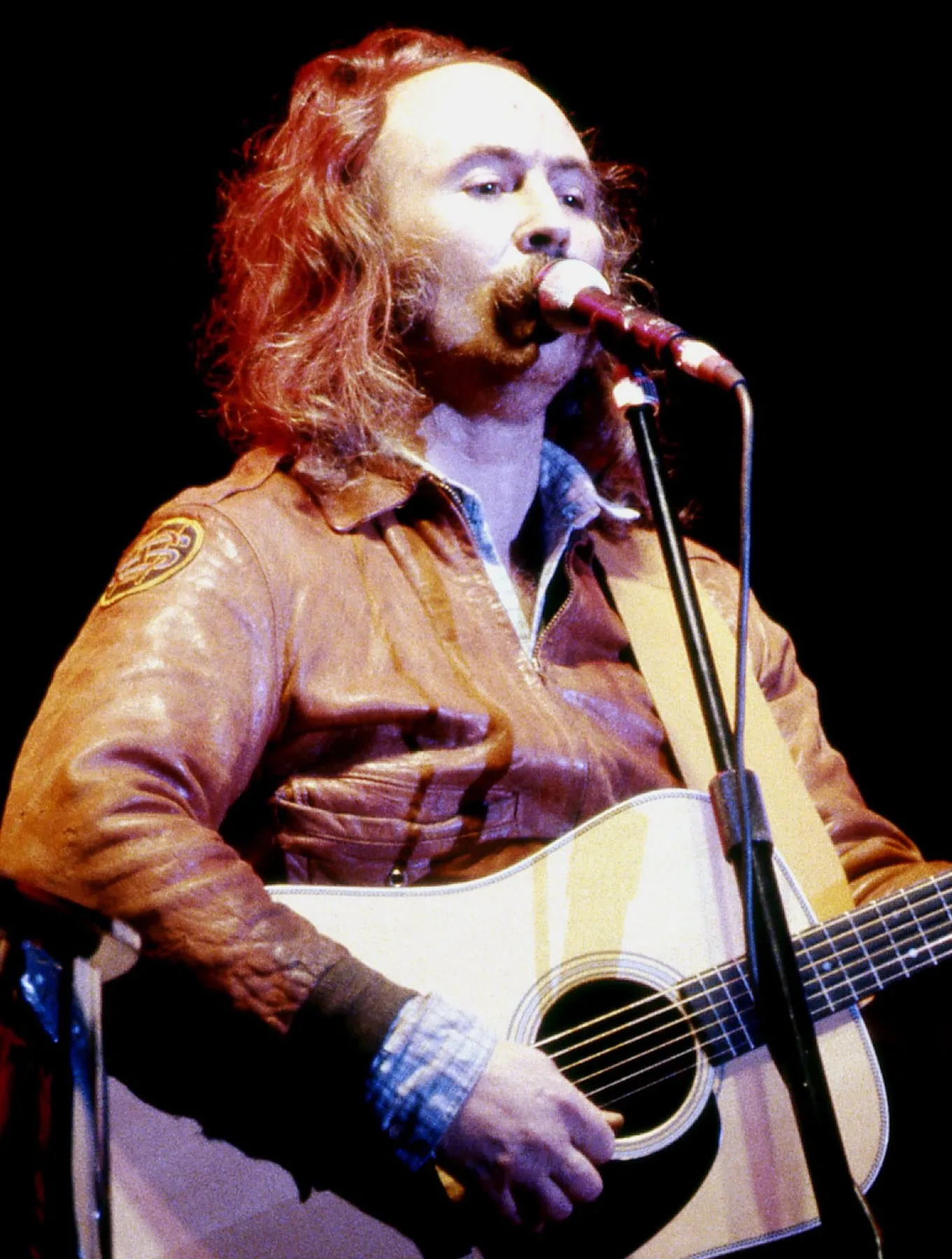
Photo by Eddi Laumanns aka RX-Guru , licensed under CC BY 3.0 · Wikimedia Commons
Rank #232
David Crosby
From Wikipedia
David Van Cortlandt Crosby was an American singer, songwriter, and guitarist. He first found fame as a member of the Byrds, with whom he helped pioneer the genres of folk rock and psychedelia in the mid-1960s, and later as part of the supergroup Crosby, Stills & Nash, which helped popularize the California sound of the 1970s. In addition to his music, Crosby was known for his outspoken personality, politics, and personal troubles: he was sometimes depicted as emblematic of the counterculture of the 1960s.
Discography & Previews
Browse through and click an album to open and play 30-second previews streamed from Apple Music.
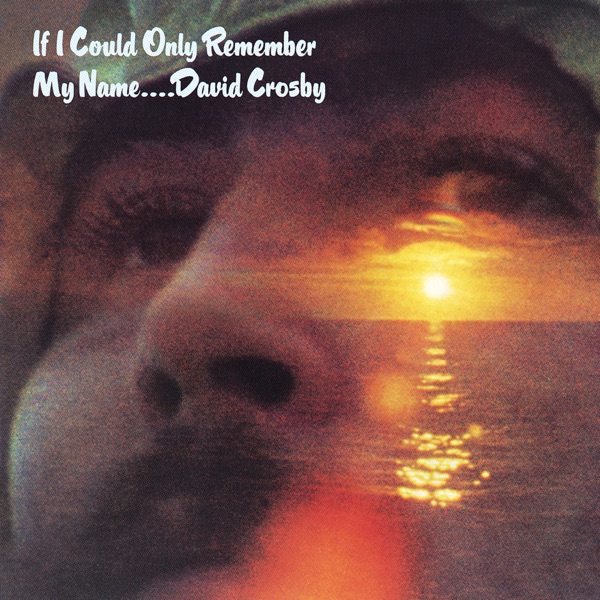
If I Could Only Remember My Name
1971 · 9 tracks

Oh Yes I Can
1989 · 11 tracks


Lighthouse
2016 · 9 tracks


Here If You Listen
2018 · 11 tracks
- 1 Glory (feat. Michael League, Becca Stevens & Michelle Willis) ↗ 5:21
- 2 Vagrants of Venice (feat. Michael League, Becca Stevens & Michelle Willis) ↗ 4:06
- 3 1974 (feat. Michael League, Becca Stevens & Michelle Willis) ↗ 3:00
- 4 Your Own Ride (feat. Michael League, Becca Stevens & Michelle Willis) ↗ 4:35
- 5 Buddha on a Hill (feat. Michael League, Becca Stevens & Michelle Willis) ↗ 4:07
- 6 I Am No Artist (feat. Michael League, Becca Stevens & Michelle Willis) ↗ 4:38
- 7 1967 (feat. Michael League, Becca Stevens & Michelle Willis) ↗ 3:19
- 8 Balanced on a Pin (feat. Michael League, Becca Stevens & Michelle Willis) ↗ 4:30
- 9 Other Half Rule (feat. Michael League, Becca Stevens & Michelle Willis) ↗ 4:34
- 10 Janet (feat. Michael League, Becca Stevens & Michelle Willis) ↗ 3:27
- 11 Woodstock (feat. Michael League, Becca Stevens & Michelle Willis) ↗ 3:35

For Free
2021 · 10 tracks
-
 If I Could Only Remember My NameDavid Crosby19719 tracks
 -
 Oh Yes I CanDavid Crosby198911 tracks
 -
 Thousand RoadsDavid Crosby199310 tracks
 -
 CrozDavid Crosby201411 tracks
 -
 LighthouseDavid Crosby20169 tracks
 -
 Sky TrailsDavid Crosby201710 tracks
 -
 Here If You ListenDavid Crosby201811 tracks
 -
 For FreeDavid Crosby202110 tracks
Deep Dive
Overview
David Crosby (1941–2023) was an American singer, songwriter, and guitarist whose influence extended across two pivotal eras of rock music. He first achieved prominence as a member of the Byrds in the mid-1960s, where he played a foundational role in the emergence of folk rock and psychedelia. Later, as a founding member of Crosby, Stills & Nash, he became central to the sophisticated, harmony-driven California sound that dominated the 1970s. Across six decades of music-making, Crosby remained a restless experimenter and a polarizing public figure—celebrated for his harmonic sensibilities and songwriting, scrutinized for his outspoken political views and personal struggles that made him, in many eyes, emblematic of the counterculture he helped soundtrack.
Formation Story
David Van Cortlandt Crosby was born in 1941 and came of age during the folk boom of the late 1950s and early 1960s. The folk music revival and the emerging rock-and-roll landscape provided the dual currents into which he stepped as a young musician. By the early 1960s, Crosby had absorbed both the acoustic tradition of folk and the electric energy of early rock, positioning himself to bridge the two idioms at a moment when that fusion felt urgent and possible. His path to prominence came through joining the Byrds, a Los Angeles-based ensemble that would become the laboratory for some of rock’s most significant experiments with genre and studio production.
Breakthrough Moment
The Byrds’ 1965 hit “Mr. Tambourine Man,” a folk-rock reimagining of a Bob Dylan composition, introduced Crosby to a mass audience and established the sound that would define the band’s early era. Crosby’s contribution to the Byrds’ harmonic architecture and his role in the group’s creative direction helped establish folk rock as a major commercial and artistic force. The band’s subsequent work—including their ventures into psychedelia—cemented Crosby’s reputation as a musician unafraid to chase sonic innovation. His tenure with the Byrds, though marked by creative friction and occasional departures, produced some of the decade’s most influential records and proved his capacity to shape the direction of a successful ensemble.
Peak Era
Crosby’s creative and commercial peak came in the late 1960s and 1970s, particularly through his work with Crosby, Stills & Nash. The supergroup, which brought together Crosby, Stephen Stills, and Graham Nash, helped define the California sound—a blend of rock, folk, country, and pop sensibilities marked by sophisticated vocal harmonies and introspective songwriting. This period saw Crosby operating at the height of his influence, both as a voice in the counterculture conversation and as a musician whose harmonic sophistication and melodic intuition shaped the sound of an era. His solo work during this span, beginning with If I Could Only Remember My Name in 1971, established him as a solo artist capable of ambitious, genre-fluid albums that drew on rock, folk, country rock, and jazz fusion.
Musical Style
Crosby’s musical signature rested on his warm, precise tenor voice and his distinctive approach to harmony. Whether in ensemble settings or as a solo artist, he favored lush vocal arrangements, intricate chord progressions, and a production sensibility that valued clarity and instrumental texture. His songwriting leaned toward introspective, often poetic lyrics that reflected both personal preoccupations and broader cultural concerns. As a guitarist, Crosby contributed rhythm parts and occasional fingerpicking that served the song’s emotional center rather than seeking virtuosic display. Over his career, his musical palette expanded to encompass country rock, jazz fusion, and other idioms, but his fundamental approach—emphasizing harmony, melody, and lyrical substance—remained consistent. His voice aged and changed across his decades of recording, yet the essential character of his musicianship persisted.
Major Albums
If I Could Only Remember My Name (1971)
Crosby’s solo debut established him as a sophisticated arranger and composer capable of ambitious, genre-fluid work. The album blended rock, folk, and jazz influences with a production approach that highlighted orchestration and vocal layering, showcasing his harmonic gifts in an intimate, experimental context.
Oh Yes I Can (1989)
Released after a period away from recording, this album marked Crosby’s return to the studio and demonstrated his continued engagement with contemporary production techniques while maintaining his core sensibility around melody and harmony.
Thousand Roads (1993)
This collaborative effort revealed Crosby’s willingness to work with younger musicians and producers, exploring contemporary arrangements without abandoning the harmonic sophistication that had always defined his work.
Croz (2014)
A late-career return to form, Croz found Crosby working with producer Jon Batiste and reflected his enduring commitment to songwriting and vocal excellence, proving that his core strengths remained vital decades into his career.
Signature Songs
- “Eight Miles High” (the Byrds) — A pioneering psychedelic rock composition that showcased the band’s willingness to experiment with feedback, modal improvisation, and studio effects.
- “Guinnevere” — A solo composition highlighting Crosby’s gift for romantic, introspective songwriting and his sophisticated harmonic sensibility.
- “Almost Cut My Hair” (Crosby, Stills, Nash & Young) — A rock song that doubled as cultural commentary, becoming an anthem of 1970s counterculture.
- “Our House” (Crosby, Stills & Nash) — A serene, harmonically rich composition that epitomized the sophisticated California sound of the early 1970s.
Influence on Rock
Crosby’s influence on rock music operated at multiple levels. First, his work with the Byrds helped establish folk rock as a viable and artistically significant genre, proving that acoustic traditions and rock electricity could coexist and enrich each other. Second, his harmonic sophistication elevated the standard for vocal arranging in rock music; the lush, complex vocal textures that became standard in 1970s rock owed much to the precedent set by Crosby, Stills & Nash. Third, his work as a solo artist demonstrated the viability of the singer-songwriter model within a rock context—showing that a rock musician could pursue ambitious, genre-blending solo work alongside or apart from band commitments. His outspoken political and cultural commentary also positioned rock musicians as voices expected to engage with the ideas and conflicts of their moment.
Legacy
David Crosby died on January 19, 2023, leaving behind six decades of recordings and a reputation as one of rock’s most influential harmony vocalists and arrangers. His extensive catalog—including work with the Byrds, Crosby, Stills & Nash, and as a solo artist—remains widely streamed and studied by musicians interested in the history of folk rock, psychedelia, and the California sound. The Byrds and Crosby, Stills & Nash are regarded as canonical figures in rock history, their influence visible in countless subsequent artists. Crosby’s late-career albums demonstrated that he remained engaged with his craft and willing to explore contemporary production and collaboration; his final solo releases reached dedicated audiences and critical appreciation. His life, marked by creative achievement and personal turbulence in equal measure, became emblematic of the promises and perils of the counterculture he helped soundtrack.
Fun Facts
- Crosby’s early harmonic experiments with the Byrds involved extensive studio overdubbing and layering, techniques that became foundational to the California sound’s sophisticated vocal textures.
- His songwriting contributions to the Byrds included compositions that blended acoustic folk sensibilities with electric rock production, establishing the folk-rock hybrid that defined the band’s early identity.
- As a member of Crosby, Stills & Nash, Crosby participated in one of rock’s most successful supergroups, a project that brought together three established singer-songwriters and produced some of the era’s most commercially successful and artistically ambitious albums.
- Crosby’s solo work spanned five decades, from 1971 to 2021, demonstrating an unusual longevity and willingness to continue recording and touring throughout his life.