
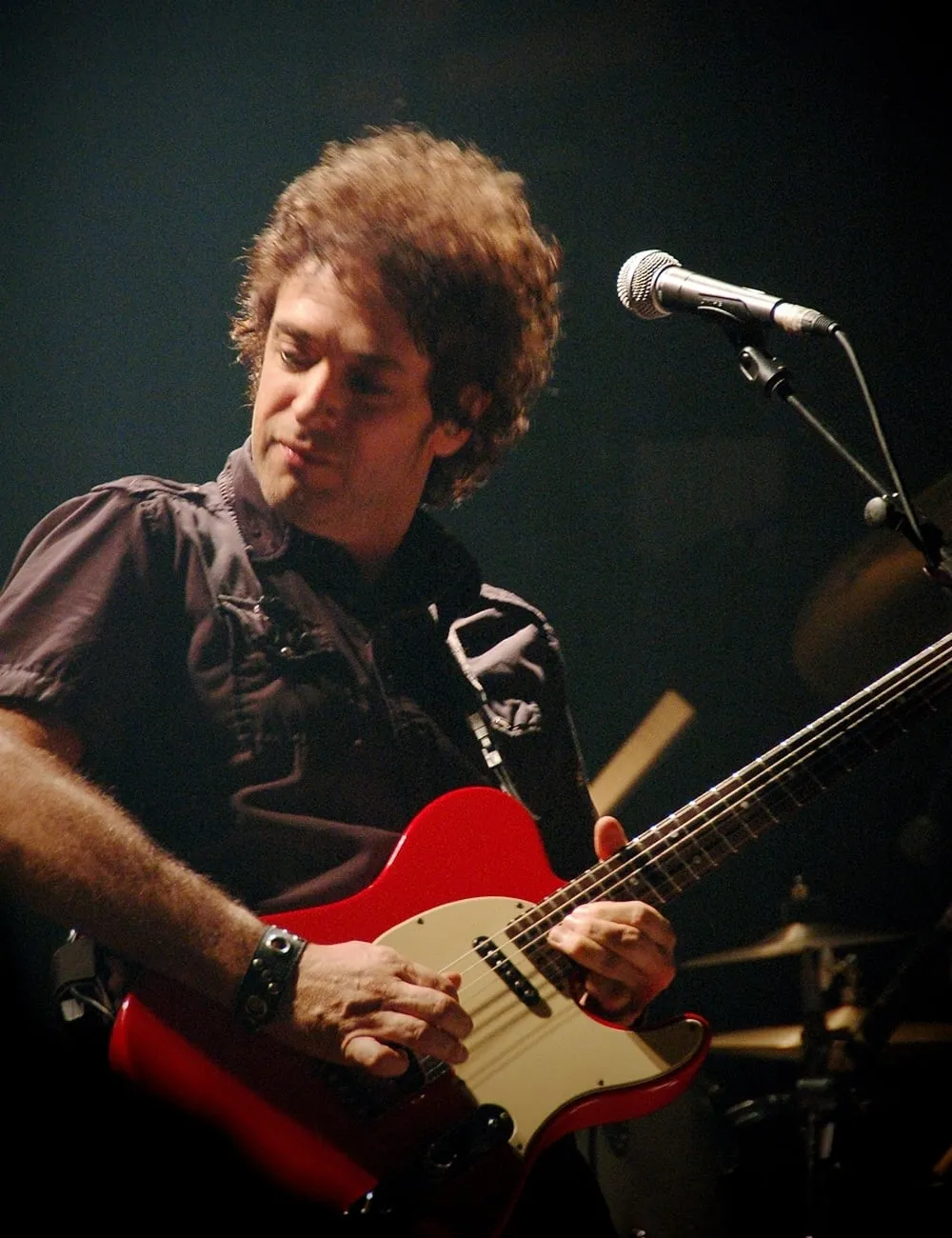
Photo by Camilo Rueda López , licensed under CC BY-SA 3.0 · Wikimedia Commons
Rank #162
Gustavo Cerati
From Wikipedia
Gustavo Adrián Cerati Clark was an Argentine musician and singer-songwriter who gained international recognition for being the leader, vocalist, composer, and guitarist of the rock band Soda Stereo. He is widely considered by critics and musicians as one of the most important and influential artists of Latin rock.
Discography & Previews
Browse through and click an album to open and play 30-second previews streamed from Apple Music.


Bocanada
1999 · 15 tracks
- 1 Tabú ↗ 4:48
- 2 Engaña ↗ 4:12
- 3 Bocanada ↗ 4:07
- 4 Puente ↗ 4:34
- 5 Río Babel ↗ 4:44
- 6 Beautiful ↗ 6:13
- 7 Perdonar Es Divíno ↗ 5:18
- 8 Verbo Carne ↗ 4:42
- 9 Raíz ↗ 4:04
- 10 Y Si el Humo Está en Foco... ↗ 4:56
- 11 Paseo Inmoral ↗ 5:31
- 12 Aquí & Ahora (Los Primeros 3 Minutos) ↗ 3:54
- 13 Aquí & Ahora (y Después) ↗ 2:38
- 14 Alma ↗ 4:37
- 15 Balsa ↗ 5:08

Siempre es hoy
2002 · 17 tracks
- 1 Cosas Imposibles ↗ 5:06
- 2 No Te Creo ↗ 3:47
- 3 Artefacto ↗ 4:17
- 4 Naci Para Esto ↗ 3:10
- 5 Amo Dejarte Así ↗ 5:25
- 6 Tu Cicatriz en Mi ↗ 4:17
- 7 Señales Luminosas ↗ 3:24
- 8 Karaoke ↗ 3:54
- 9 Sulky ↗ 4:29
- 10 Casa ↗ 4:32
- 11 Camuflaje ↗ 3:55
- 12 Altar ↗ 4:02
- 13 Torre de Marfil ↗ 4:39
- 14 Fantasma ↗ 3:20
- 15 Vívo ↗ 4:21
- 16 Sudestada ↗ 4:31
- 17 Especie ↗ 3:43

Ahí vamos
2006 · 13 tracks

Fuerza natural
2009 · 14 tracks
-
 Colores santosGustavo Cerati199211 tracks
 -
 Amor amarilloGustavo Cerati199311 tracks
 -
 BocanadaGustavo Cerati199915 tracks
 -
 Siempre es hoyGustavo Cerati200217 tracks
 -
 Ahí vamosGustavo Cerati200613 tracks
 -
 Fuerza naturalGustavo Cerati200914 tracks
Deep Dive
Overview
Gustavo Adrián Cerati Clark was an Argentine musician, singer-songwriter, and guitarist whose career spanned from 1959 to 2014. He is best known as the leader, vocalist, composer, and guitarist of Soda Stereo, the rock band that became a defining force in Latin American rock music. Beyond his work with the band, Cerati established himself as a solo artist of considerable depth, recording six studio albums between 1992 and 2009 that showcased his evolution as a songwriter and his command of multiple musical idioms—from art pop and symphonic rock to indie rock, electronic music, and folk influences.
Formation Story
Born in Buenos Aires in 1959, Cerati grew up in Argentina during a period of significant cultural and political turbulence. He emerged from the Argentine rock scene of the 1980s, a fertile landscape where local musicians were synthesizing British new wave, post-punk, and alternative rock with their own regional sensibilities. Rather than remaining confined to a single project, Cerati’s early artistic identity was shaped by his role in Soda Stereo, the band he co-founded and led through the 1980s and 1990s. The combination of his technical proficiency on guitar, his melodic sensibility, and his capacity as a composer positioned him as the creative center of that ensemble, allowing him to experiment with songwriting approaches that would later define his solo work.
Breakthrough Moment
Cerati’s transition to a sustained solo career began in earnest in 1992 with the release of Colores santos, his debut album. This record marked a deliberate shift in artistic direction, moving away from the band context and into a more introspective, individually crafted sound. The follow-up, Amor amarillo in 1993, further established his credentials as a solo composer. These early records demonstrated that his songwriting gifts were not contingent on the Soda Stereo framework; rather, they revealed a more expansive artistic vision that could encompass personal lyricism and varied sonic textures. By the mid-1990s, Cerati had proven that his influence on Latin rock extended beyond the band that had made him famous, opening doors for collaborations and creative experiments that would occupy the rest of his career.
Peak Era
Cerati’s most creatively accomplished solo period came between 1999 and 2006, beginning with Bocanada and extending through Siempre es hoy and Ahí vamos. These three albums represented the fullest flowering of his artistry as a solo composer—a period in which he synthesized influences ranging from symphonic rock and art pop to electronic and indie rock production techniques. Bocanada in particular demonstrated a maturity and cohesion that established Cerati as more than a former band member pursuing a side project; it was a major statement that cemented his status as one of the most important voices in Latin rock. The albums that followed maintained that level of sophistication while continuing to explore new territory, incorporating electronic textures and varied production approaches that reflected both contemporary studio practices and his own evolving sensibility.
Musical Style
Cerati’s musical identity was fundamentally shaped by his mastery of the guitar and his understanding of melody as a primary compositional element. As a singer-songwriter, he wielded Spanish-language lyrics with precision and emotional clarity, using narrative and introspection as central tools. His solo work drew from a broad palette: the art pop sensibility of early 1970s progressive rock, the energy and directness of 1980s new wave and post-punk, the atmospheric textures of electronic music, and the understated intimacy of folk traditions. His production choices often favored clarity and space over density, allowing individual instruments and vocal lines to emerge distinctly. Over his solo career, the production became increasingly layered and texturally sophisticated, reflecting both technological evolution and his own deepening engagement with the studio as an instrument. Throughout all these stylistic shifts, Cerati’s commitment to strong melodies and emotionally articulate songwriting remained constant.
Major Albums
Colores santos (1992)
Cerati’s debut solo album established the template for his work outside Soda Stereo: introspective songwriting, strong melodic content, and a willingness to blend rock instrumentation with pop sensibility.
Amor amarillo (1993)
Following quickly on his debut, this album further refined his solo voice and demonstrated his range as a composer across multiple emotional registers.
Bocanada (1999)
This album is widely recognized as a watershed moment in Cerati’s solo career, combining symphonic rock arrangements with art pop sophistication and establishing him as a major solo artist independent of Soda Stereo’s legacy.
Siempre es hoy (2002)
Continuing his creative momentum, this record deepened his exploration of electronic textures and production innovation while maintaining his trademark melodic strength.
Ahí vamos (2006)
Released at the height of his solo powers, this album showcased Cerati’s ability to balance accessibility with artistic ambition, drawing on influences from indie rock and contemporary production techniques.
Fuerza natural (2009)
Cerati’s final studio album demonstrated his continued evolution as a songwriter and his willingness to incorporate folk and acoustic elements into his increasingly varied sonic palette.
Signature Songs
- “Bocanada” — The title track from his breakthrough 1999 album, representing a peak of his songwriting craft and emotional directness.
- “Crimen” — A composition that showcased his gift for melody and narrative lyrical content within a pop-rock framework.
- “Amnesia” — A track that exemplified his sophisticated approach to production and arrangement in the solo context.
- “De mi” — Demonstrating his ability to craft intimate, introspective moments within larger compositional frameworks.
Influence on Rock
Cerati’s influence on Latin American rock cannot be overstated. As the leader of Soda Stereo, he helped establish rock music sung in Spanish as a viable and artistically serious medium in the 1980s and 1990s. His solo career extended that influence by demonstrating that the depth and sophistication of his artistry transcended the specific context of his most famous band. He showed that rock musicians from outside the Anglo-American heartland could create work of international significance without abandoning their linguistic and cultural roots. His synthesis of British post-punk and new wave with Argentine sensibility created a template that influenced multiple generations of Latin American rock musicians, from indie rock bands to art-pop experimenters. Cerati’s solo albums, in particular, demonstrated the creative possibilities available to rock artists willing to engage seriously with production techniques, electronic music, and the full range of contemporary songwriting approaches.
Legacy
Gustavo Cerati died in 2014, leaving behind a body of work that continues to resonate deeply in Latin American rock culture and beyond. While Soda Stereo remains his most commercially prominent legacy—the band reunited for performances after his death—his solo albums represent an essential documentation of his artistic evolution and his commitment to growth as a composer and musician. His approach to Spanish-language rock, his technical proficiency, and his refusal to be confined by genre conventions established him as a figure of central importance in late-twentieth-century rock music. Streaming platforms and digital distribution have made his work continuously accessible to new generations of listeners, ensuring that his influence extends well beyond the initial release periods of his records. Cerati’s legacy encompasses both the extraordinary catalog he created with Soda Stereo and the equally significant body of solo work that demonstrated the full range of his artistic vision.
Fun Facts
- Cerati maintained an official website (cerati.com) where fans could access information about his career and work, reflecting his engagement with digital platforms during the internet era.
- His record label Sony Music supported both his solo career and his work with Soda Stereo, giving him significant resources to pursue ambitious studio projects across both contexts.
- The span of his solo career—from 1992 through his final album in 2009—represented nearly two decades of sustained creative output as a solo artist, during which he never retreated into formulaic repetition of earlier successes.