
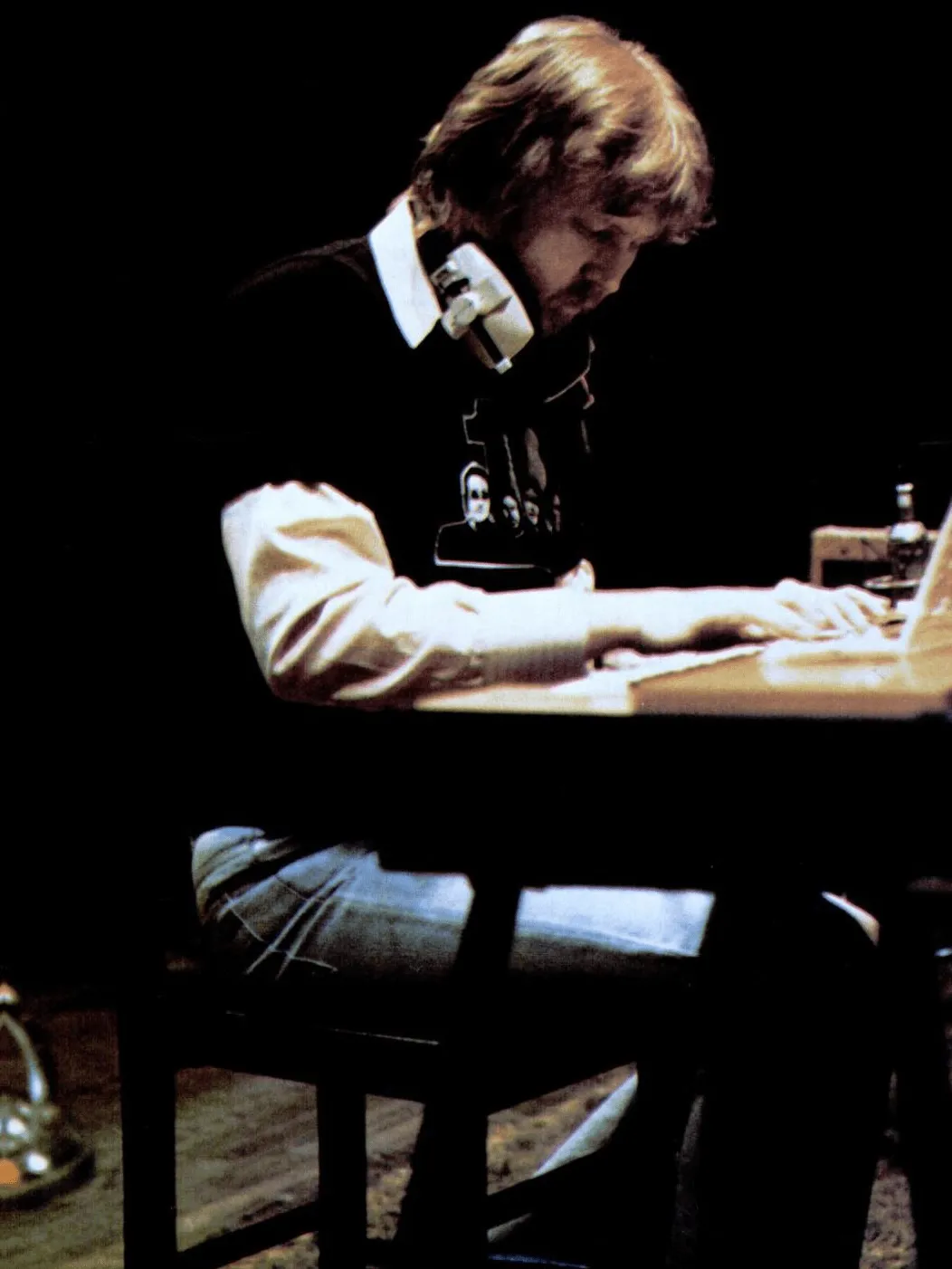
Photo by RCA Records , licensed under Public domain · Wikimedia Commons
Rank #176
Harry Nilsson
From Wikipedia
Harry Edward Nilsson III, sometimes credited and often referred to as Nilsson, was an American singer-songwriter who reached the peak of his success in the early 1970s. His work is characterized by pioneering vocal overdub experiments, a return to the Great American Songbook, and fusions of Caribbean sounds. Nilsson was one of the few major pop-rock recording artists to achieve significant commercial success without performing major public concerts or touring regularly.
Discography & Previews
Browse through and click an album to open and play 30-second previews streamed from Apple Music.

Spotlight on Nilsson
1966 · 10 tracks
- 1 The Path That Leads to Trouble (feat. The New Salvation Singers) ↗ 2:08
- 2 Good Times (feat. The New Salvation Singers) ↗ 1:51
- 3 So You Think You've Got Troubles ↗ 2:22
- 4 I'm Gonna Lose My Mind ↗ 2:06
- 5 She's Yours ↗ 2:02
- 6 Sixteen Tons ↗ 2:32
- 7 Born in Grenada ↗ 2:16
- 8 You Can't Take Your Love (Away from Me) ↗ 2:03
- 9 Growin' Up ↗ 2:50
- 10 Do You Believe ↗ 2:19

Pandemonium Shadow Show
1967 · 12 tracks
- 1 Ten Little Indians ↗ 2:50
- 2 1941 ↗ 2:43
- 3 Cuddly Toy ↗ 2:53
- 4 She Sang Hymns out of Tune ↗ 2:26
- 5 You Can't Do That ↗ 2:22
- 6 Sleep Late, My Lady Friend ↗ 2:45
- 7 She's Leaving Home ↗ 3:20
- 8 There Will Never Be ↗ 2:33
- 9 Without Her ↗ 2:21
- 10 Freckles ↗ 2:24
- 11 It's Been so Long ↗ 2:15
- 12 River Deep, Mountain High ↗ 4:21

Aerial Ballet
1968 · 13 tracks
- 1 Daddy's Song ↗ 2:42
- 2 Good Old Desk ↗ 2:21
- 3 Don't Leave Me ↗ 2:20
- 4 Mr. Richland's Favorite Song ↗ 2:16
- 5 Little Cowboy ↗ 1:23
- 6 Together ↗ 2:11
- 7 Everybody's Talkin' (From "Midnight Cowboy") ↗ 2:44
- 8 I Said Goodbye to Me ↗ 2:17
- 9 Little Cowboy (Reprise) ↗ 0:51
- 10 Mr. Tinker ↗ 2:44
- 11 One ↗ 2:55
- 12 The Wailing of the Willow ↗ 2:01
- 13 Bath ↗ 2:24
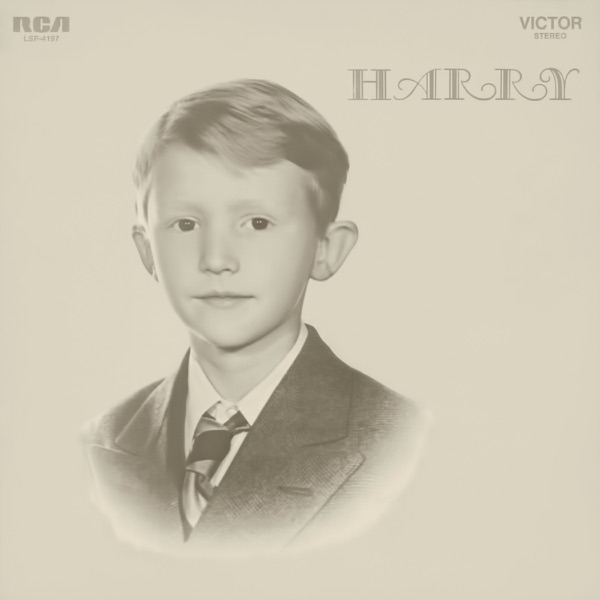
Harry
1969 · 13 tracks
- 1 The Puppy Song ↗ 2:42
- 2 Nobody Cares About the Railroads Anymore ↗ 2:45
- 3 Open Your Window ↗ 2:08
- 4 Mother Nature's Son ↗ 2:44
- 5 Fairfax Rag ↗ 2:15
- 6 City Life ↗ 2:30
- 7 Mournin' Glory Story ↗ 2:15
- 8 Maybe ↗ 3:08
- 9 Marchin' Down Broadway ↗ 1:01
- 10 I Guess the Lord Must Be in New York City ↗ 2:43
- 11 Rainmaker ↗ 2:48
- 12 Mr. Bojangles ↗ 3:55
- 13 Simon Smith and the Amazing Dancing Bear ↗ 2:46

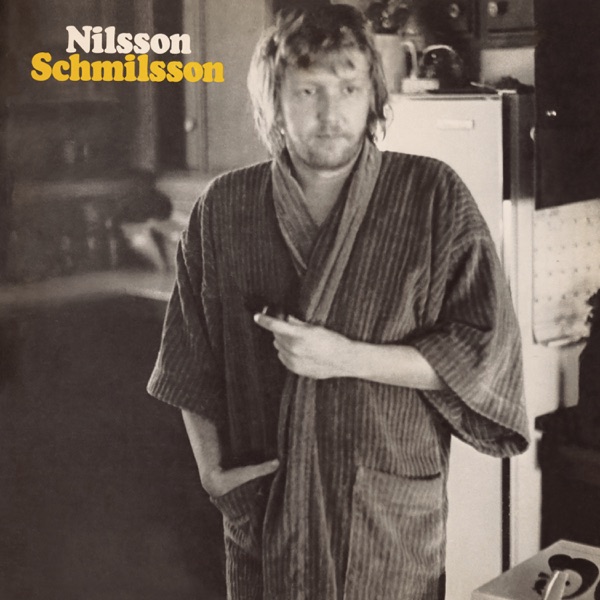

Son of Schmilsson
1972 · 11 tracks
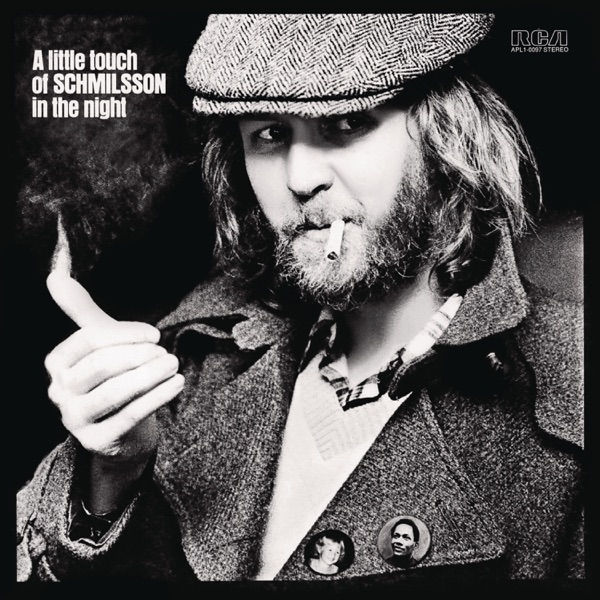
A Little Touch of Schmilsson in the Night
1973 · 12 tracks
- 1 Lazy Moon ↗ 3:22
- 2 For Me and My Gal ↗ 2:48
- 3 It Had to Be You ↗ 2:31
- 4 Always ↗ 1:49
- 5 Makin' Whoopee! ↗ 4:31
- 6 You Made Me Love You ↗ 2:33
- 7 Lullaby in Ragtime ↗ 3:41
- 8 I Wonder Who's Kissing Her Now ↗ 2:39
- 9 What'll I Do ↗ 2:27
- 10 Nevertheless (I'm In Love with You) ↗ 2:40
- 11 This Is All I Ask ↗ 3:37
- 12 As Time Goes By ↗ 3:25

Duit on Mon Dei
1975 · 11 tracks

...That’s the Way It Is
1976 · 10 tracks

Sandman
1976 · 9 tracks
- 1 I'll Take a Tango ↗ 3:00
- 2 Something True ↗ 2:58
- 3 Pretty Soon There'll Be Nothing Left for Everybody ↗ 2:53
- 4 The Ivy Covered Walls ↗ 3:15
- 5 (Thursday) Here's Why I Did Not Go to Work Today ↗ 4:09
- 6 The Flying Saucer Song (From, "Sandman") ↗ 6:44
- 7 How to Write a Song ↗ 3:14
- 8 Jesus Christ You're Tall ↗ 4:10
- 9 Will She Miss Me ↗ 4:46


Losst and Founnd
2019 · 11 tracks
-
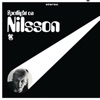 Spotlight on NilssonHarry Nilsson196610 tracks
 -
 Pandemonium Shadow ShowHarry Nilsson196712 tracks
 -
 Aerial BalletHarry Nilsson196813 tracks
 -
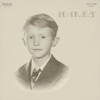 HarryHarry Nilsson196913 tracks
 -
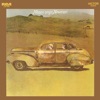 Nilsson Sings NewmanHarry Nilsson197010 tracks
 -
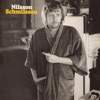 Nilsson SchmilssonHarry Nilsson197110 tracks
 -
 Son of SchmilssonHarry Nilsson197211 tracks
 -
 A Little Touch of Schmilsson in the NightHarry Nilsson197312 tracks
 -
 Duit on Mon DeiHarry Nilsson197511 tracks
 -
 ...That’s the Way It IsHarry Nilsson197610 tracks
 -
 SandmanHarry Nilsson19769 tracks
 -
 KnnillssonnHarry Nilsson197710 tracks
 -
 Losst and FounndHarry Nilsson201911 tracks
Deep Dive
Overview
Harry Nilsson was an American singer-songwriter who achieved his peak commercial and critical success in the early 1970s, establishing himself as one of rock music’s most distinctive and unconventional voices. Unlike most major recording artists of his era, Nilsson built a substantial career without relying on touring or frequent live performances—a rarity in the post-war rock era. His work synthesized pop sophistication, psychedelic experimentation, and deep engagement with the American songbook, resulting in a catalog that defied easy categorization and influenced generations of studio-focused artists.
Formation Story
Born Harry Edward Nilsson III in 1941, Nilsson grew up in an era saturated with pop standards, Broadway, and early rock and roll—cultural touchstones that would permeate his later work. He began his musical career as a songwriter and session musician in the 1960s, initially working behind the scenes for various labels and artists. Rather than pursue the conventional path of becoming a touring performer, Nilsson invested himself in the recording studio, where he could fully realize his creative vision through overdubbing, arrangement, and production experimentation. This early decision to prioritize studio craft over live performance set the trajectory for his entire career and allowed him to pioneer techniques that would become foundational to psychedelic and progressive rock.
Breakthrough Moment
Nilsson’s initial recorded work, beginning with Spotlight on Nilsson (1966) and Pandemonium Shadow Show (1967), established his willingness to blend genres and embrace unconventional song structures. However, his true breakthrough came with Aerial Ballet (1968) and Harry (1969), which expanded his audience and demonstrated the commercial viability of his sophisticated, genre-blending approach. The release of Nilsson Sings Newman (1970) marked a watershed moment—an album composed entirely of songs written by Randy Newman, showcasing Nilsson’s interpretive gifts and his ability to elevate material through distinctive vocal arrangements and production. This project proved that Nilsson could command both critical and popular attention without relying on self-penned hits, a position that solidified his reputation as a serious artist.
Peak Era
Nilsson’s commercial and creative apex arrived between 1971 and 1973, anchored by the release of Nilsson Schmilsson (1971) and Son of Schmilsson (1972). These albums showcased a fully matured artist at the height of his powers—a vocalist capable of extraordinary range and emotional nuance, backed by inventive arrangements that fused pop craftsmanship with experimental production. A Little Touch of Schmilsson in the Night (1973) continued this trajectory, further cementing his status as a major figure in 1970s rock. During this period, Nilsson achieved significant commercial success despite his refusal to tour regularly, a testament to the strength of his recordings and his cultivation of a devoted fanbase through studio innovation alone.
Musical Style
Nilsson’s sound was fundamentally rooted in the vocal—his instrument was exceptionally flexible, ranging from tender whisper to powerful belt, and he made extensive use of overdubbing to create dense, layered arrangements that became his signature. His production aesthetic borrowed from baroque pop and the Brill Building songwriting tradition while integrating psychedelic textures and experimental studio techniques. This fusion created a sound that was simultaneously sophisticated and playful, intellectually engaged yet emotionally direct. Over his career, Nilsson’s work incorporated elements of soft rock, sunshine pop, and Caribbean influences, allowing him to shift tonal palettes across albums without losing a coherent artistic identity. His approach to arrangement—dense with orchestral overdubs, unexpected harmonic turns, and unconventional song structures—set him apart from his contemporaries and influenced countless artists who would later prioritize studio production as a compositional tool.
Major Albums
Nilsson Schmilsson (1971)
The album that brought Nilsson to the height of his commercial success, balancing accessibility with his trademark experimental vocal layering and sophisticated pop sensibility.
Son of Schmilsson (1972)
A direct follow-up that maintained the momentum of its predecessor while exploring darker thematic territory and more adventurous arrangements, demonstrating that his 1971 success was no one-album phenomenon.
Aerial Ballet (1968)
An early milestone that introduced his distinctive approach to orchestration and vocal overdubbing, establishing him as more than a songwriter-for-hire and signaling his arrival as a distinctive artist.
Nilsson Sings Newman (1970)
A bold interpretive project that proved Nilsson’s gifts as a vocalist and arranger, taking Randy Newman’s compositions and reshaping them through his own sophisticated production lens.
Pussy Cats (1974)
A collaboration that showcased Nilsson’s willingness to experiment with different stylistic contexts and production approaches during a period of continued creative exploration.
Signature Songs
- “Everybody’s Talkin’” — A major crossover hit that became synonymous with Nilsson and remains his most widely recognized song, showcasing his gentle, intimate vocal delivery.
- “Without You” — A powerful cover that demonstrated his interpretive range and became one of the defining ballads of the early 1970s.
- “Me and My Arrow” — A whimsical, instantly memorable pop song that balanced novelty appeal with genuine melodic craftsmanship.
Influence on Rock
Nilsson’s approach to the recording studio as a compositional instrument had lasting effects on how subsequent generations of rock and pop artists conceived of the studio album. His vocal overdub techniques and willingness to blur genre boundaries influenced artists who would later prioritize production experimentation and studio craft over traditional rock instrumentation. His embrace of the American songbook within a rock and pop context helped legitimize the idea that rock artists could draw from earlier American music traditions without sacrificing contemporary credibility. Furthermore, his success without touring demonstrated that a major recording artist could build a substantial career through the studio alone, challenging the assumption that live performance was essential to rock legitimacy.
Legacy
Harry Nilsson died in 1994, leaving behind a catalog that has grown in appreciation over subsequent decades. His work continues to be studied by musicians and producers interested in vocal arrangement and studio innovation, and his albums have been reissued and compiled multiple times, including Life Line: The Songs of Nilsson 1967–1971 (1998) and Perfect Day: The Songs of Nilsson 1971–1993 (2006), which have introduced his work to new audiences. The posthumous release Losst and Founnd (2019) further underscored the enduring interest in his catalog. Nilsson’s position in rock history reflects his unique status—a major artist who achieved significant commercial success and critical respect through studio innovation and interpretive gifts rather than touring or conventional rock mythology, a model that remains influential for artists who prioritize production and vocal performance over live spectacle.
Fun Facts
- Nilsson’s refusal to tour regularly was not born from shyness or inability but from a deliberate artistic choice to focus entirely on studio recording and experimentation.
- His work spans multiple record labels including RCA Victor, Mercury Records, and others, reflecting the various phases and experiments of his long career.
- Nilsson’s influence extended beyond music into film and television, demonstrating the broader cultural reach of his artistic innovations.
- The playful album titles featuring “Schmilsson” became part of his artistic brand, reflecting his willingness to embrace humor and experimentation in his presentation alongside serious artistic ambition.