
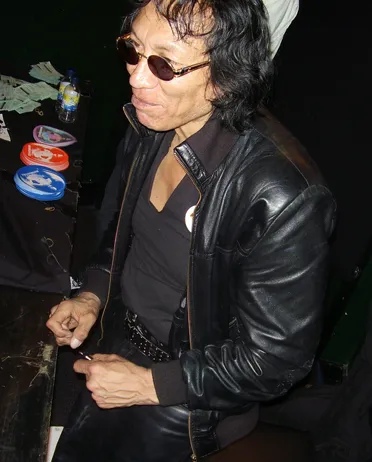
Photo by Luke Winterton ( Paulisdead at English Wikipedia ) , licensed under CC BY-SA 3.0 · Wikimedia Commons
Rank #415
Sixto Rodriguez
From Wikipedia
Sixto Diaz Rodríguez, mononymously known as Rodríguez, was an American musician from Detroit, Michigan.
Discography & Previews
Browse through and click an album to open and play 30-second previews streamed from Apple Music.

Cold Fact
1970 · 12 tracks
- 1 Sugar Man ↗ 3:49
- 2 Only Good for Conversation ↗ 2:24
- 3 Crucify Your Mind ↗ 2:32
- 4 This Is Not a Song, It's an Outburst: Or, the Establishment Blues ↗ 2:07
- 5 Hate Street Dialogue ↗ 2:34
- 6 Forget It ↗ 1:50
- 7 Inner City Blues ↗ 3:27
- 8 I Wonder ↗ 2:34
- 9 Like Janis ↗ 2:36
- 10 Gommorah (A Nursery Rhyme) ↗ 2:21
- 11 Rich Folks Hoax ↗ 3:06
- 12 Jane S. Piddy ↗ 3:00

Coming From Reality
1971 · 10 tracks
-
 Cold FactSixto Rodriguez197012 tracks
 -
 Coming From RealitySixto Rodriguez197110 tracks
Deep Dive
Overview
Sixto Diaz Rodríguez, known professionally as Rodríguez, was an American musician from Detroit, Michigan, who worked at the intersection of psychedelic rock, folk rock, and traditional folk music during the late 1960s and early 1970s. Though his initial commercial footprint was modest, Rodríguez’s two studio albums—released in 1970 and 1971 on the Sussex label—contain some of the era’s most introspective and inventive singer-songwriter material. His influence, later amplified by renewed interest and documentary attention, positions him as a significant figure in rock music’s counterculture moment, particularly within the Detroit underground scene that produced some of the decade’s most distinctive voices.
Formation Story
Rodríguez was born in Detroit in 1942, growing up in a city that would become one of postwar America’s most vital musical laboratories. Detroit in the 1950s and 1960s bred Motown’s assembly-line soul perfection and the MC5’s proto-punk defiance; into that same ferment came Rodríguez, absorbing the acoustic and electric traditions of folk music while remaining rooted in Detroit’s working-class ethos. He emerged as a solo artist within the broader folk and psychedelic rock movement of the late 1960s, a period when acoustic guitar-based songwriting began to absorb electric instrumentation, studio effects, and conceptual ambition. By the early 1970s, Rodríguez was recording for Sussex Records, a label that would release his most celebrated work.
Breakthrough Moment
Rodríguez’s breakthrough came with the release of his debut album Cold Fact in 1970. The record showcased a mature songwriting voice, blending introspective lyrics with arrangements that merged folk’s acoustic foundation with the textures of psychedelic rock and studio production. Despite critical interest in certain quarters, Cold Fact did not achieve significant commercial traction in the United States at the time of its release. However, the album found a devoted following, particularly among listeners drawn to its artistic integrity and emotional depth. His second album, Coming From Reality, followed in 1971 and continued in a similar vein, further establishing his artistic identity.
Peak Era
Rodríguez’s recording career peaked between 1970 and 1971, during which he released both of his studio albums for Sussex Records. These years represented his most focused creative period, when he was actively composing, recording, and building an audience within underground and progressive rock circles. Though neither album achieved mainstream commercial success during that era, they established Rodríguez as an artist of consequence within circles that valued artistic authenticity and musical innovation over radio accessibility. His work from this period remains the core of his recorded legacy.
Musical Style
Rodríguez’s sound synthesized psychedelic rock’s experimental approach to production and arrangement with folk music’s emphasis on lyrical nuance and acoustic instrumentation. His vocal delivery was measured and contemplative, often set against fingerpicked guitar work that drew from traditional folk idioms. The production on his recordings—particularly evident on Cold Fact and Coming From Reality—incorporated studio effects, orchestral arrangements, and overdubbing techniques that reflected the psychedelic era’s embrace of the recording studio as an instrument in itself. His songwriting combined introspective, socially conscious lyrics with melodic sophistication, positioning him alongside other singer-songwriters of the era who refused the either/or choice between folk’s acoustic purity and rock’s electric dynamism. The result was a distinctive variant of psychedelic folk that prioritized substance and artistic vision over commercial concession.
Major Albums
Cold Fact (1970)
Rodríguez’s debut and most celebrated work, Cold Fact introduced listeners to his distinctive blend of psychedelic production and folk sensibility, establishing the artistic template that would define his recording career.
Coming From Reality (1971)
His second and final studio album, Coming From Reality maintained the introspective lyrical focus and psychedelic arrangements of its predecessor, further refining his approach to song arrangement and production.
Signature Songs
- “Crucify Your Mind” — A meditation on freedom and rigid thinking, the song exemplifies Rodríguez’s philosophical approach to songwriting.
- “Inner City Blues” — An examination of urban life and social realism, rooted in his Detroit origins.
- “Jane S. Piddy” — A character-driven narrative demonstrating his gift for detail-oriented storytelling.
- “I Wonder” — A reflective composition showcasing his ability to convey emotional vulnerability within carefully crafted arrangements.
Influence on Rock
Though Rodríguez’s initial commercial impact was limited, his artistic approach—combining psychedelic rock’s studio sophistication with folk music’s lyrical and acoustic traditions—influenced subsequent generations of singer-songwriters and psychedelic folk artists. His work stands alongside other American psychedelic folk practitioners, representing a distinct regional and aesthetic tradition within 1970s rock music. The rediscovery and recontextualization of his work in later decades has expanded recognition of his influence on artists working at the intersection of folk and experimental rock.
Legacy
Rodríguez passed away in 2023, leaving behind a catalog of two studio albums released more than fifty years prior. His legacy rests primarily on the artistic integrity of Cold Fact and Coming From Reality, records that have found sustained appreciation among collectors and enthusiasts of psychedelic folk and Detroit rock history. The passing decades have brought renewed attention to his work, and his music continues to circulate among fans of introspective 1970s rock and experimental folk music. His official presence, maintained at sugarman.org, has helped preserve documentation of his career and kept his work accessible to new listeners discovering the depths of early-1970s American rock music.
Fun Facts
- Rodríguez recorded only two studio albums before stepping away from active recording, making his discography compact but artistically focused.
- His music found particular resonance in international markets, with devoted followings developing in unexpected regions decades after the original releases.
- Both of his studio albums were released within the same two-year window (1970–1971), concentrating his recording output into a remarkably brief but prolific period.