
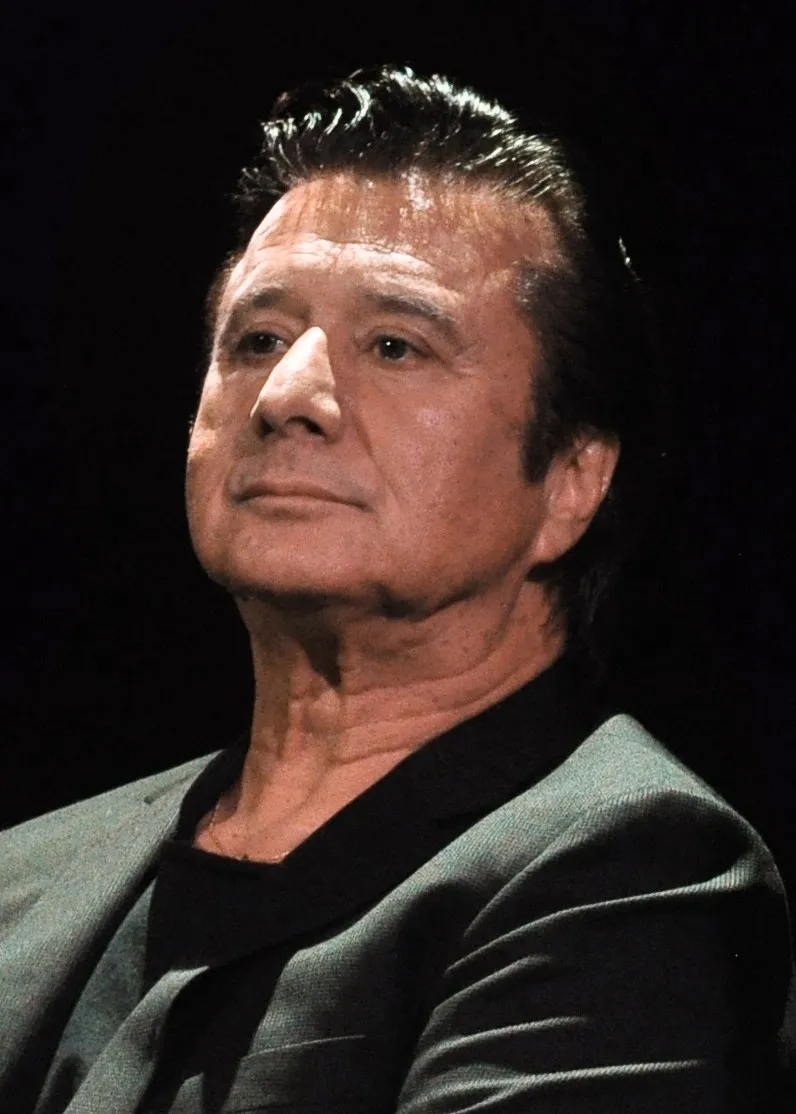
Photo by Joe Mabel , licensed under CC BY-SA 4.0 · Wikimedia Commons
Rank #252
Steve Perry
From Wikipedia
Stephen Ray Perry is an American singer and songwriter. He was the lead singer and frontman of the rock band Journey during their most successful years from 1977 to 1987, and again from 1995 to 1998. He wrote/co-wrote several Journey hit songs, including "Any Way You Want It", "Don't Stop Believin'", "Open Arms", "Who's Crying Now" and "Separate Ways ". Perry had a successful solo career between the mid-1980s and mid-1990s, made sporadic appearances in the 2000s, and returned to music full-time in 2018.
Discography & Previews
Browse through and click an album to open and play 30-second previews streamed from Apple Music.

Street Talk
1984 · 15 tracks
- 1 Oh Sherrie ↗ 3:49
- 2 I Believe ↗ 4:13
- 3 Go Away ↗ 4:07
- 4 Foolish Heart ↗ 3:40
- 5 It's Only Love ↗ 3:49
- 6 She's Mine ↗ 4:27
- 7 You Should Be Happy ↗ 3:25
- 8 Running Alone ↗ 4:07
- 9 Captured By the Moment ↗ 3:49
- 10 Strung Out ↗ 3:45
- 11 My My My ↗ 2:23
- 12 Harmony ↗ 3:57
- 13 Makes No Difference ↗ 4:52
- 14 Don't Tell Me Why You're Leavin' ↗ 3:12
- 15 If Only for the Moment ↗ 4:11

For the Love of Strange Medicine
1994 · 16 tracks
- 1 You Better Wait ↗ 4:52
- 2 Young Hearts Forever ↗ 4:41
- 3 I Am ↗ 4:53
- 4 Stand Up (Before It's Too Late) ↗ 4:48
- 5 For the Love of Strange Medicine ↗ 5:51
- 6 Donna Please ↗ 4:02
- 7 Listen to Your Heart ↗ 3:31
- 8 Tuesday Heartache ↗ 5:59
- 9 Missing You ↗ 3:48
- 10 Somewhere There's Hope ↗ 6:05
- 11 Anyway ↗ 4:18
- 12 If You Need Me Call Me ↗ 5:49
- 13 One More Time ↗ 3:30
- 14 Can't Stop ↗ 4:08
- 15 Friends of Mine ↗ 3:30
- 16 Missing You (Live In San Francisco, CA - December 1994) ↗ 4:14


Traces (Alternate Versions & Sketches)
2020 · 8 tracks


The Season 3
2024 · 16 tracks
- 1 What A Wonderful World ↗ 4:01
- 2 The Christmas Song (2024 Remaster) ↗ 3:30
- 3 Santa Claus Is Coming To Town (2024 Remaster) ↗ 3:04
- 4 This Christmas (2024 Remaster) ↗ 3:23
- 5 Jingle Bell Rock ↗ 3:18
- 6 Call Me Irresponsible (feat. Ray Perry) ↗ 3:05
- 7 What Are You Doing New Year’s Eve (2024 Remaster) ↗ 3:57
- 8 Auld Lang Syne (2024 Remaster) ↗ 2:05
- 9 Silver Bells (2024 Remaster) ↗ 5:03
- 10 I’ll Be Home For Christmas (2024 Remaster) ↗ 2:45
- 11 Let It Snow ↗ 2:33
- 12 Maybe This Year (2024 Remaster) ↗ 3:37
- 13 Winter Wonderland (2024 Remaster) ↗ 3:20
- 14 Rudolph The Red-Nosed Reindeer ↗ 3:06
- 15 Have Yourself A Merry Little Christmas (2024 Remaster) ↗ 1:55
- 16 'Twas The Night Before Christmas ↗ 3:23
-
 Street TalkSteve Perry198415 tracks
 -
 For the Love of Strange MedicineSteve Perry199416 tracks
 -
 TracesSteve Perry201810 tracks
 -
 Traces (Alternate Versions & Sketches)Steve Perry20208 tracks
 -
 The SeasonSteve Perry20218 tracks
 -
 The Season 3Steve Perry202416 tracks
Deep Dive
Overview
Steve Perry is an American rock singer and songwriter born in 1949 whose career spans nearly five decades. He is best known as the lead singer and frontman of Journey, the arena rock band whose 1980s output defined the sound of melodic rock for millions. Perry’s tenure with Journey during their peak commercial years (1977–1987, 1995–1998) produced some of the most enduring rock anthems of their era, but his story extends well beyond that band. A solo artist in his own right, Perry released a string of studio albums beginning in the mid-1980s and has continued recording into the 2020s, making his artistic journey a unique case of sustained creative work across multiple decades and musical contexts.
Formation Story
Steve Perry emerged as a rock vocalist during an era when vocal prowess and emotional delivery became hallmarks of arena rock. Born in the late 1940s, he came of age during the explosive rock expansion of the 1960s and early 1970s. His early career positioned him within the broader landscape of American rock, where strong melodic sensibility and powerful vocal technique commanded respect on stage and on record. By the mid-to-late 1970s, as prog-rock and hard rock were fragmenting into subgenres, Perry’s combination of technical vocal ability and pop-sensible songwriting made him an ideal candidate for a band seeking a frontman who could bridge commercial accessibility with instrumental ambition.
Breakthrough Moment
Perry’s breakthrough came with his joining Journey in 1977, a San Francisco-based group that had recorded two instrumental-focused progressive rock albums but were seeking a voice and a more commercial direction. His entry transformed the band almost immediately. Journey’s third studio album, Infinity (1978), marked the beginning of a new era, but it was the subsequent albums that cemented his legacy. By 1980, with the release of Departure, and especially with 1981’s Escape, Perry had become the face of Journey, and his songwriting contributions—often co-written with band members—began driving the band’s hit singles. “Don’t Stop Believin’,” released in 1981 from Escape, became the breakthrough moment that transcended rock radio and embedded Journey into mainstream American popular culture. The song’s staying power across decades has made it synonymous with Perry’s name and Journey’s identity.
Peak Era
Perry’s peak commercial and creative period with Journey extended from 1977 through the late 1980s, with particular intensity from 1980 to 1987. During this window, Journey released a series of albums that dominated rock and pop radio: Escape, Frontiers (1983), and Raised on Radio (1986). These records showcased Perry’s vocal range and his ability to deliver both power ballads and uptempo rock anthems with equal conviction. His co-writing credits on major hits—“Any Way You Want It,” “Who’s Crying Now,” “Open Arms,” and “Separate Ways (Worlds Apart)“—demonstrated that he was not merely a hired voice but a creative force shaping the band’s sound. The period also saw Journey tour extensively, with Perry becoming one of rock’s most recognizable frontmen. His sustained output and the band’s commercial dominance during this era established the template for arena rock vocal performance that influenced singers throughout the 1980s and beyond.
Musical Style
Steve Perry’s musical style is anchored in a powerful, soaring tenor voice with exceptional range and emotional flexibility. His vocal approach draws from the tradition of classic soul and rock singers—artists who could deliver intricate melodic lines while maintaining dramatic intensity. Within Journey, Perry became known for his ability to navigate from intimate, emotionally restrained verses to explosive, sustained high notes in choruses, a technique that became a signature of 1980s rock balladry. As a songwriter, he favored direct, emotionally resonant lyrics addressing themes of love, loss, perseverance, and self-determination—material that resonated across demographic boundaries. His production sensibilities, evident in his solo work, embraced contemporary production techniques of his era while maintaining a core emphasis on vocal clarity and melodic song structures. Perry’s style avoided the hard-rock aggression of heavy metal while remaining solidly within rock’s harmonic and rhythmic vocabulary, making him a crossover figure who appealed to rock audiences, pop radio, and adult contemporary listeners alike.
Major Albums
Street Talk (1984)
Perry’s debut solo album, released while he was still active with Journey, showcased his ability to sustain a solo career alongside his band work. The album demonstrated his range as a solo artist and established a template for his independent recordings.
For the Love of Strange Medicine (1994)
Released a decade after his debut, this album marked Perry’s return to sustained solo recording following a period of reduced activity. The album represented his continued commitment to writing and recording outside the Journey framework.
Traces (2018)
After a prolonged absence from recording, Perry returned with Traces, signaling his full re-engagement with music following personal and professional transitions. The album marked the beginning of a new creative chapter and demonstrated his enduring songwriting capability.
The Season (2021)
This album consolidated Perry’s return momentum, showing his continued productivity and willingness to explore contemporary recording approaches while maintaining his core vocal and songwriting identity.
Signature Songs
- “Don’t Stop Believin’” (1981) — Journey’s most iconic song and Perry’s most recognizable vocal performance, a rock anthem that transcended its era and became a generational touchstone.
- “Any Way You Want It” (1980) — A high-energy uptempo rock number showcasing Perry’s ability to deliver punch and precision in a shorter, radio-friendly format.
- “Open Arms” (1981) — A power ballad that became a staple of rock radio and wedding receptions, displaying Perry’s emotional restraint and dynamic vocal control.
- “Who’s Crying Now” (1981) — A mid-tempo rocker with a memorable hook that demonstrated Perry’s skill with hook-driven songwriting and his ability to convey vulnerability.
- “Separate Ways (Worlds Apart)” (1983) — A dramatic rock ballad from Frontiers that became one of Journey’s signature slow-burn songs and a showcase for Perry’s sustained high-note delivery.
Influence on Rock
Steve Perry’s influence on rock music centers on his role in establishing the template for arena rock vocal performance in the 1980s. His approach—combining technical vocal skill, emotional accessibility, and commercial sensibility—shaped how generations of rock singers approached their craft. Within Journey, Perry helped prove that rock bands could achieve massive commercial success without sacrificing musicianship or melodic sophistication. The band’s dominance during the early-to-mid 1980s, driven largely by Perry’s vocal presence and songwriting contributions, influenced how major rock labels approached artist development and song selection. Beyond Journey, Perry’s solo career demonstrated that arena-rock frontmen could sustain independent recording careers, opening pathways for other rock vocalists to develop dual identities as both band members and solo artists. His influence extends across multiple rock subgenres and into pop, where his melodic sensibility and vocal power established benchmarks for hook-driven rock songwriting.
Legacy
Steve Perry remains one of the most identifiable voices in rock music history. His association with Journey and particularly with “Don’t Stop Believin’” has ensured his ongoing presence in popular culture, with the song continuing to appear in films, television shows, sporting events, and digital streaming platforms decades after its release. Perry’s long career arc—from journey frontman through solo work, relative hiatus, and return to full-time music-making in 2018—demonstrates an artist’s capacity for sustained creative engagement across changing musical landscapes and personal circumstances. His continued recording activity into the 2020s, including the The Season series and archival releases, shows no diminishment of output or artistic intent. The vocal and songwriting standards he established during Journey’s peak years remain influential on contemporary rock and continue to resonate with audiences across multiple generations, ensuring his position as a significant figure in late-twentieth-century rock history.
Fun Facts
- Perry’s tenure with Journey began in 1977, transforming a progressive rock group into one of the defining arena rock bands of the 1980s within just a few years.
- “Don’t Stop Believin’,” initially released in 1981 as a b-side consideration, became Journey’s signature song and one of the most-streamed rock songs in the digital era.
- Perry released his first solo album, Street Talk, in 1984 while Journey remained actively touring and recording, demonstrating his ability to manage multiple simultaneous artistic projects.
- After a significant period away from the recording studio following the mid-1990s, Perry returned to full-time music creation in 2018 with Traces, launching a new chapter of productivity that continued through the early 2020s.