
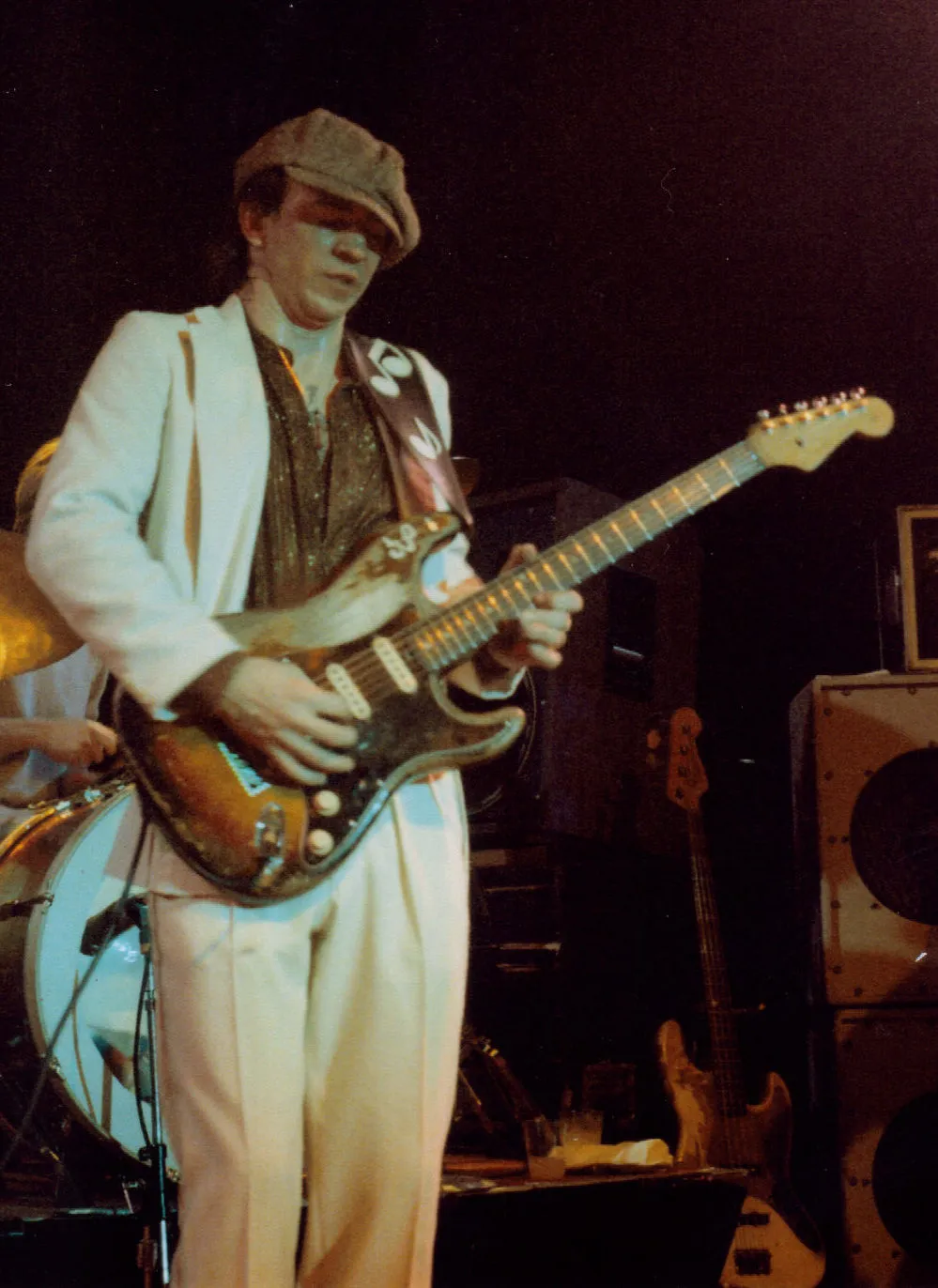
Photo by Bbadventure , licensed under CC BY-SA 4.0 · Wikimedia Commons
Rank #146
Stevie Ray Vaughan
From Wikipedia
Stephen Ray Vaughan, also known abbreviated as SRV, was an American musician, best known as the guitarist and frontman of the blues rock trio Stevie Ray Vaughan and Double Trouble. Although his mainstream career spanned only seven years, he is considered one of the most influential musicians in the history of blues music, and one of the greatest guitarists of all time. He was the younger brother of guitarist Jimmie Vaughan.
Discography & Previews
Browse through and click an album to open and play 30-second previews streamed from Apple Music.

Texas Flood
1983 · 1 track
- 1 Texas Flood (Live at Montreux, 1982) ↗ 10:48
-
 Texas FloodStevie Ray Vaughan19831 track
Deep Dive
Overview
Stevie Ray Vaughan stands as one of the most influential and revered guitarists in the history of rock and blues music. Known professionally as SRV, Vaughan emerged as a dominant force in blues rock during the 1980s, bringing the genre back into mainstream consciousness at a time when it had faded from popular radio. His seven-year recording career—spanning 1983 to 1990—produced a body of work that would secure his place among the greatest musicians of all time, despite his tragically brief arc in the spotlight.
Formation Story
Stephen Ray Vaughan was born in Dallas, Texas, on October 3, 1954, into a musical family that would shape the trajectory of American blues. His older brother, Jimmie Vaughan, established himself as a respected guitarist before Stevie’s mainstream ascendance, and the two would remain linked throughout their careers. Growing up in Texas during the 1960s and early 1970s, Vaughan came of age in a state with deep blues roots, where the music of legends like Muddy Waters, Howlin’ Wolf, and B.B. King formed the bedrock of regional culture. The Dallas-Austin axis in Texas had cultivated its own blues scene, blending traditional Delta and Chicago styles with a harder, more electric sensibility. Vaughan absorbed these influences and began developing his craft as a teenager, eventually settling in Austin, where the live music scene provided a training ground for his explosive style.
Breakthrough Moment
Vaughan’s recording career began in earnest in 1983 with the release of Triple Trouble, a project that introduced his incendiary guitar work to a wider audience. However, his major-label breakthrough came two years later when he established himself as the guitarist and frontman of the blues rock trio Stevie Ray Vaughan and Double Trouble. The band’s initial output captured the raw energy and technical brilliance that would come to define his sound—a fusion of traditional blues vocabulary with the amplified intensity and precision of rock. By 1987, with the release of Come On, Vaughan had solidified his position as a major force in contemporary blues rock, drawing both devoted blues purists and mainstream rock listeners into his orbit.
Peak Era
The latter half of the 1980s represented Vaughan’s commercial and creative zenith. During this period, he achieved what few blues musicians of his generation managed: genuine crossover appeal without compromising his artistic integrity. His live performances became legendary for their intensity and technical mastery, with Vaughan commanding the stage as both a guitarist of superhuman ability and a charismatic frontman. By the close of the decade, he had transcended the niche status that blues music had occupied for years, bringing the genre to concert halls and festival stages that had rarely hosted traditional blues acts. His work with Double Trouble established a template for contemporary blues rock that balanced respect for the genre’s foundational elements with the sonic possibilities of modern amplification and production.
Musical Style
Vaughan’s sound drew from the deep well of Texas and Chicago blues while incorporating elements of funk and rock that gave his work distinctive contemporary resonance. His guitar playing was characterized by fluid, economical phrasing that prioritized emotional expression over flashy virtuosity, though he possessed technical abilities of the highest order. His tone—achieved through meticulous attention to amplifier settings and vintage equipment—possessed a warmth and sustain that allowed each note to ring with clarity and presence. Vocally, Vaughan delivered blues standards and original material with a raspy, soulful quality that conveyed genuine feeling rather than merely performing the idiom. His arrangements often stripped blues songs to their essentials, allowing space for his guitar work to breathe while maintaining the genre’s traditional call-and-response dynamics and emotional architecture.
Major Albums
Triple Trouble (1983)
Vaughan’s debut recording introduced his full-bodied approach to blues rock, establishing the template for his subsequent work and demonstrating the range of his abilities across traditional blues forms.
Come On (1987)
Released during his peak commercial period, this album solidified Vaughan’s status as the leading contemporary blues rock artist, showcasing his mature songwriting and fully developed sonic identity.
Somewhere Over The Rainbow (1990)
Released in the year of his death, this album represented Vaughan’s final studio work and stood as a testament to his continued creative vitality and exploratory approach to the blues tradition.
Signature Songs
- Blues Numbers — Vaughan’s interpretations of traditional blues standards demonstrated his command of the genre’s vocabulary and his ability to bring fresh interpretation to time-honored material.
- Original Compositions — His own songs blended blues fundamentals with rock energy, creating works that appealed equally to blues traditionalists and mainstream rock audiences.
Influence on Rock
Vaughan’s impact on rock and blues music cannot be overstated. His emergence in the early 1980s arrived at a critical moment when blues music had largely disappeared from mainstream radio and concert programming. By bringing blues rock back into the cultural conversation, he opened doors for subsequent artists working in blues-based idioms and demonstrated that authentic blues music could achieve commercial success without dilution. Musicians across multiple genres—from blues traditionalists to rock artists seeking deeper roots—looked to his example of technical mastery married to emotional authenticity. His influence extended beyond the blues world; his approach to tone, phrasing, and the relationship between guitarist and amplifier became a touchstone for serious musicians seeking to develop their own voices within the rock tradition.
Legacy
Stevie Ray Vaughan’s death on August 27, 1990, in a helicopter accident cut short a career that had barely begun to reach its full potential. In the three decades since, his status has only grown. Posthumous releases, live recordings, and archival material have kept his work in circulation, introducing new generations to his music. His influence on blues rock remains visible across the contemporary landscape, and his recordings continue to sell steadily, testament to the durability of his artistic achievements. Vaughan represented a rare convergence: a musician of undeniable technical brilliance who used that ability in service of genuine emotional expression rather than mere display. His seven-year recording career compressed a lifetime’s worth of artistic development, leaving behind a body of work that continues to inspire musicians and move listeners across the blues-rock spectrum.
Fun Facts
- Vaughan was the younger brother of guitarist Jimmie Vaughan, and the two maintained their musical connection throughout Stevie’s career, collaborating and supporting each other’s work within the blues community.
- His full name, Stephen Ray Vaughan, was abbreviated to the professional moniker SRV, which became widely recognized across the music world.
- Vaughan’s recording career spanned only seven years from his 1983 debut until his death in 1990, yet he achieved a level of influence and commercial success that typically takes musicians decades to attain.
- He recorded for Epic Records during his most productive years, establishing a partnership that brought blues rock to the major-label audience.