
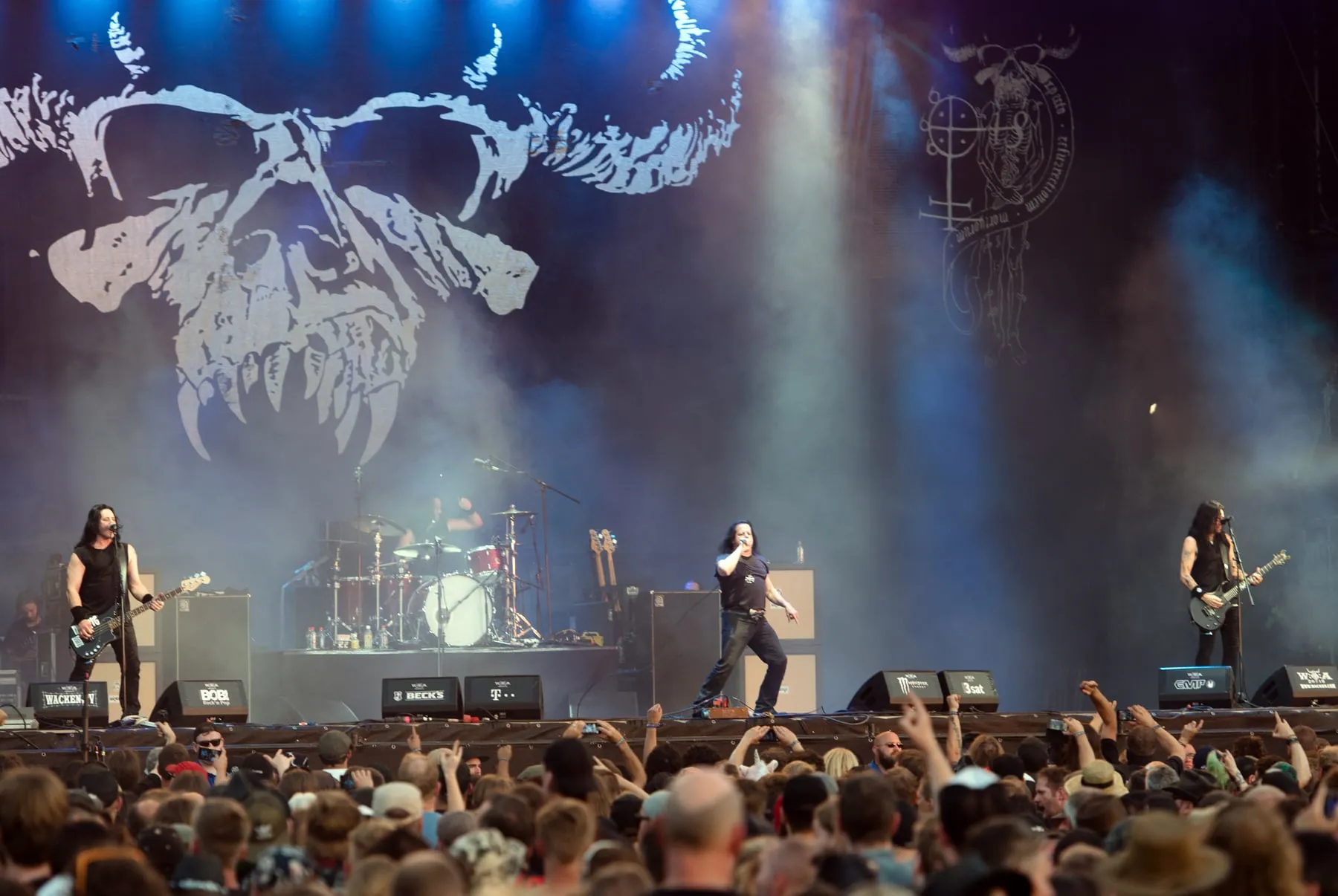
Photo by Frank Schwichtenberg , licensed under CC BY-SA 4.0 · Wikimedia Commons
Rank #465
Danzig
From Wikipedia
Danzig is an American heavy metal band led by former Misfits and Samhain frontman Glenn Danzig. Formed in 1987 in Lodi, New Jersey out of the latter band, its "classic" lineup included the eponymous vocalist and keyboardist, guitarist John Christ, bassist Eerie Von and drummer Chuck Biscuits. Earning a major hit with a live version of its 1988 song "Mother", the band's musical style fuses gothic atmospheres with blues-infused rock and metal. As of 2023, Danzig has released 12 studio albums, two EPs, one live album, and one compilation album.
Members
- Glenn Danzig
- Joey Castillo
- Tommy Victor
Discography & Previews
Browse through and click an album to open and play 30-second previews streamed from Apple Music.


Danzig II - Lucifuge
1990 · 11 tracks


Danzig 5: Blackacidevil
1996 · 10 tracks

Circle of Snakes
2004 · 11 tracks

-
 DanzigDanzig198810 tracks
 -
 Danzig II - LucifugeDanzig199011 tracks
 -
 Danzig III: How the Gods KillDanzig199210 tracks
 -
 Danzig 5: BlackacidevilDanzig199610 tracks
 -
 Circle of SnakesDanzig200411 tracks
 -
 Black Laden CrownDanzig20179 tracks
Deep Dive
Overview
Danzig is an American heavy metal band formed in 1987 in Lodi, New Jersey, built on the foundation of frontman Glenn Danzig’s prior work in the Misfits and Samhain. The band synthesizes gothic atmospheres with blues-infused rock and metal, creating a sound distinct from the hard-rock and metal landscape of the late 1980s. Led by Danzig’s distinctive baritone and complemented by a rotating lineup of skilled musicians, the band earned mainstream recognition with the 1988 live version of “Mother” and has sustained a prolific recording career across twelve studio albums.
Formation Story
Glenn Danzig founded Danzig in 1987 immediately following the dissolution of Samhain, his previous heavy metal project. The decision to establish a new band marked a deliberate stylistic shift: where Samhain had pushed toward harder, heavier territory, Danzig embraced a more compositionally ambitious approach that incorporated melodic sensibility alongside metallic heaviness. The “classic” lineup crystallized with John Christ on guitar, Eerie Von on bass, and Chuck Biscuits on drums—a quartet whose instrumental chemistry would define the band’s first several albums. Lodi, New Jersey, served as the band’s origin point, situating them within the broader East Coast metal and hardcore scene that had produced numerous influential acts across the preceding decade.
Breakthrough Moment
Danzig’s breakthrough arrived swiftly with the release of their self-titled debut album in 1988. The album’s lead single, a live version of “Mother,” became the band’s signature moment, earning significant radio play and MTV exposure. This track demonstrated the band’s ability to craft accessible yet heavy material—a balance that extended the appeal of gothic-tinged metal beyond the underground metal audience. The success of “Mother” positioned Danzig as a credible mainstream act and set the tone for their continued commercial visibility throughout the 1990s.
Peak Era
The band’s most creatively fertile and commercially successful period spanned the early 1990s, encompassing the releases of Danzig II: Lucifuge (1990), Danzig III: How the Gods Kill (1992), and Danzig 4P (1994). These albums consolidated the band’s sonic identity—the interplay between Glenn Danzig’s commanding vocal presence, the gothic production sensibilities, and the blues-rock underpinnings became increasingly refined. The numbering system Danzig adopted for subsequent releases (5, 6, 777, etc.) reflected the band’s commitment to thematic conceptualization and visual branding, though the creative output remained anchored in the hard rock and heavy metal traditions established during these foundational years.
Musical Style
Danzig’s sound fuses gothic atmospheres—spare, minor-key arrangements and heavily reverb-laden production—with blues-infused rock and metal. Glenn Danzig’s voice operates as the band’s primary textural anchor: a low, resonant baritone capable of delivering both melodic phrases and aggressive growls. The instrumental arrangements typically emphasize restrained, deliberate songwriting rather than technical virtuosity or speed; guitar lines tend toward atmospheric rather than flashy, and the rhythm section locks into a groove-oriented pocket that distinguishes the band from the faster, more chaotic variants of 1980s heavy metal. Over the band’s extensive catalog, this core approach remained consistent even as specific album production values and guest musicians shifted.
Major Albums
Danzig (1988)
The self-titled debut introduced the band’s signature sound and featured “Mother,” the live version of which became their breakthrough hit, establishing the template for subsequent releases.
Danzig II: Lucifuge (1990)
The second album deepened the gothic and blues-rock dimensions of the band’s style, demonstrating that the debut’s success was not a one-off but indicative of a sustainable artistic direction.
Danzig III: How the Gods Kill (1992)
Released at the peak of the band’s early momentum, this album refined the interplay between Danzig’s vocals and the instrumental arrangements, solidifying the band’s standing as major-label heavy metal act.
Danzig 777: I Luciferi (2002)
A later-period release that maintained the band’s core sonic identity while continuing their numbered album tradition, illustrating the consistency of their approach across two decades.
Signature Songs
- “Mother” (1988) — The live version became the band’s breakthrough hit, earning mainstream radio and MTV exposure and defining their public identity.
- “Twist of Cain” — A fan favorite that showcased the band’s ability to craft accessible yet heavy material.
- “How the Gods Kill” — Title track from the 1992 album, exemplifying the gothic-metal fusion central to the band’s style.
- “Skin Carver” — Demonstrated the band’s blues-rock foundations and Danzig’s commanding vocal delivery.
Influence on Rock
Danzig’s fusion of gothic atmosphere and heavy metal proved influential within the broader hard-rock and metal communities, particularly among bands seeking to blend melodic sophistication with metallic heaviness. The band’s sustained commitment to a distinctive aesthetic—neither fully adopting the speed-metal conventions of thrash nor the folk-influenced approaches emerging in alternative rock—carved out a discrete space within 1990s heavy music. Their emphasis on production quality and compositional arrangement over technical showmanship influenced subsequent gothic metal and industrial metal acts exploring similar territory. Glenn Danzig’s continued visibility as a solo entity and band leader also reinforced the band’s cultural presence across multiple decades.
Legacy
Danzig’s twelve studio albums and consistent touring schedule have established them as a durable presence in rock and metal music from the late 1980s through the 2020s. The band’s longevity—remaining active and recording new material into the 2020s—speaks to both the durability of their core sound and their sustained fan base. The numerical album titling system became an idiosyncratic identifier, distinguishing the band’s catalog from peer acts. As of 2023, the band had released twelve studio albums alongside EPs, live recordings, and compilation material, securing their position as a notable entry in the heavy metal canon of the late twentieth and early twenty-first centuries.
Fun Facts
- The band adopted an unconventional album-numbering system (Danzig, II, III, 4P, 5, 6:66, 777, etc.), making their discography instantly visually distinctive on record-store shelves and streaming platforms.
- Chuck Biscuits, the original drummer of the classic lineup, had previously played in the hardcore punk band Black Flag before joining Danzig, connecting the band to punk’s early energy and work ethic.
- In 2020, the band released Life Without a Net Demo 1987, a compilation of unreleased material from the band’s formation year, offering fans a rare glimpse into the project’s earliest stages.