
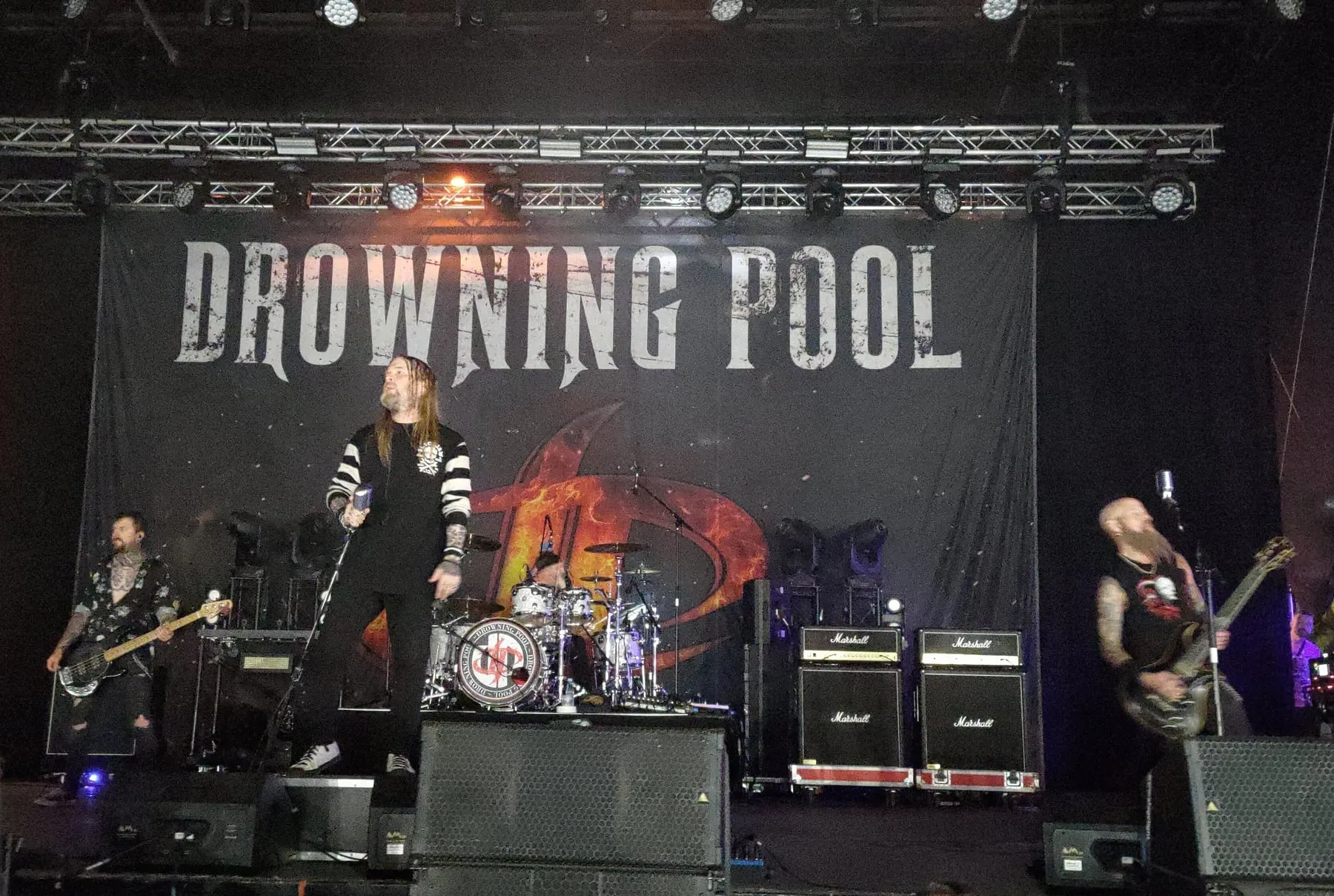
Photo by RoFra , licensed under CC BY-SA 4.0 · Wikimedia Commons
Rank #429
Drowning Pool
From Wikipedia
Drowning Pool is an American rock band formed in Dallas, Texas, in 1996. The band was named after the 1975 film The Drowning Pool. Since its formation, the band has consisted of guitarist C.J. Pierce, drummer Mike Luce and bassist Stevie Benton, as well as a revolving cast of vocalists.
Members
- Dave Williams
Discography & Previews
Browse through and click an album to open and play 30-second previews streamed from Apple Music.


Resilience
2013 · 15 tracks
- 1 ANYTIME, ANYPLACE ↗ 3:36
- 2 DIE FOR NOTHING ↗ 3:13
- 3 ONE FINGER AND A FIST ↗ 3:07
- 4 DIGGING THESE HOLES ↗ 3:49
- 5 SATURDAY NIGHT ↗ 3:53
- 6 LOW CRAWL ↗ 3:40
- 7 LIFE OF MISERY ↗ 3:50
- 8 BROKEN AGAIN ↗ 3:20
- 9 UNDERSTAND ↗ 3:42
- 10 BLEED WTH YOU ↗ 3:31
- 11 SKIP TO THE END ↗ 3:39
- 12 IN MEMORY OF ↗ 3:57
- 13 BLINDFOLD ↗ 3:12
- 14 APATHETIC ↗ 3:55
- 15 ONE WAY PROPHECY ↗ 3:59

Hellelujah
2016 · 13 tracks

-
 SinnerDrowning Pool200111 tracks
 -
 DesensitizedDrowning Pool200411 tracks
 -
 Full CircleDrowning Pool200713 tracks
 -
 Drowning PoolDrowning Pool201011 tracks
 -
 ResilienceDrowning Pool201315 tracks
 -
 HellelujahDrowning Pool201613 tracks
 -
 Strike a NerveDrowning Pool202211 tracks
Deep Dive
Overview
Drowning Pool is an American rock band formed in Dallas, Texas, in 1996, rooted in the nu metal and hard rock tradition that defined late-1990s heavy music. Named after the 1975 film of the same name, the band emerged from a Texas scene that produced several influential acts and quickly found an audience within the nu metal movement. Throughout their existence, the group has maintained a core lineup of guitarist C.J. Pierce, drummer Mike Luce, and bassist Stevie Benton, while cycling through vocalists, a structural choice that has defined their identity and longevity.
Formation Story
Drowning Pool crystallized in Dallas in 1996, a moment when nu metal was beginning to permeate American rock radio and MTV. The band’s founding configuration brought together three musicians committed to a heavy, rhythmically driving sound rooted in the intersection of thrash metal, groove, and contemporary hard rock sensibilities. Dallas, though historically known for its blues and country heritage, had developed a vibrant metal underground by the mid-1990s, and Drowning Pool positioned themselves within that regional infrastructure. The choice to name the band after a 1975 film—itself a crime thriller—suggested an interest in darker cultural reference points, a posture consistent with the broader aesthetics of the era’s metal scene.
Breakthrough Moment
Drowning Pool’s breakthrough arrived with their 2001 debut album Sinner, released on Wind-up Records. The album introduced their signature sound to a mainstream audience primed for the nu metal wave that had begun with acts like Korn and Limp Bizkit in the late 1990s. Sinner established the band’s commercial and creative foothold, making them a recognizable name within the expanding nu metal demographic and setting up their trajectory across the early 2000s. The record’s reception positioned them as a substantial act within their genre and validated their Dallas origins as part of a broader metal ecosystem.
Peak Era
Drowning Pool’s most commercially and creatively active period spanned the early-to-mid 2000s, anchored by the release of Desensitized in 2004 and Full Circle in 2007. During this window, the band operated at maximum visibility within the nu metal and hard rock circuits, touring extensively and maintaining cultural relevance in a genre that had begun fragmenting after its initial commercial peak. The period saw them solidify their identity as a consistent touring act and album producer, releasing work that resonated with the core nu metal audience even as broader mainstream interest in the genre began to soften. By the end of the 2000s, Drowning Pool had transitioned into a more stable touring and recording entity, less dependent on radio novelty and more embedded in the live rock circuit.
Musical Style
Drowning Pool’s sound synthesizes the grooved rhythmic approach of early nu metal with straightforward hard rock songwriting and aggressive vocal delivery. The band’s architecture relies on heavy downtuned guitars, syncopated bass lines, and precise, impact-driven drumming, creating a wall-of-sound aesthetic that privileges rhythmic propulsion over melodic complexity. The consistent presence of Pierce on guitar and the Luce-Benton rhythm section provided sonic continuity even as vocalists changed, allowing the instrumental foundation to remain recognizable across albums. Their approach sits within the broader nu metal lineage—influenced by the rhythmic vocabularies of bands like Pantera and the contemporary production aesthetics of early-2000s metal—while maintaining ties to traditional hard rock muscle. The revolving vocalist model meant that lyrical and vocal color varied across albums, though the band’s core instrumental voice remained a constant point of identity.
Major Albums
Sinner (2001)
Drowning Pool’s debut established their sound for a mainstream audience and became their definitive statement of intent, introducing the band’s rhythmic-heavy nu metal approach and marking their entry into the Wind-up Records roster.
Desensitized (2004)
The band’s third album (following their self-titled 2001 record and 2004’s major-label push) consolidated their position within the nu metal landscape and demonstrated their ability to sustain commercial and creative relevance in a maturing genre.
Full Circle (2007)
Released at a moment when nu metal was fragmenting into broader hard rock identity, Full Circle represented the band’s continued presence in the touring and recording circuit, maintaining their audience through album releases and live performances.
Drowning Pool (2010)
The self-titled album served as a reinstatement of core identity, released after a period of relative quiet and positioning the band for the next phase of their career in the late 2010s.
Signature Songs
- Bodies — The band’s highest-profile single and most recognizable song, a nu metal anthem that became their calling card within the genre and on rock radio.
- Tear the World Down — An aggressive statement track that showcases the band’s rhythmic drive and vocal intensity.
- Follow — A track that demonstrated the band’s ability to craft hooks within their heavy framework.
- Soldiers — A song that represents the band’s mature approach to songwriting and thematic content.
Influence on Rock
Drowning Pool occupied a significant position within the nu metal ecosystem of the early 2000s, contributing to the genre’s dominance of rock radio and MTV during that period. While not the innovators that bands like Korn or Deftones were, they proved the commercial viability and staying power of nu metal in the American mainstream, influencing subsequent generations of groove-heavy metal and hard rock acts. Their model of maintaining a consistent core lineup while cycling vocalists also offered an alternative to the fixed-lineup paradigm that dominated rock, a structural choice that has influenced how later heavy bands have approached membership and creative continuity.
Legacy
Drowning Pool’s longevity—active from 1996 to the present—positions them as one of the more enduring acts within the nu metal tradition. Their continued touring and album releases (including Hellelujah in 2016 and Strike a Nerve in 2022) demonstrate an ability to maintain relevance in a genre often dismissed as a 1990s artifact. While not recipients of the critical reappraisal that some contemporary acts have enjoyed, Drowning Pool remains a fixture of rock radio, nostalgia tours, and streaming platforms, their catalog reaching audiences who came of age during the nu metal era as well as new listeners encountering the genre through digital platforms. Their consistent recording and touring presence has made them a reliable part of the hard rock infrastructure that persists outside the mainstream spotlight.
Fun Facts
- The band took their name from the 1975 crime thriller film The Drowning Pool, a detail that reflects a broader interest in darker cultural reference points within the metal scene of their era.
- Drowning Pool’s model of maintaining a rotating vocalist position while preserving a consistent instrumental lineup has allowed the band to continue operating despite personnel changes, a structural choice that differs from the fixed-member model typical of most rock bands.
- The band emerged from Dallas, Texas, a city whose metal underground produced several nationally recognized acts during the 1990s and 2000s, contributing to a regional heavy music identity distinct from California and New York scenes.
- Their tenure on Wind-up Records and Eleven Seven Music positioned them within the same label ecosystem as other significant nu metal and hard rock acts of their era.