
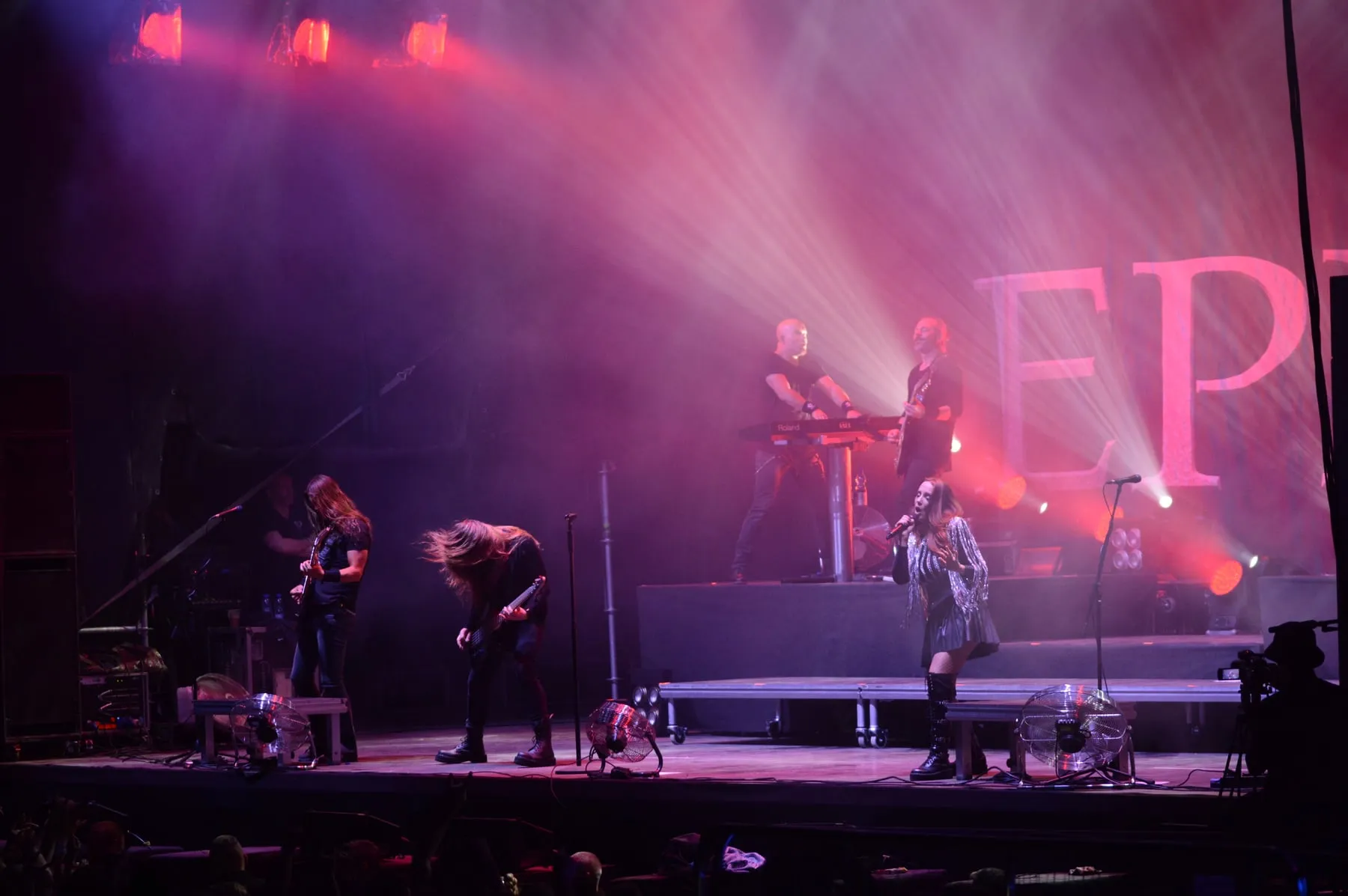
Photo by Wojciech Pędzich , licensed under CC BY 4.0 · Wikimedia Commons
Rank #459
Epica
From Wikipedia
Epica is a Dutch symphonic metal band founded by guitarist and vocalist Mark Jansen after his departure from After Forever. Originally formed as a symphonic metal band with gothic influences, Epica later incorporated strong death metal elements into their sound. Starting with their third album, progressive metal influences also became evident. Additionally, the band often incorporates thrash metal and groove metal riffs, black metal elements, power metal sections, and influences from Arabic music. Some songs also incorporate electronic elements, djent transitions, and folk metal melodies inspired by Middle Eastern, Chinese, and Celtic traditions.
Members
- Ad Sluijter (2002–2008)
- Coen Janssen (2002–present)
- Helena Iren Michaelsen (2002–2002)
- Jeroen Simons (2002–2006)
- Mark Jansen (2002–present)
- Simone Simons (2002–present)
- Yves Huts (2002–2012)
- Ariën van Weesenbeek (2007–present)
- Isaac Delahaye (2009–present)
- Rob van der Loo (2012–present)
Discography & Previews
Browse through and click an album to open and play 30-second previews streamed from Apple Music.

The Phantom Agony
2003 · 22 tracks
- 1 Adyta (The Neverending Embrace) ↗ 1:27
- 2 Sensorium ↗ 4:49
- 3 Cry for the Moon (The Embrace That Smothers , Pt. 4) ↗ 6:46
- 4 Feint ↗ 4:20
- 5 Illusive Consensus ↗ 5:02
- 6 Façade of Reality (The Embrace That Smothers , Pt. 5) ↗ 8:12
- 7 Run for a Fall ↗ 6:33
- 8 Seif Al Din (The Embrace That Smothers , Pt. 6) ↗ 5:48
- 9 The Phantom Agony ↗ 9:01
- 10 Veniality ↗ 4:39
- 11 The Phantom Agony (Single Version) ↗ 4:34
- 12 Triumph of Defeat ↗ 3:54
- 13 Adyta (Orchestral Version) ↗ 1:30
- 14 Sensorium (Orchestral Version) ↗ 4:55
- 15 Cry for the Moon (Orchestral Version) ↗ 6:42
- 16 Basic Instinct (Orchestral Version) ↗ 4:09
- 17 Run for a Fall (Orchestral Version) ↗ 6:28
- 18 The Phantom Agony (Orchestral Version) ↗ 9:02
- 19 Veniality (Orchestral Version) ↗ 4:37
- 20 Feint (Piano Version) ↗ 4:55
- 21 Cry for the Moon (Single Version) ↗ 3:31
- 22 Run for a Fall (Single Version) ↗ 4:29


The Divine Conspiracy
2007 · 13 tracks
- 1 Indigo ↗ 2:05
- 2 The Obsessive Devotion ↗ 7:13
- 3 Menace of Vanity ↗ 4:14
- 4 Chasing the Dragon ↗ 7:40
- 5 Never Enough ↗ 4:47
- 6 La Fetach Chatat Rovetz - The Last Embrace ↗ 1:46
- 7 Death of a Dream - The Embrace That Smothers, Pt. 7 ↗ 6:04
- 8 Living a Lie - The Embrace That Smothers, Pt. 8 ↗ 4:57
- 9 Fools of Damnation - The Embrace That Smothers, Pt. 9 ↗ 8:42
- 10 Beyond Belief ↗ 5:25
- 11 Safeguard to Paradise ↗ 3:47
- 12 Sancta Terra ↗ 4:58
- 13 The Divine Conspiracy ↗ 13:57
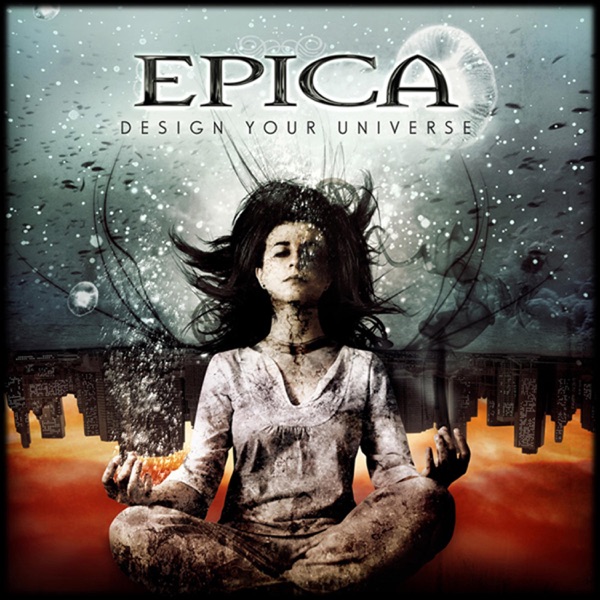
Design Your Universe
2009 · 15 tracks
- 1 Samadhi - Prelude ↗ 1:27
- 2 Resign to Surrender ~ A New Age Dawns, Pt. 4 ↗ 6:19
- 3 Unleashed ↗ 5:48
- 4 Martyr of the Free Word ↗ 5:03
- 5 Our Destiny ↗ 6:00
- 6 Kingdom of Heaven ~ A New Age Dawns, Pt. 5 ↗ 13:35
- 7 The Price of Freedom - Interlude ↗ 1:14
- 8 Burn to a Cinder ↗ 5:41
- 9 Tides of Time ↗ 5:33
- 10 Deconstruct ↗ 4:14
- 11 Semblance of Liberty ↗ 5:42
- 12 White Waters ↗ 4:44
- 13 Design Your Universe ~ A New Age Dawns, Pt. 6 ↗ 9:28
- 14 Incentive ↗ 4:15
- 15 Unleashed (Duet Version) ↗ 5:51

Requiem for the Indifferent
2012 · 15 tracks
- 1 Karma ↗ 1:33
- 2 Monopoly on Truth ↗ 7:11
- 3 Storm the Sorrow ↗ 5:12
- 4 Delirium ↗ 6:08
- 5 Internal Warfare ↗ 5:13
- 6 Requiem for the Indifferent ↗ 8:34
- 7 Anima ↗ 1:25
- 8 Guilty Demeanor ↗ 3:22
- 9 Deep Water Horizon ↗ 6:33
- 10 Stay the Course ↗ 4:25
- 11 Deter the Tyrant ↗ 6:38
- 12 Avalanche ↗ 6:53
- 13 Serenade of Self-Destruction ↗ 9:52
- 14 Nostalgia ↗ 3:26
- 15 Twin Flames ↗ 4:47

The Quantum Enigma
2014 · 9 tracks

The Holographic Principle
2016 · 17 tracks
- 1 Eidola ↗ 2:39
- 2 Edge of the Blade ↗ 4:35
- 3 A Phantasmic Parade ↗ 4:36
- 4 Universal Death Squad ↗ 6:39
- 5 Divide and Conquer ↗ 7:48
- 6 Beyond the Matrix ↗ 6:26
- 7 Once Upon a Nightmare ↗ 7:08
- 8 The Cosmic Algorithm ↗ 4:54
- 9 Ascension - Dream State Armageddon ↗ 5:16
- 10 Dancing in a Hurricane ↗ 5:26
- 11 Tear Down Your Walls ↗ 5:03
- 12 The Holographic Principle - A Profound Understanding of Reality ↗ 11:36
- 13 Beyond the Good, the Bad and the Ugly ↗ 4:30
- 14 Dancing in a Gypsy Camp ↗ 4:28
- 15 Immortal Melancholy (Acoustic Version) ↗ 3:14
- 16 The Funky Algorithm ↗ 3:30
- 17 Universal Love Squad ↗ 3:45


Aspiral
2025 · 11 tracks
- 1 Cross the Divide ↗ 4:18
- 2 Arcana ↗ 5:02
- 3 Darkness Dies in Light - A New Age Dawns Pt. VII - ↗ 7:59
- 4 Obsidian Heart ↗ 5:05
- 5 Fight to Survive - The Overview Effect - ↗ 6:10
- 6 Metanoia - A New Age Dawns, Pt. VIII - ↗ 7:18
- 7 T.I.M.E. ↗ 3:58
- 8 Apparition ↗ 4:13
- 9 Eye of the Storm ↗ 4:43
- 10 The Grand Saga of Existence - A New Age Dawns, Pt. IX - ↗ 6:51
- 11 Aspiral ↗ 5:40
-
 The Phantom AgonyEpica200322 tracks
 -
 Consign to OblivionEpica20053 tracks
 -
 The Divine ConspiracyEpica200713 tracks
 -
 Design Your UniverseEpica200915 tracks
 -
 Requiem for the IndifferentEpica201215 tracks
 -
 The Quantum EnigmaEpica20149 tracks
 -
 The Holographic PrincipleEpica201617 tracks
 -
 ΩmegaEpica20211 track
 -
 AspiralEpica202511 tracks
Deep Dive
Overview
Epica is a Dutch symphonic metal band founded in 2002 in Limburg by guitarist and vocalist Mark Jansen following his departure from After Forever. The band emerged as one of the defining acts within the symphonic metal genre, a subgenre that melds classical orchestration, operatic and clean vocals, and metal instrumentation. Over two decades, Epica crafted a distinctive sound that fused symphonic grandeur with progressive metal complexity, death metal intensity, and a diverse array of global musical influences—from Arabic to Celtic to Chinese traditions. Their evolution across nine studio albums traces a path from gothic-tinged symphonic metal toward increasingly ambitious sonic architecture.
Formation Story
Mark Jansen’s departure from After Forever in 2001 set the stage for Epica’s formation the following year in Limburg, the southern Dutch region bordering Belgium and Germany. Jansen assembled the band’s core lineup alongside vocalist Simone Simons and keyboardist Coen Janssen, both of whom became foundational to the project’s identity and remained with the band continuously from 2002 onward. Early recruits included drummer Ariën van Weesenbeek (who officially joined in 2007), alongside early members Jeroen Simons (bass, 2002–2006), Ad Sluijter (keyboards, 2002–2008), and Yves Huts (guitar, 2002–2012). This original nucleus worked to establish a symphonic metal sound rooted in gothic sensibilities while maintaining the technical proficiency that metal audiences expected. By 2003, the lineup had solidified enough to record their debut, setting in motion a career that would span multiple decades and multiple shifts in musical direction.
Breakthrough Moment
Epica’s breakthrough came with their debut album The Phantom Agony in 2003, which introduced listeners to their fusion of symphonic orchestration and metal aggression. The album established the band’s trademark approach: layered string and keyboard arrangements beneath Simone Simons’s soaring clean vocals, anchored by heavier guitar riffs and rhythm. Following that debut, Consign to Oblivion in 2005 expanded their audience and solidified their standing within the symphonic metal landscape. By the time The Divine Conspiracy arrived in 2007, Epica had moved beyond emerging act status to become a band with genuine European and international traction. These early albums, coupled with robust touring and festival appearances, positioned them as serious contenders within a metal subgenre that was itself gaining prominence in the 2000s.
Peak Era
Epica’s most creatively ambitious period came with the release of Design Your Universe in 2009 and Requiem for the Indifferent in 2012. By this phase, the band had integrated progressive metal influences alongside their core symphonic framework, expanding compositions beyond traditional verse-chorus structures into sprawling, multi-movement arrangements. The Quantum Enigma (2014) and The Holographic Principle (2016) demonstrated the band’s deepening engagement with conceptual and philosophical themes, reflected in both lyrical content and increasingly intricate instrumental passages. This period, roughly 2009 to 2016, saw the band refining their signature sound: massive orchestral sections produced by keyboards and synths, complex time signatures and djent-influenced transitions, death metal growls layered beneath clean vocals, and frequent forays into world music influences—elements that Wikipedia documentation notes became increasingly characteristic of their output. The band’s 2012 lineup shift, with guitarist Rob van der Loo joining, further stabilized the musical identity during these peak creative years.
Musical Style
Epica’s sound rests on a foundation of symphonic metal: the marriage of full orchestral arrangements with heavy electric guitar and rhythmic brutality. Keyboardist Coen Janssen’s arrangements provide lush, often cinematic textures reminiscent of film scores, layered beneath crunching riffs and powerful drums. Simone Simons’s voice—clear, operatic, and expressive—typically carries the melodic weight, but the band frequently incorporates harsh death metal vocals and occasional chanted or whispered passages for contrast and dramatic effect. Over time, Epica absorbed progressive metal’s structural ambition and time-signature complexity, thrash metal and groove metal rhythmic drive, black metal atmospheric touches, and power metal’s soaring melodic sensibilities. The incorporation of folk metal melodic sensibilities, electronic elements, and heavy doses of non-Western instrumentation and compositional idioms—drawing from Arabic, Chinese, and Celtic musical traditions—further differentiated their palette. This eclecticism makes Epica difficult to pin to any single substyle; they are fundamentally a band that view metal as a vehicle capable of containing multiple sonic worlds simultaneously.
Major Albums
The Phantom Agony (2003)
Epica’s debut introduced their symphonic-metal formula: orchestral grandeur paired with operatic vocals and driving guitar work. The album established their core identity and won them an immediate foothold in the European metal scene.
Consign to Oblivion (2005)
The second album expanded on the debut’s foundation, deepening the band’s songwriting and production while solidifying their reputation. It marked a turning point toward greater commercial recognition across the broader metal audience.
Design Your Universe (2009)
A step forward in ambition and complexity, this album introduced stronger progressive metal elements and more elaborate conceptual underpinnings, signaling Epica’s artistic maturation.
The Quantum Enigma (2014)
This album showcased the band’s engagement with philosophical and scientific themes, married to increasingly sophisticated compositional structures and their signature blend of orchestral and metal elements.
The Holographic Principle (2016)
A landmark release that synthesized the band’s decade-long evolution, combining symphonic grandeur, progressive metal intricacy, and global musical influences into a cohesive artistic statement.
Ωmega (2021)
Released after five years of silence, this album demonstrated the band’s continued vitality and their ability to evolve within their established sound world.
Signature Songs
- **