
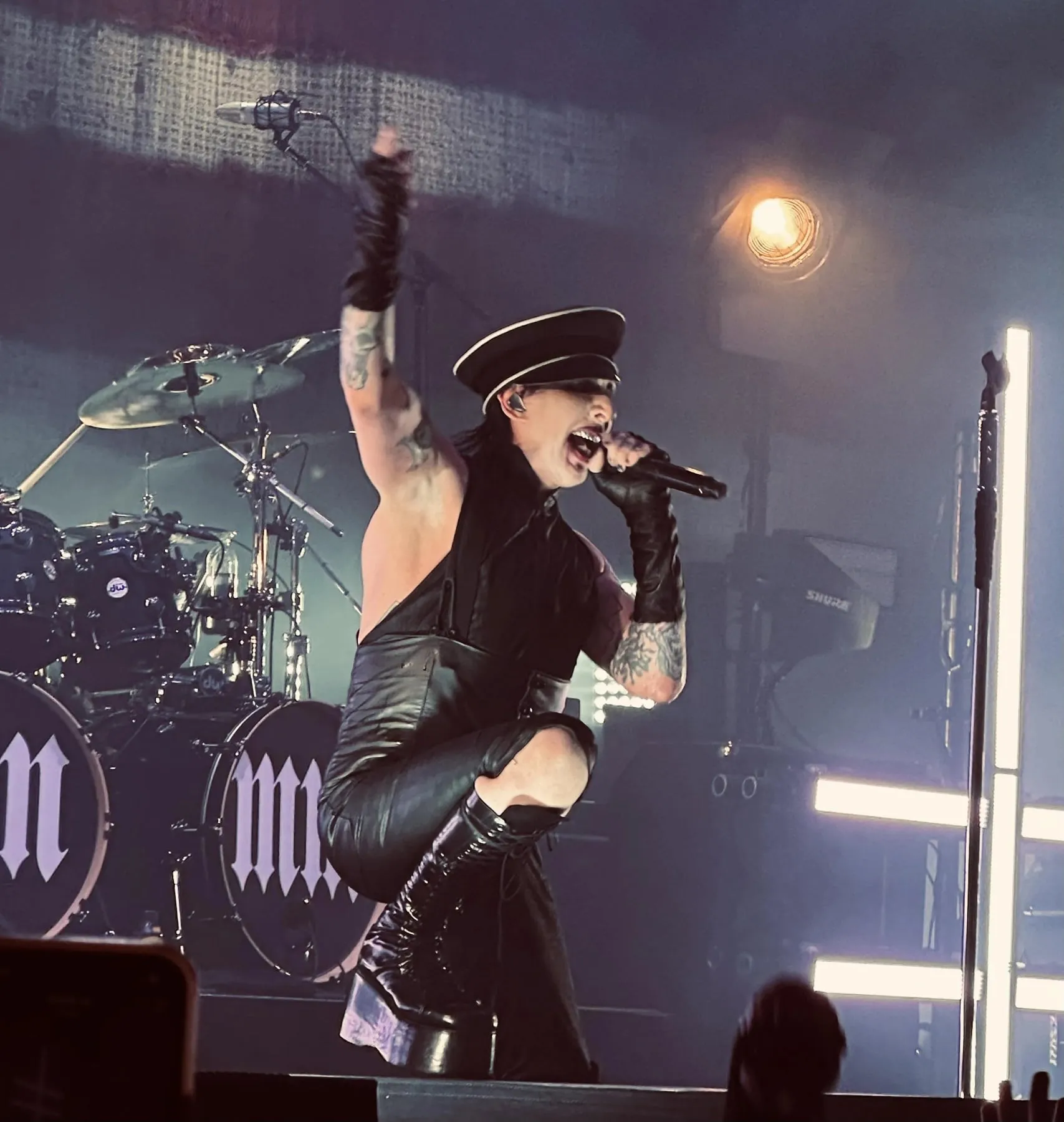
Photo by Aversives , licensed under CC BY 4.0 · Wikimedia Commons
Rank #373
Marilyn Manson
From Wikipedia
Brian Hugh Warner, known professionally as Marilyn Manson, is an American rock musician. He is the lead singer and the only original member remaining of the same-titled band he founded in 1989. The band members initially created their stage names by combining the first name of an American female sex symbol, Marilyn Monroe, and the last name of a male serial killer, Charles Manson.
Discography & Previews
Browse through and click an album to open and play 30-second previews streamed from Apple Music.
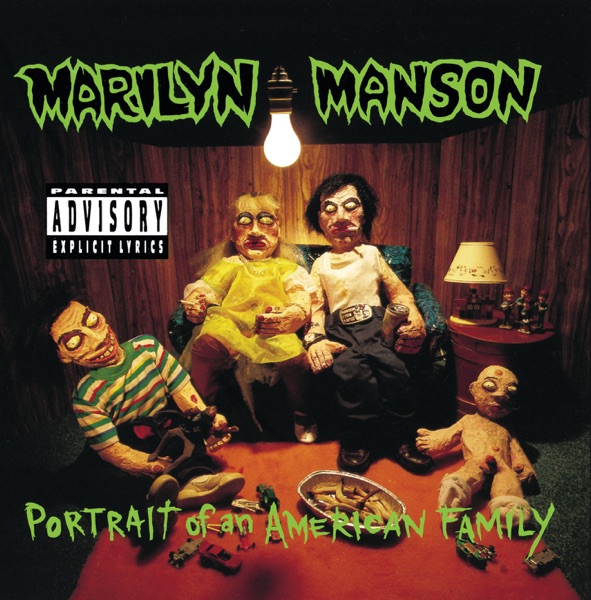
Portrait of an American Family
1994 · 13 tracks
- 1 Prelude (The Family Trip) ↗ 1:22
- 2 Cake and Sodomy ↗ 3:46
- 3 Lunchbox ↗ 4:33
- 4 Organ Grinder ↗ 4:23
- 5 Cyclops ↗ 3:33
- 6 Dope Hat ↗ 4:18
- 7 Get Your Gunn ↗ 3:19
- 8 Wrapped In Plastic ↗ 5:35
- 9 Dogma ↗ 3:22
- 10 Sweet Tooth ↗ 5:03
- 11 Snake Eyes and Sissies ↗ 4:07
- 12 My Monkey ↗ 4:30
- 13 Misery Machine ↗ 13:09
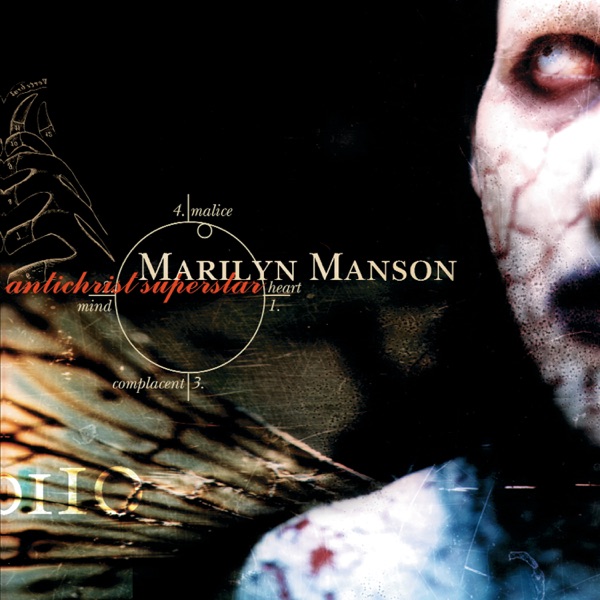
Antichrist Superstar
1996 · 17 tracks
- 1 Irresponsible Hate Anthem ↗ 4:18
- 2 The Beautiful People ↗ 3:39
- 3 Dried Up, Tied and Dead to the World ↗ 4:16
- 4 Tourniquet ↗ 4:29
- 5 Little Horn ↗ 2:43
- 6 Cryptorchid ↗ 2:44
- 7 Deformography ↗ 4:31
- 8 Wormboy ↗ 3:56
- 9 Mister Superstar ↗ 5:04
- 10 Angel with the Scabbed Wings ↗ 3:52
- 11 Kinderfeld ↗ 4:52
- 12 Antichrist Superstar ↗ 5:14
- 13 1996 ↗ 4:01
- 14 Minute of Decay ↗ 4:44
- 15 The Reflecting God ↗ 5:36
- 16 Man That You Fear ↗ 6:11
- 17 Untitled ↗ 1:39
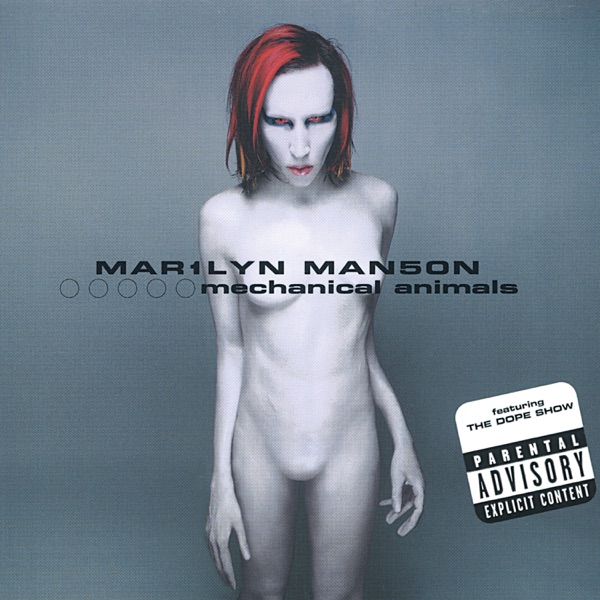
Mechanical Animals
1998 · 14 tracks
- 1 Great Big White World ↗ 5:01
- 2 The Dope Show ↗ 3:47
- 3 Mechanical Animals ↗ 4:33
- 4 Rock Is Dead ↗ 3:10
- 5 Disassociative ↗ 4:51
- 6 The Speed of Pain ↗ 5:30
- 7 Posthuman ↗ 4:18
- 8 I Want to Disappear ↗ 2:57
- 9 I Don't Like the Drugs (But the Drugs Like Me) ↗ 5:03
- 10 New Model No. 15 ↗ 3:41
- 11 User Friendly ↗ 4:17
- 12 Fundamentally Loathsome ↗ 4:50
- 13 The Last Day On Earth ↗ 5:01
- 14 Coma White ↗ 5:38
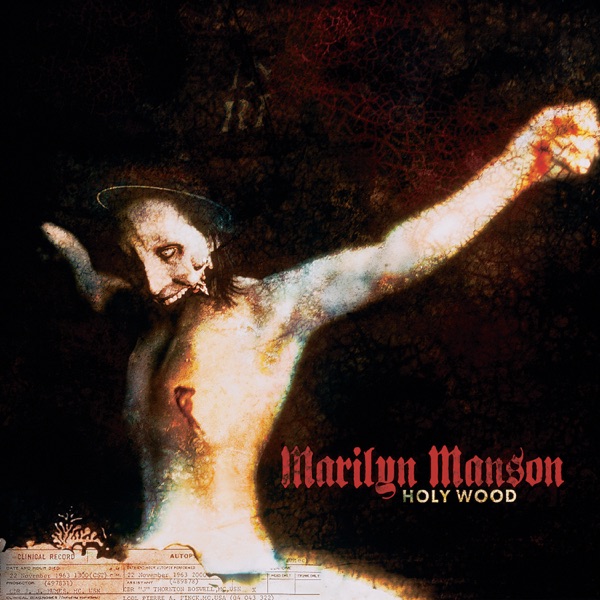
Holy Wood (In the Shadow of the Valley of Death)
2000 · 19 tracks
- 1 GodEatGod ↗ 2:34
- 2 The Love Song ↗ 3:17
- 3 The Fight Song ↗ 2:56
- 4 Disposable Teens ↗ 3:02
- 5 Target Audience (Narcissus Narcosis) ↗ 4:18
- 6 "President Dead" ↗ 3:13
- 7 In the Shadow of the Valley of Death ↗ 4:08
- 8 Cruci-Fiction In Space ↗ 4:56
- 9 A Place In the Dirt ↗ 3:37
- 10 The Nobodies ↗ 3:35
- 11 The Death Song ↗ 3:30
- 12 Lamb of God ↗ 4:40
- 13 Born Again ↗ 3:21
- 14 Burning Flag ↗ 3:21
- 15 Coma Black ↗ 5:59
- 16 Valentine's Day ↗ 3:32
- 17 The Fall of Adam ↗ 2:34
- 18 King Kill 33º ↗ 2:18
- 19 Count to Six and Die (The Vacuum of Infinite Space Encompassing) ↗ 3:23

The Golden Age of Grotesque
2003 · 15 tracks
- 1 Thaeter ↗ 1:14
- 2 This Is the New Shit ↗ 4:20
- 3 mOBSCENE ↗ 3:26
- 4 Doll-Dagga Buzz-Buzz Ziggety-Zag ↗ 4:11
- 5 Use Your Fist and Not Your Mouth ↗ 3:35
- 6 The Golden Age of Grotesque ↗ 4:05
- 7 (s)AINT ↗ 3:42
- 8 Ka-Boom Ka-Boom ↗ 4:03
- 9 Slutgarden ↗ 4:07
- 10 Spade ↗ 4:35
- 11 Para-Noir ↗ 6:01
- 12 The Bright Young Things ↗ 4:19
- 13 Better of Two Evils ↗ 3:48
- 14 Vodevil ↗ 4:40
- 15 Obsequy (The Death of Art) ↗ 1:35
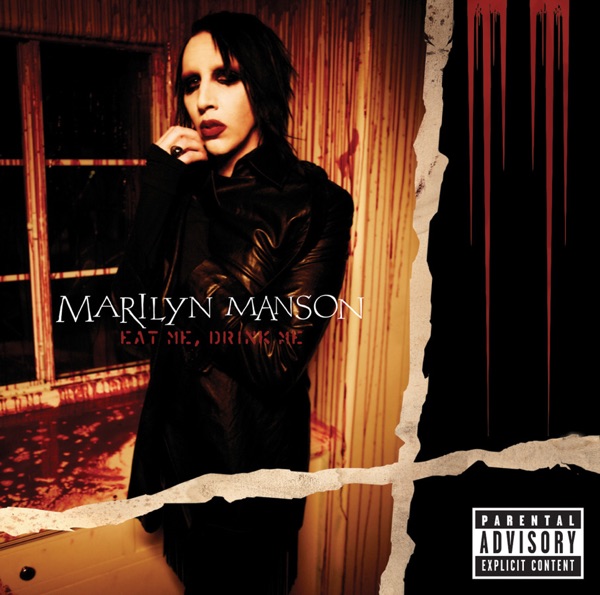
Eat Me, Drink Me
2007 · 12 tracks
- 1 If I Was Your Vampire ↗ 5:56
- 2 Putting Holes In Happiness ↗ 4:31
- 3 The Red Carpet Grave ↗ 4:05
- 4 They Said That Hell's Not Hot ↗ 4:15
- 5 Just a Car Crash Away ↗ 4:52
- 6 Heart-Shaped Glasses (When the Heart Guides the Hand) ↗ 5:06
- 7 Evidence ↗ 5:20
- 8 Are You the Rabbit? ↗ 4:14
- 9 Mutilation Is the Most Sincere Form of Flattery ↗ 3:51
- 10 You and Me and the Devil Makes 3 ↗ 4:24
- 11 Eat Me, Drink Me ↗ 5:41
- 12 Heart-Shaped Glasses (When the Heart Guides the Hand) [Inhuman Remix by Jade E. Puget] ↗ 4:08
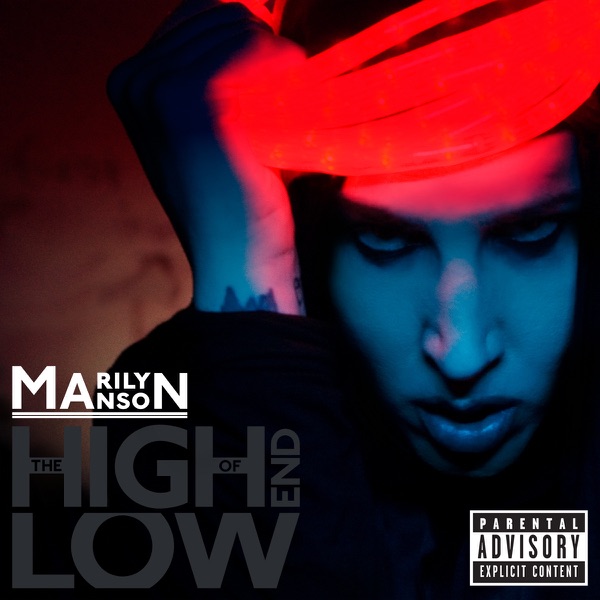
The High End of Low
2009 · 15 tracks
- 1 Devour ↗ 3:46
- 2 Pretty As a ($) ↗ 2:45
- 3 Leave a Scar ↗ 3:55
- 4 Four Rusted Horses ↗ 5:00
- 5 Arma-Goddamn-M**********n-Geddon ↗ 3:39
- 6 Blank and White ↗ 4:27
- 7 Running to the Edge of the World ↗ 6:26
- 8 I Want to Kill You Like They Do In the Movies ↗ 9:02
- 9 WOW ↗ 4:55
- 10 Wight Spider ↗ 5:33
- 11 Unkillable Monster ↗ 3:44
- 12 We're from America ↗ 5:04
- 13 I Have to Look Up Just to See Hell ↗ 4:12
- 14 Into the Fire ↗ 5:15
- 15 15 ↗ 4:21
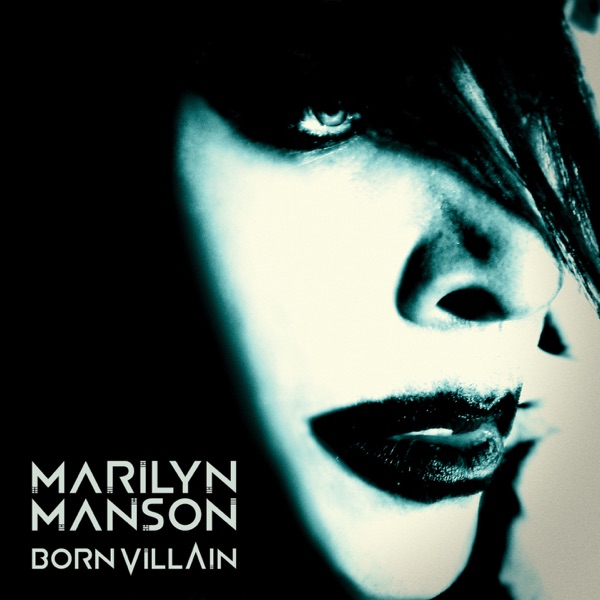
Born Villain
2012 · 14 tracks
- 1 Hey, Cruel World ↗ 3:45
- 2 No Reflection ↗ 4:36
- 3 Pistol Whipped ↗ 4:11
- 4 Overneath the Path of Misery ↗ 5:19
- 5 Slo-Mo-Tion ↗ 4:24
- 6 The Gardener ↗ 4:39
- 7 The Flowers of Evil ↗ 5:20
- 8 Children of Cain ↗ 5:18
- 9 Disengaged ↗ 3:25
- 10 Lay Down Your Goddamn Arms ↗ 4:14
- 11 Murderers Are Getting Prettier Every Day ↗ 4:19
- 12 Born Villain ↗ 5:26
- 13 Breaking the Same Old Ground ↗ 4:27
- 14 You're so Vain ↗ 4:02
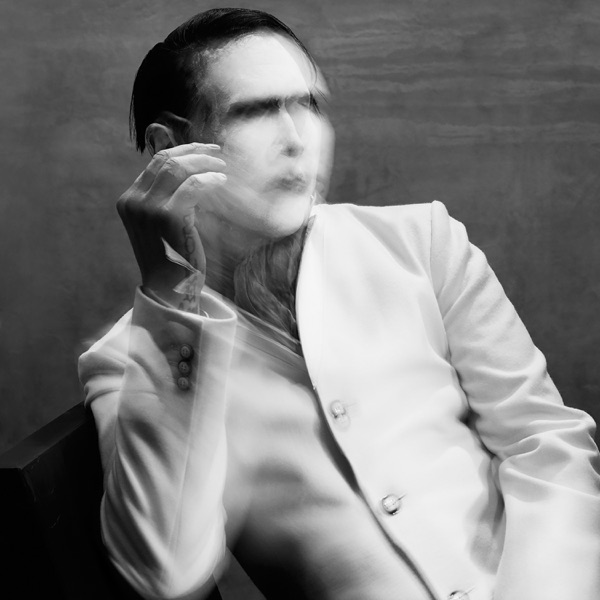
The Pale Emperor
2014 · 13 tracks
- 1 Killing Strangers ↗ 5:36
- 2 Deep Six ↗ 5:03
- 3 Third Day Of A Seven Day Binge ↗ 4:27
- 4 The Mephistopheles Of Los Angeles ↗ 4:57
- 5 Warship My Wreck ↗ 5:57
- 6 Slave Only Dreams To Be King ↗ 5:20
- 7 The Devil Beneath My Feet ↗ 4:16
- 8 Birds Of Hell Awaiting ↗ 5:06
- 9 Cupid Carries A Gun ↗ 4:59
- 10 Odds Of Even ↗ 6:23
- 11 Day 3 ↗ 4:12
- 12 Fated, Faithful, Fatal ↗ 4:41
- 13 Fall Of The House Of Death ↗ 4:31
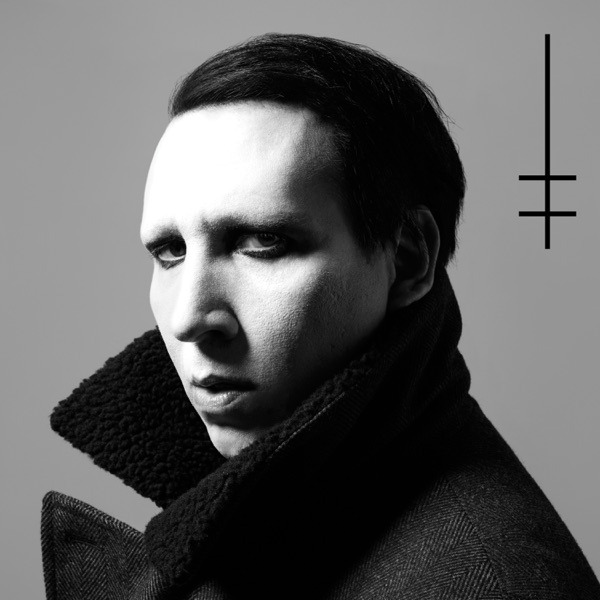
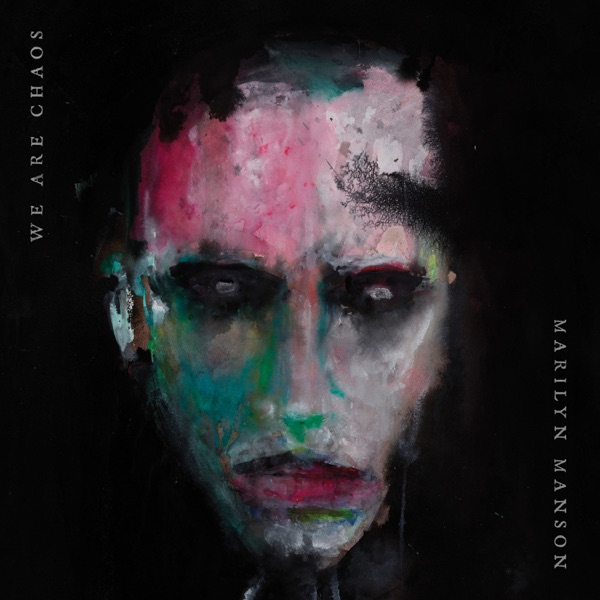
We Are Chaos
2020 · 10 tracks

One Assassination Under God, Chapter 1
2024 · 9 tracks
-
 Portrait of an American FamilyMarilyn Manson199413 tracks
 -
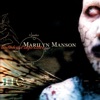 Antichrist SuperstarMarilyn Manson199617 tracks
 -
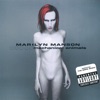 Mechanical AnimalsMarilyn Manson199814 tracks
 -
 Holy Wood (In the Shadow of the Valley of Death)Marilyn Manson200019 tracks
 -
 The Golden Age of GrotesqueMarilyn Manson200315 tracks
 -
 Eat Me, Drink MeMarilyn Manson200712 tracks
 -
 The High End of LowMarilyn Manson200915 tracks
 -
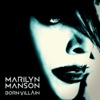 Born VillainMarilyn Manson201214 tracks
 -
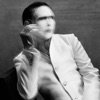 The Pale EmperorMarilyn Manson201413 tracks
 -
 Heaven Upside DownMarilyn Manson201710 tracks
 -
 We Are ChaosMarilyn Manson202010 tracks
 -
 One Assassination Under God, Chapter 1Marilyn Manson20249 tracks
Deep Dive
Overview
Marilyn Manson is an American rock band founded in 1989 by Brian Hugh Warner, who remains the group’s lead singer and sole original member. Operating at the intersection of industrial rock and heavy metal with pronounced shock-rock theatricality, the band emerged from Florida in the early 1990s and became one of the most culturally disruptive forces in mainstream rock by the late decade. Their visual presentation—grotesque makeup, provocative stage design, transgressive imagery—combined with multi-layered, distortion-heavy arrangements to create a project that generated sustained mainstream controversy while achieving significant commercial success.
Formation Story
Briyan Hugh Warner founded Marilyn Manson in 1989, establishing the band’s conceptual framework that would define its entire existence. The group’s nomenclature derived from combining the first name of American female icon Marilyn Monroe with the surname of serial killer Charles Manson—an immediate signal of the project’s intent to conjoin glamour and darkness, celebrity and criminality, feminine and masculine violence. Though formation occurred in 1989, the band’s early studio output and broader cultural footprint would not solidify until the mid-1990s, when they had built a touring presence and refined their aesthetic and sonic approach across multiple releases.
Breakthrough Moment
Marilyn Manson’s progression from underground shock act to mainstream cultural phenomenon accelerated significantly with the 1996 release of Antichrist Superstar. The album marked a sharp escalation in both sonic ambition and transgressive content, arriving at a moment when industrial rock was experiencing renewed commercial visibility. The record’s combination of grinding synthesizers, heavily processed vocals, and explicit thematic material surrounding religion, violence, and power dynamics generated significant radio play and MTV exposure alongside mounting parental and religious-group protests. This cycle of commercial penetration and cultural backlash—rather than obscuring the band’s profile—amplified it considerably, positioning Marilyn Manson as the decade’s preeminent embodiment of rock music’s capacity to unsettle mainstream sensibilities.
Peak Era
The band’s creatively and commercially dominant period extended from the mid-1990s through the early 2000s, anchored by three consecutive landmark albums. Antichrist Superstar (1996) established the industrial-metal framework; Mechanical Animals (1998) refined and complicated that approach with increased melodic ambition and baroque production flourishes; and Holy Wood (In the Shadow of the Valley of Death) (2000) completed a loose conceptual trilogy while consolidating the band’s position as stadium-level rock attraction. During this span, the band toured extensively, headlined major festivals, and maintained unprecedented cultural visibility for an act of such deliberate outrageousness. Album releases The Golden Age of Grotesque (2003), Eat Me, Drink Me (2007), The High End of Low (2009), Born Villain (2012), The Pale Emperor (2014), and Heaven Upside Down (2017) continued the band’s output, though with diminished mainstream commercial profile compared to the 1996–2000 window.
Musical Style
Marilyn Manson’s sound draws from multiple industrial and heavy music lineages while maintaining a distinctive visual and conceptual identity. The band’s core approach combines heavily processed vocal delivery—often layered, heavily compressed, and electronically manipulated—with grinding synthesizers, distorted guitars, and percussion patterns derived from industrial music’s mechanistic precision. The arrangements typically favor density and textural accumulation over traditional verse-chorus clarity, with songs often structured around sustained atmospheres and build-and-release dynamics rather than conventional pop-song architecture. Production work emphasizes extreme equalization, distortion, and effects processing as compositional tools rather than mere ornament. Thematically, the band’s lyrical content consistently engages apocalyptic imagery, religious transgression, power dynamics, and media saturation—conceptual concerns that informed the overall sonic approach and reinforced the project’s identity as deliberate cultural provocation rather than straightforward entertainment. This integration of sound and concept created a project that functioned simultaneously as musical entity and performance art piece.
Major Albums
Antichrist Superstar (1996)
The album establishing Marilyn Manson’s signature sonic and thematic identity, combining industrial metal instrumentals with vocalist Brian Warner’s heavily processed delivery and explicitly transgressive lyrical content concerning religious imagery and power. The release generated both mainstream radio play and sustained moral panic, fundamentally repositioning the band’s cultural status.
Mechanical Animals (1998)
Following the success of Antichrist Superstar, this album increased melodic sophistication and baroque production textures while maintaining industrial heaviness, demonstrating the band’s capacity to evolve beyond shock-rock novelty into more architecturally complex songwriting. The record solidified the band’s position as stadium-level act.
Holy Wood (In the Shadow of the Valley of Death) (2000)
Completing the band’s most artistically ambitious period, this album maintained the industrial-metal framework while incorporating conceptual ambitions around American violence, celebrity culture, and moral decline. The release represented the apex of their critical and commercial reach during the 1990s–2000s transition.
The Golden Age of Grotesque (2003)
Released after a significant gap, this album found the band refining their aesthetic without substantially departing from established formulas, maintaining commercial viability while marking the gradual transition away from peak-era dominance.
Signature Songs
- “Antichrist Superstar” — Title track establishing the band’s signature sound and thematic preoccupations with religious transgression and power dynamics.
- “The Dope Hat” — Early industrial-rock statement combining mechanical percussion with processed vocal delivery.
- “The Beautiful People” — Industrial track featuring grinding synthesizers and commentary on celebrity and superficiality.
- “Mechanical Animals” — Title track from the 1998 album representing the band’s increased melodic ambition.
Influence on Rock
Marilyn Manson’s impact on 1990s and 2000s rock lay primarily in legitimizing industrial metal as a commercially viable stadium-rock genre and demonstrating that extreme visual presentation and conceptually transgressive content could achieve mainstream currency without dilution. The band’s success influenced subsequent generations of heavy, electronics-informed rock acts and demonstrated that shock-rock provocation could function as sustained career strategy rather than novelty gimmick. Their integration of synthesizer-driven arrangements with distorted guitars established an aesthetic template that countless subsequent alternative metal and industrial bands would develop. Additionally, the intense cultural backlash surrounding the band—from parent groups, religious organizations, and politicians—positioned rock music generally as a legitimate arena for broader culture-war conflict, amplifying the genre’s perceived social significance and stakes.
Legacy
Marilyn Manson’s continued existence across three decades, with Brian Warner as permanent centerpiece, has allowed sustained exploration of the band’s conceptual framework even as mainstream commercial attention diminished significantly after the early 2000s. The band’s touring presence remains consistent, and periodic album releases—including We Are Chaos (2020) and One Assassination Under God, Chapter 1 (2024)—maintain their position within active rock discourse. The 1996–2000 period remains the defining cultural moment, when Marilyn Manson functioned as primary lightning rod for mainstream anxieties regarding rock music, youth culture, and transgressive expression. That role has largely passed to subsequent acts, but the band’s fundamental achievement—positioning industrial metal as commercially viable rock subgenre and demonstrating shock-rock’s continued cultural power—remains their enduring structural contribution to late-20th-century rock history.
Fun Facts
- Brian Hugh Warner adopted the stage name Marilyn Manson by combining Marilyn Monroe’s first name with Charles Manson’s surname, establishing the band’s conceptual framework around the fusion of glamour and darkness from their inception.
- The band released Sweet Dreams (Bootleg) in 1997, a release distinct from their standard studio output that reflected the bootleg circulation practices of the era.
- Marilyn Manson maintained an unusually long tenure of stylistic consistency, with the same core conceptual framework—combining industrial music with shock-rock visual presentation—spanning from 1989 through the present despite significant shifts in mainstream rock culture.