
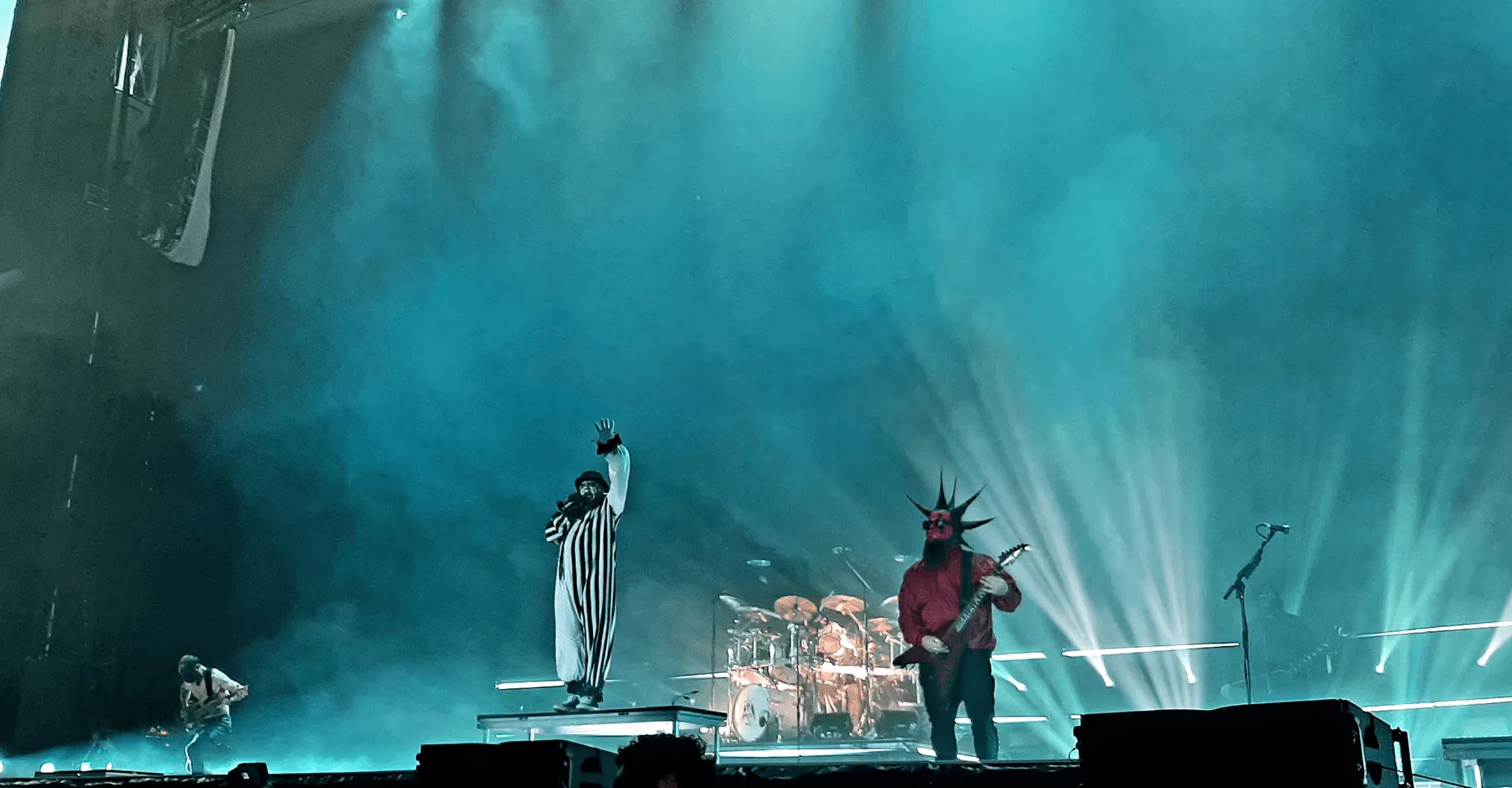
Photo by Ed.Gein1984 , licensed under CC BY-SA 4.0 · Wikimedia Commons
Rank #383
Mudvayne
From Wikipedia
Mudvayne is an American heavy metal band formed in Peoria, Illinois, in 1996. Known for their sonic experimentation, face and body paint, masks and uniforms, the band has sold over five million records worldwide. The group consists of lead guitarist Greg Tribbett, drummer Matthew McDonough, lead vocalist Chad Gray, bassist Ryan Martinie and live rhythm guitarist Marcus Rafferty. The band became popular in the late-1990s Peoria underground music scene, and they found success with the single "Dig" from their debut album L.D. 50 (2000). After releasing four more albums and touring for nearly a decade, Mudvayne went on hiatus in 2010. They reunited in 2021, continuing to perform live, and on August 28, 2025, released their first new song in sixteen years, titled "Hurt People Hurt People".
Members
- Chad Gray
Discography & Previews
Browse through and click an album to open and play 30-second previews streamed from Apple Music.
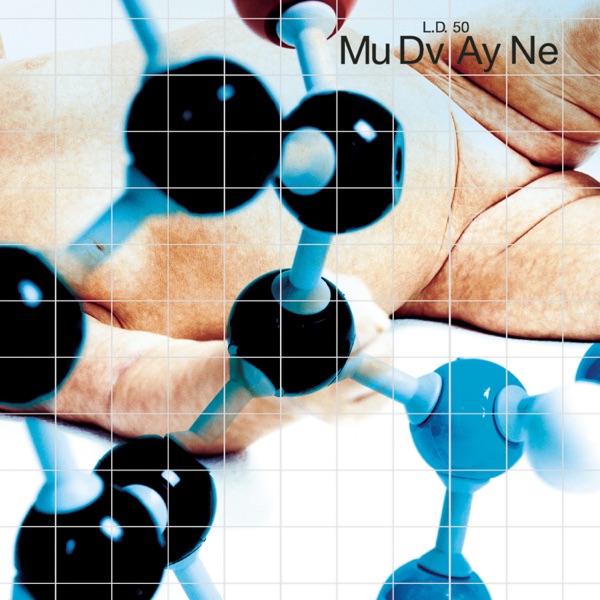
L.D. 50
2000 · 17 tracks
- 1 Monolith ↗ 1:53
- 2 Dig ↗ 2:42
- 3 Internal Primates Forever ↗ 4:25
- 4 -1 ↗ 3:59
- 5 Death Blooms ↗ 4:52
- 6 Golden Ratio ↗ 0:55
- 7 Cradle ↗ 5:15
- 8 Nothing To Gein ↗ 5:29
- 9 Mutatis Mutandis ↗ 1:44
- 10 Everything And Nothing ↗ 3:15
- 11 Severed ↗ 6:29
- 12 Recombinant Resurgence ↗ 2:02
- 13 Prod ↗ 6:04
- 14 Pharmaecopia ↗ 5:35
- 15 Under My Skin ↗ 3:47
- 16 (k)Now F(orever) ↗ 7:06
- 17 Lethal Dosage ↗ 2:59

The End of All Things to Come
2002 · 13 tracks
- 1 Silenced ↗ 3:01
- 2 Trapped In the Wake of a Dream ↗ 4:41
- 3 Not Falling ↗ 4:04
- 4 (Per)Version of a Truth ↗ 4:40
- 5 Mercy, Severity ↗ 4:55
- 6 World So Cold ↗ 5:37
- 7 The Patient Mental ↗ 4:39
- 8 Skrying ↗ 5:38
- 9 Solve Et Coagula ↗ 2:49
- 10 Shadow of a Man ↗ 3:54
- 11 12:97:24:99 ↗ 0:11
- 12 The End of All Things to Come ↗ 3:01
- 13 A Key to Nothing ↗ 5:07


-
 L.D. 50Mudvayne200017 tracks
 -
 The End of All Things to ComeMudvayne200213 tracks
 -
 Lost and FoundMudvayne200512 tracks
 -
 The New GameMudvayne200811 tracks
 -
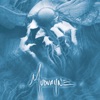 MudvayneMudvayne200911 tracks
Deep Dive
Overview
Mudvayne is an American heavy metal band that emerged from Peoria, Illinois, in 1996 and became one of the defining acts of the late-1990s underground metal scene. The group distinguished itself not merely through sonic adventurism but through a comprehensive visual identity that encompassed face and body paint, masks, and coordinated uniforms—elements that set them apart from their contemporaries in an era when nu metal was consolidating its commercial power. With over five million records sold worldwide, Mudvayne proved that uncompromising instrumental complexity and theatrical presentation could coexist with mainstream success.
Formation Story
Mudvayne coalesced in Peoria, Illinois, in 1996, drawing from a city not traditionally associated with metal innovation but nonetheless fertile ground for ambitious musicians. The band’s core lineup comprised lead guitarist Greg Tribbett, bassist Ryan Martinie, drummer Matthew McDonough, and lead vocalist Chad Gray—a quartet whose complementary skills would define the group’s sound across its first decade. The Peoria underground music scene of the mid-1990s provided the crucible in which Mudvayne refined their approach, blending the rhythmic aggression of emerging nu metal with progressive structural ambitions that resisted easy categorization. By the late 1990s, the band had cultivated a devoted local following and begun to attract attention beyond their Midwestern origins.
Breakthrough Moment
Mudvayne’s transition from underground phenomenon to mainstream recognition crystallized with their debut album, L.D. 50, released in 2000. The single “Dig” became the band’s signature moment, establishing Chad Gray’s distinctive vocal approach and the group’s willingness to bend heavy metal’s formal conventions. The song’s success on rock radio and MTV vindicated Mudvayne’s refusal to dilute their sonic experimentation for broader appeal; instead, their unorthodox approach—complex time signatures, dissonant guitar textures, and abstract lyrical content—proved commercially viable. L.D. 50 announced Mudvayne as a force capable of sustaining a major-label career while maintaining the creative restlessness that had defined them in Peoria.
Peak Era
The five years spanning 2000 to 2005 constituted Mudvayne’s commercial and creative peak. Following L.D. 50’s success, the band released The End of All Things to Come in 2002, consolidating their fanbase and demonstrating that their debut was no anomaly. Lost and Found arrived in 2005, marking the apogee of their commercial trajectory and touring profile. During this window, Mudvayne toured extensively, building a reputation for visually arresting and musically uncompromising live performances that matched their recorded output. The band’s theatrical presentation—their ever-evolving masks and body paint—became as integral to their identity as the music itself, creating a total artistic package that appealed to fans seeking something beyond conventional metal formulas. This era positioned them as innovators within the broader nu metal ecosystem, pushing instrumental and compositional boundaries that many of their peers did not attempt.
Musical Style
Mudvayne’s sound synthesized nu metal’s heavy, syncopated rhythms with progressive metal’s structural ambition and alternative metal’s willingness to embrace dissonance and timbral experimentation. Ryan Martinie’s bass playing—often locked in polyrhythmic conversations with Matthew McDonough’s intricate drumming—provided a rhythmic foundation that eschewed the straightforward grooves favored by many nu metal bands. Greg Tribbett’s guitar work ranged from heavily distorted riffing to atonal textures and clean-toned passages, refusing to remain within a single register or production aesthetic. Chad Gray’s vocal delivery encompassed rapping, singing, and spoken-word elements, shifting fluidly between registers and emotional intensities. The band’s production choices—angular, detailed, and often claustrophobic—reflected their interest in sonic design as a compositional tool rather than a transparent window onto live performance. Over the course of their albums from 2000 to 2009, Mudvayne’s style evolved incrementally, becoming progressively more layered and conceptually ambitious while maintaining the core experimental ethos that defined their emergence.
Major Albums
L.D. 50 (2000)
Mudvayne’s debut announced a fully realized artistic vision: complex arrangements, provocative lyrics, and the single “Dig,” which became their calling card and proved that experimental metal could reach radio audiences.
The End of All Things to Come (2002)
The follow-up deepened their exploration of dissonance and unconventional song structures, consolidating their fanbase and establishing them as a sustained creative force rather than a one-album phenomenon.
Lost and Found (2005)
At the height of their commercial reach, Mudvayne delivered their most ambitious work, balancing accessibility with uncompromising instrumental sophistication and thematic complexity.
The New Game (2008)
Released as touring remained central to their identity, this album continued their engagement with progressive structures and sonic experimentation within an increasingly confident artistic framework.
Signature Songs
- “Dig” — The breakthrough single from L.D. 50 that established Mudvayne’s commercial viability and became their most widely recognized composition.
- “Chains” — A showcase for the band’s rhythmic intricacy and capacity to balance heaviness with melodic detail.
- “Nothing to Gain” — Demonstrating Chad Gray’s range as a vocalist and the band’s ability to sustain emotional intensity across complex arrangements.
- “Internal Primates Forever” — A later-period composition reflecting the band’s ongoing commitment to conceptual ambition and instrumental innovation.
Influence on Rock
Mudvayne’s influence on contemporary heavy music emerged from their insistence that nu metal need not sacrifice instrumental virtuosity or compositional sophistication for commercial relevance. Their emphasis on progressive elements within a broadly metal context helped legitimize instrumental complexity within a genre often predicated on maximizing immediate impact. Bands working in progressive metal, mathcore, and experimental metal contexts have drawn from Mudvayne’s template of fusing visceral heaviness with rhythmic and harmonic ambition. Their theatrical presentation—the masks, the paint, the visual coordination—influenced how subsequent metal acts approached the relationship between music and visual identity, demonstrating that spectacle and substance were not mutually exclusive. Within the broader nu metal landscape, Mudvayne represented a counterweight to simplification, proving that audiences existed for metal that demanded rather than pandered to listener attention.
Legacy
After nearly a decade of touring, Mudvayne entered a hiatus in 2010, a departure that initially suggested a permanent conclusion to their recording career. The band’s 2021 reunion, however, reset their narrative, allowing them to reassess their position within metal’s evolving landscape. On August 28, 2025, Mudvayne released “Hurt People Hurt People,” their first new song in sixteen years—a return that affirmed their continued creative engagement and suggested ongoing plans for new material. Across all metrics, Mudvayne’s five-million-record sales and sustained touring presence position them as a significant commercial and cultural force in early-2000s metal. Their body of work from 2000 to 2009 remains a reference point for musicians and listeners seeking proof that heavy music can sustain complexity, ambition, and accessibility simultaneously. The band’s influence extends beyond their direct sonic progeny to encompass a broader argument about metal’s capacity for reinvention and intellectual rigor.
Fun Facts
- Mudvayne’s name and visual identity were central to their artistic conception from inception, with band members committing to coordinated face and body paint as integral components of their live and recorded presentation.
- The band’s debut album L.D. 50 was named after the median lethal dose of toxins—a reflection of their willingness to embrace conceptual provocations and abstract thematic frameworks.
- Ryan Martinie’s bass work on Mudvayne’s recordings became widely recognized within metal communities for its technical sophistication and role in driving unconventional rhythmic patterns.
- The band’s 2021 reunion came after an eleven-year hiatus, demonstrating sustained fan engagement and the enduring commercial viability of their catalog.