
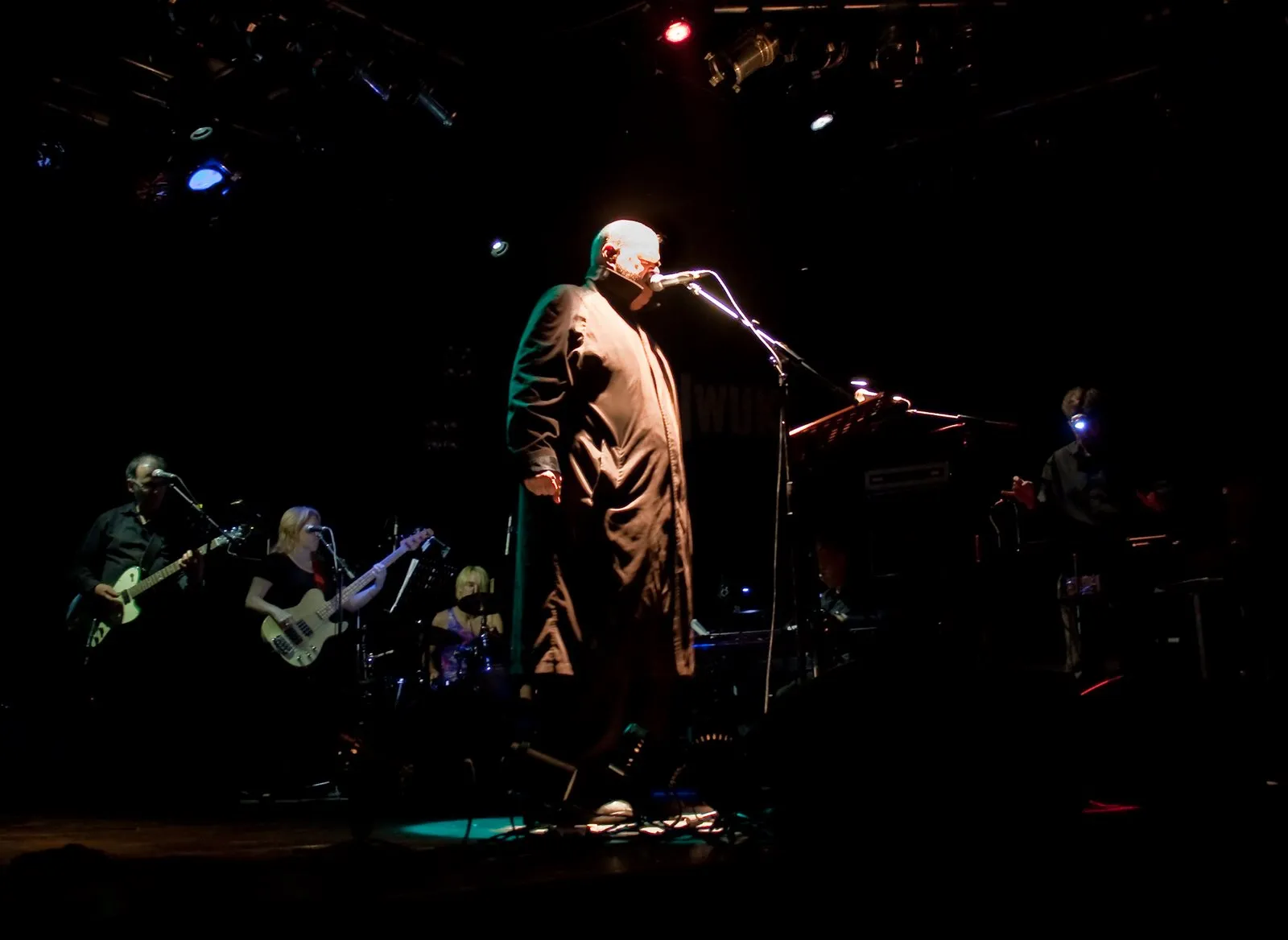
Photo by Sonictruth , licensed under CC0 · Wikimedia Commons
Rank #137
Pere Ubu
From Wikipedia
Pere Ubu is an American rock band formed in Cleveland, Ohio, in 1975. The band had a variety of lineup changes, with singer and songwriter David Thomas remaining the sole constant. In December 1975, they released their debut single 30 Seconds Over Tokyo, and later their debut album The Modern Dance in 1978. After several more releases they disbanded in 1982, only to reform in 1987. Thomas remained active, recording and touring until his death on April 23, 2025.
Members
- Peter Laughner
Discography & Previews
Browse through and click an album to open and play 30-second previews streamed from Apple Music.


Song of the Bailing Man
1982 · 11 tracks

Pennsylvania
1998 · 13 tracks
- 1 Woolie Bullie (2021 Remix & Remaster) ↗ 2:51
- 2 Highwaterville (2021 Remix & Remaster) ↗ 1:30
- 3 SAD.TXT (2021 Remix & Remaster) ↗ 3:19
- 4 Urban Lifestyle (2021 Remix & Remaster) ↗ 2:46
- 5 Silent Spring (2021 Remix & Remaster) ↗ 2:33
- 6 Mr Wheeler (2021 Remix & Remaster) ↗ 3:30
- 7 Muddy Waters (2021 Remix & Remaster) ↗ 3:21
- 8 Drive (2021 Remix & Remaster) ↗ 4:37
- 9 Indiangiver (2021 Remix & Remaster) ↗ 0:50
- 10 Monday Morning (2021 Remix & Remaster) ↗ 2:55
- 11 Perfume (2021 Remix & Remaster) ↗ 4:18
- 12 Fly's Eye (2021 Remix & Remaster) ↗ 2:37
- 13 Wheelhouse (2021 Remix & Remaster) ↗ 5:01

St. Arkansas
2002 · 10 tracks
- 1 Fevered Dream of Hernando Desoto (2021 Remix & Remaster) ↗ 2:41
- 2 Slow Walking Daddy (2021 Remix & Remaster) ↗ 4:41
- 3 Michele (2021 Remix & Remaster) ↗ 3:08
- 4 333 (2021 Remix & Remaster) ↗ 4:00
- 5 Hell (2021 Remix & Remaster) ↗ 4:58
- 6 Phone Home Jonah (2021 Remix & Remaster) ↗ 2:39
- 7 Lisbon (2021 Remix & Remaster) ↗ 3:14
- 8 Mr Steve (2021 Remix & Remaster) ↗ 2:41
- 9 Where's the Truth (2021 Remix & Remaster) ↗ 3:17
- 10 Dark (2021 Remix & Remaster) ↗ 9:05

“Long Live Père Ubu!”
2009 · 14 tracks
- 1 Ubu Overture (feat. Sarah Jane Morris) [2022 Remix and Master] ↗ 2:14
- 2 Song of the Grocery Police (feat. Sarah Jane Morris) [2022 Remix and Master] ↗ 1:49
- 3 Banquet of the Butchers (feat. Sarah Jane Morris) [2022 Remix and Master] ↗ 2:53
- 4 Tear Your Eyes Out (feat. Sarah Jane Morris) [2022 Remix and Master] ↗ 1:41
- 5 March of Greed (feat. Sarah Jane Morris) [2022 Remix and Master] ↗ 3:13
- 6 Big Sombrero (feat. Sarah Jane Morris) [2022 Remix and Master] ↗ 4:08
- 7 Bring Me the Head (feat. Sarah Jane Morris) [2022 Remix and Master] ↗ 3:28
- 8 Alienating the Audience (feat. Sarah Jane Morris) [2022 Remix and Master] ↗ 1:54
- 9 Road to Reason (feat. Sarah Jane Morris) [2022 Remix and Master] ↗ 4:01
- 10 Slowly I Turn (feat. Sarah Jane Morris) [2022 Remix and Master] ↗ 4:24
- 11 Watching the Pigeons (feat. Sarah Jane Morris) [2022 Remix and Master] ↗ 2:38
- 12 The Story so Far (feat. Sarah Jane Morris) [2022 Remix and Master] ↗ 7:57
- 13 Snowy Livonia, Pt. 1 (feat. Sarah Jane Morris) [2022 Remix and Master] ↗ 1:49
- 14 Elsinore & Beyond (feat. Sarah Jane Morris) [2022 Remix and Master] ↗ 1:24

Lady From Shanghai
2013 · 11 tracks
- 1 Thanks ↗ 2:15
- 2 Free White ↗ 2:29
- 3 Feuksley Ma'am, the Hearing ↗ 5:12
- 4 Mandy ↗ 7:14
- 5 And Then Nothing Happened ↗ 4:14
- 6 Musicians Are Scum ↗ 3:33
- 7 Another One (Oh Maybellene) ↗ 2:48
- 8 The Road Trip of Bipasha Ahmed ↗ 4:13
- 9 Lampshade Man ↗ 6:21
- 10 414 Seconds ↗ 6:49
- 11 The Carpenter Sun ↗ 5:58


20 Years in a Montana Missile Silo
2017 · 12 tracks

The Long Goodbye
2019 · 10 tracks

-
 The Modern DancePere Ubu197810 tracks
 -
 Dub HousingPere Ubu197810 tracks
 -
 New Picnic TimePere Ubu197910 tracks
 -
 The Art of WalkingPere Ubu198011 tracks
 -
 Song of the Bailing ManPere Ubu198211 tracks
 -
 PennsylvaniaPere Ubu199813 tracks
 -
 St. ArkansasPere Ubu200210 tracks
 -
 “Long Live Père Ubu!”Pere Ubu200914 tracks
 -
 Lady From ShanghaiPere Ubu201311 tracks
 -
 Carnival of SoulsPere Ubu20149 tracks
 -
 20 Years in a Montana Missile SiloPere Ubu201712 tracks
 -
 The Long GoodbyePere Ubu201910 tracks
 -
 Trouble on Big Beat StreetPere Ubu202310 tracks
Deep Dive
Overview
Pere Ubu stands as one of post-punk’s most uncompromising voices, a Cleveland-based ensemble that synthesized art rock’s conceptual ambitions with the raw urgency of the mid-1970s punk moment. Formed in 1975, the band operated in a register distinctly separate from either the New York or London punk establishments—theirs was a more austere, science-fictional unease, built from atonal guitar work, unpredictable rhythm structures, and vocalist David Thomas’s keening wail. Singer and songwriter David Thomas remained the sole constant through decades of membership shifts, anchoring a project that would prove foundational to how American rock digested punk’s formal innovations.
Formation Story
Pere Ubu coalesced in Cleveland, Ohio, in 1975, emerging from a local scene far removed from the media centers that were already mythologizing punk as a British and New York phenomenon. The band’s genesis lay in the collision of avant-garde sensibilities with rock instrumentation, a fusion that would define their entire trajectory. Peter Laughner, a guitarist of experimental bent, played a crucial role in the early ensemble, working alongside Thomas to establish the group’s confrontational approach to composition and performance. From the outset, Pere Ubu rejected conventional song structures, favoring architectures that felt more like architectural blueprints than pop formulas.
Breakthrough Moment
Pere Ubu announced their arrival with the single “30 Seconds Over Tokyo,” released in December 1975. That early marker was followed by their debut album, The Modern Dance, in 1978, a record that crystallized the band’s singular vision: spare, angular, often discordant arrangements anchored by Thomas’s vocals, which oscillated between spoken narrative and abstract cry. The Modern Dance made clear that Pere Ubu was neither a punk band nor an art-rock band in any conventional sense, but rather a hybrid that drew from both while belonging fully to neither. The album’s unflinching strangeness—its refusal to smooth rough edges for radio play or commercial appeal—earned them a devoted following among underground listeners and critics attuned to experimental rock.
Peak Era
The period from 1978 to 1982 marked Pere Ubu’s most prolific and creatively restless phase. In rapid succession, the band released Dub Housing (1978), New Picnic Time (1979), and The Art of Walking (1980), each album deepening their exploration of fractured rhythms, unsettling atmospherics, and oblique lyrics that often deployed sci-fi imagery and philosophical abstraction. These records documented a band in constant motion, never settling into a signature formula but instead treating each album as a distinct experiment. The live document X‐Mas Concert at Interstate Mall / Live at Club Wow (1979) captured the abrasive intensity of Pere Ubu in performance, before Song of the Bailing Man (1982) brought the first phase of their career to a close. The band disbanded following that album, having burned through the possibilities of their early approach.
Musical Style
Pere Ubu’s sound was built on deliberate dissonance and rhythmic instability. Where post-punk contemporaries in New York and London sought to harness punk’s energy within recognizable song forms, Pere Ubu dismantled those forms. Guitar textures ranged from atonal scrapes to abrupt, staccato picking; the rhythm section operated on principles closer to free jazz than rock meter; Thomas’s vocals—sometimes pitched high enough to sound nearly inhuman, sometimes dropped into deadpan recitation—refused the emotional catharsis that rock singing conventionally offered. Their art-rock lineage traced back through Captain Beefheart and the experimental impulses of 1970s rock, yet their post-punk context gave them an urgency and bleakness that earlier art rock had often lacked. Production choices emphasized clarity of detail rather than polished cohesion, allowing individual instruments to occupy distinct spaces rather than blending into an integrated whole.
Major Albums
The Modern Dance (1978)
The band’s debut established their aesthetic blueprint: fractured song structures, atonal guitar interplay, and Thomas’s distinctive vocals floating across arrangements that often felt more architectural than organic. The album’s commercial obscurity was matched only by its critical esteem among those seeking rock music that refused easy consumption.
Dub Housing (1978)
Released the same year as The Modern Dance, this album pushed further into experimental territory, with production choices and compositional strategies that drew the band even further from recognizable post-punk parameters. The album’s title referenced both dub reggae and the band’s Cleveland base, hinting at the heterodox influences they were absorbing.
The Art of Walking (1980)
By their third proper studio album, Pere Ubu had distilled their vision into a set of pieces that balanced abstraction with a haunting melodic undertow. The album remains the most listenable entry point into their ’70s and ’80s catalog, neither compromising their experimental principles nor rendering them utterly inaccessible.
The Tenement Year (1988)
After a five-year hiatus, Pere Ubu returned with an album that suggested the band had absorbed some of the synthesizer-driven textures of the 1980s without surrendering their foundational unease. The Tenement Year charted a middle path between their earlier austerity and late-career eclecticism.
Cloudland (1989)
The follow-up continued their post-reunion trajectory, suggesting that the band’s reconvening had unleashed new compositional energies. The album’s title evoked a kind of atmospheric dissolution, a sonic equivalent to the band’s longstanding interest in unmooring listeners from conventional emotional responses.
Signature Songs
- “30 Seconds Over Tokyo” — The band’s debut single, a stark introduction to their refusal of conventional rock song architecture.
- “Street Waves” — A track capturing the band’s ability to generate unease through fractured rhythmic structures and atonal interplay.
- “The Modern Dance” — The title track of their debut, establishing the thematic and sonic vocabulary they would explore throughout the ’70s.
- “Final Solution” — Demonstrating the band’s use of provocative language and sci-fi imagery to unsettle rather than comfort.
Influence on Rock
Pere Ubu’s impact on American post-punk and alternative rock cannot be overstated, even if their influence operated more as a conceptual and sonic lineage than as direct stylistic imitation. They demonstrated that post-punk could exist outside the grid of New York and London, that experimental rock could coexist with the genre’s urgency, and that American bands need not defer to European innovators. Their unflinching commitment to formal experiment over commercial palatability established a template for underground and alternative rock that would extend through the 1980s and beyond. The band’s emphasis on the producer and the studio as compositional instruments, their integration of found sounds and production techniques, and their willingness to let individual instruments exist in isolation rather than blend into a coherent whole all prefigured later developments in alternative and indie rock. David Thomas’s vocal approach, in particular—its embrace of ugliness, its rejection of the conventions of rock beauty—influenced a generation of American vocalists who sought to unsettle rather than seduce their audiences.
Legacy
David Thomas kept Pere Ubu active across the subsequent decades, recording steadily from their 1987 reformation onward. The band released over a dozen albums after their return, including Ray Gun Suitcase (1995), Pennsylvania (1998), and a succession of records that demonstrated their willingness to absorb contemporary production techniques and sonic influences without surrendering their core aesthetic. Thomas’s death in April 2025 marked the end of an era for a project that had operated, with brief interruptions, for fifty years. Despite their commercial obscurity, Pere Ubu maintained a devoted international following, with their records available through the band’s own ubuprojex.net operation and various record labels that had documented their work over the decades. Critical reassessment has positioned them as essential architects of post-punk’s American evolution, a band whose uncompromising stance prefigured much of what followed in alternative and experimental rock.
Fun Facts
- The band name “Pere Ubu” derives from Alfred Jarry’s absurdist play Ubu Roi, a literary reference that signals the band’s commitment to avant-garde cultural traditions beyond rock music.
- David Thomas remained the sole continuous member through every incarnation of the band, making Pere Ubu functionally a vehicle for his artistic vision across five decades.
- The band’s recording output included live documents and live-in-concert albums, capturing the deliberately dissonant and unpredictable nature of their live performances.