
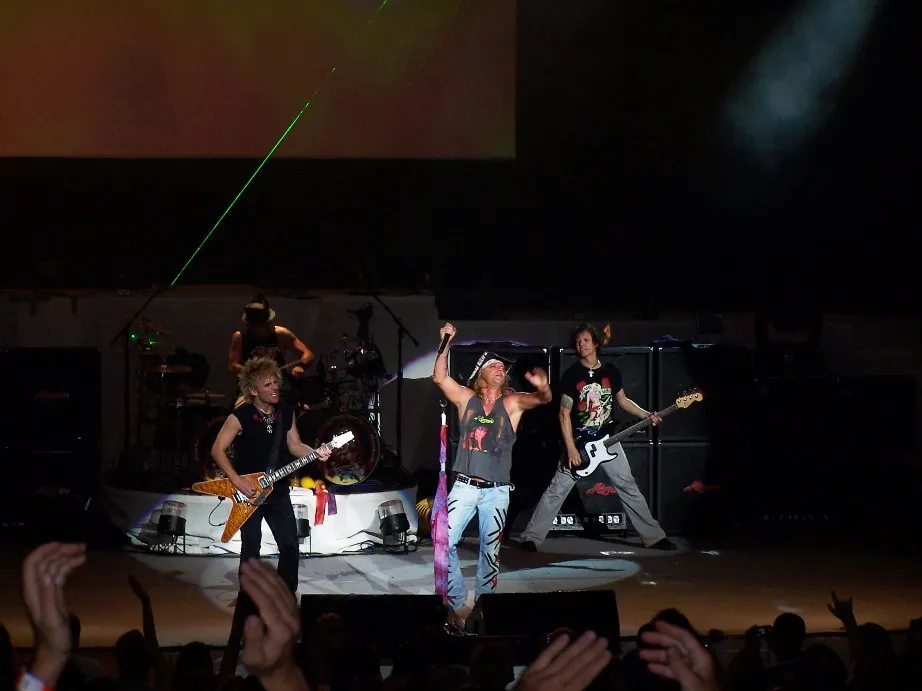
Photo by Osvaldo Loiacono , licensed under CC BY-SA 3.0 · Wikimedia Commons
Rank #500
Poison
From Wikipedia
Poison is an American rock band formed in Mechanicsburg, Pennsylvania in 1983. The most successful incarnation of the band consists of lead singer and rhythm guitarist Bret Michaels, drummer Rikki Rockett, bassist Bobby Dall and lead guitarist C.C. DeVille. The band achieved huge commercial success in the mid-1980s through the mid-1990s and sold over 65 million records and DVDs worldwide. In 2012, VH1 ranked them at No. 1 on their list of the "Top 5 Hair Bands of the '80s".
Members
- Bobby Dall
- Bret Michaels
- C.C. DeVille
- Rikki Rockett
Discography & Previews
Browse through and click an album to open and play 30-second previews streamed from Apple Music.

Look What the Cat Dragged In
1986 · 10 tracks

Open Up and Say… Ahh!
1988 · 10 tracks

Flesh & Blood
1990 · 16 tracks
- 1 Strange Days of Uncle Jack ↗ 1:40
- 2 Valley of Lost Souls ↗ 3:58
- 3 (Flesh & Blood) Sacrifice ↗ 4:41
- 4 Swampjuice (Soul-O) ↗ 1:26
- 5 Unskinny Bop ↗ 3:48
- 6 Let It Play ↗ 4:22
- 7 Life Goes On ↗ 4:48
- 8 Come Hell or High Water ↗ 5:02
- 9 Ride the Wind ↗ 3:51
- 10 Don't Give Up an Inch ↗ 3:44
- 11 Something to Believe In ↗ 5:28
- 12 Ball and Chain ↗ 4:23
- 13 Life Loves a Tragedy ↗ 5:15
- 14 Poor Boy Blues ↗ 5:02
- 15 Something to Believe In (Alternate/Acoustic) ↗ 6:01
- 16 God Save the Queen ↗ 2:48

Native Tongue
1993 · 15 tracks
- 1 Native Tongue ↗ 1:01
- 2 The Scream ↗ 3:50
- 3 Stand ↗ 5:16
- 4 Stay Alive ↗ 4:24
- 5 Until You Suffer Some (Fire and Ice) ↗ 4:15
- 6 Body Talk ↗ 4:01
- 7 Bring It Home ↗ 3:55
- 8 7 Days Over You ↗ 4:13
- 9 Richie's Acoustic Thang ↗ 0:56
- 10 Ain't That the Truth ↗ 3:25
- 11 Theatre of the Soul ↗ 4:42
- 12 Strike Up the Band ↗ 4:16
- 13 Ride Child Ride ↗ 3:53
- 14 Blind Faith ↗ 3:32
- 15 Bastard Son of a Thousand Blues ↗ 4:57

Crack A Smile
1996 · 20 tracks
- 1 Best Thing You Ever Had ↗ 4:19
- 2 Shut Up, Make Love ↗ 3:52
- 3 Baby Gets Around a Bit ↗ 3:37
- 4 Cover of the Rolling Stone ↗ 3:09
- 5 Be the One ↗ 5:39
- 6 Mr. Smiley ↗ 2:43
- 7 Sexual Thing ↗ 3:38
- 8 Lay Your Body Down ↗ 5:28
- 9 No Ring, No Gets ↗ 3:27
- 10 That's the Way I Like It ↗ 3:40
- 11 Tragically Unhip ↗ 2:54
- 12 Doin' As I Seen On My TV ↗ 2:53
- 13 One More For the Bone (Outtake From Crack a Smile) ↗ 3:18
- 14 Set You Free (Outtake From Crack a Smile) ↗ 3:56
- 15 Crack a Smile Unfinished Demo ↗ 3:46
- 16 Face the Hangman (Outtake From "Open Up and Say...Ahh!") ↗ 3:21
- 17 Your Mama Don't Dance (Live On MTV Unplugged) [2000 - Remaster] ↗ 3:13
- 18 Every Rose Has It's Thorn (Live On MTV Unplugged) [2000 - Remaster] ↗ 4:38
- 19 Unskinny Bop (Live On MTV Unplugged) [2000 - Remaster] ↗ 4:03
- 20 Talk Dirty To Me (Live On MTV Unplugged) [24-Bit Remastered 99] ↗ 4:06
Crack a Smile... and More!
2000 · 20 tracks
- 1 Best Thing You Ever Had ↗ 4:19
- 2 Shut Up, Make Love ↗ 3:52
- 3 Baby Gets Around a Bit ↗ 3:37
- 4 Cover of the Rolling Stone ↗ 3:09
- 5 Be the One ↗ 5:39
- 6 Mr. Smiley ↗ 2:43
- 7 Sexual Thing ↗ 3:38
- 8 Lay Your Body Down ↗ 5:28
- 9 No Ring, No Gets ↗ 3:27
- 10 That's the Way I Like It ↗ 3:40
- 11 Tragically Unhip ↗ 2:54
- 12 Doin' As I Seen On My TV ↗ 2:53
- 13 One More For the Bone (Outtake From Crack a Smile) ↗ 3:18
- 14 Set You Free (Outtake From Crack a Smile) ↗ 3:56
- 15 Crack a Smile Unfinished Demo ↗ 3:46
- 16 Face the Hangman (Outtake From "Open Up and Say...Ahh!") ↗ 3:21
- 17 Your Mama Don't Dance (Live On MTV Unplugged) [2000 - Remaster] ↗ 3:13
- 18 Every Rose Has It's Thorn (Live On MTV Unplugged) [2000 - Remaster] ↗ 4:38
- 19 Unskinny Bop (Live On MTV Unplugged) [2000 - Remaster] ↗ 4:03
- 20 Talk Dirty To Me (Live On MTV Unplugged) [24-Bit Remastered 99] ↗ 4:06
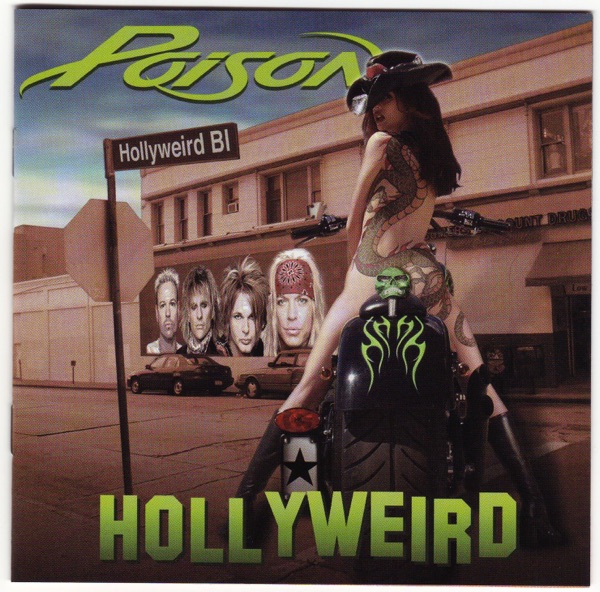
Hollyweird
2002 · 13 tracks
- 1 Hollyweird ↗ 3:13
- 2 Squeeze Box ↗ 2:29
- 3 Shooting Star ↗ 4:37
- 4 Wishful Thinkin' ↗ 2:46
- 5 Get 'Ya Some ↗ 4:20
- 6 Emperor's New Clothes ↗ 2:12
- 7 Devil Woman ↗ 3:45
- 8 Wasteland ↗ 3:53
- 9 Livin' In the Now ↗ 2:35
- 10 Stupid, Stoned & Dumb ↗ 3:08
- 11 Home (Bret's Story) ↗ 2:47
- 12 Home (C.C.'s Story) ↗ 2:45
- 13 Rock Star (Bonus Track) ↗ 3:33

Poison'd!
2007 · 14 tracks
- 1 Little Willy ↗ 3:18
- 2 Suffragette City ↗ 2:57
- 3 I Never Cry ↗ 3:34
- 4 I Need To Know ↗ 2:22
- 5 Can't You See ↗ 4:57
- 6 What I Like About You ↗ 3:00
- 7 Dead Flowers ↗ 4:22
- 8 Just What I Needed ↗ 3:36
- 9 Rock and Roll All Nite ↗ 3:35
- 10 Squeeze Box ↗ 2:30
- 11 You Don't Mess Around With Jim (Demo Version) ↗ 3:06
- 12 Your Mama Don't Dance ↗ 3:01
- 13 We're an American Band ↗ 3:10
- 14 Sexyback ↗ 3:26
-
 Look What the Cat Dragged InPoison198610 tracks
 -
 Open Up and Say… Ahh!Poison198810 tracks
 -
 Flesh & BloodPoison199016 tracks
 -
 Native TonguePoison199315 tracks
 -
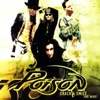 Crack A SmilePoison199620 tracks
 - Crack a Smile... and More!Poison200020 tracks
-
 HollyweirdPoison200213 tracks
 -
 Poison'd!Poison200714 tracks
Deep Dive
Overview
Poison is an American rock band formed in Mechanicsburg, Pennsylvania, that rose to become one of the defining acts of glam metal in the 1980s and early 1990s. Fronted by lead singer and rhythm guitarist Bret Michaels with lead guitarist C.C. DeVille, bassist Bobby Dall, and drummer Rikki Rockett, the band achieved massive commercial success across the mid-1980s through the mid-1990s, selling over 65 million records and DVDs worldwide. In 2012, VH1 ranked them at No. 1 on their list of the “Top 5 Hair Bands of the ’80s,” a testament to their cultural footprint during rock’s most flamboyant decade.
Formation Story
Poison emerged from Mechanicsburg, Pennsylvania in 1983, a working-class steel town that seemed an unlikely birthplace for one of glam metal’s biggest acts. The band coalesced around the partnership of Bret Michaels and C.C. DeVille, whose songwriting and guitar chemistry would define the group’s sound. Completed by the rhythm section of Bobby Dall on bass and Rikki Rockett behind the drums, Poison quickly developed a reputation for high-energy live shows that combined hard rock muscle with the theatrical presentation and melodic sensibilities that were beginning to dominate arena rock in the early 1980s. The band’s formation coincided with the explosion of glam metal as a commercial force, positioning them at the center of a movement that prioritized accessibility, catchiness, and spectacle.
Breakthrough Moment
Poison announced their arrival with the 1986 debut album Look What the Cat Dragged In, released through Capitol Records. The record showcased the band’s signature blend of anthemic hooks, driving rhythms, and Michaels’ vocals delivered with charismatic swagger. The album’s success established Poison as more than a regional act; it proved that the glam metal formula—party-ready hooks wrapped in heavy guitar tone and image-forward presentation—could reach millions of listeners. The commercial traction of this debut set the stage for the band to become one of the dominant forces in rock radio and MTV rotation throughout the remainder of the decade.
Peak Era
Poison’s peak commercial and creative period spanned the late 1980s and early 1990s. The 1988 follow-up Open Up and Say… Ahh! solidified their status as arena rock headliners, building on the foundation of their debut with a refined production approach and increasingly polished songwriting. The band sustained momentum through 1990’s Flesh & Blood, cementing their position at the top of the glam metal hierarchy. During this window, Poison dominated rock radio, MTV playlists, and sold-out tours, becoming synonymous with the era’s visual and sonic excess. Though the 1993 release Native Tongue and the 1996 Crack A Smile reflected shifts in rock tastes as alternative and grunge movements gained ground, they demonstrated the band’s determination to remain relevant as musical and cultural currents changed.
Musical Style
Poison’s sound fused the heaviness and distortion of hard rock with the melodic accessibility and production polish of glam metal. Michaels’ vocals—confident, swagger-laden, and built for stadium anthems—became the public face of the band, while C.C. DeVille’s lead guitar work combined shredding technique with song-serving sensibility rather than virtuosity for its own sake. The rhythm section of Dall and Rockett provided the propulsive, groove-oriented foundation that made the band’s records radio-friendly without sacrificing the instrumental power expected of hard rock. Lyrically, the band favored themes of partying, romance, and the rock-and-roll lifestyle, delivered with a mix of humor and earnestness that resonated with their fanbase. The band’s production approach—heavy use of synthesizers, layered vocals, and pristine studio clarity—reflected the production-intensive methods standard to glam metal in the 1980s, creating records that sounded massive on radio and in concert.
Major Albums
Look What the Cat Dragged In (1986)
Poison’s debut announced the band as a major force in glam metal, establishing the songwriting partnership and production aesthetic that would define their sound. The record’s success launched them from regional act to national touring draw.
Open Up and Say… Ahh! (1988)
The band’s second album refined their formula with increasingly polished songwriting and production, becoming one of their most commercially successful releases and cementing their status as arena rock headliners.
Flesh & Blood (1990)
Released at the height of Poison’s commercial dominance, this album showcased the band’s ability to evolve while maintaining the hooks and bombast that had made them a household name in rock.
Native Tongue (1993)
Released during a period of seismic change in rock music, Native Tongue represented the band’s attempt to adapt to the post-grunge landscape while maintaining their core identity.
Crack A Smile (1996)
The band continued to tour and record despite the decline of glam metal’s mainstream commercial dominance, demonstrating their resilience and loyal fanbase.
Signature Songs
- “Nothin’ but a Good Time” — An arena-sized celebration of hedonism and the rock lifestyle, capturing the spirit of Poison’s fanbase and touring appeal.
- “Unskinny Bop” — A hard-hitting rock single that showcased the band’s ability to combine heavy instrumentation with accessible hooks and innuendo-laden swagger.
- “Talk Dirty to Me” — One of the band’s earliest radio hits that helped establish their signature sound and performance attitude.
- “Every Rose Has Its Thorn” — A power ballad that demonstrated the band’s range beyond party anthems, revealing a softer melodic sensibility.
- “Fallen Angel” — Another showcase for Michaels’ vocal charisma and the band’s gift for constructing stadium-sized rock songs with memorable hooks.
Influence on Rock
Poison’s success cemented glam metal as a legitimate commercial force in mainstream rock, proving that image, accessibility, and spectacle could coexist with genuine musicianship and songwriting craft. The band’s approach to performance and presentation influenced countless acts within the glam metal sphere and established a template for rock entertainment that prioritized visual impact and charisma alongside musical competence. Their chart success and radio dominance demonstrated that hard rock could reach audiences far beyond traditional heavy metal fans, a lesson that subsequent generations of rock and metal acts would absorb. While grunge and alternative rock eventually displaced glam metal from the mainstream, Poison’s commercial and cultural impact during their peak years made them central to understanding 1980s popular music and the particular strain of theatrical hard rock that defined the decade.
Legacy
Poison remains one of the most commercially successful rock bands of the 1980s, with their catalog continuing to generate revenue through streaming, classic rock radio rotation, and catalog licensing. The band’s ranking by VH1 as the No. 1 hair band of the ’80s affirms their historical importance to the era and the glam metal movement. Though their cultural cachet declined after the early 1990s, they have maintained an active touring schedule and recorded new material through the 2000s, including releases like Poison’d! in 2007, testament to their determination to remain active performers and recording artists. Their impact on rock music history is secured by their platinum-selling albums, radio ubiquity during their peak, and influence on subsequent generations of hard rock and metal acts.
Fun Facts
- The band’s origin in Mechanicsburg, Pennsylvania—a small, industrial city—made them unlikely candidates for glam metal stardom, a genre often associated with Los Angeles and other major music capitals.
- In 2012, more than a quarter-century after their commercial peak, VH1 ranked Poison at No. 1 on their “Top 5 Hair Bands of the ’80s” list, reflecting their enduring cultural standing within the genre.
- Poison achieved their massive commercial success—over 65 million records and DVDs sold worldwide—during an era when physical media sales dominated the industry, a figure that underscores their commercial dominance across multiple formats and territories.
- The band’s longevity, remaining active from their 1983 formation through the present day, places them among the more durable acts of their generation, adapting to changing tastes while maintaining their core lineup.