
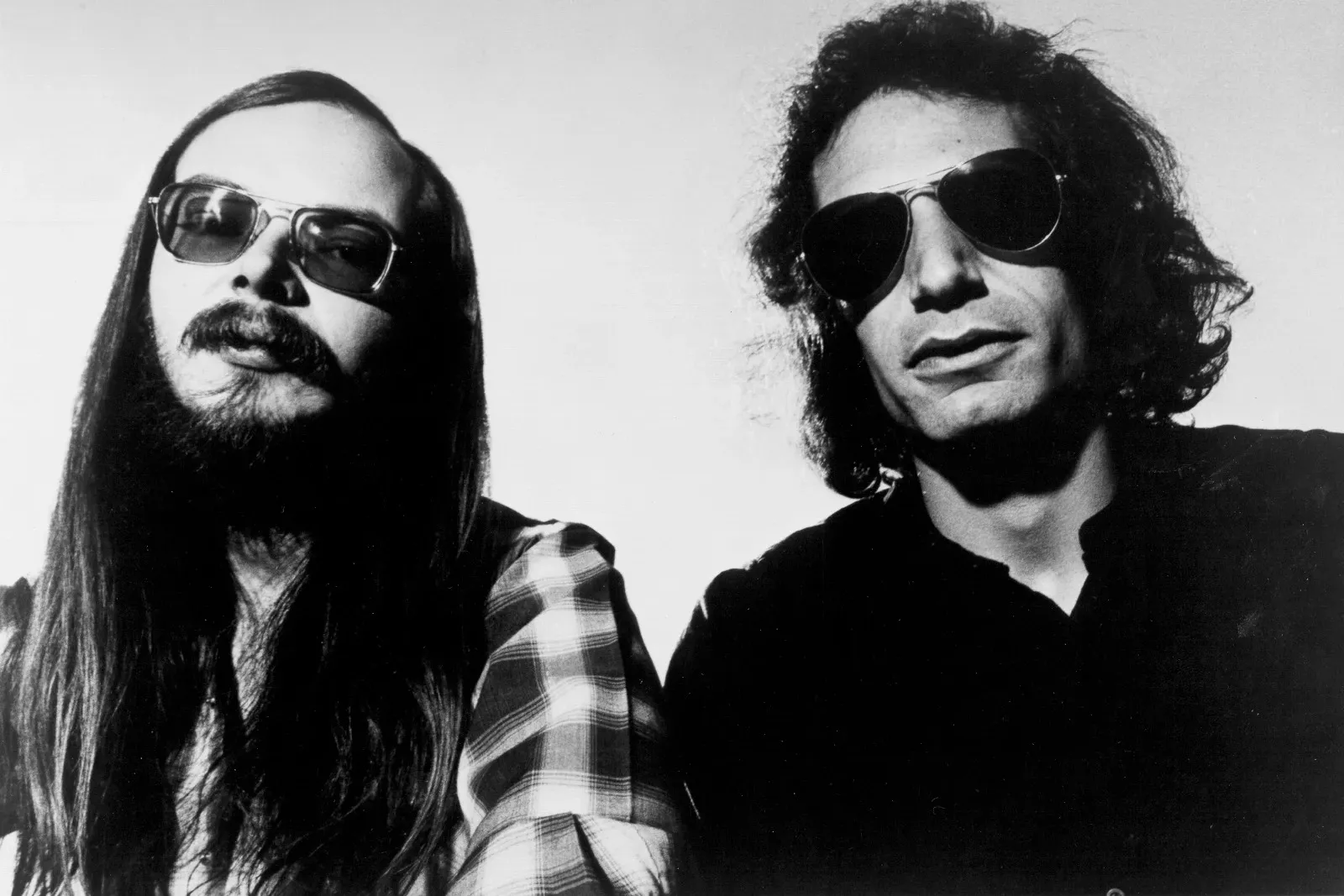
Photo by Distributed by ABC Records , licensed under Public domain · Wikimedia Commons
Rank #31
Steely Dan
From Wikipedia
Steely Dan was an American rock band formed in Annandale-on-Hudson, New York, in 1971 by Walter Becker and Donald Fagen. Originally having a traditional band lineup, Becker and Fagen chose to stop performing live by the end of 1974 and continued Steely Dan as a studio-only duo, using a revolving cast of session musicians. Rolling Stone magazine named them "the perfect musical antiheroes for the seventies".
Members
- Jeff Baxter (1972–1974)
- Walter Becker (1972–2017)
- Donald Fagen
Discography & Previews
Browse through and click an album to open and play 30-second previews streamed from Apple Music.

Can’t Buy a Thrill
1972 · 10 tracks


Pretzel Logic
1974 · 11 tracks
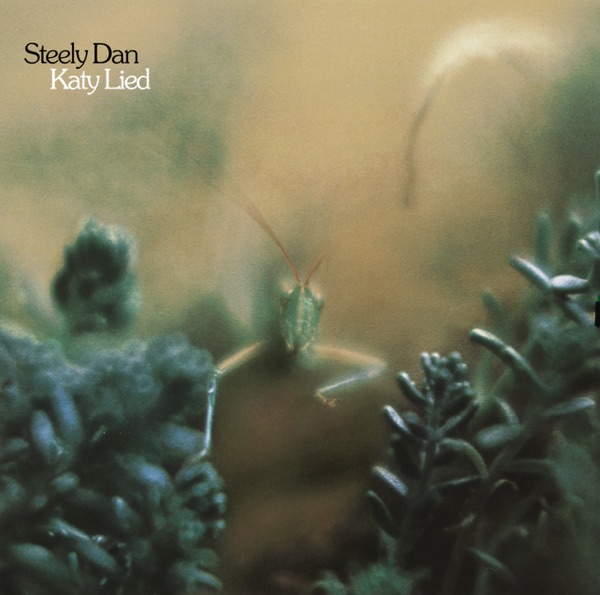
Katy Lied
1975 · 10 tracks
- 1 Black Friday ↗ 3:41
- 2 Bad Sneakers ↗ 3:20
- 3 Rose Darling ↗ 3:04
- 4 Daddy Don't Live In That New York City No More ↗ 3:14
- 5 Doctor Wu ↗ 3:55
- 6 Everyone's Gone to the Movies ↗ 3:44
- 7 Your Gold Teeth II ↗ 4:12
- 8 Chain Lightning ↗ 3:00
- 9 Any World (That I'm Welcome To) ↗ 3:54
- 10 Throw Back the Little Ones ↗ 3:13

The Royal Scam
1976 · 9 tracks
- 1 Kid Charlemagne (2025 Remaster) ↗ 4:34
- 2 The Caves Of Altamira (2025 Remaster) ↗ 3:32
- 3 Don't Take Me Alive (2025 Remaster) ↗ 4:14
- 4 Sign In Stranger (2025 Remaster) ↗ 4:22
- 5 The Fez (2025 Remaster) ↗ 3:57
- 6 Green Earrings (2025 Remaster) ↗ 4:07
- 7 Haitian Divorce (2025 Remaster) ↗ 5:47
- 8 Everything You Did (2025 Remaster) ↗ 3:57
- 9 The Royal Scam (2025 Remaster) ↗ 6:32


-
 Can’t Buy a ThrillSteely Dan197210 tracks
 -
 Countdown to EcstasySteely Dan19738 tracks
 -
 Pretzel LogicSteely Dan197411 tracks
 -
 Katy LiedSteely Dan197510 tracks
 -
 The Royal ScamSteely Dan19769 tracks
 -
 AjaSteely Dan19777 tracks
 -
 GauchoSteely Dan19807 tracks
 -
 Two Against NatureSteely Dan20009 tracks
 -
 Everything Must GoSteely Dan20039 tracks
Deep Dive
Overview
Steely Dan was an American rock band formed in 1971 by Walter Becker and Donald Fagen, emerging from Annandale-on-Hudson, New York, as one of the defining studio acts of the 1970s. The band fused jazz harmony with cynical rock songcraft, creating a sound marked by sophisticated chord progressions, carefully crafted arrangements, and lyrics that depicted urban American life with detached precision. Rolling Stone magazine named them “the perfect musical antiheroes for the seventies,” a designation that captured their refusal to embrace rock’s conventional theatricality or earnest sentiment.
Formation Story
Walter Becker and Donald Fagen established Steely Dan in 1972, initially operating as a full band with guitarist Jeff Baxter completing the core lineup. The duo had met at Bard College in upstate New York and began writing and performing together, quickly establishing a reputation for meticulous songcraft and harmonic sophistication that set them apart from their rock contemporaries. The band’s formation coincided with the emergence of art rock and progressive tendencies in mainstream popular music, yet Steely Dan distinguished itself through a pop sensibility grounded in jazz and R&B structures rather than classical expansion or conceptual ambition.
Breakthrough Moment
Steely Dan’s debut album, Can’t Buy a Thrill (1972), announced their arrival with immediate commercial and critical success. Released on ABC Records, the album established the band’s signature formula: pop-rock hooks married to jazz-inflected harmony and lyrics that observed American culture through a lens of irony and skepticism. The quick succession of Countdown to Ecstasy (1973) and Pretzel Logic (1974) cemented their status as serious studio artists, each album refining their approach and demonstrating Becker and Fagen’s growing control over production and arrangement. By the end of 1974, the duo made the decisive choice to cease live performance entirely, transforming Steely Dan into a studio-only operation that employed revolving session musicians to realize their increasingly exacting vision.
Peak Era
The period from 1975 to 1980 represented Steely Dan’s commercial and artistic zenith. Katy Lied (1975) deepened their exploration of jazz voicings and R&B rhythm, while The Royal Scam (1976) showcased their ability to craft complex narratives within radio-friendly song structures. The album Aja (1977) stands as their most celebrated work, synthesizing their stylistic interests into a collection of meticulously produced tracks that balanced accessibility with harmonic and lyrical sophistication. Gaucho (1980) extended this refinement further, maintaining their commercial presence while pushing production standards to new extremes. These five albums established Steely Dan as the premier exemplars of studio craft in rock music, musicians for whom the recording studio itself became an instrument.
Musical Style
Steely Dan’s sound was rooted in the foundations of rock, pop, and R&B but filtered through a distinctly jazz-harmonic sensibility. Becker and Fagen favored complex chord progressions, diminished and augmented voicings, and countermelodic elements that resisted simple functional harmony. Their arrangements typically featured tight rhythm sections grounded in funk and soul grooves, layered with horns, keyboards, and guitars deployed with surgical precision. Lyrically, the band adopted a persona of world-weary observation, constructing narratives around flawed characters, failed romance, and the compromise of adult life. The vocals—primarily Fagen’s—were deliberately untheatrical, delivered with emotional restraint that complemented the intellectual distance of the lyrics and arrangements. This combination of musical sophistication and emotional reserve made Steely Dan sound simultaneously polished and unsentimental, perfectly calibrated for the ironic tenor of 1970s popular consciousness.
Major Albums
Can’t Buy a Thrill (1972)
The debut established the fundamental Steely Dan sound: pop sensibility married to jazz harmony, with Fagen’s detached vocals and Becker’s production control evident across tracks that balanced commercial appeal with musical substance.
Pretzel Logic (1974)
The third album refined their studio approach and marked the final recording with the full band before Becker and Fagen’s transition to session-only recording, showcasing the duo’s confidence in their compositional and arranging abilities.
Aja (1977)
Their commercial and artistic peak, featuring some of their most celebrated compositions, with horn arrangements and production values that represented the height of 1970s studio craft and sophistication.
Gaucho (1980)
The final studio album of their original run, extending the sonic and harmonic refinements of Aja while maintaining their distinctive blend of funk-influenced rhythm and complex jazz voicing.
Two Against Nature (2000)
A return to studio recording after a two-decade hiatus, demonstrating that Becker and Fagen’s songwriting and production sensibilities remained intact despite the passage of time.
Signature Songs
- “Reelin’ in the Years” — The opening track of Can’t Buy a Thrill, featuring a now-iconic guitar riff and establishing the band’s ability to craft hooks within sophisticated harmonic frameworks.
- “Do It Again” — A funk-inflected early single that showcased the band’s rhythmic sophistication and Fagen’s controlled vocal delivery.
- “Rikki Don’t Lose That Number” — A meditative track from Pretzel Logic that balanced pop accessibility with jazz-piano sophistication.
- “Black Friday” — A narrative song from Katy Lied exemplifying the band’s gift for literary storytelling and character observation.
- “Deacon Blues” — A ballad from Aja that demonstrated the band’s range and ability to sustain emotional complexity across an extended form.
- “Peg” — From Aja, a track featuring session musicians at the height of their craft, with intricate arrangement and production detail.
- “Babylon Sisters” — Another Aja standout showcasing the band’s sophisticated approach to rhythm and the integration of horn sections.
Influence on Rock
Steely Dan’s influence extended far beyond their immediate commercial success, fundamentally reshaping attitudes toward studio craftsmanship in popular music. Their insistence on precision, their integration of jazz harmony into rock structures, and their refusal to embrace rock’s traditional performance-centered identity inspired subsequent generations of pop and art-rock musicians to prioritize the studio as a compositional tool. The band’s example demonstrated that rock and pop music could accommodate intellectual complexity, harmonic sophistication, and lyrical subtlety without sacrificing commercial viability. Their approach presaged the studio-centric practices of 1980s and 1990s pop and alternative music, wherein the recording engineer and producer became as creatively central as the performers themselves. Musicians across genres—from progressive rock to electronic pop to hip-hop producers sampling and recontextualizing their work—have drawn on Steely Dan’s template of high-craft pop music grounded in African-American musical traditions.
Legacy
Steely Dan’s catalog has sustained and grown in cultural prominence through decades of shifting musical fashion. Their albums remain staples of sophisticated popular-music listening, and their influence appears across contemporary music through direct sampling and stylistic emulation. The band’s decision to return to studio recording with Two Against Nature in 2000 reasserted their relevance and demonstrated the durability of their creative partnership. Walter Becker’s death in 2017 ended an era, though the band’s recorded work continues to circulate widely on streaming platforms and in critical reassessments of 1970s rock. Their legacy stands as a monument to the possibilities of pop-rock music created with meticulous attention to harmonic language, arrangement, and production, a legacy that has only grown more apparent as subsequent decades of music history have unfolded.
Fun Facts
- Jeff Baxter, the band’s original guitarist, performed on the first two studio albums before departing in 1974; he subsequently became known for his work with The Doobie Brothers and later as a defense and technology policy analyst.
- Steely Dan’s choice to abandon live performance while still at the height of their commercial success was an extraordinarily rare decision in rock music, one that prioritized the studio album as the primary artistic expression and proved the viability of a tour-less recording career.
- The band employed a rotating cast of highly skilled session musicians on their albums, including some of Los Angeles’s most accomplished studio professionals, who performed parts written with extreme specificity.