
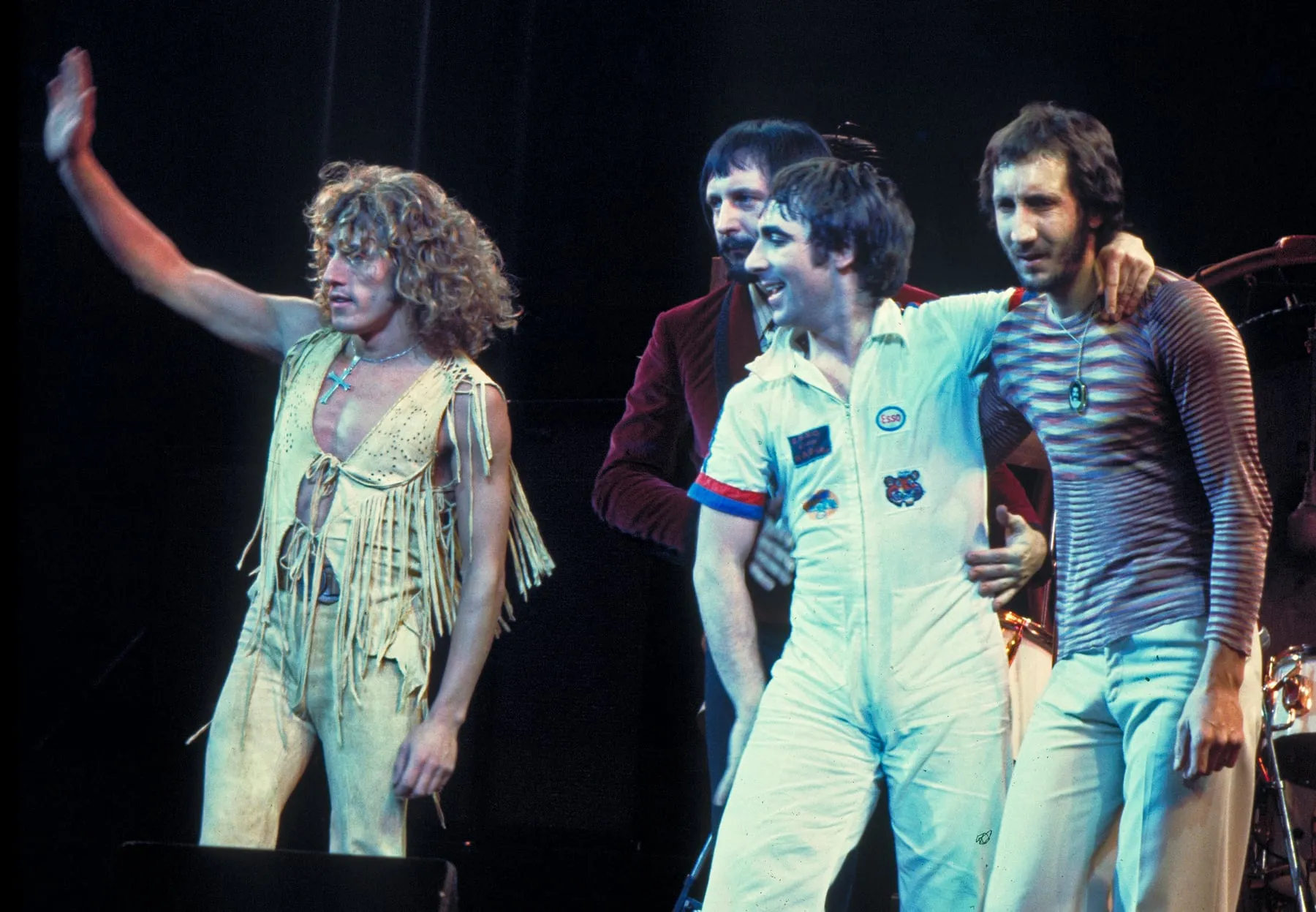
Photo by Jim Summaria , licensed under CC BY-SA 3.0 · Wikimedia Commons
Rank #6
The Who
From Wikipedia
The Who are an English rock band formed in London in 1964. Their classic lineup (1964–1978) consisted of lead vocalist Roger Daltrey, guitarist Pete Townshend, bassist John Entwistle, and drummer Keith Moon. Considered one of the most influential rock bands of the 20th century, their contributions to rock music include the development of the Marshall stack, large public address systems, the use of synthesisers, Entwistle's and Moon's influential playing styles, Townshend's feedback and power chord guitar technique, and the development of the rock opera. They are cited as an influence by many hard rock, punk, power pop and mod bands. They were inducted into the Rock and Roll Hall of Fame in 1990.
Members
- John Entwistle
- Keith Moon
- Kenney Jones
- Pete Townshend
- Roger Daltrey
Discography & Previews
Browse through and click an album to open and play 30-second previews streamed from Apple Music.

My Generation
1965 · 12 tracks
- 1 Out In the Street (Mono Version) ↗ 2:32
- 2 I Don't Mind (Mono Version) ↗ 2:37
- 3 The Good's Gone (Mono Version) ↗ 4:03
- 4 La-La Lies (Mono Version) ↗ 2:17
- 5 Much Too Much (Mono Version) ↗ 2:48
- 6 My Generation (Mono Version) ↗ 3:19
- 7 The Kids Are Alright (Mono Version) ↗ 2:47
- 8 Please, Please, Please (Mono Version) ↗ 2:46
- 9 It's Not True (Mono Version) ↗ 2:32
- 10 The Ox (Mono Version) ↗ 3:50
- 11 A Legal Matter (Mono Version) ↗ 2:49
- 12 Instant Party (Circles) [Mono Version] ↗ 3:14

A Quick One
1966 · 18 tracks
- 1 Run Run Run ↗ 2:45
- 2 Boris the Spider ↗ 2:30
- 3 I Need You ↗ 2:24
- 4 Whiskey Man ↗ 2:58
- 5 Heat Wave ↗ 1:55
- 6 Cobwebs and Strange ↗ 2:32
- 7 Don't Look Away ↗ 2:54
- 8 See My Way ↗ 1:54
- 9 So Sad About Us ↗ 3:04
- 10 A Quick One, While He's Away ↗ 9:14
- 11 Batman ↗ 1:35
- 12 Bucket T ↗ 2:07
- 13 Barbara Ann ↗ 2:00
- 14 Disguises ↗ 3:22
- 15 I've Been Away ↗ 2:09
- 16 In the City ↗ 2:25
- 17 Man With Money ↗ 2:47
- 18 My Generation / Land of Hope and Glory (Live) ↗ 2:03

The Who Sell Out
1967 · 13 tracks
- 1 Armenia City In The Sky (Incl. Two Radio London Jingles) ↗ 3:50
- 2 Heinz Baked Beans (Incl. "More Music" Jingle) ↗ 1:01
- 3 Mary Anne With The Shaky Hand (Acoustic / Incl. "Premier Drums Commercial" / Radio London Jingle) ↗ 2:34
- 4 Odorono (Incl. Radio London "Smooth Sailing" Jingle) ↗ 2:35
- 5 Tattoo (Incl. "Church Of Your Choice" Jingle) ↗ 2:54
- 6 Our Love Was (Incl. "Pussycat, Speakeasy & Rotosound" Jingles) ↗ 3:25
- 7 I Can See For Miles ↗ 4:10
- 8 I Can't Reach You (Incl. "Charles Atlas" Commercial) ↗ 3:31
- 9 Medac ↗ 0:57
- 10 Relax ↗ 2:41
- 11 Silas Stingy ↗ 3:06
- 12 Sunrise ↗ 3:05
- 13 Rael (Pt.1 & Pt.2) ↗ 5:56

Tommy
1969 · 24 tracks
- 1 Overture ↗ 5:20
- 2 It's A Boy ↗ 0:39
- 3 1921 ↗ 2:49
- 4 Amazing Journey ↗ 5:04
- 5 Sparks ↗ 2:05
- 6 Eyesight To The Blind (The Hawker) ↗ 2:14
- 7 Christmas ↗ 4:35
- 8 Cousin Kevin ↗ 4:07
- 9 The Acid Queen ↗ 3:34
- 10 Underture ↗ 10:04
- 11 Do You Think It's Alright? ↗ 0:24
- 12 Fiddle About ↗ 1:31
- 13 Pinball Wizard ↗ 3:01
- 14 There's A Doctor ↗ 0:24
- 15 Go To The Mirror! ↗ 3:48
- 16 Tommy Can You Hear Me? ↗ 1:35
- 17 Smash The Mirror ↗ 1:35
- 18 Sensation ↗ 2:28
- 19 Miracle Cure ↗ 0:13
- 20 Sally Simpson ↗ 4:10
- 21 I'm Free ↗ 2:39
- 22 Welcome ↗ 4:33
- 23 Tommy's Holiday Camp ↗ 0:57
- 24 We're Not Gonna Take It ↗ 7:06

Who’s Next
1971 · 9 tracks
- 1 Baba O'Riley (Remastered 2022) ↗ 5:04
- 2 Bargain (Remastered 2022) ↗ 5:35
- 3 Love Ain't For Keeping (Remastered 2022) ↗ 2:12
- 4 My Wife (Remastered 2022) ↗ 3:36
- 5 The Song Is Over (Remastered 2022) ↗ 6:25
- 6 Getting In Tune (Remastered 2022) ↗ 4:51
- 7 Going Mobile (Remastered 2022) ↗ 3:46
- 8 Behind Blue Eyes (Remastered 2022) ↗ 3:42
- 9 Won't Get Fooled Again (Remastered 2022) ↗ 8:34
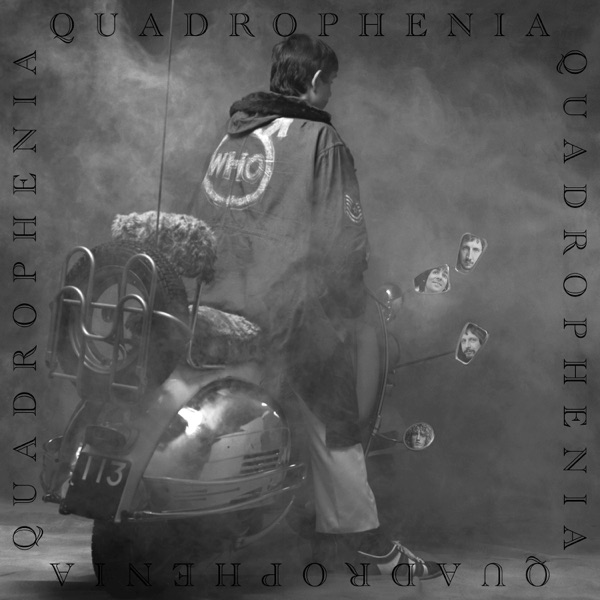
Quadrophenia
1973 · 17 tracks
- 1 I Am the Sea ↗ 2:09
- 2 The Real Me ↗ 3:22
- 3 Quadrophenia ↗ 6:15
- 4 Cut My Hair ↗ 3:46
- 5 The Punk and the Godfather ↗ 5:18
- 6 I'm One ↗ 2:39
- 7 The Dirty Jobs ↗ 4:30
- 8 Helpless Dancer ↗ 2:36
- 9 Is It In My Head? ↗ 3:46
- 10 I've Had Enough ↗ 6:18
- 11 5:15 ↗ 5:03
- 12 Sea and Sand ↗ 5:06
- 13 Drowned ↗ 5:28
- 14 Bell Boy ↗ 5:01
- 15 Doctor Jimmy ↗ 8:39
- 16 The Rock ↗ 6:40
- 17 Love, Reign O'er Me ↗ 5:49

The Who by Numbers
1975 · 13 tracks
- 1 Slip Kid ↗ 4:38
- 2 However Much I Booze ↗ 5:05
- 3 Squeeze Box ↗ 2:41
- 4 Dreaming from the Waist ↗ 4:09
- 5 Imagine a Man ↗ 4:05
- 6 Success Story ↗ 3:23
- 7 They Are All In Love ↗ 3:03
- 8 Blue, Red and Grey ↗ 2:49
- 9 How Many Friends ↗ 4:06
- 10 In a Hand or a Face ↗ 3:23
- 11 Squeeze Box (Live) ↗ 3:19
- 12 Behind Blue Eyes (Live) ↗ 4:41
- 13 Dreaming from the Waist (Live) ↗ 4:50


Face Dances
1981 · 13 tracks
- 1 You Better You Bet ↗ 5:37
- 2 Don't Let Go the Coat ↗ 3:45
- 3 Cache Cache ↗ 3:56
- 4 The Quiet One ↗ 3:09
- 5 Did You Steal My Money ↗ 4:17
- 6 How Can You Do It Alone ↗ 5:28
- 7 Daily Records ↗ 3:28
- 8 You ↗ 4:31
- 9 Another Tricky Day ↗ 4:58
- 10 I Like Nightmares ↗ 3:10
- 11 It's In You ↗ 5:15
- 12 How Can You Do It Alone (Live at the International Amphitheatre, Chicago, 12/08/79) ↗ 8:13
- 13 The Quiet One (Live at Shea Stadium, NYC, 10/13/82) ↗ 4:01

It’s Hard
1982 · 16 tracks
- 1 Athena ↗ 3:48
- 2 It's Your Turn (feat. Andy Fairweather Low) ↗ 3:41
- 3 Cooks Country ↗ 3:50
- 4 It's Hard ↗ 3:46
- 5 Dangerous ↗ 3:20
- 6 Eminence Front ↗ 5:40
- 7 I've Known No War ↗ 5:59
- 8 One Life's Enough ↗ 2:21
- 9 One At a Time ↗ 3:03
- 10 Why Did I Fall For That ↗ 3:25
- 11 A Man Is a Man ↗ 3:56
- 12 Cry If You Want ↗ 4:44
- 13 It's Hard (Live) ↗ 5:28
- 14 Eminence Front (Live) ↗ 5:55
- 15 Dangerous (Live) ↗ 3:42
- 16 Cry If You Want (Live) ↗ 7:00

Endless Wire
2006 · 21 tracks
- 1 Fragments ↗ 3:57
- 2 A Man In a Purple Dress ↗ 4:15
- 3 Mike Post Theme ↗ 4:28
- 4 In the Ether ↗ 3:36
- 5 Black Widow's Eyes ↗ 3:07
- 6 Two Thousand Years ↗ 2:51
- 7 God Speaks, of Marty Robbins ↗ 3:27
- 8 It's Not Enough ↗ 4:03
- 9 You Stand By Me ↗ 1:36
- 10 Sound Round ↗ 1:21
- 11 Pick Up the Peace ↗ 1:29
- 12 Unholy Trinity ↗ 2:08
- 13 Trilby's Piano ↗ 2:05
- 14 Endless Wire ↗ 1:52
- 15 Fragments of Fragments ↗ 2:23
- 16 We Got a Hit ↗ 1:18
- 17 They Make My Dream Come True ↗ 1:13
- 18 Mirror Door ↗ 4:14
- 19 Tea & Theatre ↗ 3:24
- 20 We Got a Hit (Extended Version) ↗ 3:05
- 21 Endless Wire (Extended Version) ↗ 3:02

WHO
2019 · 11 tracks
-
 My GenerationThe Who196512 tracks
 -
 A Quick OneThe Who196618 tracks
 -
 The Who Sell OutThe Who196713 tracks
 -
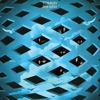 TommyThe Who196924 tracks
 -
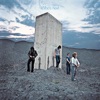 Who’s NextThe Who19719 tracks
 -
 QuadropheniaThe Who197317 tracks
 -
 The Who by NumbersThe Who197513 tracks
 -
 Who Are YouThe Who19789 tracks
 -
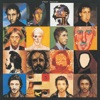 Face DancesThe Who198113 tracks
 -
 It’s HardThe Who198216 tracks
 -
 Endless WireThe Who200621 tracks
 -
 WHOThe Who201911 tracks
Deep Dive
Overview
The Who are an English rock band formed in London in 1964 who stand among the most influential rock acts of the 20th century. Emerging from the mod movement, they transformed rock into a vehicle for ambitious conceptual storytelling and physicality, pioneering the rock opera and establishing performance standards that made the live rock show a spectacle unto itself. Their classic lineup of Roger Daltrey (vocals), Pete Townshend (guitar), John Entwistle (bass), and Keith Moon (drums) created a body of work that proved rock music could sustain narrative depth, instrumental virtuosity, and raw power simultaneously.
Formation Story
The Who coalesced in London in 1964 from the collision of two earlier groups. Townshend and Entwistle had played together in a band called The Detours before joining forces with Daltrey and Moon. The pair arrived at a moment when London’s mod subculture was crystallizing around sharp tailoring, scooters, and soul and R&B music filtered through a British rock sensibility. The band’s name itself—stark, simple, and interrogative—embodied mod aesthetics. Their early sets drew from American rock and roll, rhythm and blues covers, and increasingly from Townshend’s original compositions, which captured the mod ethos of youth alienation and defiant swagger.
Breakthrough Moment
The Who’s debut album My Generation arrived in 1965 and announced their arrival with unmistakable force. The title track became their signature statement, its stutter-laden vocals, aggressive power chords, and feedback-drenched guitar work marking Townshend’s rapid emergence as a composer and player of uncommon ambition. The song’s target demographic—mod teenagers bristling against parental authority—resonated beyond Britain, establishing the band as more than a regional phenomenon. The album’s raw energy and Townshend’s explicit use of feedback and power chords as compositional tools set them apart from their contemporaries. Follow-up albums A Quick One (1966) and The Who Sell Out (1967) deepened their catalog while the latter’s integration of pirate-radio jingles and mini-narrative sequences hinted at the conceptual sophistication to come.
Peak Era
The Who’s creative and commercial zenith spanned the decade from 1969 to 1973, anchored by two landmark rock operas. Tommy, released in 1969, told the story of a deaf, dumb, and blind boy and the pilgrimage surrounding his affliction and eventual triumph. The album’s ambition—a double album conceived as a unified narrative—established the rock opera as a viable genre form. Who’s Next (1971) refined their approach, balancing conceptual ambition with shorter, punchier songs that functioned as both standalone statements and chapters in a larger work. Quadrophenia (1973), a return to double-album scope, documented the mod movement’s interior psychology through the prism of a young man’s psychological fragmentation. Across this period, the band’s live performances became legendary, marked by Townshend’s explosive guitar smashing and Moon’s destructive drumming, transforming the rock concert into theater.
Musical Style
The Who’s sound was built on a foundation of rhythm and blues and 1950s rock and roll, filtered through mod sensibilities and transformed by technological and compositional innovation. Townshend’s guitar work centered on the power chord, played with precision and distortion, often deployed to create textural feedback rather than melodic lead lines. His use of the Marshall stack—a towering amplifier setup that became standard in rock—allowed him to achieve unprecedented volume and presence. Entwistle’s bass playing departed sharply from the supporting rhythm function, instead filling the mid-range with melodic counter-statements and technical flourishes that made bass a lead instrument. Moon’s drumming eschewed metronomic timekeeping in favor of dynamic fills, sudden explosive accents, and a willingness to disrupt the expected beat, creating a volatile, propulsive sound. Daltrey’s vocals combined raw power with emotional vulnerability, capable of both the acerbic sneer of My Generation and the pleading desperation of Tommy. The band’s later incorporation of synthesizers, particularly on Who’s Next, expanded their sonic palette without diluting their essential rock identity.
Major Albums
My Generation (1965)
The Who’s debut established the template for everything to follow: aggressive power chords, Townshend’s emerging songwriting voice, and a youthful fury that captured mod ennui. The album showcased covers alongside originals, with tracks like “The Kids Are Alright” and “I Can’t Explain” demonstrating Townshend’s ability to write pop-inflected songs that retained genuine edge. The title track’s iconic stutter and feedback-drenched arrangement became one of rock’s defining moments.
Tommy (1969)
The Who’s creative breakthrough, Tommy transcended the concept-album format by telling a complete, emotionally coherent story across a double album. The narrative of a traumatized boy’s journey to self-realization gave Townshend a framework within which to explore a range of musical moods, from the gentle “Pinball Wizard” to the devastating “We’re Not Gonna Take It.” The album’s commercial and critical success proved that rock audiences would embrace ambitious storytelling.
Who’s Next (1971)
Who’s Next achieved what Tommy aimed for while avoiding some of that work’s excesses. The album opened with the synthesizer-driven “Baba O’Riley,” signaling a sonic expansion, before settling into a more focused set of songs that balanced conceptual coherence with individual strength. Tracks like “Won’t Get Fooled Again” and “Behind Blue Eyes” became concert staples and radio staples, demonstrating that The Who could marry artistic ambition with popular appeal.
Quadrophenia (1973)
The Who’s second double album addressed the mod movement with a specificity and psychological depth that Tommy had approached more obliquely. The album traced a protagonist’s fragmentation into four selves, each represented by different musical styles and emotional registers. It stands as perhaps the band’s most comprehensive artistic statement, merging personal narrative, sociological observation, and musical innovation into a coherent whole.
Signature Songs
The Who’s catalog contains numerous songs that defined them and rock music broadly: “My Generation” remains their calling card, its generational defiance undiminished by age; “Pinball Wizard” and “Won’t Get Fooled Again” are concert necessities that sell out stadiums; “Behind Blue Eyes” and “We’re Not Gonna Take It” showcase Townshend’s gift for melody yoked to emotional weight; and “Baba O’Riley” introduced synthesizers as a primary compositional voice in rock.
Influence on Rock
The Who’s influence on rock music is nearly impossible to overstate. They proved the viability of the rock opera, a form that influenced progressive rock, punk, and Broadway-inflected rock for decades. Townshend’s feedback guitar technique and power-chord approach became foundational to hard rock and punk; bands from Led Zeppelin to Green Day cite him as a direct influence. Moon’s radical drumming style opened possibilities for percussionists in rock music, while Entwistle’s melodic, high-register bass playing became a template for players across genres. The band’s live performance aesthetic—the smashed guitar, the explosive energy, the refusal to simply stand and play—established the rock concert as spectacle and helped define what audiences expected from a rock show. Hard rock, punk, power pop, and mod revivalists all trace clear lineage to The Who.
Legacy
The Who continued recording and performing long past their initial phase, with albums including The Who by Numbers (1975), Who Are You (1978), Face Dances (1981), and It’s Hard (1982) maintaining their presence through the 1980s and beyond. A much later album, Endless Wire (2006), demonstrated their continued creative engagement, followed by WHO in 2019. The band was inducted into the Rock and Roll Hall of Fame in 1990, cementing their status as one of rock’s foundational acts. The Who have remained active performers into the present, with the classic lineup reduced by the deaths of Moon and Entwistle, and Daltrey and Townshend continuing to tour and record. Their influence extends across rock’s entire ecosystem, from the prog-rock acts who took the concept album to greater extremes to the punk and new-wave bands who absorbed their minimalist assault.
Fun Facts
- Keith Moon was known for his destructive behavior on and offstage, including demolishing drum kits and hotel rooms, making him one of rock’s most legendarily anarchic figures.
- The Who developed and popularized the Marshall stack amplifier system, which became the standard touring amplification setup for generations of rock bands.
- The Who Sell Out (1967) integrated fake pirate-radio jingles into its structure, presaging the band’s later conceptual ambitions by embedding narrative and commercial parody throughout the album.
- Pete Townshend’s songwriting often drew on his personal experiences and the mod movement’s sociological underpinnings, giving The Who’s rock operas psychological and cultural specificity rare in the genre.
- The band’s live performances in the early 1970s became legendary for Townshend’s guitar smashing and the sheer physical intensity of their shows, establishing the rock concert as dramatic spectacle.