
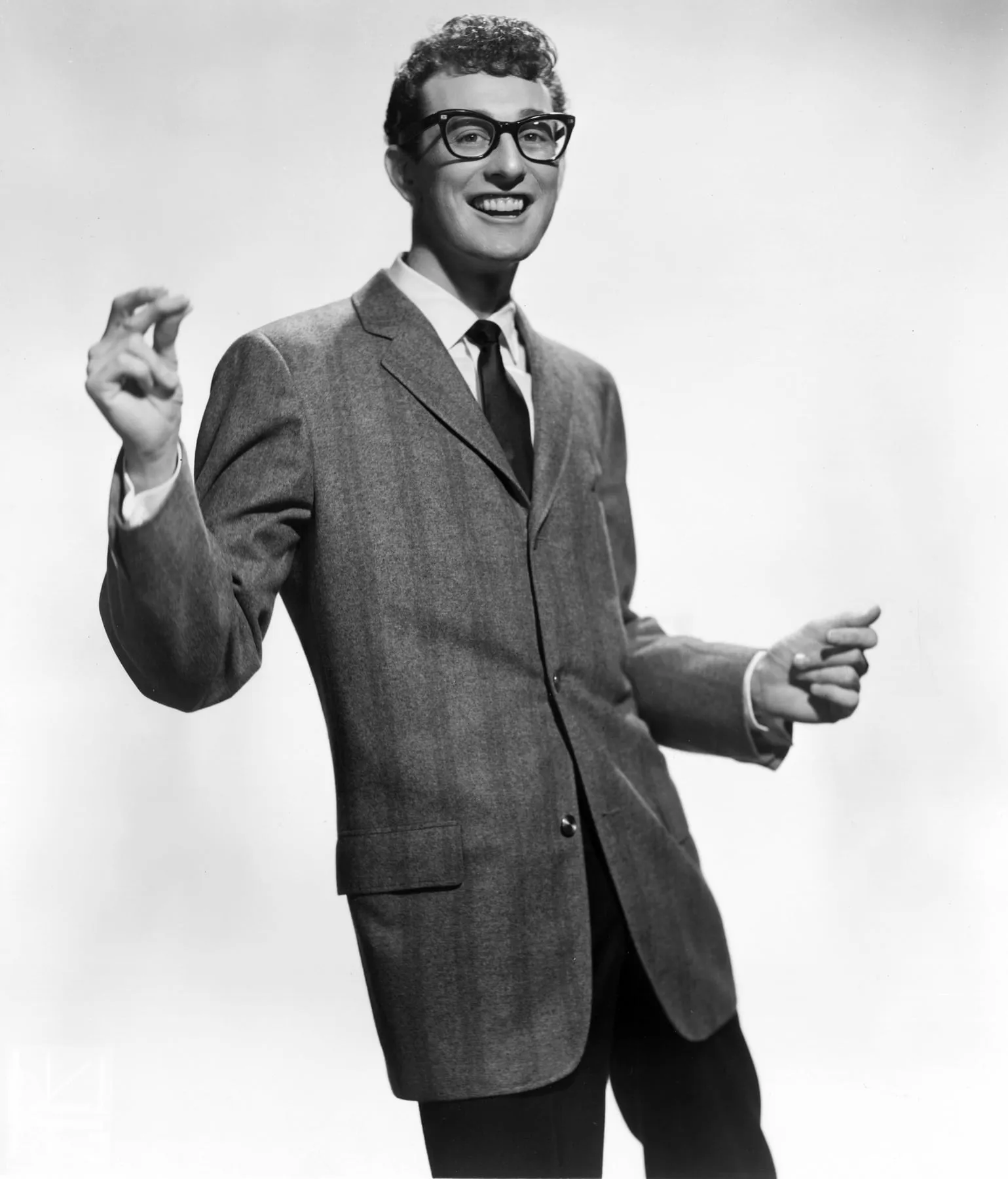
Photo by Brunswick Records (photographer: James J. Kriegsmann ); scan by Hulton Archive; restored by Hohum . , licensed under Public domain · Wikimedia Commons
Rank #67
Buddy Holly
From Wikipedia
Charles Hardin Holley, known professionally by his stage name Buddy Holly, was an American singer, songwriter, and musician who was a central and pioneering figure of rock and roll. He was born to a musical family in Lubbock, Texas, during the Great Depression, and learned to play guitar and sing alongside his two siblings.
Discography & Previews
Browse through and click an album to open and play 30-second previews streamed from Apple Music.

Buddy Holly
1958 · 17 tracks
- 1 I'm Gonna Love You Too ↗ 2:17
- 2 Peggy Sue ↗ 2:31
- 3 Look At Me ↗ 2:05
- 4 Listen To Me ↗ 2:23
- 5 Valley of Tears ↗ 2:09
- 6 Ready Teddy ↗ 1:33
- 7 Everyday ↗ 2:09
- 8 Mailman Bring Me No More Blues ↗ 2:13
- 9 Words of Love ↗ 1:57
- 10 You're So Square (Baby, I Don't Care) ↗ 1:38
- 11 Rave On ↗ 1:50
- 12 Little Baby ↗ 1:55
- 13 That's My Desire ↗ 2:25
- 14 Think It Over ↗ 1:46
- 15 Fool's Paradise ↗ 2:31
- 16 Well...All Right ↗ 2:15
- 17 Take Your Time ↗ 2:00

That’ll Be the Day
1958 · 13 tracks
- 1 You Are My One Desire ↗ 2:25
- 2 Blue Days, Black Nights ↗ 2:06
- 3 Modern Don Juan ↗ 2:41
- 4 Rock Around With Ollie Vee (Alternate Version) ↗ 2:18
- 5 Ting-A-Ling ↗ 2:44
- 6 Girl On My Mind ↗ 2:18
- 7 That'll Be the Day (Album Version) ↗ 2:30
- 8 Love Me ↗ 2:08
- 9 Changing All Those Changes (Single Version) ↗ 2:14
- 10 Don't Come Back Knockin' ↗ 2:15
- 11 Midnight Shift ↗ 2:12
- 12 Rock Around With Ollie Vee ↗ 2:13
- 13 Changing All Those Changes ↗ 1:43

True Love Ways
2018 · 13 tracks
- 1 True Love Ways ↗ 3:48
- 2 It Doesn't Matter Anymore ↗ 2:14
- 3 Everyday ↗ 2:17
- 4 Heartbeat ↗ 2:13
- 5 Raining In My Heart ↗ 2:50
- 6 Oh Boy ↗ 2:09
- 7 Rave On ↗ 1:51
- 8 Words Of Love ↗ 2:16
- 9 That'll Be The Day ↗ 2:19
- 10 Peggy Sue ↗ 2:32
- 11 Moondreams ↗ 2:47
- 12 Maybe Baby ↗ 2:20
- 13 Raining In My Heart ↗ 2:50
-
 Buddy HollyBuddy Holly195817 tracks
 -
 That’ll Be the DayBuddy Holly195813 tracks
 -
 True Love WaysBuddy Holly201813 tracks
Deep Dive
Overview
Charles Hardin Holley, known professionally as Buddy Holly, stands as a central and pioneering figure of rock and roll whose influence extends far beyond his brief career. Emerging from Lubbock, Texas, during the 1950s, Holly synthesized country music roots with the emerging energy of rockabilly and early rock and roll, crafting a template that would shape popular music for decades. His work as a singer, songwriter, and musician demonstrated that rock and roll could be intelligent, melodically sophisticated, and built on the foundation of traditional songwriting craft—a radical proposition at a moment when the genre was still finding its identity.
Formation Story
Buddy Holly was born in 1936 into a musical family in Lubbock, Texas, during the depths of the Great Depression. Growing up in the Texas Panhandle, he learned to play guitar and sing alongside his two siblings, absorbing the country, western swing, and gospel traditions that saturated his household and community. Lubbock’s musical landscape—rooted in country music and regional folk traditions—provided the soil from which his artistic sensibility would grow. By the mid-1950s, as rhythm and blues and early rock and roll were beginning to reshape American popular music, Holly found himself positioned at a crossroads where country musicianship met the raw energy of a new generation. His entry into professional music came naturally from this background, as he began performing locally and gradually attracted attention beyond the Texas border.
Breakthrough Moment
Holly’s breakthrough arrived with the 1958 release of That’ll Be the Day, a recording that captured both his distinctive vocal approach and his innate sense of pop melody. The album’s title track became a signature piece that established him as more than a regional curiosity; it demonstrated that a musician rooted in country traditions could produce records that spoke to the national rock and roll audience. This commercial and artistic success opened doors to major record labels and national touring, positioning him as one of the era’s most promising young artists. The album Buddy Holly, released the same year, further solidified his standing, proving that his initial success was not a one-off achievement but rather the beginning of a sustained creative presence.
Peak Era
The period between 1958 and 1959 represented Buddy Holly’s fullest flowering as an artist. During these years, he established himself as a recording artist of genuine substance, capable of moving between uptempo rock and roll numbers and more introspective, ballad-oriented material. His recordings from this period showcased his willingness to experiment with production techniques and arrangements while maintaining the melodic clarity and emotional directness that defined his work. Though his career was cut short, the output from these years would prove enormously influential, suggesting an artist whose creative evolution was far from complete.
Musical Style
Buddy Holly’s sound emerged from a synthesis of country music and rockabilly with the new language of rock and roll. His vocal approach was distinctive—clear, somewhat high-pitched, and marked by a direct emotional sincerity that set him apart from many of his contemporaries. As a guitarist and songwriter, he drew on country music’s melodic sophistication and harmonic structures while incorporating the rhythmic drive and raw energy of rockabilly. His recordings frequently featured clean, articulate production that allowed the songs’ melodies and arrangements to shine clearly, an aesthetic choice that contrasted with some of the more heavily echoed or distorted recordings of the era. Holly’s approach to songwriting emphasized strong melodic hooks, clever lyrical turns, and structural sophistication—he understood that rock and roll could be intelligent without sacrificing its essential appeal to young audiences. His work bridged the gap between country tradition and rock and roll innovation, demonstrating that these were not mutually exclusive categories but rather complementary vocabularies within a broader popular music ecosystem.
Major Albums
Buddy Holly (1958)
Released in 1958, this self-titled debut established Holly as a major new voice in rock and roll, featuring recordings that balanced uptempo rockers with more reflective material and showcasing his full range as an artist.
That’ll Be the Day (1958)
Also released in 1958, this album’s title track became one of Holly’s signature pieces and a landmark recording in early rock and roll history, capturing the infectious energy and melodic clarity that defined his approach.
Signature Songs
- That’ll Be the Day — The definitive Buddy Holly recording, a fast-paced rock and roll number that became his calling card and a foundational track in the genre’s early history.
- Peggy Sue — A mid-tempo number showcasing Holly’s ability to blend rock and roll drive with melodic sophistication and his distinctive vocal character.
- Oh, Boy! — An uptempo rocker demonstrating Holly’s gift for crafting infectious hooks and his mastery of the rockabilly form.
- Rave On — A driving rock and roll showcase featuring Holly’s enthusiastic vocal delivery and his talents as both performer and songwriter.
Influence on Rock
Buddy Holly’s brief but intense career established several crucial precedents for rock and roll’s development. First, he demonstrated that the genre could be built on sophisticated songwriting and musicianship rather than mere novelty or shock value. Second, his work as a songwriter showed that rock and roll artists could create their own material with the intelligence and craft traditionally associated with pop songwriting. Third, his integration of country music traditions into rock and roll helped legitimize the genre in the eyes of audiences and musicians who might otherwise have dismissed it as a passing fad. Artists in the 1960s and beyond—including The Beatles, who were profoundly influenced by Holly’s recordings and approach—would build directly on the template he established: the idea of the rock and roll artist as a complete musician capable of writing, arranging, and producing intelligent, memorable popular music.
Legacy
Buddy Holly’s death in 1959 transformed him into a tragic figure whose influence would only grow with time. His recordings have remained continuously available and influential, demonstrating a staying power that speaks to their fundamental quality. The body of work he left behind—though small by the standards of artists with longer careers—contains no filler and established patterns that would become central to rock and roll and popular music more broadly. His integration of country roots with rock and roll energy, his sophisticated approach to songwriting and production, and his persona as a complete musician rather than merely a vocalist have made him a touchstone for countless artists across multiple generations. His songs continue to be covered and reinterpreted, his recordings continue to influence musicians, and his example continues to demonstrate that rock and roll, even at its inception, was capable of artistic depth and lasting cultural significance.
Fun Facts
- Buddy Holly learned to play guitar and sing in his childhood as part of a musical family in Lubbock, Texas, providing the foundation for his later career as a multi-instrumentalist and songwriter.
- His stage name, Buddy Holly, derived from his childhood nickname and became the professional identity under which he achieved his greatest success in the music industry.
- Despite his brief recording career, Holly recorded for multiple major labels including Coral, Brunswick Records, and Decca, demonstrating the level of interest in his talent from the record industry.
- His influence extended beyond his lifetime, with his recordings and songwriting approach becoming foundational reference points for rock musicians throughout subsequent decades.