
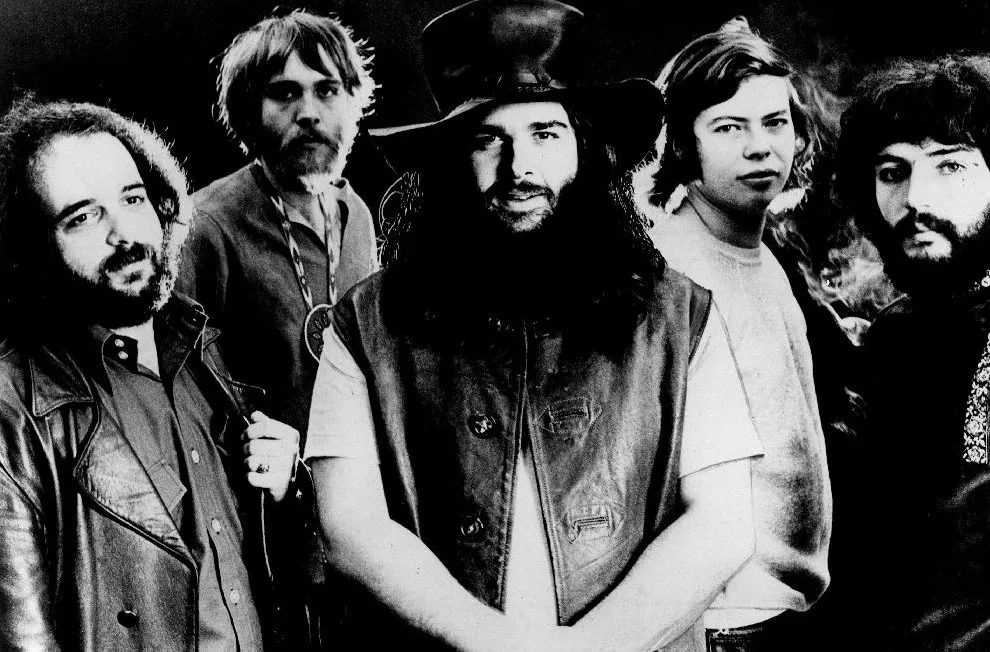
Photo by Skip Taylor Productions (management)/Liberty Records , licensed under Public domain · Wikimedia Commons
Rank #373
Canned Heat
From Wikipedia
Canned Heat is an American blues rock band that was formed in Los Angeles in 1965. The group has been noted for its efforts to promote interest in blues music and its original artists. It was launched by two blues enthusiasts, Alan Wilson and Bob Hite, who took the name from Tommy Johnson's 1928 "Canned Heat Blues", a song about an alcoholic who had desperately turned to drinking Sterno, generically called "canned heat". After appearances at the Monterey and Woodstock festivals at the end of the 1960s, the band acquired worldwide fame with a lineup of Hite (vocals), Wilson, Henry Vestine and later Harvey Mandel, Larry Taylor (bass), and Adolfo de la Parra (drums).
Members
- Alan Wilson
- Bob Hite
- Dale Spalding
- Harvey Mandel
- Henry Vestine
Discography & Previews
Browse through and click an album to open and play 30-second previews streamed from Apple Music.


Hallelujah
1969 · 13 tracks
- 1 Same All Over ↗ 2:51
- 2 Change My Ways ↗ 2:48
- 3 Canned Heat ↗ 4:22
- 4 Sic 'Em Pigs ↗ 2:40
- 5 I'm Her Man ↗ 2:56
- 6 Time Was ↗ 3:22
- 7 Do Not Enter ↗ 2:51
- 8 Big Fat (The Fat Man) ↗ 1:58
- 9 Huautla ↗ 3:33
- 10 Get Off My Back ↗ 5:12
- 11 Down In The Gutter But Free ↗ 5:36
- 12 Low Down (And High Up) [Bonus Track] ↗ 2:51
- 13 Poor Moon (Bonus Track) ↗ 3:25


Future Blues
1970 · 13 tracks
- 1 Sugar Bee ↗ 2:40
- 2 Shake It and Break It ↗ 2:35
- 3 That's All Right Mama ↗ 4:19
- 4 My Time Ain't Long ↗ 3:48
- 5 Skat ↗ 2:43
- 6 Let's Work Together ↗ 2:50
- 7 London Blues ↗ 5:30
- 8 So Sad (The World's In a Tangle) ↗ 7:56
- 9 Future Blues ↗ 3:05
- 10 Poor Moon (Bonus Track) ↗ 3:26
- 11 Wooly Bully (Bonus Track) ↗ 2:32
- 12 Let's Work Together (Long Version / Bonus Track) ↗ 3:14
- 13 Human Condition (Bonus Track) ↗ 5:25
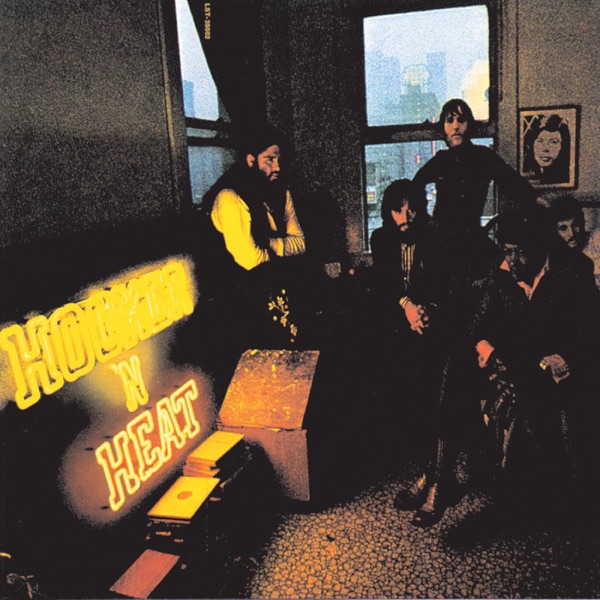
Hooker ’n Heat
1971 · 17 tracks
- 1 Messin' With the Hook ↗ 3:24
- 1 The World Today ↗ 7:48
- 2 The Feelin' Is Gone ↗ 4:33
- 2 I Got My Eyes On You ↗ 4:27
- 3 Send Me a Pillow ↗ 4:49
- 3 Whiskey and Wimmen ↗ 4:37
- 4 Sittin' Here Thinkin' ↗ 4:07
- 4 Just You and Me ↗ 7:42
- 5 Meet Me In the Bottom ↗ 3:34
- 5 Let's Make It ↗ 4:06
- 6 Alimonia Blues ↗ 4:32
- 6 Peavine ↗ 5:08
- 7 Drifter ↗ 4:58
- 7 Boogie Chillen, No. 2 ↗ 11:33
- 8 You Talk Too Much ↗ 3:17
- 9 Burning Hell ↗ 5:28
- 10 Bottle Up and Go ↗ 2:27

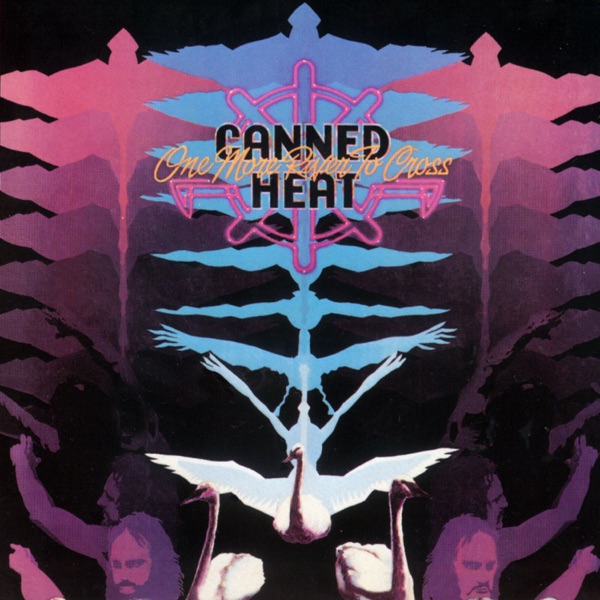
One More River to Cross
1973 · 10 tracks

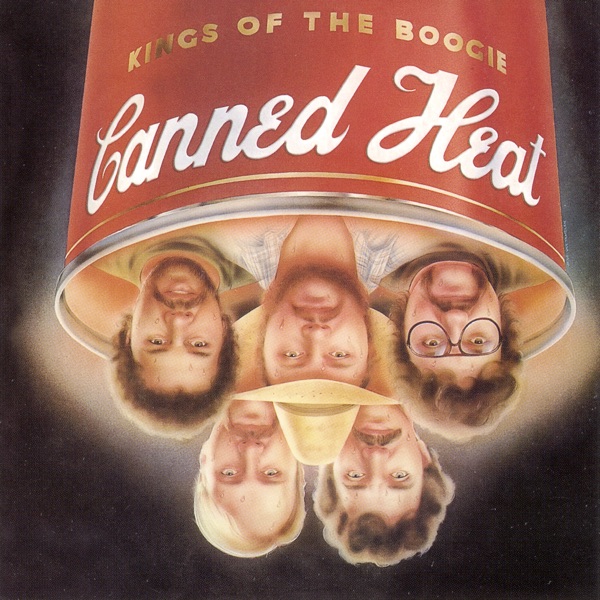
Kings of the Boogie
1981 · 10 tracks

Finyl Vinyl
2024 · 11 tracks
- 1 One Last Boogie ↗ 3:59
- 2 Blind Owl ↗ 6:04
- 3 Goin' to Heaven (In a Pontiac) ↗ 3:02
- 4 So Sad (The World's in a Tangle) [feat. Joe Bonamassa] ↗ 5:52
- 5 East/West Boogie (Instrumental) ↗ 4:09
- 6 Tease Me ↗ 3:11
- 7 A Hot Ole Time ↗ 3:29
- 8 You're the One ↗ 4:50
- 9 When You're 69 ↗ 4:51
- 10 Independence Day ↗ 4:27
- 11 There Goes That Train ↗ 3:10
-
 Canned HeatCanned Heat196711 tracks
 -
 Living the BluesCanned Heat196810 tracks
 -
 Boogie With Canned HeatCanned Heat196810 tracks
 -
 HallelujahCanned Heat196913 tracks
 -
 VintageCanned Heat196910 tracks
 -
 Future BluesCanned Heat197013 tracks
 -
 Hooker ’n HeatCanned Heat197117 tracks
 -
 Historical Figures and Ancient HeadsCanned Heat19728 tracks
 -
 One More River to CrossCanned Heat197310 tracks
 -
 The New AgeCanned Heat19739 tracks
 -
 Human ConditionCanned Heat19789 tracks
 -
 Kings of the BoogieCanned Heat198110 tracks
 -
 Canned HeatCanned Heat20177 tracks
 -
 Finyl VinylCanned Heat202411 tracks
Deep Dive
Overview
Canned Heat is an American blues rock band that emerged from Los Angeles in 1965, founded by blues enthusiasts Alan Wilson and Bob Hite. Taking their name from Tommy Johnson’s 1928 song “Canned Heat Blues”—a reference to the desperate drinking of Sterno-based fuel—the group became noted for its efforts to promote both blues music and its original artists. The band rose to international prominence following performances at Monterey and Woodstock in the late 1960s, establishing themselves as custodians of a tradition that might otherwise have been lost to younger rock audiences.
Formation Story
Canned Heat coalesced in Los Angeles in 1965 when Alan Wilson and Bob Hite, two blues devotees with deep knowledge of the genre’s history and catalog, decided to form a working band. Wilson and Hite shared a vision: to bring blues music back into the cultural conversation at a moment when it was overshadowed by psychedelic rock and other contemporary movements. The name itself was an act of scholarship, drawn from Tommy Johnson’s 1928 blues standard. The group soon solidified its classic lineup with Henry Vestine on guitar, Larry Taylor on bass, and Adolfo de la Parra on drums. Harvey Mandel would later join the band as a guitarist, adding another layer of instrumental firepower. This configuration—mixing Wilson and Hite’s passion with the musicianship of Vestine, Mandel, Taylor, and de la Parra—created a unit capable of both honoring blues tradition and reaching audiences who had never encountered it before.
Breakthrough Moment
Canned Heat’s breakthrough came through the iconic festival circuit of the late 1960s. Appearances at Monterey and Woodstock thrust the band into the national spotlight, exposing their brand of electric blues to rock audiences on a mass scale. The timing was fortuitous: as psychedelic rock began to dominate, Canned Heat offered something rawer and historically grounded. Their early studio albums, beginning with Canned Heat in 1967 and continuing through Living the Blues and Boogie With Canned Heat (both 1968), established the band’s reputation for energetic, direct interpretations of blues material. The release of Hallelujah in 1969 cemented their status, arriving just as their festival visibility reached its peak and radio began to take them seriously.
Peak Era
The period from 1968 through 1971 represented Canned Heat’s most creatively fertile and commercially successful years. Albums such as Living the Blues, Boogie With Canned Heat, Hallelujah, and Vintage (1969), followed by Future Blues (1970) and Hooker ‘n Heat (1971), demonstrated the band’s range and commitment to blues material. During this window, Canned Heat refined their live energy and recording approach, capturing the spontaneity of blues performance while benefiting from modern studio production. The band was touring extensively and building a loyal international fanbase, particularly in Europe, where blues remained a serious artistic concern. This era solidified their role not merely as another rock band, but as educators and advocates for a musical heritage that earlier generations of rock musicians had already begun to explore.
Musical Style
Canned Heat’s sound is rooted in electric blues but filtered through a rock sensibility forged in the 1960s. The band’s approach emphasized rhythmic groove, extended instrumental passages, and a willingness to let songs breathe and develop. Alan Wilson’s harmonica and vocal contributions provided a folk-blues connection, while Henry Vestine and Harvey Mandel supplied guitar work that could be both traditional and exploratory. Larry Taylor’s bass lines anchored the low end with a walking, conversational quality typical of blues tradition, and Adolfo de la Parra’s drumming drove the rhythm without overwhelming the other instruments. Vocally, Bob Hite delivered with a bluesman’s authenticity, his interpretations informed by study of the classic singers rather than imitation. The band’s production across their peak years—reflected in albums like Future Blues and Hooker ‘n Heat—avoided overembellishment, letting the interplay between instruments and the tightness of the ensemble be the focus.
Major Albums
Canned Heat (1967)
The band’s debut established their commitment to blues material and energetic interpretation. It introduced listeners to the core lineup and their ability to execute blues standards with enthusiasm and musicianship.
Living the Blues (1968)
One of the band’s most accomplished early efforts, this album showcased their growing studio maturity and the tightness achieved through touring. It solidified their reputation as serious interpreters of the form.
Hallelujah (1969)
Released at the height of their festival visibility, Hallelujah arrived when the band’s live performances were most celebrated. The album captured their energy and broadened their audience among rock listeners discovering blues for the first time.
Future Blues (1970)
A marker of the band’s artistic confidence, this album demonstrated their ability to extend blues traditions into longer instrumental passages and more ambitious arrangements while maintaining fidelity to the genre’s core values.
Hooker ‘n Heat (1971)
This album featured collaborations that underscored Canned Heat’s role as ambassadors and bridge between blues tradition and contemporary rock audiences, exemplifying their passion for the broader blues community.
Signature Songs
- “On the Road Again”—A blues standard that became synonymous with Canned Heat’s live performances and radio presence, showcasing the band’s ability to reimagine classic material.
- “Going Up the Country”—A high-energy blues-rock number that exemplified the band’s fusion of traditional blues energy with rock-era production and appeal.
- “Dust My Broom”—A traditional blues song that demonstrated the band’s connection to prewar blues repertoire and their commitment to preservation.
Influence on Rock
Canned Heat’s primary influence lay in their role as educators and revivalists at a crucial moment. By performing at Monterey and Woodstock when blues was considered outside the mainstream rock conversation, they demonstrated to a generation of rock musicians and listeners that American blues was a living, vital tradition worthy of serious engagement. Their albums provided a direct pipeline to blues material for listeners who might otherwise have encountered only rock music. The band’s approach—respectful of tradition but not antiquarian, energetic without being novelty-driven—influenced how subsequent generations of rock musicians approached blues material. In particular, they helped establish a template for blues-rock interpretation that balanced authenticity with contemporary production, a model that would be followed by countless bands and artists in the 1970s and beyond.
Legacy
Canned Heat’s legacy endures as an essential bridge between prewar blues and the rock era. Although the band experienced personnel changes and shifting commercial fortunes through the 1970s and beyond, their role in the blues revival of the 1960s remains historically significant. The band continued to record and perform through subsequent decades, releasing albums such as Kings of the Boogie (1981), Internal Combustion (1994), and Canned Heat (2017), maintaining their presence on the touring circuit and demonstrating longevity across changing musical landscapes. Their extensive catalog from the late 1960s and early 1970s continues to be sought by blues-rock enthusiasts and stands as a comprehensive document of blues interpretation during the period when rock was discovering its own historical roots. The band’s foundational work at Monterey and Woodstock secured their place in rock festival history, and their discography remains a resource for understanding how blues material was adapted and reimagined during the transition from analog to modern recording technology.
Fun Facts
- The band’s name derives directly from Tommy Johnson’s 1928 blues standard “Canned Heat Blues,” demonstrating the band’s scholarly approach to blues history and their desire to honor the tradition’s foundational figures.
- Canned Heat’s performances at Monterey and Woodstock, two of the most historically significant rock festivals of the era, were pivotal in introducing electric blues to mainstream rock audiences and established the band as key players in the late-1960s festival circuit.
- The band released albums throughout multiple decades, from their 1967 debut through Finyl Vinyl in 2024, demonstrating a remarkable longevity and continued commitment to performing and recording blues-rock material across changing musical eras.