
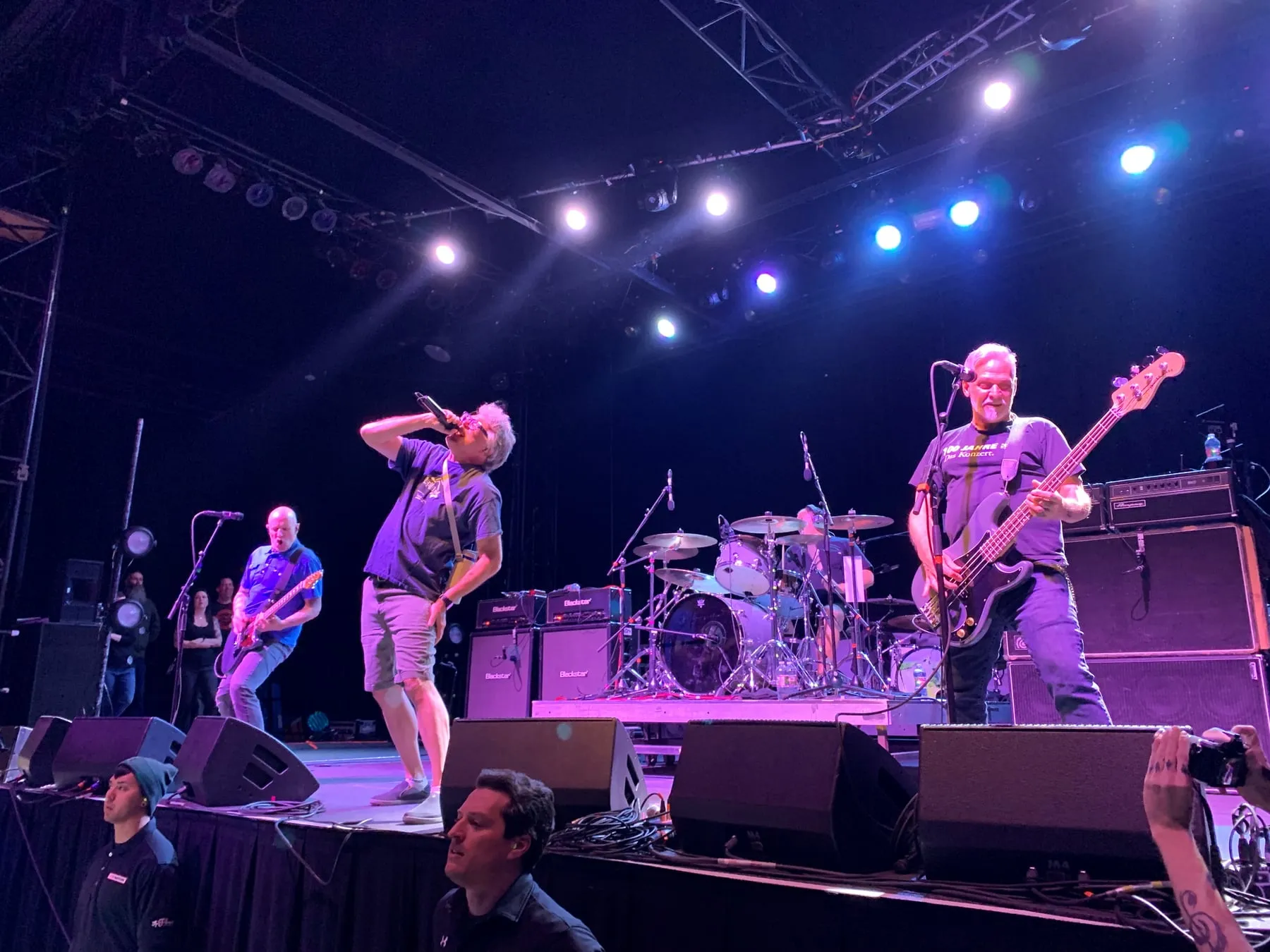
Photo by AppalachianCentrist , licensed under CC BY-SA 4.0 · Wikimedia Commons
Rank #246
Descendents
From Wikipedia
The Descendents are an American punk rock band formed in Manhattan Beach, California, in 1977, by guitarist Frank Navetta, bassist Tony Lombardo and drummer Bill Stevenson as a power pop/surf punk band. In 1979, they enlisted Stevenson's school friend Milo Aukerman as a singer, and reappeared as a melodic hardcore punk band, becoming a major player in the hardcore scene developing in Los Angeles at the time. They have released eight studio albums, three live albums, three compilation albums, and four EPs. Since 1986, the band's lineup has consisted of vocalist Milo Aukerman, drummer Bill Stevenson, guitarist Stephen Egerton, and bassist Karl Alvarez.
Members
- Bill Stevenson
Discography & Previews
Browse through and click an album to open and play 30-second previews streamed from Apple Music.

Milo Goes to College
1982 · 15 tracks
- 1 Myage ↗ 2:01
- 2 I Wanna Be a Bear ↗ 0:43
- 3 I'm Not a Loser ↗ 1:29
- 4 Parents ↗ 1:38
- 5 Tonyage ↗ 0:56
- 6 M-16 ↗ 0:43
- 7 I'm Not a Punk ↗ 1:04
- 8 Catalina ↗ 1:48
- 9 Suburban Home ↗ 1:40
- 10 Statue of Liberty ↗ 1:59
- 11 Kabuki Girl ↗ 1:11
- 12 Marriage ↗ 1:40
- 13 Hope ↗ 2:00
- 14 Bikeage ↗ 2:14
- 15 Jean Is Dead ↗ 1:33

I Don’t Want to Grow Up
1985 · 14 tracks


Everything Sucks
1996 · 15 tracks
- 1 Everything Sux ↗ 1:30
- 2 I'm the One ↗ 2:15
- 3 Coffee Mug ↗ 0:35
- 4 Rotting Out ↗ 1:58
- 5 Sick - O - Me ↗ 1:46
- 6 Caught ↗ 1:48
- 7 When I Get Old ↗ 2:30
- 8 Doghouse ↗ 1:47
- 9 She Loves Me ↗ 2:34
- 10 Hateful Notebook ↗ 2:24
- 11 We ↗ 2:36
- 12 Eunuch Boy ↗ 0:20
- 13 This Place ↗ 1:17
- 14 I Won't Let Me ↗ 3:07
- 15 Thank You ↗ 4:30

Cool to Be You
2004 · 14 tracks

Hypercaffium Spazzinate
2016 · 21 tracks
- 1 Feel This ↗ 1:14
- 2 Victim of Me ↗ 1:37
- 3 On Paper ↗ 1:46
- 4 Shameless Halo ↗ 2:05
- 5 No Fat Burger ↗ 0:43
- 6 Testosterone ↗ 1:22
- 7 Without Love ↗ 3:20
- 8 We Got Defeat ↗ 0:58
- 9 Smile ↗ 3:11
- 10 Limiter ↗ 2:07
- 11 Fighting Myself ↗ 2:14
- 12 Spineless and Scarlet Red ↗ 3:16
- 13 Human Being ↗ 0:41
- 14 Full Circle ↗ 1:54
- 15 Comeback Kid ↗ 2:19
- 16 Beyond the Music ↗ 2:24
- 17 Days of Desperation ↗ 2:09
- 18 Thinkin' ↗ 2:28
- 19 Grindstone ↗ 1:04
- 20 Business a.U. ↗ 2:17
- 21 Unchanged ↗ 3:01

9th & Walnut
2021 · 18 tracks
- 1 Sailor's Choice ↗ 1:15
- 2 Crepe Suzette ↗ 1:06
- 3 You Make Me Sick ↗ 0:57
- 4 Lullaby ↗ 1:02
- 5 Nightage ↗ 2:23
- 6 Baby Doncha Know ↗ 0:56
- 7 Tired of Being Tired ↗ 1:17
- 8 I'm Shaky ↗ 1:48
- 9 Grudge ↗ 1:29
- 10 Mohicans ↗ 1:42
- 11 Like the Way I Know ↗ 0:57
- 12 It's a Hectic World ↗ 1:37
- 13 To Remember ↗ 1:45
- 14 Yore Disgusting ↗ 0:52
- 15 It's My Hair ↗ 1:14
- 16 I Need Some ↗ 1:11
- 17 Ride the Wild ↗ 2:15
- 18 Glad All Over ↗ 1:38
-
 Milo Goes to CollegeDescendents198215 tracks
 -
 I Don’t Want to Grow UpDescendents198514 tracks
 -
 Enjoy!Descendents198612 tracks
 -
 ALLDescendents198713 tracks
 -
 Everything SucksDescendents199615 tracks
 -
 Cool to Be YouDescendents200414 tracks
 -
 Hypercaffium SpazzinateDescendents201621 tracks
 -
 9th & WalnutDescendents202118 tracks
 - Enjoy+Descendents—12 tracks
Deep Dive
Overview
The Descendents are an American punk rock band that emerged from Manhattan Beach, California, and became one of the most influential acts in hardcore punk history. Formed in 1977 as a power pop and surf punk outfit, the band transformed into a melodic hardcore force upon the arrival of vocalist Milo Aukerman in 1979, establishing themselves as a major player in the Los Angeles hardcore scene of the early 1980s. Their approach—combining sing-along melodies and clever, introspective lyrics with aggressive instrumentation—helped define melodic hardcore as a subgenre and proved that punk rock could be both intellectually engaging and sonically uncompromising.
Formation Story
The Descendents began in 1977 in Manhattan Beach when guitarist Frank Navetta, bassist Tony Lombardo, and drummer Bill Stevenson came together to play power pop and surf-inflected punk. The trio operated as an instrumental or loosely vocal ensemble during their first years, capturing the sun-and-sand atmosphere of their Southern California beach town while maintaining the raw energy of the emerging punk movement. The band’s trajectory shifted decisively in 1979 when Stevenson recruited his school friend Milo Aukerman as vocalist. This addition was transformative: Aukerman brought a distinctive nasal tenor, sharp observational lyrics, and a willingness to explore emotional vulnerability within the punk framework. The reconstituted band quickly became central to the nascent Los Angeles hardcore scene, which was developing independently from the East Coast punk establishment and the British post-punk movement.
Breakthrough Moment
The Descendents’ first significant statement came with the release of Milo Goes to College in 1982, an album that announced the band’s fully realized vision of melodic hardcore. The record established the template that would define their approach: short, punchy songs with singable hooks, clever wordplay and emotionally direct lyrics, and a rhythm section that drove songs forward with precision rather than mere volume. Milo Goes to College showcased songs about everyday experience—education, relationships, boredom, ambition—stripped of the political posturing that often dominated punk discourse. The album’s success within the hardcore underground and college radio circuit proved there was an audience for punk that was funny, introspective, and musically sophisticated. This breakthrough positioned the Descendents not merely as regional Los Angeles players but as architects of a distinct melodic hardcore sound that would influence countless bands throughout the 1980s and beyond.
Peak Era
The Descendents’ creative and commercial peak extended from the early-to-mid 1980s through the late 1980s, anchored by the release of four studio albums in six years: I Don’t Want to Grow Up (1985), Enjoy! (1986), and ALL (1987), following their breakthrough debut. During this period, the band’s lineup stabilized around Milo Aukerman (vocals), Bill Stevenson (drums), Stephen Egerton (guitar), and Karl Alvarez (bass)—a configuration that has remained consistent since 1986 and continues to the present day. These albums refined the melodic hardcore formula while exploring new sonic territory, balancing experimentation with the catchy, hook-laden songwriting that made their music accessible without sacrificing intensity. The band’s reputation grew beyond the hardcore underground into broader alternative and college rock circles, establishing them as one of the most important American punk acts of the decade.
Musical Style
The Descendents’ sound is characterized by the fusion of punk aggression with pop melody, creating what has been termed melodic hardcore. Musically, the band employs tight, economical song structures typically built around major-key guitar riffs, propulsive bass lines that anchor rather than merely accompany the drums, and Stevenson’s precise, often minimalist drumming. Aukerman’s vocal delivery—nasal, conversational, frequently in the higher register—distinguishes the band from grittier hardcore contemporaries and allows the lyrical content to take center stage. Thematically, the band’s songwriting moves through emotional registers from humor to genuine pathos, addressing love, alienation, intellectual pursuits, and the struggle to maintain authenticity in an increasingly commercialized world. This combination of melodic accessibility and emotional depth positioned the Descendents as precursors to the pop-punk movement of the 1990s, though the band has maintained a harder edge and greater lyrical sophistication than most of their pop-punk descendants.
Major Albums
Milo Goes to College (1982)
The debut album that introduced the band’s fully realized melodic hardcore vision, establishing the template of catchy, emotionally intelligent songs about everyday life and personal struggle delivered with punk urgency.
I Don’t Want to Grow Up (1985)
A refinement of the band’s melodic hardcore approach with increasingly sophisticated arrangements and production, solidifying their status beyond the Los Angeles hardcore underground.
Enjoy! (1986)
Released in the year the stable lineup of Aukerman, Stevenson, Egerton, and Alvarez coalesced, this album showcases the band’s creative confidence and expanded sonic palette.
ALL (1987)
A critically acclaimed addition to the band’s core discography that continued their exploration of melodic hardcore while maintaining the accessibility and wit that characterized their best work.
Everything Sucks (1996)
A reunion album released after a seven-year hiatus, proving the band’s songwriting remained vital and their fanbase loyal across generations of punk listeners.
Hypercaffium Spazzinate (2016)
A studio album released three decades after their formation, demonstrating the band’s sustained creative output and relevance in contemporary punk discourse.
Signature Songs
- “Suburban Home” — A defining early statement of the band’s melodic hardcore ethos and thematic focus on everyday experience.
- “I’m Not a Loser” — An ironic, self-aware exploration of social anxiety that became one of their most recognizable tracks.
- “Jean Is Dead” — A fan favorite that exemplifies the band’s ability to blend humor with genuine emotional weight.
- “Weinerschnitzel” — An early song that showcased the band’s willingness to address mundane subjects with punk energy.
- “Everything Sucks” — Title track from their 1996 reunion album, reasserting the band’s lyrical bite after years away.
Influence on Rock
The Descendents’ influence on rock and punk music is substantial and multifaceted. They demonstrated that hardcore punk could accommodate melody, humor, and emotional vulnerability without sacrificing credibility or intensity, effectively widening the genre’s expressive range. Their emphasis on intelligent, accessible songwriting—combined with technical proficiency—provided a direct lineage to the pop-punk explosion of the 1990s, influencing bands from Green Day to Blink-182 and countless others who would mine the intersection of punk aggression and pop melody. Beyond pop-punk proper, the Descendents’ insistence on literary and emotional sophistication within a punk context influenced alternative rock more broadly, proving that punk rock could address complex emotional and intellectual terrain. The band’s sustained existence and relatively consistent touring schedule have made them ambassadors for the possibility of longevity in punk, challenging the movement’s own myth of disposability.
Legacy
The Descendents remain active and relevant nearly five decades after their formation, having released 9th & Walnut in 2021 and maintaining a presence in punk culture through touring and critical reassessment. Their catalog has been repeatedly reissued and remains in print on multiple labels including Epitaph Records and Fat Wreck Chords, testament to sustained fan interest and the albums’ perceived enduring value. The band’s consistent output—eight studio albums spanning nearly four decades—and the stable presence of three core members (Aukerman, Stevenson, and Egerton) since the mid-1980s have cemented their status as elder statesmen of American punk. They are frequently cited in retrospectives of 1980s hardcore as pioneers of the melodic hardcore subgenre and continue to be discovered by new generations of listeners through streaming platforms and physical reissues. The Descendents’ career arc refutes the notion that punk is inherently a young person’s game, demonstrating that thoughtful, well-crafted rock music can sustain an audience and artistic relevance across decades.
Fun Facts
- The band’s name, The Descendents, was suggested by a friend and reflects the group’s self-deprecating humor and willingness to position themselves as inheritors of punk rather than its originators.
- Milo Aukerman pursued graduate studies in microbiology while the band was at the height of their fame in the 1980s, embodying the band’s intellectual ethos beyond music.
- The Descendents have released material under the related moniker ALL, exploring different musical directions while maintaining core personnel overlap.
- The band’s 1996 album Everything Sucks marked a reunion after a seven-year hiatus, proving both their original fanbase’s loyalty and the staying power of their melodic hardcore formula.