
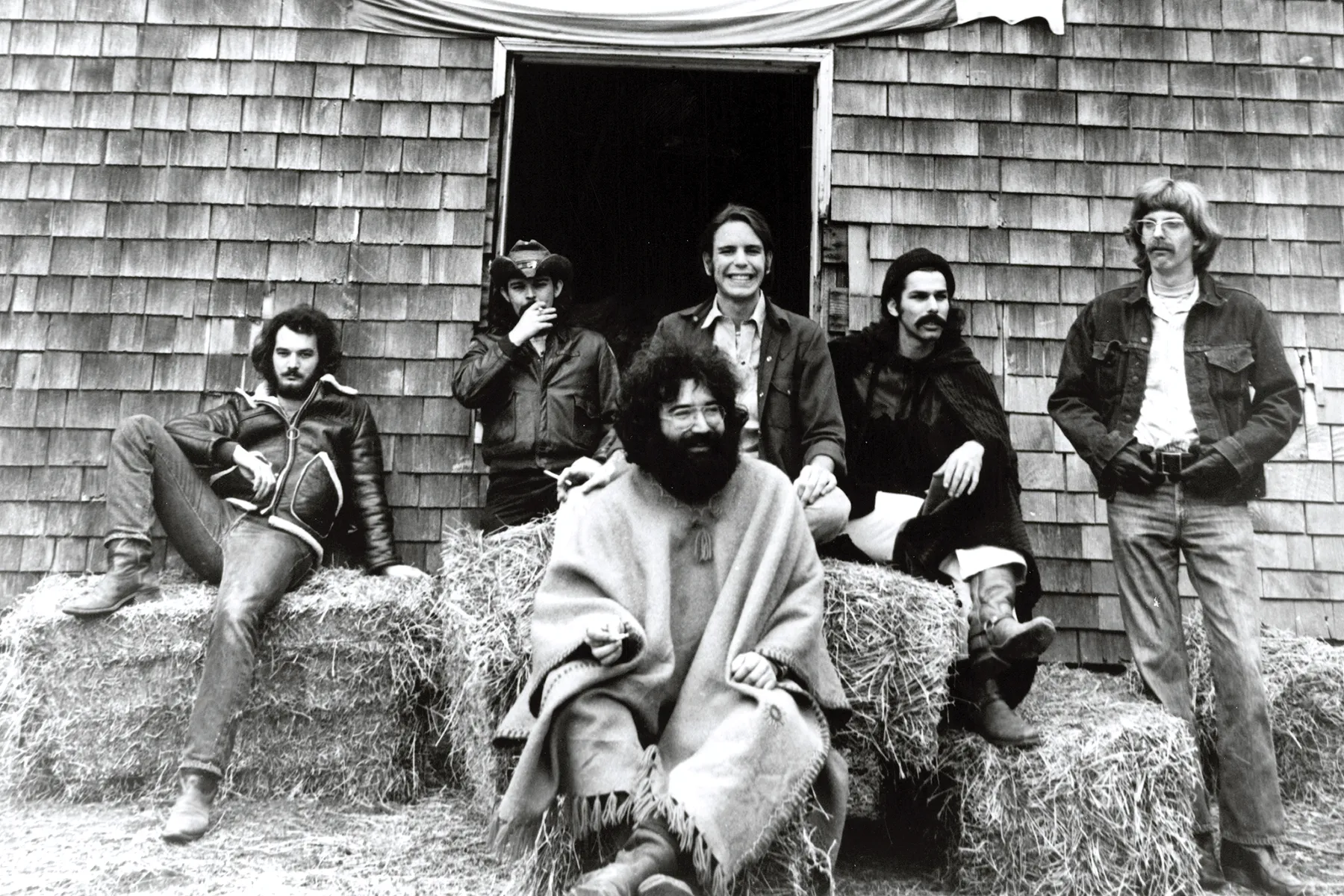
Photo by Herb Greene , licensed under Public domain · Wikimedia Commons
Rank #54
Grateful Dead
From Wikipedia
The Grateful Dead was an American rock band formed in Palo Alto, California, in 1965. Known for their eclectic style that fused elements of rock, blues, jazz, folk, country, bluegrass, rock and roll, gospel, reggae, and world music with psychedelia, the band is famous for improvisation during their live performances, and for their devoted fan base, known as "Deadheads". According to the musician and writer Lenny Kaye, the music of the Grateful Dead "touches on ground that most other groups don't even know exists". For the range of their influences and the structure of their live performances, the Grateful Dead are considered "the pioneering godfathers of the jam band world".
Members
- Bill Kreutzmann (1965–1995)
- Bob Weir (1965–1995)
- Jerry Garcia (1965–1995)
- Phil Lesh (1965–1995)
- Ron "Pigpen" McKernan (1965–1972)
- Tom Constanten (1968–1970)
- Donna Jean Godchaux (1971–1979)
- Keith Godchaux (1971–1979)
- Brent Mydland (1979–1990)
- Bruce Hornsby (1990–1992)
- Vince Welnick (1990–1995)
- Mickey Hart
Discography & Previews
Browse through and click an album to open and play 30-second previews streamed from Apple Music.
The Grateful Dead
1967 · 18 tracks
- 1 New New Minglewood Blues ↗ 2:34
- 2 Cosmic Charlie ↗ 5:30
- 3 Truckin' ↗ 5:03
- 4 Black Peter ↗ 7:27
- 5 Born Cross-Eyed ↗ 2:56
- 6 Ripple ↗ 4:10
- 7 Doin' That Rag ↗ 4:41
- 8 Dark Star (Single Version) ↗ 2:42
- 9 High Time ↗ 5:13
- 10 New Speedway Boogie ↗ 4:05
- 11 St. Stephen (Alternate Version) ↗ 5:23
- 12 Jack Straw (Live At L'Olympia, Paris) ↗ 4:48
- 13 Me & My Uncle (Live At Fillmore East, New York) ↗ 3:03
- 14 Tennessee Jed (Live At L'Olympia, Paris) [Edit] ↗ 7:11
- 15 Cumberland Blues (Live At Wembley Empire Pool, London) ↗ 5:41
- 16 Playing In the Band (Live At Manhattan Center, New York) ↗ 4:38
- 17 Brown-Eyed Women (Live At Tivoli Concert Hall, Denmark) ↗ 4:38
- 18 Ramble On Rose (Live At the Strand Lyceum, London) ↗ 6:01




Blues for Allah
1975 · 6 tracks
- 1 Help on the Way / Slipknot! / Franklin's Tower (2025 Steven Wilson Remix) ↗ 12:01
- 2 King Solomon's Marbles (2025 Steven Wilson Remix) ↗ 5:13
- 3 The Music Never Stopped (2025 Steven Wilson Remix) ↗ 4:42
- 4 Crazy Fingers (2025 Steven Wilson Remix) ↗ 6:45
- 5 Sage & Spirit (2025 Steven Wilson Remix) ↗ 3:05
- 6 Blues for Allah: Sand Castles and Glass Camels / Unusual Occurrences in the Desert (2025 Steven Wilson Remix) ↗ 12:37



-
 The Grateful DeadGrateful Dead196718 tracks
 -
 Anthem of the SunGrateful Dead19685 tracks
 -
 AoxomoxoaGrateful Dead19698 tracks
 -
 Workingman’s DeadGrateful Dead19708 tracks
 -
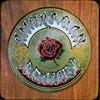 American BeautyGrateful Dead197010 tracks
 -
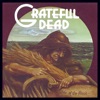 Wake of the FloodGrateful Dead19737 tracks
 -
 From the Mars HotelGrateful Dead19748 tracks
 -
 Blues for AllahGrateful Dead19756 tracks
 -
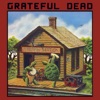 Terrapin StationGrateful Dead19776 tracks
 -
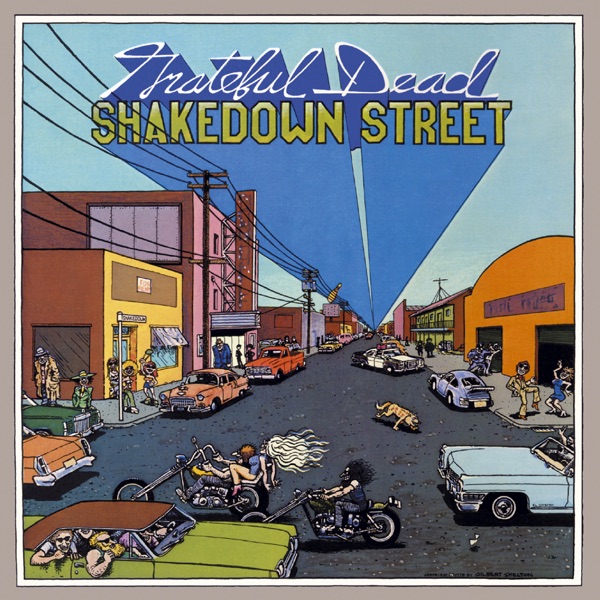
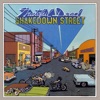 Shakedown StreetGrateful Dead197810 tracks
 -
 Go to HeavenGrateful Dead19809 tracks
 -
 In the DarkGrateful Dead19877 tracks
 -
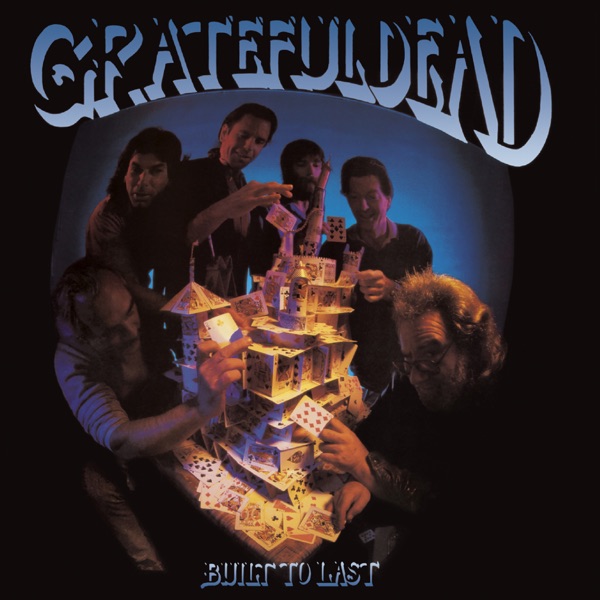
 Built to LastGrateful Dead19899 tracks
Deep Dive
Overview
The Grateful Dead stands as one of rock music’s most distinctive and enduring acts, emerging from Palo Alto, California in 1965 as a vessel for musical experimentation that would ultimately reshape what live rock performance could be. Rather than a singles-driven pop act or a tightly choreographed rock band, the Grateful Dead built their identity around the practice of lengthy, communal exploration—weaving together rock, blues, jazz, folk, country, bluegrass, gospel, reggae, and world music under a psychedelic umbrella. Their devoted fan base, known as Deadheads, became as integral to the band’s mythology as the music itself, attending shows with an expectation that each performance would be a unique, unrepeatable event. The band’s reach extended far beyond commercial success; their structural approach to the jam band format and their pioneering philosophy of live improvisation established a template that countless acts would follow.
Formation Story
The Grateful Dead coalesced in the San Francisco Bay Area in 1965, drawing together musicians from the region’s folk and rock scenes. The core founding lineup—Jerry Garcia, Bob Weir, Phil Lesh, Bill Kreutzmann, and Ron “Pigpen” McKernan—came together in Palo Alto during the early days of psychedelia’s emergence on the West Coast. Garcia, already established as a banjo player in folk circles, became the band’s lead guitarist and primary voice. Weir provided rhythm guitar, Lesh handled bass duties, Kreutzmann anchored the drums, and McKernan contributed organ and harmonica, adding a blues and R&B foundation to the group’s sound. This was a band that crystallized during a moment of radical artistic questioning in American rock, when musicians began to view the three-minute pop single as a constraint rather than a format, and when the counterculture’s values of communal participation and spiritual exploration began to permeate the music itself.
Breakthrough Moment
The Grateful Dead’s early studio work—beginning with their self-titled debut in 1967 and expanding through Anthem of the Sun (1968) and Aoxomoxoa (1969)—established their experimental credentials, but their true breakthrough arrived with Workingman’s Dead and American Beauty, both released in 1970. These albums marked a decisive shift toward more structured songwriting and accessibility while retaining the band’s improvisational spirit. With these records, the Grateful Dead transcended their regional California psychedelic following to capture a national audience. The band demonstrated that complex, intelligent rock music could reach beyond the avant-garde listener; American Beauty especially became a landmark entry point for listeners seeking something deeper than radio-friendly rock but not as abstract as their earlier work. The combination of these two albums in a single year established the Grateful Dead as a major force in American rock, and they would spend the rest of the 1970s and beyond building on that foundation.
Peak Era
The 1970s represented the Grateful Dead’s most creatively fertile and commercially successful period. Albums such as Wake of the Flood (1973), From the Mars Hotel (1974), Blues for Allah (1975), and Terrapin Station (1977) showcased a band at the height of their improvisational powers, crafting expansive compositions that seemed to contain entire universes of possibility within them. Jerry Garcia’s guitar work evolved into a language of extraordinary fluidity, able to shift from blues-based rock to Eastern-influenced passages to pure textural abstraction within a single song. Bob Weir’s rhythm guitar became increasingly sophisticated, while Phil Lesh’s bass playing—informed by both rock and classical music—created harmonic architecture that allowed the band’s soloists room to explore without losing cohesion. By the mid-to-late 1970s, the Grateful Dead had achieved the rare status of a band that could sell out large venues night after night while maintaining the ethos of experimentation and risk that had defined their earliest days. The band’s willingness to extend songs, shift arrangements, and follow musical impulses rather than setlists created an almost hypnotic live experience that Deadheads sought again and again.
Musical Style
The Grateful Dead’s sound defies easy categorization, which was very much the point. At their core, they were a rock band built on the foundation of American blues and folk music—Jerry Garcia’s lead guitar work rooted in both folk fingerstyle and electric blues, while Ron “Pigpen” McKernan’s organ and harmonica playing channeled a deep R&B sensibility. To this they added elements of jazz-style improvisation, where musicians listen and respond to one another in real time rather than following predetermined arrangements. The introduction of keyboardists Tom Constanten (1968–1970) and later Keith Godchaux (1971–1979) added harmonic complexity and modal exploration. A striking feature of the band’s approach was their embrace of extended instrumental passages—a single song might stretch to fifteen, twenty, or even thirty minutes in concert, with each musician taking solo space while the rhythm section maintained a kind of gravitational center. Their use of psychedelia was never merely decorative; instead, effects and studio manipulation served to enhance the music’s sense of spatial depth and emotional nuance. From the raw, blues-inflected debut through the more sophisticated arrangements of the 1970s, the Grateful Dead proved that rock music could be intellectually serious, spiritually ambitious, and viscerally entertaining all at once.
Major Albums
Workingman’s Dead (1970)
An unexpected pivot toward country and folk influences, featuring some of Garcia’s most singable melodies and establishing the band as writers of genuine songs, not just vehicles for jamming.
American Beauty (1970)
Released the same year as Workingman’s Dead, this album deepened the band’s songwriting maturity with intricate harmonies and emotional sophistication, becoming one of their most beloved and frequently revisited albums.
Wake of the Flood (1973)
Marked the band’s move to self-released albums and showcased their ability to craft layered, multi-part compositions that balanced structure with improvisation.
Terrapin Station (1977)
A late-era studio high point featuring the epic title track and demonstrating the band’s continued evolution in arrangement and production sophistication.
In the Dark (1987)
A return to commercial prominence after several years of lower profile, produced with a slightly more contemporary sonic approach while retaining the band’s essential character.
Signature Songs
- Sugar Magnolia — An upbeat, folk-inflected celebration that became a staple closer, showcasing Bob Weir’s songwriting.
- Casey Jones — A rhythmically driving number that highlighted the band’s blues-rock foundation and became a concert favorite.
- Friend of the Devil — A country-influenced acoustic piece that demonstrated the band’s range and emotional depth.
- Ripple — A spare, introspective folk composition that became one of the Dead’s most covered and beloved songs.
- Johnny B. Goode — Chuck Berry cover that the Grateful Dead made their own through extended improvisational treatment.
- Truckin’ — A rolling, blues-based number that captured the band’s road-tested sensibility.
Influence on Rock
The Grateful Dead’s influence on rock music extends far beyond their direct sound. They pioneered and legitimized the jam band format—the idea that rock groups could build entire careers on the principle of musical exploration and collective improvisation rather than hit records. Their philosophy influenced generations of musicians across multiple genres: from blues-rock acts to progressive rockers to later jam bands like Phish, the Allman Brothers Band, and countless others who viewed the Grateful Dead as the template for what was possible in live rock performance. The band’s approach to their devoted fan base—allowing and encouraging taping of shows, building community around live experience rather than album sales—presaged the way streaming and digital culture would later reshape the music industry’s relationship with fans. Their eclectic musical vocabulary, drawing from American vernacular traditions (blues, country, gospel) and global influences, helped establish the idea that rock could be a genuinely cosmopolitan art form rather than a geographically or culturally bounded one.
Legacy
The Grateful Dead disbanded in 1995 following Jerry Garcia’s death, but the band’s cultural footprint has only deepened with time. Deadheads continue to attend tribute concerts and archival releases; the band’s recorded legacy, documented in thousands of hours of concert recordings, remains a primary object of study for musicians and fans alike. The streaming era has introduced new generations to the Grateful Dead’s music, and their influence continues to manifest across jam bands, indie rock, and alternative country. The band’s insistence on the primacy of live experience—that the performance itself, not the recording, was the primary artistic statement—stands as a countercultural principle that has gained rather than lost relevance in an age of infinite digital reproduction. Their legacy is not confined to rock music; the Grateful Dead represent a broader statement about artistic values, community, and the possibilities of sustained artistic exploration over the course of a career.
Fun Facts
- The band’s name was chosen from a dictionary of slang terms, reflecting their commitment to chance and accident as artistic principles.
- Jerry Garcia’s ongoing work as a painter and visual artist meant that the boundaries between rock and fine art remained fluid within the band’s world.
- The Grateful Dead recorded extensive archival material that has been released decades after the band’s dissolution, with many fans considering certain officially unreleased performances superior to studio versions.