
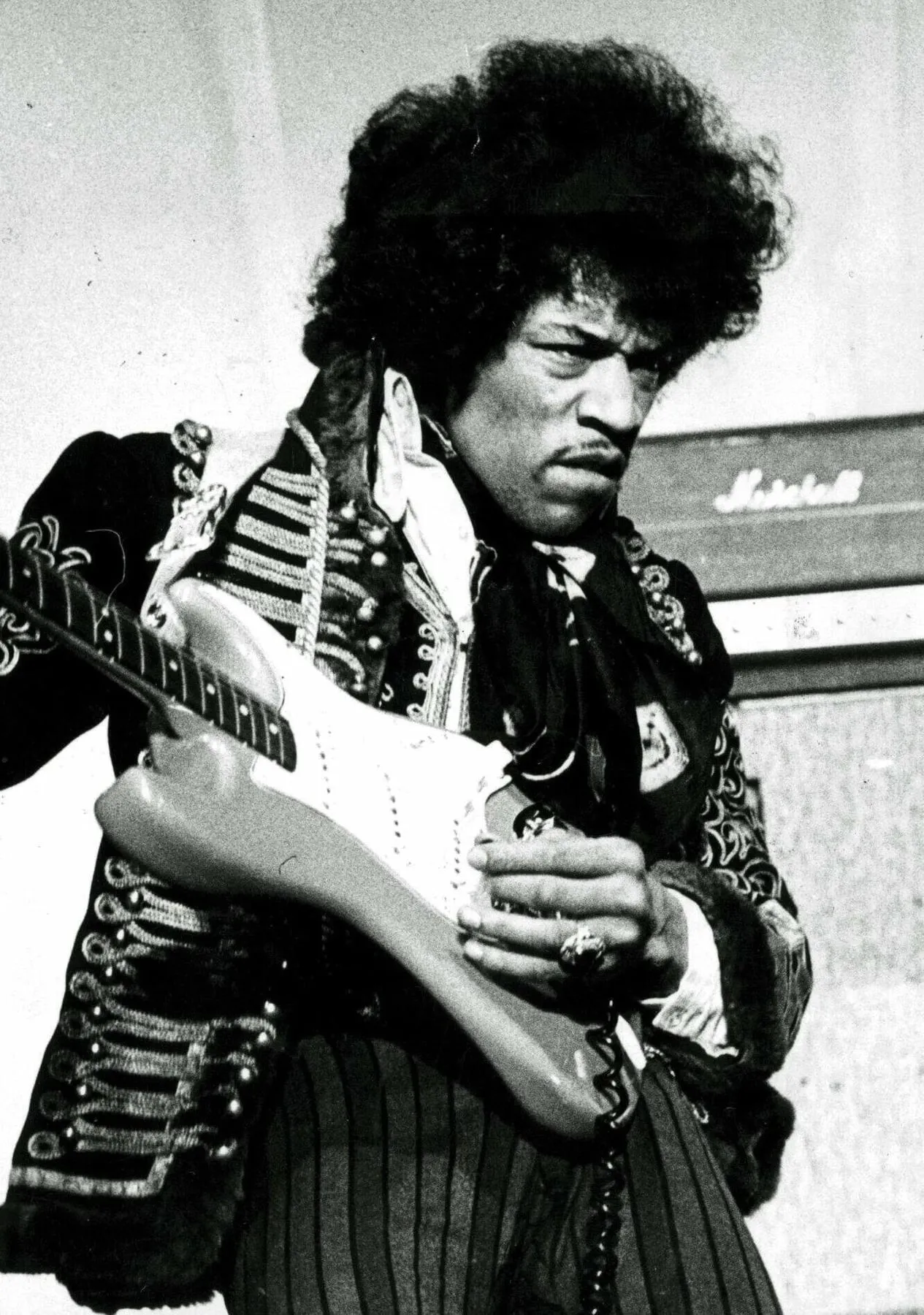
Photo by Original photographer unknown , licensed under Public domain · Wikimedia Commons
Rank #62
Jimi Hendrix
From Wikipedia
James Marshall "Jimi" Hendrix was an American guitarist, singer, and songwriter. He is widely regarded as one of the greatest and most influential guitarists of all time. He was inducted into the Rock and Roll Hall of Fame in 1992 as a part of his band, the Jimi Hendrix Experience; the institution describes him as "arguably the greatest instrumentalist in the history of rock music".
Discography & Previews
Browse through and click an album to open and play 30-second previews streamed from Apple Music.

Rainbow Bridge
1971 · 8 tracks
- 1 Dolly Dagger ↗ 4:44
- 2 Earth Blues ↗ 4:21
- 3 Pali Gap ↗ 5:07
- 4 Room Full of Mirrors ↗ 3:35
- 5 The Star Spangled Banner (Record Plant, New York, NY, March 18, 1969) ↗ 4:11
- 6 Look Over Yonder ↗ 3:25
- 7 Hear My Train A-Comin' (Live At Berkeley Community Theatre, Berkeley, CA) ↗ 11:14
- 8 Hey Baby (New Rising Sun) ↗ 6:05


Both Sides of the Sky
2018 · 13 tracks
- 1 Mannish Boy ↗ 5:02
- 2 Lover Man ↗ 3:03
- 3 Hear My Train A-Comin' ↗ 7:26
- 4 Stepping Stone ↗ 3:13
- 5 $20 Fine ↗ 4:59
- 6 Power of Soul ↗ 5:55
- 7 Jungle ↗ 3:28
- 8 Things I Used to Do ↗ 3:41
- 9 Georgia Blues ↗ 7:55
- 10 Sweet Angel ↗ 3:55
- 11 Woodstock ↗ 5:19
- 12 Send My Love to Linda ↗ 4:37
- 13 Cherokee Mist ↗ 7:01
-
 Rainbow BridgeJimi Hendrix19718 tracks
 -
 The Cry of LoveJimi Hendrix197110 tracks
 -
 Both Sides of the SkyJimi Hendrix201813 tracks
Deep Dive
Overview
Jimi Hendrix was an American guitarist, singer, and songwriter whose command of the electric instrument fundamentally altered rock music’s technical and creative possibilities. Born James Marshall Hendrix in 1942, he emerged from the American blues and R&B tradition and reshaped it through psychedelic and hard rock sensibilities during the 1960s. His approach to tone production, feedback manipulation, and fretboard dexterity established new standards for rock musicianship that persisted for decades. By the time of his death in 1970, Hendrix had become widely regarded as one of the greatest and most influential guitarists of all time.
Formation Story
Hendrix came of age in the post-war American rock and roll landscape, absorbing blues from artists across the electric and acoustic traditions. His early exposure to the instrument came through Seattle’s music scene, where he played in various R&B and rock groups before moving east and eventually to London in the mid-1960s. His arrival in England coincided with a fertile moment in rock experimentation, and he quickly formed the Jimi Hendrix Experience with drummer Mitch Mitchell and bassist Noel Redding. This lineup became the vehicle for his most celebrated recorded work and emerged as one of the defining rock groups of the era.
Breakthrough Moment
The Jimi Hendrix Experience achieved rapid international recognition in 1966 and 1967, establishing Hendrix as a transformative figure in rock music. His early recordings and live performances demonstrated that the electric guitar could be treated as an instrument of orchestral range and expressive power—bending notes far beyond traditional blues vocabulary, using amplifier feedback as a compositional element, and layering overdubbed textures that suggested entire ensemble arrangements from a single guitarist. By the late 1960s, Hendrix stood at the center of rock music’s most ambitious and experimental period.
Peak Era
Hendrix’s most creatively fertile and commercially successful period spanned the late 1960s through 1970. During these years, he recorded and released the studio albums Strange Things and Flashing in 1968, followed by Rainbow Bridge and The Cry of Love in 1971. These recordings documented his evolution from blues-rock interpreter to psychedelic innovator and back again, as he explored acid rock textures, hard rock aggression, and experimental production techniques. His live performances—particularly documented festival appearances—became legendary moments in rock history. Even as his recording output became less frequent by 1970, his influence on contemporary guitarists and rock music broadly was already firmly established.
Musical Style
Hendrix’s sound synthesized blues tradition with the textural possibilities of 1960s psychedelic rock and hard rock. His primary instrument was the electric guitar, which he played left-handed and often restrung in unconventional ways to achieve novel voicings. His playing was characterized by fluid, wide-interval bends; rapid scalar passages executed with precision; and a sophisticated understanding of harmonic substitution that drew from bebop jazz as much as from blues. Tonally, he favored thick, compressed sustain with pronounced use of amplifier feedback and fuzz, creating sounds that ranged from liquid and ethereal to raw and visceral depending on the song’s demands. His voice—warm, fluid, and often layered in multitrack arrangements—delivered lyrics rooted in blues themes of love, loss, and social experience, though increasingly inflected with psychedelic imagery and experimental vocal processing. The music crossed acid rock, psychedelic rock, blues rock, hard rock, and electric blues, resisting easy categorization.
Major Albums
Strange Things (1968)
Capturing Hendrix’s early studio explorations with the Experience, this collection demonstrated his ability to translate live intensity into recorded form and introduced his approach to studio production and overdubbing.
Flashing (1968)
Released in the same year as Strange Things, this album further documented his studio work and cemented his status as a rock musician of major creative ambition and technical skill.
Rainbow Bridge (1971)
A posthumous release organized from recordings made in the late 1960s, Rainbow Bridge showcased the experimental and psychedelic dimensions of Hendrix’s vision, with layered textures and exploratory arrangements.
The Cry of Love (1971)
Another posthumous compilation drawing from his archive, this collection emphasized his blues-rock roots alongside psychedelic innovation and remained in circulation as a key entry point to his recorded legacy.
War Heroes (1972)
A posthumous assembly of unreleased material and alternate takes, War Heroes offered listeners further access to his studio work and demonstrated the breadth of material he had generated during his peak years.
Crash Landing (1975)
Released years after his death, this posthumous album featured previously unreleased recordings alongside newly recorded accompaniments, representing efforts to complete and contextualize his unfinished work.
Signature Songs
- A blues-rock standard that became synonymous with his name and demonstrated his ability to reshape traditional material through modern electric technique and psychedelic arrangement.
- A showcase for his rhythmic and harmonic sophistication, displaying the influence of jazz and experimental rock on his songwriting and performance practice.
- An extended instrumental exploration that highlighted his mastery of feedback, sustain, and tonal manipulation as compositional and expressive tools.
- A psychedelic-tinged track that balanced lyrical accessibility with experimental production and exemplified his range as a vocalist and arranger.
Influence on Rock
Hendrix’s influence on rock music proved immediate and enduring. He demonstrated that the electric guitar could function as a lead instrument capable of extraordinary range and nuance, matching or surpassing the expressive capacity of keyboards, horns, or human voice. His approach to distortion, feedback, and overdubbing as legitimate compositional elements influenced generations of rock and metal guitarists. The fusion of blues tradition with psychedelic texture and hard rock power that he pioneered became a template for countless artists in the 1970s and beyond. His work validated both technical virtuosity and experimental risk-taking in rock contexts, encouraging musicians to pursue innovation without abandoning blues and soul foundations.
Legacy
Jimi Hendrix’s death in 1970 at age 27 truncated a career of barely five years in the spotlight, yet his impact on rock music’s subsequent trajectory proved immense and irreversible. In 1992, the Rock and Roll Hall of Fame inducted him as part of the Jimi Hendrix Experience, describing him as “arguably the greatest instrumentalist in the history of rock music.” His recordings have remained continuously in print and in active rotation on rock radio and streaming platforms, introducing successive generations to his innovations. Posthumous albums assembled from his archive—including Rainbow Bridge, The Cry of Love, War Heroes, Crash Landing, Midnight Lightning, and Both Sides of the Sky (2018)—have kept his work before the public and revealed the depth of material he had accumulated. His influence extends across rock subgenres, from hard rock and heavy metal to progressive rock and funk-rock fusion, all of which trace elements of their sonic and technical vocabulary to his pioneering work.
Fun Facts
- Hendrix played guitar left-handed and often had instruments restrung to accommodate his dominant hand, a practice that required both creative problem-solving and contributed to his unique voicings and approach.
- His early career in Seattle and subsequent work in the American R&B and rock circuit preceded his breakthrough in London, where he found an audience and collaborators more attuned to experimental rock practice.
- Hendrix’s output of official studio albums during his lifetime was modest by later standards, yet the quantity of material he recorded and left behind ensured decades of posthumous compilation and archival release.
- His recording contracts with Reprise Records and associated labels helped circulate his work widely and established infrastructure for managing and reissuing his catalog long after his death.