
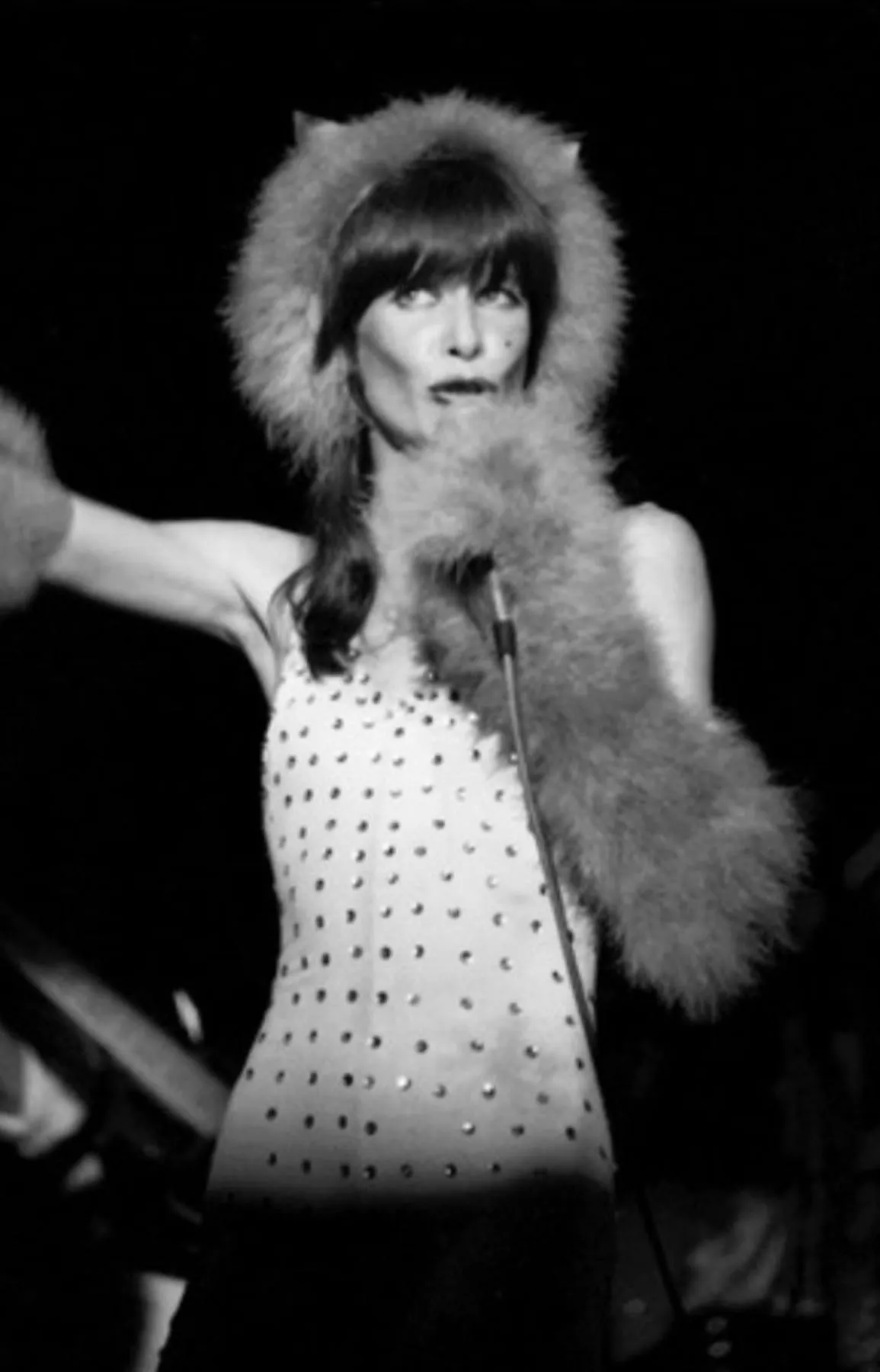
Photo by Robin Hauster , licensed under CC BY-SA 4.0 · Wikimedia Commons
Rank #147
Rita Lee
From Wikipedia
Rita Lee Jones de Carvalho was a Brazilian singer, songwriter, author, actress and television host. Known as the "Queen of Brazilian Rock", she stood out as one of the most influential figures in the country's popular music, recognised for her reinvention and versatility in musical and audiovisual production. She began her career in rock, but over the years explored psychedelia, pop rock, disco, new wave, pop, bossa nova and electronic music, promoting a pioneering hybridisation between international genres and domestic traditions. This trajectory enabled her to move beyond the underground circuit of the 1960s and 1970s and achieve widespread success with romantic ballads in the 1980s, contributing significantly to the Brazilian musical revolution.
Discography & Previews
Browse through and click an album to open and play 30-second previews streamed from Apple Music.

Build Up
1970 · 11 tracks

Hoje é o primeiro dia do resto da sua vida
1972 · 10 tracks


Bombom
1983 · 13 tracks

Rita Lee
1993 · 13 tracks

Aqui, ali, em qualquer lugar
2001 · 14 tracks
- 1 A Hard Day's Night ↗ 3:41
- 2 With a Little Help from My Friends ↗ 2:46
- 3 Pra Você Eu Digo Sim (If I Fell) ↗ 2:40
- 4 All My Loving ↗ 3:06
- 5 Minha Vida (In My Life) ↗ 2:25
- 6 She Loves You ↗ 2:38
- 7 Michelle ↗ 2:42
- 8 Here, There and Everywhere (Aqui, Ali, em Qualquer Lugar) [Bilingual] ↗ 2:29
- 9 I Want to Hold Your Hand ↗ 2:18
- 10 Tudo Por Amor (Can't Buy Me Love) ↗ 2:39
- 11 Lucy In the Sky with Diamonds ↗ 4:41
- 12 Here, There and Everywhere (Bonus English Version) ↗ 2:28
- 13 In My Life (Bonus English Version) ↗ 2:24
- 14 If I Feel (Bonus English Version) ↗ 2:40
-
 Build UpRita Lee197011 tracks
 -
 Hoje é o primeiro dia do resto da sua vidaRita Lee197210 tracks
 -
 Atrás do porto tem uma cidadeRita Lee197410 tracks
 -
 Fruto proibidoRita Lee19759 tracks
 -
 Entradas e bandeirasRita Lee19769 tracks
 -
 BabilôniaRita Lee19789 tracks
 -
 Rita LeeRita Lee19798 tracks
 -
 Rita LeeRita Lee19808 tracks
 -
 SaúdeRita Lee19818 tracks
 -
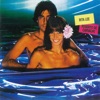 Rita Lee & Roberto de CarvalhoRita Lee19829 tracks
 -
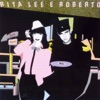 BombomRita Lee198313 tracks
 -
 Rita LeeRita Lee199313 tracks
 -
 Aqui, ali, em qualquer lugarRita Lee200114 tracks
Deep Dive
Overview
Rita Lee Jones de Carvalho (1947–2023) was a Brazilian singer, songwriter, author, actress, and television host whose career spanned more than five decades and defined the trajectory of rock music in Brazil. Known as the “Queen of Brazilian Rock,” she stood out as one of the country’s most influential and versatile musical figures, pioneering a hybridisation of international rock, pop, and electronic genres with domestic traditions including bossa nova and música popular brasileira. Her willingness to reinvent herself across rock, psychedelia, pop, disco, new wave, and electronic music allowed her to transcend the underground circuits of the 1960s and 1970s and achieve mainstream commercial success, particularly in the 1980s with romantic ballads that shifted Brazilian pop’s emotional and stylistic landscape.
Formation Story
Rita Lee emerged as a performer and songwriter in Brazil during the 1960s, a pivotal moment when rock music was gaining a foothold in a country long defined by samba, bossa nova, and traditional MPB (música popular brasileira). She grew up in São Paulo, the epicenter of Brazil’s modernizing urban culture and the most receptive market for imported rock and roll sounds. Rather than copy Anglo-American models wholesale, she recognized early that Brazilian rock could absorb psychedelic and pop influences while maintaining connection to local harmonic and rhythmic traditions. This sensibility—international in scope yet rooted in Brazilian identity—became her trademark and set the tone for her first studio album, Build Up, released in 1970, which introduced her distinctive voice and adventurous approach to rock composition.
Breakthrough Moment
Rita Lee’s transition from underground experimental musician to nationally recognized performer crystallized in the mid-1970s. Albums such as Atrás do porto tem uma cidade (1974) and Fruto proibido (1975) deepened her reputation as a serious songwriter unafraid to blend rock energy with Brazilian sensibilities. Her 1978 album Babilônia and the self-titled Rita Lee (1979) marked a shift toward more accessible, radio-friendly production while maintaining artistic credibility. By the early 1980s, her collaborations with Roberto de Carvalho—documented on albums like Rita Lee & Roberto de Carvalho (1982) and Rita e Roberto (1985)—helped establish her as a crossover artist whose work appealed to both rock purists and mainstream audiences. These albums demonstrated her evolving command of pop songwriting and production, laying the groundwork for her ascent to the top tier of Brazilian popular music.
Peak Era
The 1980s and 1990s represented Rita Lee’s period of greatest commercial reach and creative confidence. Albums including Saúde (1981), Baila Conmigo (1983), Bombom (1983), and Flerte fatal (1987) showcased her ability to craft engaging pop and romantic ballads without sacrificing musical substance. Zona zen (1988) continued her exploration of electronic textures and contemporary production values, while Santa Rita de Sampa (1998) reasserted her connection to São Paulo and reflected on her status as a cultural institution. Throughout this period, she maintained a high-profile presence not only as a recording artist but as an actress and television personality, making her one of the most omnipresent figures in Brazilian entertainment. Her later albums such as 3001 (2000) and Aqui, ali, em qualquer lugar (2001) confirmed her enduring relevance, proving that her appeal transcended generational boundaries.
Musical Style
Rita Lee’s sound evolved considerably across her five decades of recording, but several constant elements defined her approach. Her voice—distinctive, expressive, and capable of both delicate phrasing and direct rock intensity—became instantly recognizable and served as the anchor for her many stylistic pivots. In the 1970s, her music absorbed psychedelic rock’s experimental attitude while grafting it onto Brazilian harmonic language; albums like Hoje é o primeiro dia do resto da sua vida (1972) and Entradas e bandeiras (1976) featured adventurous production, layered instrumentation, and lyrical themes that blended personal introspection with cultural commentary. By the 1980s, she embraced pop and new wave idioms, incorporating synthesizers, drum machines, and crisp production without losing the sophisticated harmonic sense derived from bossa nova. Her rhythmic foundation remained distinctly Brazilian, drawing on samba and other local grooves even when the surface texture was European pop or electronic dance music. This ability to code-switch between international and domestic musical languages—to make a psychedelic rock song sound Brazilian and a ballad sound contemporary—was her defining artistic strategy.
Major Albums
Build Up (1970)
Her debut established her as a serious composer unafraid of experimental production and psychedelic textures; it announced her intention to create rock music on Brazilian terms.
Atrás do porto tem uma cidade (1974)
A critical success that deepened her reputation for merging rock innovation with local sensibility, expanding her audience beyond underground circles.
Babilônia (1978)
Marked a shift toward radio-friendly yet substantive pop-rock, bridging her avant-garde origins and her commercial breakthrough.
Rita Lee & Roberto de Carvalho (1982)
A landmark collaboration that showcased her partnership with producer and musician Roberto de Carvalho, establishing the polished pop-rock sound that would define her 1980s success.
Santa Rita de Sampa (1998)
A reflective album that reasserted her cultural roots in São Paulo while demonstrating her continued relevance and creative vitality in the 1990s.
Signature Songs
- “Lança Perfume” — A standout track from her 1970s output, exemplifying her fusion of rock energy and Brazilian rhythmic sophistication.
- “Deckchair” — A later composition showcasing her gift for accessible yet substantive pop songwriting.
- “Ovelha Negra” — Captured her ability to deliver emotionally direct material with both vulnerability and rock-edged production.
- “Amor e Paz” — Representative of her successful ventures into romantic ballads that dominated Brazilian radio in the 1980s and beyond.
Influence on Rock
Rita Lee’s career redefined what rock music could mean in a non-Anglo-American context. By refusing to view Brazilian musical traditions and international rock as incompatible, she opened a path for subsequent generations of Brazilian musicians to pursue rock without surrendering cultural specificity. Her success proved that a rock musician from Brazil could achieve international-scale commercial success while remaining rooted in local identity. Her willingness to experiment across psychedelia, new wave, electronic music, and pop showed that stylistic range need not undermine artistic credibility; in her hands, reinvention became a form of intellectual honesty rather than commercial opportunism. She influenced countless Brazilian pop and rock musicians who came of age in the 1970s and 1980s, establishing a template for female rock and pop artists in Brazil and Latin America more broadly. Her career also demonstrated the viability of rock music as a vehicle for serious female songwriters and performers in a region long dominated by male musicians.
Legacy
Rita Lee’s death in 2023 marked the end of a career that had reshaped Brazilian popular music and proven the staying power of an artist willing to evolve without abandoning her core identity. Her influence extends across multiple generations of Brazilian musicians and continues to resonate in contemporary Latin American rock and pop. Streaming platforms have ensured that her extensive discography remains accessible, allowing new audiences to trace her stylistic journey from psychedelic experimentation to pop mastery. Her status as the “Queen of Brazilian Rock” reflects not a single moment but the cumulative impact of more than fifty years of sustained creativity, commercial success, and cultural presence. Beyond music, her work as a television personality and author expanded her footprint in Brazilian culture, making her a multidisciplinary icon whose contributions transcended any single medium. Her recordings across labels including Mercury, Philips, EMI, Som Livre, and Polydor documented the evolution of Brazilian popular music itself, making her catalog an essential historical record.
Fun Facts
- Rita Lee maintained an exceptionally prolific recording schedule, releasing albums in nearly every year of the 1970s and early 1980s, a commitment to studio productivity that rivaled her international rock contemporaries.
- Her partnership with Roberto de Carvalho extended across multiple albums spanning the 1980s and 1990s, representing one of rock and pop music’s enduring creative collaborations.
- In addition to her recording career, Rita Lee worked extensively in television and film, bringing the same artistic versatility to acting and hosting that she applied to music.
- Her album Rock Your Babies (2015) demonstrated her continued recording activity and creative engagement well into her seventh decade, defying common assumptions about longevity in rock music.