
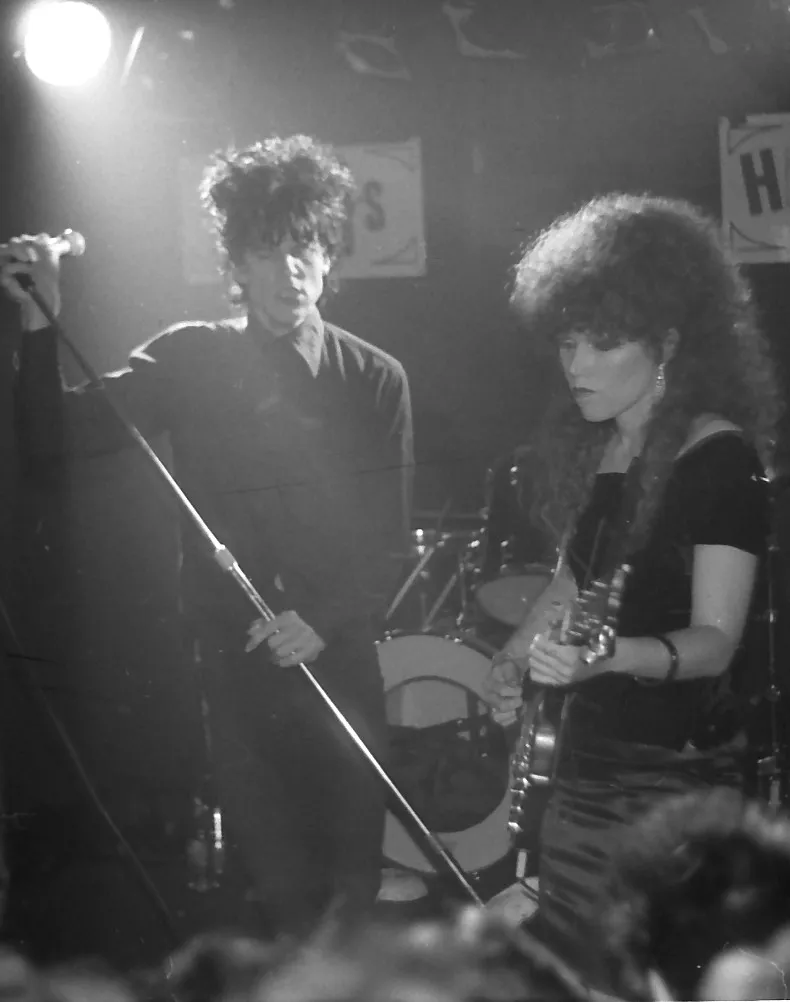
Photo by Canada Jack aka Jeremy Gilbert , licensed under CC BY-SA 3.0 · Wikimedia Commons
Rank #338
The Cramps
From Wikipedia
The Cramps were an American rock band formed in 1976 and active until 2009. Their lineup rotated frequently during their existence, with the duo of singer Lux Interior and guitarist Poison Ivy the only ever-present members. The band is credited as progenitors of the psychobilly subgenre, fusing elements of punk rock with rockabilly. The addition of guitarist Bryan Gregory and drummer Pam Balam resulted in the first complete lineup in April 1976. They released their debut album Songs the Lord Taught Us in 1980. The band split after the death of lead singer Interior in 2009.
Members
- Bryan Gregory (1976–1980)
- Lux Interior (1976–2009)
- Miriam Linna (1976–1977)
- Poison Ivy (1976–2009)
- Nick Knox (1977–1991)
- Kid Congo Powers (1980–1983)
- Jim Sclavunos (1991–1991)
- Sean Yseult (2006–2006)
Discography & Previews
Browse through and click an album to open and play 30-second previews streamed from Apple Music.

Songs the Lord Taught Us
1980 · 18 tracks
- 1 TV Set ↗ 3:13
- 2 Rock On the Moon ↗ 1:54
- 3 Garbageman ↗ 3:37
- 4 I was a Teenage Werewolf ↗ 3:04
- 5 Sunglasses After Dark ↗ 3:48
- 6 The Mad Daddy ↗ 3:49
- 7 Mystery Plane ↗ 2:44
- 8 Zombie Dance ↗ 1:55
- 9 What's Behind the Mask ↗ 2:05
- 10 Strychnine ↗ 2:25
- 11 I'm Cramped ↗ 2:38
- 12 Tear It Up ↗ 2:32
- 13 Fever ↗ 4:17
- 14 I Was a Teenage Werewolf (With False Start) ↗ 4:49
- 15 Mystery Plane ↗ 2:40
- 16 Twist and Shout ↗ 2:32
- 17 I'm Cramped ↗ 2:37
- 18 The Mad Daddy ↗ 3:15

Psychedelic Jungle
1981 · 14 tracks
- 1 Greenfuz ↗ 2:09
- 2 Goo Goo Muck ↗ 3:06
- 3 Rockin' Bones ↗ 2:49
- 4 Voodoo Idol ↗ 3:39
- 5 Primitive ↗ 3:32
- 6 Caveman ↗ 3:51
- 7 The Crusher ↗ 1:48
- 8 Don't Eat Stuff Off the Sidewalk ↗ 2:04
- 9 Can't Find My Mind ↗ 3:02
- 10 Jungle Hop ↗ 2:07
- 11 The Natives Are Restless ↗ 3:00
- 12 Under the Wires ↗ 2:45
- 13 Beautiful Gardens ↗ 3:59
- 14 The Green Door ↗ 2:36

A Date With Elvis
1986 · 15 tracks
- 1 How Far Can Too Far Go? ↗ 4:10
- 2 The Hot Pearl Snatch ↗ 3:17
- 3 People Ain't No Good ↗ 3:47
- 4 What's Inside a Girl? ↗ 3:22
- 5 Can Your P***y Do the Dog? ↗ 3:23
- 6 Kizmiaz ↗ 3:01
- 7 Cornfed Dames ↗ 5:27
- 8 Chicken ↗ 1:40
- 9 (Hot Pool of) Womanneed ↗ 3:10
- 10 Aloha From Hell ↗ 2:36
- 11 It's Just That Song ↗ 2:35
- 12 Blue Moon Baby ↗ 2:39
- 13 Georgia Lee Brown ↗ 3:24
- 14 Give Me a Woman ↗ 2:26
- 15 Get Off the Road ↗ 3:13

Stay Sick!
1989 · 17 tracks
- 1 Bop Pills ↗ 2:24
- 2 God Damn Rock 'N' Roll ↗ 2:39
- 3 Bikini Girls With Machine Guns ↗ 3:18
- 4 All Women Are Bad ↗ 3:09
- 5 The Creature From the Black Leather Lagoon ↗ 3:07
- 6 Shortnin' Bread ↗ 2:51
- 7 Daisys Up Your Butterfly ↗ 2:38
- 8 Everything Goes ↗ 3:47
- 9 Journey To the Center of a Girl ↗ 4:49
- 10 Mama Oo Pow Pow ↗ 2:33
- 11 Saddle Up a Buzz Buzz ↗ 2:43
- 12 Muleskinner Blues ↗ 2:51
- 13 Her Love Rubbed Off ↗ 2:59
- 14 Her Love Rubbed Off (Live) ↗ 5:06
- 15 Bikini Girls With Machine Guns (Live) ↗ 3:20
- 16 Jailhouse Rock ↗ 2:28
- 17 Jackyard Backoff ↗ 3:18

Look Mom No Head!
1991 · 14 tracks
- 1 Dames, Booze, Chains and Boots ↗ 4:36
- 2 Two Headed Sex Change ↗ 2:53
- 3 Blow Up Your Mind ↗ 4:29
- 4 Hardworkin' Man ↗ 4:03
- 5 Miniskirt Blues (feat. Iggy Pop) ↗ 2:40
- 6 Alligator Stomp ↗ 4:05
- 7 I Wanna Get In Your Pants ↗ 4:19
- 8 Bend Over, I'll Drive ↗ 4:06
- 9 Don't Get Funny With Me ↗ 3:24
- 10 Eyeball In My Martini ↗ 3:21
- 11 Hipsville 29 B.C. ↗ 2:32
- 12 The Strangeness In Me ↗ 3:18
- 13 Wilder Wilder Faster Faster ↗ 4:56
- 14 Jelly Roll Rock ↗ 2:28

Flamejob
1994 · 15 tracks
- 1 Mean Machine ↗ 3:57
- 2 Ultra Twist ↗ 3:48
- 3 Lets Get F****d Up ↗ 3:55
- 4 Nest of the Cuckoo Bird ↗ 3:26
- 5 I'm Customized ↗ 3:05
- 6 Sado County Auto Show ↗ 2:59
- 7 Naked Girls Falling Down the Stairs ↗ 2:45
- 8 How Come You Do Me? ↗ 2:17
- 9 Inside out and Upside Down ↗ 2:28
- 10 Trapped Love ↗ 2:00
- 11 Swing the Big Eyes Rabbit ↗ 3:40
- 12 Strange Love ↗ 2:49
- 13 Blues Blues Blues ↗ 2:24
- 14 Sinners ↗ 2:07
- 15 Route 66 (Get Your Kicks On) ↗ 3:17

Big Beat From Badsville
1997 · 18 tracks
- 1 Cramp Stomp ↗ 3:25
- 2 God Monster ↗ 4:06
- 3 It Thing Hard-On ↗ 2:49
- 4 Like a Bad Girl Should ↗ 3:05
- 5 Sheena's In a Goth Gang ↗ 2:45
- 6 Queen of Pain ↗ 3:50
- 7 Monkey With Your Tail ↗ 3:39
- 8 Devil Behind That Bush ↗ 3:34
- 9 Super Goo ↗ 2:28
- 10 Hypno Sex Ray ↗ 2:26
- 11 Burn She-Devil, Burn ↗ 2:24
- 12 Wet Nightmare ↗ 3:36
- 13 Badass Bug ↗ 2:26
- 14 Haulass Hyena ↗ 2:54
- 15 Confessions of a Psycho Cat ↗ 3:33
- 16 No Club Lone Wolf ↗ 2:28
- 17 I Walked All Night ↗ 2:50
- 18 Peter Gunn ↗ 3:10

Fiends of Dope Island
2003 · 12 tracks
- 1 Big Black Witchcraft Rock ↗ 3:28
- 2 Papa Satan Sang Louie ↗ 2:48
- 3 Hang Up ↗ 2:45
- 4 Fissure of Rolando ↗ 3:53
- 5 Dr. F****r M.D. (Musical Deviant) ↗ 3:18
- 6 Dopefiend Boogie ↗ 4:21
- 7 Taboo ↗ 3:48
- 8 Elvis F*****g Christ ↗ 3:19
- 9 She's Got Balls ↗ 2:59
- 10 Oowee Baby ↗ 3:08
- 11 Mojo Man From Mars ↗ 3:00
- 12 Color Me Black ↗ 4:02
-
 Songs the Lord Taught UsThe Cramps198018 tracks
 -
 Psychedelic JungleThe Cramps198114 tracks
 -
 A Date With ElvisThe Cramps198615 tracks
 -
 Stay Sick!The Cramps198917 tracks
 -
 Look Mom No Head!The Cramps199114 tracks
 -
 FlamejobThe Cramps199415 tracks
 -
 Big Beat From BadsvilleThe Cramps199718 tracks
 -
 Fiends of Dope IslandThe Cramps200312 tracks
Deep Dive
Overview
The Cramps were an American rock band that emerged from Sacramento in 1976 and remained active until 2009, when the death of lead singer Lux Interior brought their run to an end. Fronted by the singular pairing of Lux Interior’s raw, unhinged vocals and Poison Ivy’s minimalist, menacing guitar work, the band created a sound that merged punk rock’s anarchic energy with rockabilly’s primal rhythm and hillbilly aesthetics. They are credited as the progenitors of psychobilly, a fusion genre that would influence garage and post-punk acts for decades.
The Cramps occupied a peculiar position in late-1970s punk—neither New York nor London, neither art-school nor working-class, but rather emerging from the inland Sacramento scene with an obsession for B-movie horror imagery, 1950s Americana, and the seediest corners of American popular culture. Their recordings and live shows became legendary for their visceral intensity and theatrical grotesquerie, earning them a devoted cult following that extended well beyond the punk underground.
Formation Story
Lux Interior and Poison Ivy formed the core of The Cramps in Sacramento in 1976, with a rotating cast of supporting musicians filling out the rhythm section. The first complete lineup coalesced in April 1976 with the addition of guitarist Bryan Gregory and drummer Pam Balam. Miriam Linna provided early bass support during the band’s formative months, though Nick Knox would take over drum duties beginning in 1977, eventually becoming the band’s most enduring percussionist alongside the Lux Interior–Poison Ivy partnership.
The band’s emergence in Sacramento, far from the established punk epicenters, gave The Cramps a distinctive identity rooted in American roots music and horror culture rather than the political aggression or art-world irony dominating coasts. From the outset, Lux Interior and Poison Ivy’s shared vision of fusing punk’s raw power with rockabilly’s swagger and B-movie aesthetics set them apart from their contemporaries. The band’s name and early performances signaled a deliberate embrace of transgression and the macabre, positioning themselves as outlaws even within punk’s already marginal scene.
Breakthrough Moment
The Cramps’ debut album, Songs the Lord Taught Us, arrived in 1980 and established them as major innovators within post-punk and punk rock. The record’s sparse, menacing arrangements—driven by Poison Ivy’s guitar and featuring Kid Congo Powers on second guitar alongside Bryan Gregory’s original contributions—proved that punk could absorb and reimagine American vernacular music without sacrificing the genre’s primal force. The album’s grotesque energy and commitment to their psychobilly aesthetic gained them attention beyond the underground, with the band’s live reputation for fevered, dangerous performances cementing their status as more than a regional curiosity.
Following up in 1981 with Psychedelic Jungle, The Cramps deepened their sonic palette while maintaining the raw intensity that defined their approach. Both records showcased their ability to strip rock music down to its most essential, nervous components—sparse rhythm, angular guitar work, and Lux Interior’s uncontrolled, almost shamanic vocals—and reassemble them into something genuinely unsettling and original.
Peak Era
The Cramps’ most prolific and influential period spanned the 1980s through the early 1990s, encompassing a series of albums that refined and expanded their psychobilly blueprint. A Date With Elvis (1986) and Stay Sick! (1989) saw the band consolidating their sound, with Poison Ivy’s guitar work becoming increasingly sophisticated while maintaining its skeletal clarity. The collaboration with Kid Congo Powers from 1980 to 1983 added textural depth to their arrangements, allowing the band to explore darker psychedelic textures within their fundamentally punk-derived framework.
By the 1990s, albums like Look Mom No Head! (1991) and Flamejob (1994) demonstrated The Cramps’ ability to maintain their core identity while adapting to changing production technology and audience expectations. Throughout this era, the Lux Interior–Poison Ivy partnership remained the band’s creative and performance center, with the rhythm section rotating around them. The band’s willingness to tour relentlessly and maintain their iconoclastic visual presentation kept them relevant across multiple generations of alternative rock listeners.
Musical Style
The Cramps’ sound exists at the intersection of punk rock’s three-chord assault and rockabilly’s rhythmic swagger, inflected with an almost anthropological interest in the margins of American musical history—garage rock, jump blues, horror-movie soundtracks, and B-side obscurities. Poison Ivy’s guitar style, deceptively simple on the surface, conveyed menace through minimal note economy and precise, sometimes dissonant phrasing; she rarely soloed in the conventional sense, instead treating the guitar as a rhythmic and textural instrument that carved out space for Lux Interior’s vocals to dominate. The rhythm section—whether Nick Knox on drums or later percussionists—operated in lockstep with Poison Ivy, creating a hypnotic, tribal pulse that underlay the band’s more chaotic surface elements.
Lux Interior’s vocal approach was genre-unto-itself: speaking, howling, moaning, and occasionally singing in a thin, strained register that conveyed genuine psychological disturbance. Lyrically and thematically, The Cramps drew from trashy Americana, sexual transgression, and horror-movie imagery, treating these subjects with a blend of affection and revulsion. This combination of musical minimalism, lyrical provocation, and theatrical presentation created a psychobilly sound that owed as much to the unhinged energy of 1950s rockabilly records and the exploitative aesthetics of B-movies as it did to punk’s structural innovations.
Major Albums
Songs the Lord Taught Us (1980)
The Cramps’ debut established their signature sound: sparse, menacing arrangements built on Poison Ivy’s angular guitar work and a rhythm section locked into hypnotic, tribal grooves, all anchored by Lux Interior’s uncontrolled, almost shamanic vocals. This record defined psychobilly as a viable fusion of punk rock and rockabilly and remains the band’s most essential statement.
Psychedelic Jungle (1981)
The follow-up deepened their exploration of psychobilly while introducing darker, more textured arrangements. Poison Ivy’s guitar work grew more sophisticated without sacrificing rawness, and the album’s commitment to sonic depravity over conventional song structure demonstrated the band’s artistic ambitions beyond novelty.
A Date With Elvis (1986)
This album found The Cramps refining their approach with more polished production while maintaining their core grotesqueness. The record showcased their ability to absorb and subvert rock and roll history without losing sight of their primal energy.
Stay Sick! (1989)
Building on the achievements of A Date With Elvis, Stay Sick! represented The Cramps at their most assured, balancing accessibility with genuine strangeness. The album proved their staying power as a creative force beyond their initial formation era.
Look Mom No Head! (1991)
By the 1990s, The Cramps had solidified their approach into a reliable formula without becoming predictable. This album maintained their commitment to the grotesque while adapting to contemporary alternative rock’s broader acceptance of their aesthetic.
Flamejob (1994)
The band’s mid-1990s effort continued to mine their psychobilly vein, demonstrating consistent output across nearly two decades of continuous touring and recording.
Signature Songs
- Garbageman — A stripped-down showcase for Lux Interior’s unhinged vocal style over a minimal, hypnotic rhythm.
- Surfin’ Dead — The band’s marriage of surf-rock imagery with horror themes, demonstrating their genre-fusion approach.
- I Was a Teenage Werewolf — A direct engagement with B-movie horror culture set to punked-up rockabilly.
- Human Fly — One of their most recognizable tracks, showcasing Poison Ivy’s minimalist guitar work and the band’s ability to generate menace from simplicity.
- Drug Train — A demonstration of their lyrical interest in transgression and depravity within a carefully controlled musical framework.
Influence on Rock
The Cramps’ invention of psychobilly as a viable fusion genre opened pathways for countless post-punk and alternative acts to engage with American roots music without apology or irony. By legitimizing rockabilly and garage rock as materials for contemporary punk musicians, they expanded punk’s stylistic vocabulary and demonstrated that the genre need not remain tethered to purely British or New York models. Bands working in psychobilly, horror-punk, and garage-punk lineages—from The Meteors to The Gun Club to countless contemporary acts—trace direct lineage to The Cramps’ foundational work.
Beyond genre-specific influence, The Cramps demonstrated a model of sustained artistic independence through relentless touring and a commitment to uncompromising aesthetics. Their willingness to remain defiantly weird in an industry that often demands softening or broadening of appeal influenced alternative rock’s broader embrace of the grotesque and transgressive throughout the 1980s and 1990s. Their impact extended beyond music into visual culture, establishing archetypes of punk performance art and horror-theatrical presentation that influenced countless musicians and visual artists.
Legacy
The Cramps disbanded in 2009 following Lux Interior’s death, but their catalog has experienced sustained interest through reissues, streaming platforms, and their adoption into the permanent canon of American rock music. The Lux Interior–Poison Ivy partnership, spanning from 1976 to 2009 without interruption, remains one of rock’s most durable and artistically coherent creative relationships. Their records have been continuously available and have found new audiences through each successive generation’s discovery of punk and post-punk’s deeper history.
The band’s influence on contemporary punk, garage rock, and alternative music remains measurable and ongoing. Their commitment to artistic vision over commercial compromise, combined with their consistent touring schedule throughout their existence, established a template for independent rock success that continues to inform underground and alternative musicians. The Cramps’ legacy resides not in chart positions or mainstream accolades but in their permanent alteration of what rock music could be—proof that punk’s democratizing ethos could subsume and transform American roots music without losing its power or strangeness.
Fun Facts
- Lux Interior and Poison Ivy remained the only ever-present members throughout The Cramps’ entire 33-year existence, with the rhythm section rotating through numerous musicians including Nick Knox, Kid Congo Powers, and others, yet the core duo’s vision remained unaltered.
- The band’s aesthetic drew heavily from B-movie horror culture and trashy Americana, with the band conducting what might be termed an anthropological study of marginal American popular culture through their music, lyrics, and visual presentation.
- Despite their cult status and influence, The Cramps maintained a relentless touring schedule throughout their existence, building their following through live performance rather than radio play or mainstream music industry support.
- The band recorded for multiple independent and alternative labels throughout their career—Big Beat Records, I.R.S. Records, Creation Records, Epitaph Records, and Illegal Records—reflecting their status as perennially outside the mainstream industry apparatus.