
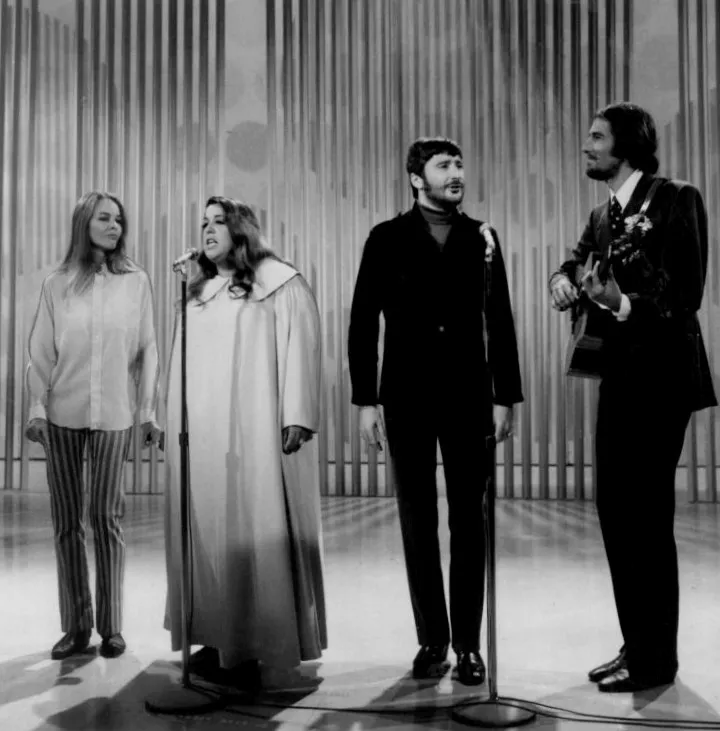
Photo by CBS Television , licensed under Public domain · Wikimedia Commons
Rank #82
The Mamas & the Papas
From Wikipedia
The Mamas & the Papas were an American-Canadian folk rock vocal group that recorded and performed from 1965 to 1968, with a brief reunion in 1971. The group was a defining force in the music scene of the counterculture of the 1960s. Formed in New York City, the group consisted of Americans John Phillips, Cass Elliot, and Michelle Phillips, and Canadian Denny Doherty. Its sound was based on vocal harmonies arranged by John Phillips – the songwriter and leader of the group – who adapted folk to the new beat style of the early 1960s.
Discography & Previews
Browse through and click an album to open and play 30-second previews streamed from Apple Music.

If You Can Believe Your Eyes and Ears
1966 · 12 tracks
- 1 Monday, Monday (Single) ↗ 3:28
- 2 Straight Shooter ↗ 2:59
- 3 Got a Feelin' ↗ 2:53
- 4 I Call Your Name ↗ 2:39
- 5 Do You Wanna Dance ↗ 3:01
- 6 Go Where You Wanna Go ↗ 2:29
- 7 California Dreamin' (Single) ↗ 2:42
- 8 Spanish Harlem ↗ 3:22
- 9 Somebody Groovy (Single/) ↗ 3:17
- 10 Hey Girl ↗ 2:31
- 11 You Baby ↗ 2:23
- 12 The "In" Crowd ↗ 3:12

The Mamas & the Papas
1966 · 12 tracks
- 1 No Salt On Her Tail ↗ 2:43
- 2 Trip, Stumble & Fall ↗ 2:41
- 3 Dancing Bear ↗ 4:11
- 4 Words of Love (Single Version) ↗ 2:16
- 5 My Heart Stood Still ↗ 1:44
- 6 Dancing In the Street ↗ 3:49
- 7 I Saw Her Again (Single Version) ↗ 3:14
- 8 Strange Young Girls ↗ 2:55
- 9 I Can't Wait ↗ 2:44
- 10 Even If I Could ↗ 2:44
- 11 That Kind of Girl ↗ 2:38
- 12 Once Was a Time I Thought ↗ 1:02

Deliver
1967 · 12 tracks
- 1 Dedicated To the One I Love ↗ 2:59
- 2 My Girl ↗ 3:33
- 3 Creeque Alley ↗ 3:49
- 4 Sing For Your Supper ↗ 2:49
- 5 Twist and Shout ↗ 2:53
- 6 Free Advice ↗ 3:20
- 7 Look Through My Window ↗ 3:07
- 8 Boys and Girls Together ↗ 3:16
- 9 String Man ↗ 3:02
- 10 Frustration ↗ 2:57
- 11 Did You Ever Want To Cry ↗ 2:54
- 12 John's Music Box ↗ 1:06

The Papas & the Mamas
1968 · 12 tracks
- 1 The Right Somebody To Love ↗ 0:41
- 2 Safe In My Garden ↗ 3:12
- 3 Meditation Mama (Transcendental Woman Travels) ↗ 4:22
- 4 For The Love Of Ivy ↗ 3:42
- 5 Dream A Little Dream Of Me (With Introduction) ↗ 3:14
- 6 Mansions ↗ 3:46
- 7 Gemini Childe ↗ 4:08
- 8 Nothing's Too Good For My Little Girl ↗ 3:08
- 9 Too Late ↗ 4:09
- 10 Twelve Thirty (Single Version) ↗ 3:25
- 11 Rooms ↗ 2:47
- 12 Midnight Voyage ↗ 3:13

People Like Us
1971 · 12 tracks
-
 If You Can Believe Your Eyes and EarsThe Mamas & the Papas196612 tracks
 -
 The Mamas & the PapasThe Mamas & the Papas196612 tracks
 -
 DeliverThe Mamas & the Papas196712 tracks
 -
 The Papas & the MamasThe Mamas & the Papas196812 tracks
 -
 People Like UsThe Mamas & the Papas197112 tracks
Deep Dive
Overview
The Mamas & the Papas were an American-Canadian folk rock vocal group that emerged as a defining force in the music and counterculture of the 1960s. Operating primarily between 1965 and 1968, with a brief reunion in 1971, the band built their reputation on precisely arranged vocal harmonies and John Phillips’ compositional gifts. Their sound married folk music’s acoustic sensibility with the rhythmic and harmonic sophistication of early 1960s pop, creating a blueprint that would influence vocal group records for decades to come.
Formation Story
The Mamas & the Papas coalesced in the mid-1960s with four members: John Phillips, Cass Elliot, Michelle Phillips, and Denny Doherty. Although Wikipedia notes the group was formed in New York City, Wikidata places their origin in Los Angeles, suggesting the band’s official base or recording operations relocated west during their formative period. John Phillips served as the group’s primary songwriter and arranger, having adapted folk music traditions to the contemporary pop-rock sensibilities of the early 1960s. The convergence of these four voices—Phillips providing melodic direction and harmonic architecture, Cass Elliot’s contralto, Michelle Phillips’ soprano, and Doherty’s tenor—created a vocal texture distinct from both traditional folk groups and the manufactured pop groups dominating the charts. Their formation in 1965 placed them squarely in the moment when folk-rock was shifting from acoustic purists into more produced, harmony-forward territory.
Breakthrough Moment
The Mamas & the Papas achieved rapid and substantial commercial breakthrough with their debut and second albums released in 1966. If You Can Believe Your Eyes and Ears, released earlier that year, introduced their signature sound to a national audience. Their eponymous second album, The Mamas & the Papas, consolidated their success and established them as major voices in contemporary pop music. The group’s radio-friendly approach to folk rock—lush vocal arrangements, professional production, and John Phillips’ crafted songwriting—resonated across radio formats and helped carry folk-rock beyond its late-1950s and early 1960s origins into mainstream pop consciousness. By mid-1966, they had transitioned from emerging artists to recognized names in American popular music.
Peak Era
The years 1966 through 1968 represented the group’s most creatively and commercially significant period. Following their initial success, they released Deliver in 1967 and The Papas & the Mamas in 1968, both of which maintained their harmonic sophistication and topical songwriting. During this three-year span, the band functioned as cultural ambassadors of sorts for the counterculture movement—their music articulated the era’s sensibilities while remaining accessible to mainstream audiences. Their ability to blend folk tradition with contemporary pop production allowed them to occupy a unique position in 1960s rock, neither as folk purists nor as purely commercial pop acts. By 1968, internal tensions and the broader cultural shifts of the late 1960s led to the group’s initial dissolution, though they would reunite briefly in 1971 to release People Like Us.
Musical Style
The Mamas & the Papas’ sound was anchored in vocal harmony arranged by John Phillips with meticulous care. Unlike the raw, acoustic approach of earlier folk groups or the screaming reverb-heavy harmonies of doo-wop and girl groups, their arrangement style emphasized clarity and sophistication. Instrumental backing combined acoustic and electric guitars with piano and orchestral strings, grounding folk melodies in a lush pop-production aesthetic. Cass Elliot’s distinctive alto voice provided vocal weight and depth; Michelle Phillips offered bright soprano counterpoint; and Denny Doherty’s tenor wove through the arrangement, often handling lead vocal duties. John Phillips, as the group’s conceptual leader, typically sang a baritone or mid-range part that guided the harmonic structure. Their songwriting, rooted in Phillips’ compositional voice, addressed contemporary social concerns and personal themes with the introspection valued by the counterculture, distinguishing them from pure pop groups. The result was folk rock that felt both intellectually engaged and emotionally direct—a middle path between the earnestness of folk and the commercial calculation of pop.
Major Albums
If You Can Believe Your Eyes and Ears (1966)
The group’s debut introduced their vocal harmony formula to a national audience and established John Phillips as a significant songwriter in contemporary rock. The album’s success confirmed that there was substantial market demand for harmonically sophisticated folk-rock.
The Mamas & the Papas (1966)
Their second album, released the same year, consolidated their breakthrough and deepened listener familiarity with their sound. Its rapid succession after their debut underscored the group’s momentum and commercial appeal.
Deliver (1967)
Released at the height of 1960s cultural ferment, this album maintained their harmonic signature while engaging more directly with the era’s social and emotional preoccupations. It demonstrated their ability to grow beyond novelty or one-album success.
The Papas & the Mamas (1968)
The group’s final studio recording before initial dissolution arrived as the 1960s counterculture was fracturing. This album represented the end of their first and most productive chapter, arriving at a moment of cultural transition.
People Like Us (1971)
Released as part of a brief reunion, this album attempted to re-establish the group after a three-year hiatus. Its existence demonstrated both the enduring appeal of their catalog and internal relationships that had not fully severed.
Signature Songs
- “California Dreamin’” — A signature Phillips composition capturing the era’s west-coast mythology and the group’s harmonic gift.
- “Monday, Monday” — A major commercial success showcasing the group’s ability to merge contemporary songwriting with sophisticated vocal arrangement.
- “Dedicated to the One I Love” — A deeply harmonic showcase for all four voices, demonstrating their technical precision and emotional maturity.
- “Creeque Alley” — A narrative-driven song revealing the group’s formation story and historical self-awareness.
Influence on Rock
The Mamas & the Papas demonstrated that folk-rock did not require guitar heroics or raw vocal delivery to reach mass audiences. Their success opened space for harmony-focused acts and legitimized the notion that pop production values and folk-music engagement were not mutually exclusive. John Phillips’ songwriting approach—blending personal narrative with social observation—influenced subsequent singer-songwriters and vocal groups. The group’s ability to occupy the counterculture’s margins while maintaining mainstream chart presence provided a template for how 1960s rock music could serve both underground and commercial audiences simultaneously. Their harmonic approach influenced the production and arrangement choices of vocal-driven rock and pop acts throughout the 1970s and beyond.
Legacy
The Mamas & the Papas remain artifacts of a specific cultural moment—the mid-to-late 1960s counterculture—while their music has proven remarkably durable. Their studio recordings from 1966 to 1968 have remained continuously available and continue to circulate through streaming platforms and broadcast media. The group’s reunion in 1971, though brief, demonstrated the enduring appeal of their material and the personal bonds that sustained them. Their influence persists in discussions of 1960s vocal harmony groups and folk-rock hybrids, marking them as essential figures in the era’s musical and cultural landscape. The song catalog generated during their primary years—particularly John Phillips’ compositions—remains fundamental to understandings of 1960s pop-rock songwriting.
Fun Facts
- Denny Doherty was Canadian, making The Mamas & the Papas one of the few major rock groups of the 1960s with a cross-border membership.
- The group was formed after the folk scene’s early-1960s commercial decline, meaning they developed their harmonically sophisticated approach at a moment when acoustic folk was already being superseded by rock instrumentation.
- Their recording history included work with Dunhill Records and RCA Victor, reflecting both independent and major-label relationships during a period of significant industry consolidation.