
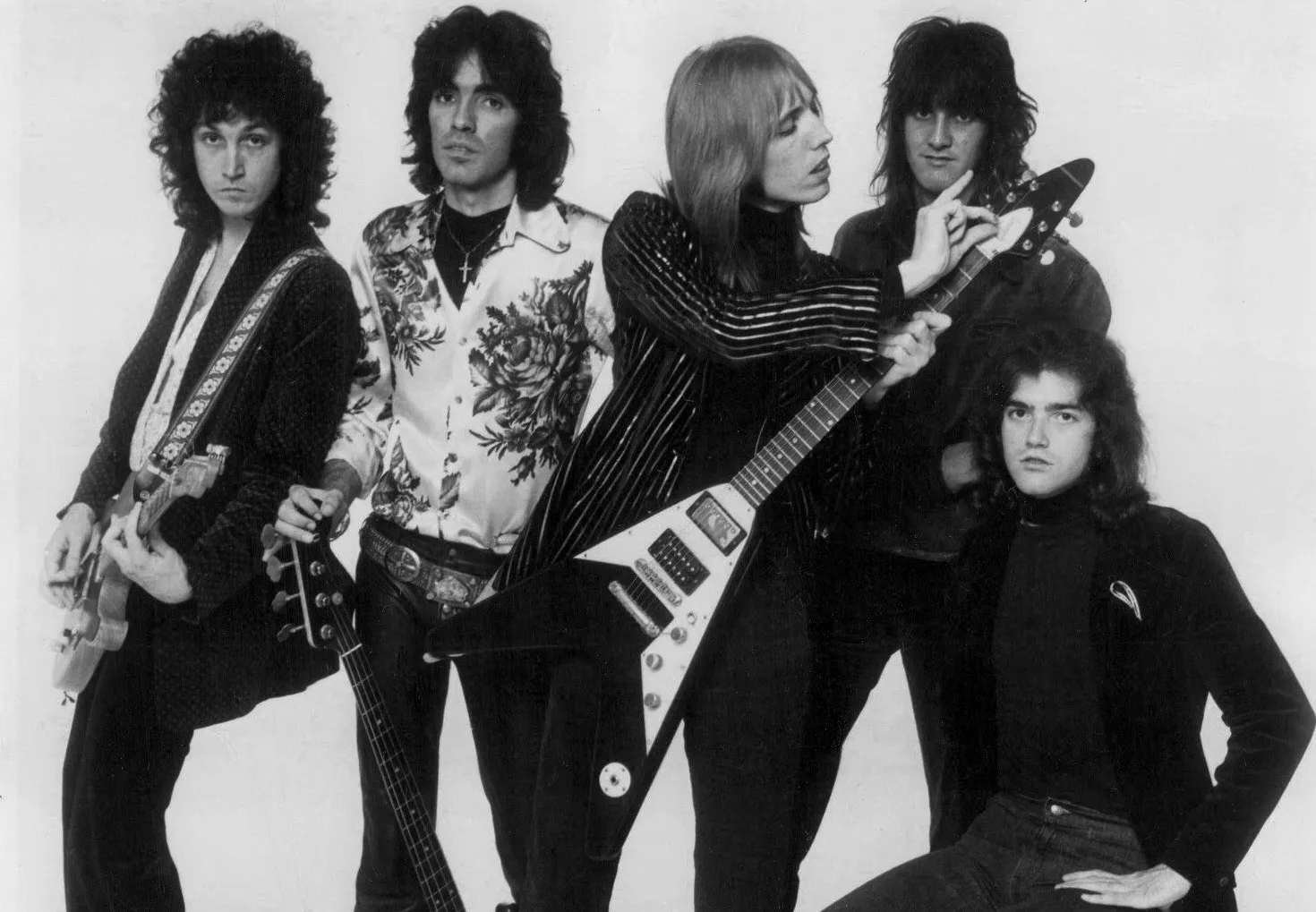
Photo by ABC/Shelter Records , licensed under Public domain · Wikimedia Commons
Rank #124
Tom Petty and the Heartbreakers
From Wikipedia
Tom Petty and the Heartbreakers were an American rock band formed in Gainesville, Florida, in 1976. The band originally comprised lead singer and rhythm guitarist Tom Petty, lead guitarist Mike Campbell, keyboardist Benmont Tench, drummer Stan Lynch and bassist Ron Blair. In 1982, Blair, weary of the touring lifestyle, departed the band. His replacement, Howie Epstein, remained with the band for the next two decades. In 1991, Scott Thurston joined the band as a multi-instrumentalist, primarily on rhythm guitar and secondary keyboard. In 1994, Steve Ferrone replaced Lynch on drums. Blair returned to the Heartbreakers in 2002, the year before Epstein's death. The band had a long string of hit singles, including "Breakdown", "American Girl", "Refugee" (1979), "The Waiting" (1981), "Learning to Fly" (1991), and "Mary Jane's Last Dance" (1993), among many others, that stretched over several decades of work.
Members
- Benmont Tench (1976–present)
- Mike Campbell (1976–present)
- Ron Blair (1976–1981)
- Stan Lynch (1976–1994)
- Tom Petty (1976–present)
- Howie Epstein (1982–2002)
- Scott Thurston (1991–present)
- Steve Ferrone (1994–present)
Discography & Previews
Browse through and click an album to open and play 30-second previews streamed from Apple Music.

Tom Petty and the Heartbreakers
1976 · 10 tracks


Hard Promises
1981 · 10 tracks


Let Me Up (I’ve Had Enough)
1987 · 11 tracks

Into the Great Wide Open
1991 · 12 tracks
- 1 Learning to Fly ↗ 4:02
- 2 Kings Highway ↗ 3:08
- 3 Into the Great Wide Open ↗ 3:43
- 4 Two Gunslingers ↗ 3:09
- 5 The Dark of the Sun ↗ 3:23
- 6 All or Nothin' ↗ 4:05
- 7 All the Wrong Reasons ↗ 3:45
- 8 Too Good to Be True ↗ 4:00
- 9 Out In the Cold ↗ 3:40
- 10 You and I Will Meet Again ↗ 3:41
- 11 Makin' Some Noise ↗ 3:26
- 12 Built to Last ↗ 3:59
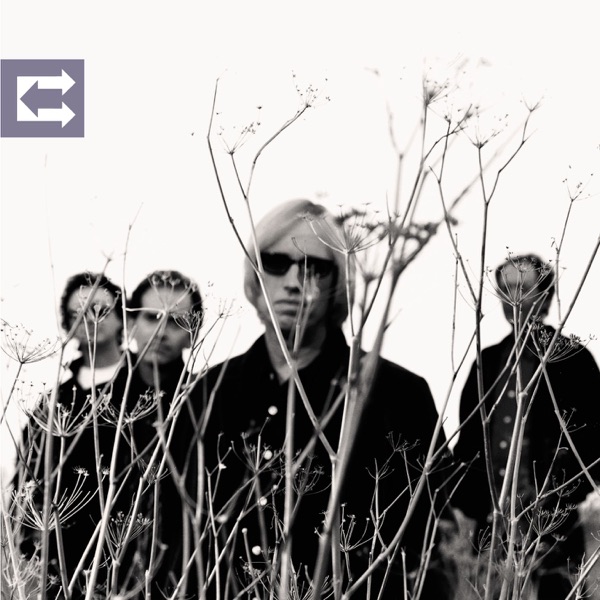
Echo
1999 · 15 tracks
- 1 Room at the Top ↗ 5:01
- 2 Counting On You ↗ 4:06
- 3 Free Girl Now ↗ 3:30
- 4 Lonesome Sundown ↗ 4:32
- 5 Swingin' ↗ 5:30
- 6 Accused of Love ↗ 2:45
- 7 Echo ↗ 6:37
- 8 Won't Last Long ↗ 4:19
- 9 Billy the Kid ↗ 4:08
- 10 I Don't Wanna Fight ↗ 2:49
- 11 This One's for Me ↗ 2:42
- 12 No More ↗ 3:15
- 13 About to Give Out ↗ 3:13
- 14 Rhino Skin ↗ 3:57
- 15 One More Day, One More Night ↗ 5:38

The Last DJ
2002 · 12 tracks

Mojo
2010 · 18 tracks
- 1 Jefferson Jericho Blues ↗ 3:23
- 2 First Flash of Freedom ↗ 6:53
- 3 Running Man's Bible ↗ 6:01
- 4 The Trip to Pirate's Cove ↗ 4:59
- 5 Candy ↗ 4:11
- 6 No Reason to Cry ↗ 3:04
- 7 I Should Have Known It ↗ 3:36
- 8 U.S. 41 ↗ 3:00
- 9 Takin' My Time ↗ 4:21
- 10 Let Yourself Go ↗ 3:23
- 11 Don't Pull Me Over ↗ 4:04
- 12 Lover's Touch ↗ 4:23
- 13 High in the Morning ↗ 3:36
- 14 Something Good Coming ↗ 4:11
- 15 Good Enough ↗ 5:51
- 16 Help Me ↗ 3:30
- 17 Mystery of Love ↗ 4:05
- 18 Little Girl Blues ↗ 3:08
-
 Tom Petty and the HeartbreakersTom Petty and the Heartbreakers197610 tracks
 -
 You’re Gonna Get It!Tom Petty and the Heartbreakers197810 tracks
 -
 Damn the TorpedoesTom Petty and the Heartbreakers19799 tracks
 -
 Hard PromisesTom Petty and the Heartbreakers198110 tracks
 -
 Long After DarkTom Petty and the Heartbreakers198210 tracks
 -
 Southern AccentsTom Petty and the Heartbreakers19859 tracks
 -
 Let Me Up (I’ve Had Enough)Tom Petty and the Heartbreakers198711 tracks
 -
 Into the Great Wide OpenTom Petty and the Heartbreakers199112 tracks
 -
 EchoTom Petty and the Heartbreakers199915 tracks
 -
 The Last DJTom Petty and the Heartbreakers200212 tracks
 -
 MojoTom Petty and the Heartbreakers201018 tracks
 -
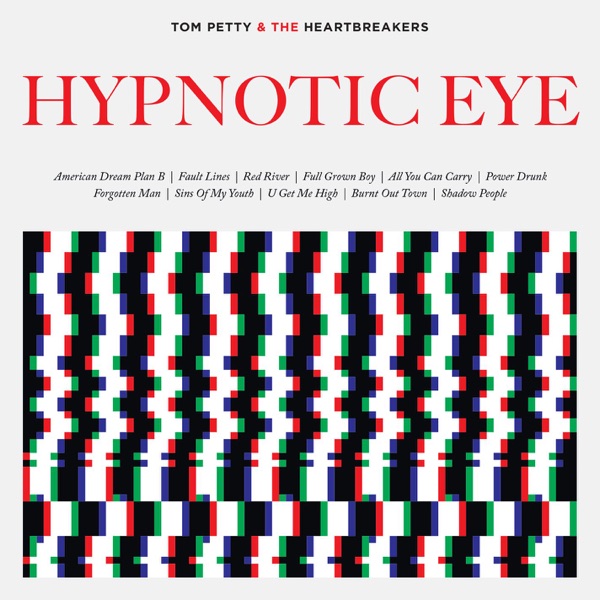
 Hypnotic EyeTom Petty and the Heartbreakers201411 tracks
Deep Dive
Overview
Tom Petty and the Heartbreakers stand as one of American rock’s most durable and commercially successful acts. Formed in Gainesville, Florida, in 1976, the band built a career on melodic hard rock with Southern roots, delivering a string of hit singles that spanned from the late 1970s through the 1990s and beyond. Their music blended the directness of heartland rock with the swagger of Southern rock, creating a sound that felt both urgent and timeless—one that spoke to working-class experience without pretense or bombast.
Formation Story
Tom Petty and the Heartbreakers emerged from Gainesville’s small but fertile rock scene in 1976. The founding lineup brought together Tom Petty as lead singer and rhythm guitarist, Mike Campbell on lead guitar, Benmont Tench on keyboards, Stan Lynch on drums, and Ron Blair on bass. All five players possessed strong instincts for hooks and arrangement; from the start, they operated as a genuine band rather than a vehicle for a single personality. Gainesville, though not a major recording hub, proved to be a launching pad for a group whose work would eventually define a generation’s understanding of American rock.
Breakthrough Moment
The band’s eponymous 1976 debut album introduced their signature approach, but it was Damn the Torpedoes in 1979 that transformed them from rising act to mainstream force. That album yielded the hit “Refugee” and consolidated their reputation for crafting radio-friendly yet substantive rock songs. By the early 1980s, with the 1981 album Hard Promises further establishing their commercial reach, Tom Petty and the Heartbreakers had become a fixture on rock radio and a proven draw on the touring circuit.
Peak Era
The band’s most successful and creatively vital period spanned the late 1970s through the early 1990s. During these years, they released a succession of strong albums—You’re Gonna Get It! (1978), Southern Accents (1985), and Into the Great Wide Open (1991)—while maintaining a relentless touring schedule. The 1980s saw significant lineup changes: Ron Blair departed in 1982, replaced by Howie Epstein, and in 1991, Scott Thurston joined as a multi-instrumentalist on rhythm guitar and secondary keyboards. Stan Lynch remained the band’s drummer until 1994, when Steve Ferrone took over the kit. Despite—or perhaps because of—these personnel shifts, the band’s sound remained consistent and their commercial momentum undiminished.
Musical Style
Tom Petty and the Heartbreakers played a form of rock that drew from heartland rock, Southern rock, and the British Invasion—a synthesis that made them immediate and accessible without sacrificing substance. Campbell’s lead guitar work combined blues-inflected phrasing with clean, modern tone; Tench’s keyboards provided color without overwhelming the mix; and Petty’s vocals, conversational and slightly world-weary, delivered lyrics grounded in everyday situations and emotional truths. The rhythm section—whether Blair or Epstein on bass, Lynch or Ferrone on drums—provided a tight, propulsive foundation. Lyrically, Petty favored storytelling and emotional directness; songs often centered on romantic disappointment, the strain of the touring life, or the struggle to maintain integrity in the music industry. The band’s approach to melody was distinctly pop-rock; hooks came early and often, yet the arrangements rarely felt slick or calculated.
Major Albums
Damn the Torpedoes (1979)
The album that established the band as major commercial players, featuring “Refugee” and cementing their reputation for melody-driven rock with substance.
Hard Promises (1981)
A tightly constructed set that included “The Waiting,” demonstrating the band’s ability to sustain creative momentum while growing their radio presence.
Southern Accents (1985)
A landmark album that deepened the band’s Southern rock roots while expanding their sonic palette, marking the height of their mid-1980s creative power.
Into the Great Wide Open (1991)
Featuring the hit “Learning to Fly,” this album reinforced the band’s status as enduring hitmakers and showcased Thurston’s integration into the lineup.
Echo (1999)
A later-career effort that demonstrated the band’s continued ability to craft compelling material decades into their existence.
Mojo (2010)
A return to their blues-influenced roots, proof that the band could still deliver vital rock music in the 21st century.
Signature Songs
- “Breakdown” — An early showcase for Petty’s conversational vocal style and the band’s knack for infectious hooks.
- “American Girl” — A defining anthem that captured the band’s command of melody and their understanding of rock radio.
- “Refugee” — The 1979 breakthrough hit that demonstrated their ability to combine commercial appeal with emotional weight.
- “The Waiting” — A 1981 track that typified Petty’s lyrical focus on frustration and patience in matters of the heart.
- “Learning to Fly” — A 1991 song that became one of the band’s signature statements and showcased their enduring creative vitality.
- “Mary Jane’s Last Dance” — A 1993 single that proved the band could still generate major radio hits in their later years.
Influence on Rock
Tom Petty and the Heartbreakers’ influence on rock music lies in their demonstration that straightforward, melody-driven rock with Southern and heartland roots could sustain a 40-year career and achieve both critical respect and mass commercial success. They proved that arena rock did not require excess or pretension; their stripped-down approach and focus on songcraft influenced countless acts in the 1980s and beyond. The band’s touring discipline and commitment to the band format—as opposed to the cult of the frontman—set an example for how professional rock musicians could build lasting careers through consistency and quality control.
Legacy
The band’s longevity is itself a kind of legacy. Remaining active for decades while maintaining the same core lineup (with key personnel changes in the 1980s and 1990s) speaks to a stable creative partnership rare in rock music. By the 2000s and 2010s, despite Howie Epstein’s death in 2002 and Ron Blair’s return to the lineup in 2002, Tom Petty and the Heartbreakers remained fixtures of American rock, demonstrating that bands formed in the 1970s could retain cultural relevance without becoming nostalgia acts. Their presence on classic rock radio, their studio output well into the 2010s, and their consistent touring presence underscored their status not as heritage artists but as working musicians with something ongoing to say.
Fun Facts
- The band formed in Gainesville, Florida, a city far from Los Angeles, New York, or Nashville, yet became one of rock’s most successful acts despite their geographic distance from established music industry centers.
- Howie Epstein remained with the band for two decades after replacing Ron Blair in 1982, providing bass and vocal harmony through some of the band’s most successful years before his death in 2002.
- Ron Blair returned to the Heartbreakers in 2002, the same year Epstein passed away, making for a significant reunion and personnel shift after a 20-year absence.
- Steve Ferrone, who replaced Stan Lynch on drums in 1994, brought his studio and touring experience from other high-profile rock acts, strengthening the band’s rhythmic foundation during their later peak years.