
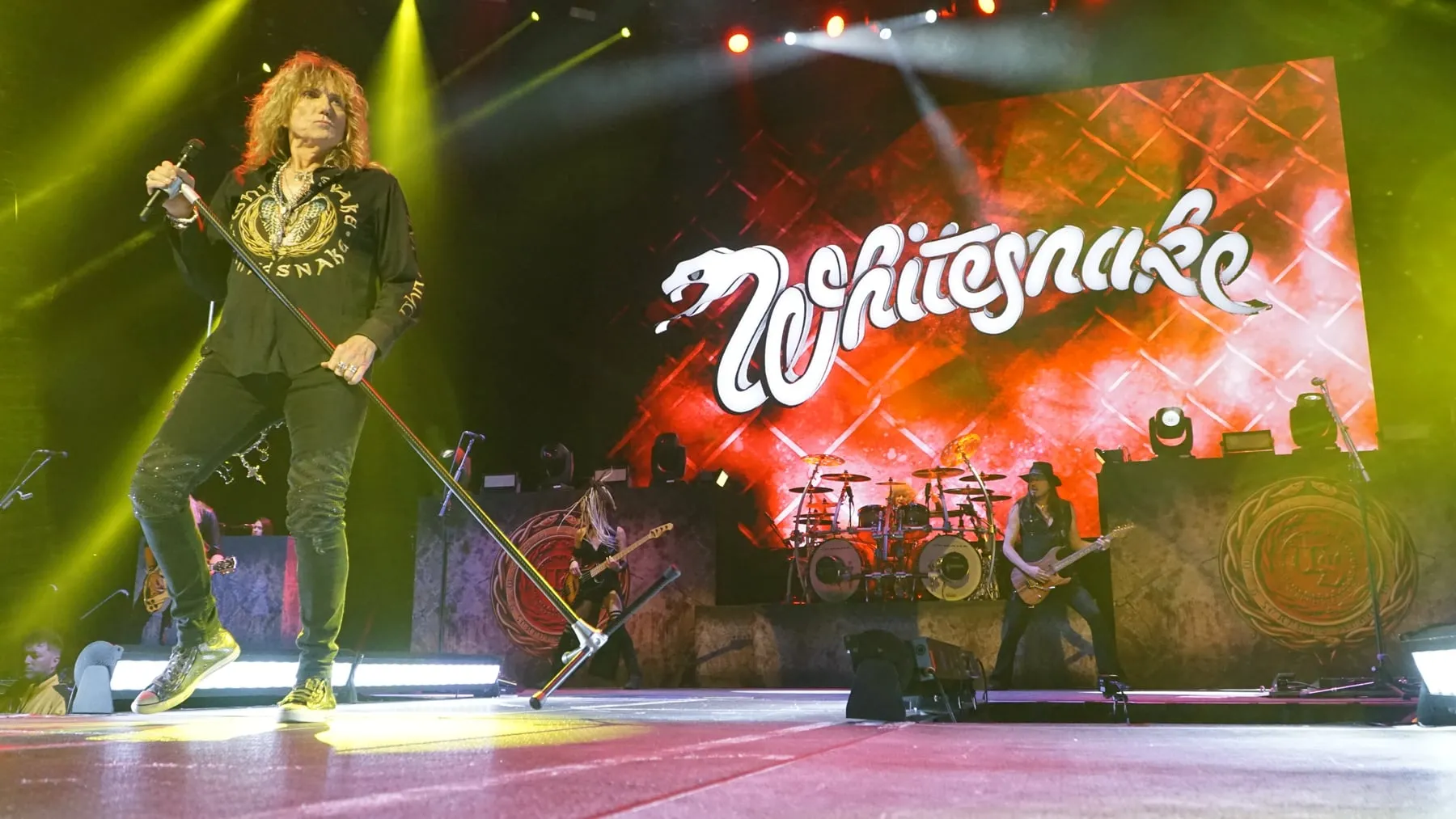
Photo by aliina s. , licensed under CC BY 2.0 · Wikimedia Commons
Rank #183
Whitesnake
From Wikipedia
Whitesnake were an English rock band formed in London in 1978. The group originated as the backing band for singer David Coverdale, who had recently left Deep Purple. Though the band quickly developed their own entity, Coverdale was the only constant member throughout their history.
Members
- Bernie Marsden (1978–1982)
- Jon Lord (1978–1984)
- Micky Moody (1978–1983)
- Michele Luppi (2015–present)
- David Coverdale
Discography & Previews
Browse through and click an album to open and play 30-second previews streamed from Apple Music.
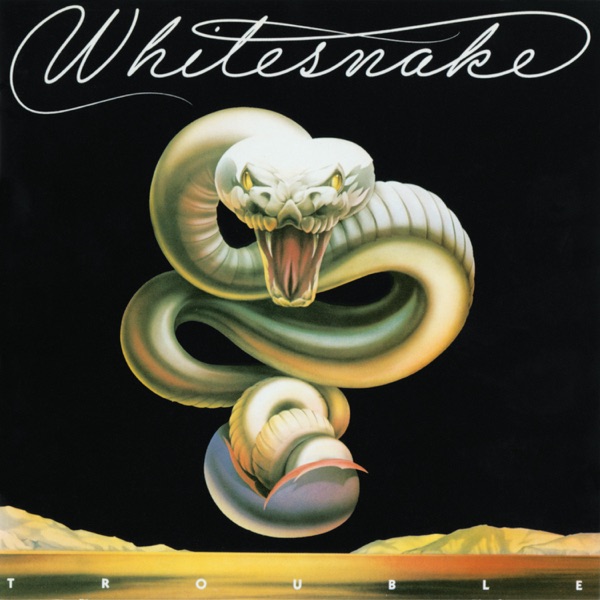
Trouble
1978 · 14 tracks
- 1 Take Me with You ↗ 4:46
- 2 Love to Keep You Warm ↗ 3:44
- 3 Lie Down (A Modern Love Song) ↗ 3:14
- 4 Day Tripper ↗ 3:47
- 5 Nighthawk (Vampire Blues) ↗ 3:39
- 6 The Time Is Right for Love ↗ 3:27
- 7 Trouble ↗ 4:48
- 8 Belgian Tom's Hat Trick ↗ 3:26
- 9 Free Flight ↗ 4:06
- 10 Don't Mess with Me ↗ 3:19
- 11 Come On ↗ 3:33
- 12 Bloody Mary ↗ 3:18
- 13 Steal Away ↗ 4:16
- 14 Ain't No Love In the Heart of the City ↗ 5:07
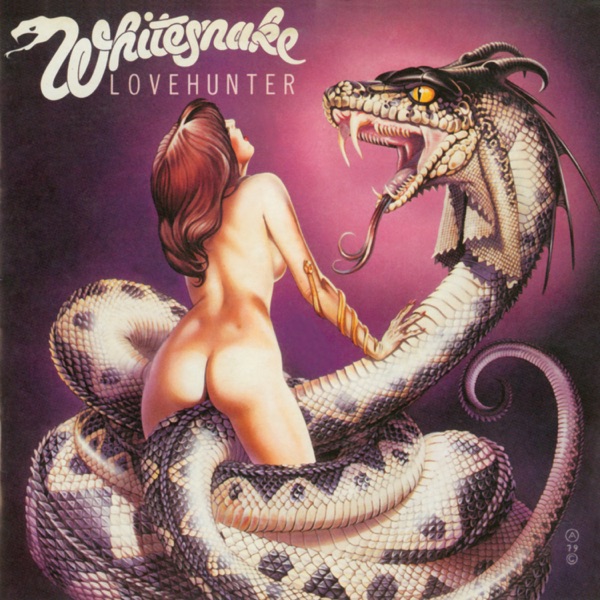
Lovehunter
1979 · 14 tracks
- 1 Long Way from Home ↗ 4:57
- 2 Walking In the Shadow of the Blues ↗ 4:24
- 3 Help Me Thro' the Day ↗ 4:39
- 4 Medicine Man ↗ 3:58
- 5 You 'N' Me ↗ 3:25
- 6 Mean Business ↗ 3:47
- 7 Love Hunter ↗ 5:36
- 8 Outlaw ↗ 4:02
- 9 Rock 'N' Roll Women ↗ 4:44
- 10 We Wish You Well ↗ 1:34
- 11 Belgian Tom's Hat Trick (Andy Peebles BBC Radio 1 Sessions, 03/29/79) ↗ 3:39
- 12 Love to Keep You Warm (Andy Peebles BBC Radio 1 Sessions, 03/29/79) ↗ 3:28
- 13 Ain't No Love In the Heart of the City (Andy Peebles BBC Radio 1 Sessions, 03/29/79) ↗ 4:54
- 14 Trouble (Andy Peebles BBC Radio 1 Sessions, 03/29/79) ↗ 4:30


Whitesnake
1987 · 11 tracks
- 1 Crying In The Rain (1987 Version / 2018 Remaster) ↗ 5:38
- 2 Bad Boys (2018 Remaster) ↗ 4:06
- 3 Still Of The Night (2018 Remaster) ↗ 6:38
- 4 Here I Go Again (1987 Version / 2018 Remaster) ↗ 4:35
- 5 Give Me All Your Love (2018 Remaster) ↗ 3:28
- 6 Is This Love (2018 Remaster) ↗ 4:44
- 7 Children Of The Night (2018 Remaster) ↗ 4:23
- 8 Straight For The Heart (2018 Remaster) ↗ 3:37
- 9 Don't Turn Away (2018 Remaster) ↗ 5:06
- 10 Looking For Love (2018 Remaster) ↗ 6:31
- 11 You're Gonna Break My Heart Again (2018 Remaster) ↗ 4:13

Slip of the Tongue
1989 · 10 tracks
- 1 Slip Of The Tongue (2009 Remaster) ↗ 5:24
- 2 Judgement Day (2009 Remaster) ↗ 5:11
- 3 Fool For Your Loving (2009 Remaster) ↗ 4:09
- 4 Now You're Gone (2009 Remaster) ↗ 4:06
- 5 Kitten's Got Claws (2009 Remaster) ↗ 5:04
- 6 Cheap & Nasty (2009 Remaster) ↗ 3:31
- 7 The Deeper The Love (2009 Remaster) ↗ 4:20
- 8 Slow Poke Music (2009 Remaster) ↗ 4:02
- 9 Wings Of The Storm (2009 Remaster) ↗ 5:06
- 10 Sailing Ships (2009 Remaster) ↗ 6:07

Restless Heart
1997 · 15 tracks
- 1 Restless Heart (2021 Remix) ↗ 4:53
- 2 You're So Fine (2021 Remix) ↗ 5:11
- 3 Can't Go On (2021 Remix) ↗ 4:28
- 4 Crying (2021 Remix) ↗ 5:38
- 5 Take Me Back Again (2021 Remix) ↗ 6:24
- 6 Anything You Want (2021 Remix) ↗ 4:12
- 7 Too Many Tears (2021 Remix) ↗ 5:44
- 8 All In The Name Of Love (2021 Remix) ↗ 5:14
- 9 Your Precious Love (2021 Remix) ↗ 4:32
- 10 Can't Stop Now (2021 Remix) ↗ 3:26
- 11 Woman Trouble Blues (2021 Remix) ↗ 5:42
- 12 Stay With Me (2021 Remix) ↗ 4:07
- 13 Oi (Theme For An Imaginary Drum Solo) [2021 Remix] ↗ 3:44
- 14 Don't Fade Away (2021 Remix) ↗ 4:58
- 15 Can't Go On (Unzipped) ↗ 3:47

Good to Be Bad
2008 · 58 tracks
- 1 Best Years (2023 Remix) ↗ 5:16
- 1 Best Years (2023 Remaster) ↗ 5:16
- 1 Lay Down Your Love (feat. Hook City Harlots) ↗ 6:10
- 1 Best Years (Evolution) ↗ 6:02
- 2 Can You Hear The Wind Blow (2023 Remix) ↗ 5:23
- 2 Can You Hear The Wind Blow (2023 Remaster) ↗ 5:04
- 2 Call On Me (feat. Hook City Harlots) ↗ 5:02
- 2 Can You Hear The Wind Blow (Evolution) ↗ 5:41
- 3 Lay Down Your Love (2023 Remix) ↗ 6:10
- 3 Lay Down Your Love (2023 Remaster) ↗ 6:02
- 3 All For Love (feat. Hook City Harlots) ↗ 5:12
- 3 Lay Down Your Love (Evolution) ↗ 5:50
- 4 All I Want All I Need (2023 Remix) ↗ 5:40
- 4 If You Want Me (2023 Remaster) ↗ 4:09
- 4 Good To Be Bad (feat. Hook City Harlots) ↗ 5:10
- 4 All I Want All I Need (Evolution) ↗ 5:44
- 5 Call On Me (2023 Remix) ↗ 5:01
- 5 All I Want All I Need (2023 Remaster) ↗ 5:42
- 5 If You Want Me (feat. Hook City Harlots) ↗ 4:09
- 5 Call On Me (Evolution) ↗ 5:09
- 6 All For Love (2023 Remix) ↗ 5:12
- 6 Call On Me (2023 Remaster) ↗ 5:03
- 6 Got What You Need (feat. Hook City Harlots) ↗ 4:15
- 6 All For Love (Evolution) ↗ 5:44
- 7 Good To Be Bad (2023 Remix) ↗ 5:09
- 7 Ready To Rock (2023 Remaster) ↗ 4:30
- 7 A Fool In Love (feat. Hook City Harlots) ↗ 5:47
- 7 Good To Be Bad (Evolution) ↗ 5:00
- 8 Summer Rain (2023 Remix) ↗ 6:24
- 8 Summer Rain (2023 Remaster) ↗ 6:12
- 8 Dog (feat. Tommy Aldridge) ↗ 3:28
- 8 Summer Rain (Evolution) ↗ 4:39
- 9 If You Want Me (2023 Remix) ↗ 4:09
- 9 Good To Be Bad (2023 Remaster) ↗ 5:16
- 9 All I Want Is You (feat. Tommy Aldridge) ↗ 4:44
- 9 If You Want Me (Evolution) ↗ 4:08
- 10 Got What You Need (2023 Remix) ↗ 4:14
- 10 All For Love (2023 Remaster) ↗ 5:15
- 10 Ready To Rock (feat. Tommy Aldridge) ↗ 4:28
- 10 Got What You Need (Evolution) ↗ 4:27
- 11 Dog (2023 Remix) ↗ 3:27
- 11 All I Want Is You (2023 Remaster) ↗ 4:36
- 11 If You Want Me (feat. Tommy Aldridge) ↗ 4:09
- 11 Dog (Evolution) ↗ 3:28
- 12 All I Want Is You (2023 Remix) ↗ 4:45
- 12 Got What You Need (2023 Remaster) ↗ 4:17
- 12 All For Love (Doug Aldrich Alternate Solo) ↗ 5:13
- 12 All I Want Is You (Evolution) ↗ 5:11
- 13 A Fool In Love (2023 Remix) ↗ 5:46
- 13 A Fool In Love (2023 Remaster) ↗ 5:50
- 13 Summer Rain (Unzipped) ↗ 6:23
- 13 A Fool In Love (Evolution) ↗ 5:47
- 14 Ready To Rock (2023 Remix) ↗ 4:28
- 14 Dog (2023 Remaster) ↗ 3:28
- 14 Ready To Rock (Evolution) ↗ 4:18
- 15 Til The End Of Time (2023 Remix) ↗ 5:21
- 15 Til The End Of Time (2023 Remaster) ↗ 5:36
- 15 Til The End Of Time (Evolution) ↗ 5:54

Flesh & Blood
2019 · 18 tracks
- 1 Good To See You Again ↗ 3:43
- 2 Gonna Be Alright ↗ 3:52
- 3 Shut Up & Kiss Me ↗ 3:37
- 4 Hey You (You Make Me Rock) ↗ 5:30
- 5 Always & Forever ↗ 3:53
- 6 When I Think Of You (Color Me Blue) ↗ 3:53
- 7 Trouble Is Your Middle Name ↗ 4:17
- 8 Flesh & Blood ↗ 5:18
- 9 Well I Never ↗ 4:01
- 10 Heart Of Stone ↗ 6:43
- 11 Get Up ↗ 4:46
- 12 After All ↗ 3:47
- 13 Sands Of Time ↗ 6:09
- 14 Can't Do Right For Doing Wrong ↗ 4:59
- 15 If I Can't Have You ↗ 4:23
- 16 Gonna Be Alright (X-Tendo Mix) ↗ 4:12
- 17 Sands Of Time (Radio Mix) ↗ 6:21
- 18 Shut Up & Kiss Me (Video Mix) ↗ 3:43
-
 TroubleWhitesnake197814 tracks
 -
 LovehunterWhitesnake197914 tracks
 -
 Ready an’ WillingWhitesnake19809 tracks
 -
 Come an’ Get ItWhitesnake198110 tracks
 -
 Slide It InWhitesnake198410 tracks
 -
 WhitesnakeWhitesnake198711 tracks
 -
 Slip of the TongueWhitesnake198910 tracks
 -
 Restless HeartWhitesnake199715 tracks
 -
 Good to Be BadWhitesnake200858 tracks
 -
 Flesh & BloodWhitesnake201918 tracks
Deep Dive
Overview
Whitesnake were an English hard rock and blues rock band that emerged from London in 1978 as the vehicle for former Deep Purple vocalist David Coverdale. Beginning as Coverdale’s backing ensemble, the band evolved into a full entity that would define much of the 1980s hard rock landscape, transitioning from blues-drenched heaviness to MTV-era commercial appeal. Coverdale remained the sole constant throughout Whitesnake’s tenure, steering the band through stylistic shifts that ranged from underground credibility to mainstream platinum success.
Formation Story
Whitesnake coalesced in London in 1978 following David Coverdale’s departure from Deep Purple, one of hard rock’s foundational acts. Coverdale assembled a lineup anchored by guitarists Bernie Marsden and Micky Moody, and keyboardist Jon Lord, the latter a Deep Purple alumnus himself. The band’s roots traced to both London’s rock establishment and the muscular blues tradition that had animated Deep Purple’s sound, creating a template of bluesy hard rock played with both technical precision and raw emotional delivery. This initial lineup—Coverdale, Marsden, Moody, and Lord—would define Whitesnake’s formative years and establish the sonic identity that carried them through their most creatively fertile period.
Breakthrough Moment
Whitesnake’s early albums built a reputation within the hard rock underground, but their breakthrough to broader recognition arrived with Slide It In in 1984. Released on Geffen Records, the album signaled a shift toward production sheen and more accessible song structures while retaining the band’s bluesy core. The record’s commercial and critical success positioned Whitesnake as serious contenders in a hard rock market increasingly dominated by glam-influenced acts. This period marked the band’s transition from cult status among hard rock purists to viable mainstream competitors, setting the stage for the arena-sized success that would follow.
Peak Era
Whitesnake’s commercial and cultural peak arrived with their self-titled 1987 album, a record that capitalized on MTV’s dominance and the glam metal boom of the late 1980s. The band’s sound evolved toward more polished production values, radio-friendly hooks, and visual spectacle while maintaining enough edge to preserve their hard rock credibility. This era culminated with Slip of the Tongue in 1989, released while the band was at peak visibility. During these years, Whitesnake commanded arena crowds and achieved platinum certifications, establishing themselves as fixtures of 1980s rock radio and music television.
Musical Style
Whitesnake’s sound fused the blues-rock vocabulary inherited from Deep Purple and Black Sabbath with the melodic sensibilities and production techniques characteristic of 1980s glam metal. Coverdale’s vocals—raspy, soulful, and built on the wailing tradition of hard rock—remained the band’s emotional centerpiece, delivered with dramatic phrasing and sustained intensity. The guitar work of Marsden and Moody emphasized blues-inflected soloing and rhythmic riffing, while Lord’s keyboards added textural depth and symphonic weight. The band’s musical evolution tracked the broader movement in hard rock toward tighter production and radio accessibility during the late 1980s, though they retained enough blues DNA to distinguish themselves from pure glam-metal acts that eschewed substantive musicianship.
Major Albums
Trouble (1978)
The debut established Whitesnake as a blues-rock outfit centered on Coverdale’s vocal prowess and the interplay between Marsden, Moody, and Lord, introducing the foundational sound that would evolve across subsequent releases.
Lovehunter (1979)
The second album consolidated the band’s early identity, deepening their blues-rock foundation while demonstrating increasing confidence in songwriting and arrangement.
Ready an’ Willing (1980)
Released during the height of the New Wave of British Heavy Metal era, this record proved Whitesnake’s relevance to contemporary hard rock discourse while maintaining their blues-drenched approach.
Slide It In (1984)
A watershed moment that refined the band’s commercial instincts without sacrificing musicianship, Slide It In opened doors to a broader audience and foreshadowed the arena-rock direction to come.
Whitesnake (1987)
The self-titled album represented peak commercial success and MTV presence, showcasing the band’s ability to craft polished, hook-laden hard rock without abandoning their blues heritage.
Slip of the Tongue (1989)
Final album of the peak era, capturing Whitesnake at maximum visibility while consolidating the studio achievement and live momentum of the mid-to-late 1980s.
Signature Songs
- Trouble — The title track from their 1978 debut, establishing Coverdale’s vocal authority and the band’s blues-rock template.
- Come an’ Get It — A showcase for the band’s melodic hard rock approach and Coverdale’s emotional delivery from their 1981 album.
- Slide It In — The title track that signaled commercial evolution while retaining blues credibility and tight arrangement.
- Is This Love — From the 1987 self-titled album, encapsulating the band’s MTV-era polished production and mainstream accessibility.
- Give Me All Your Love — A reflection of the band’s glam-metal flourish during their late-1980s commercial peak.
Influence on Rock
Whitesnake occupied a crucial position in hard rock’s 1980s trajectory, helping to bridge the gap between 1970s blues-rock heaviness and the more theatrical, production-focused glam metal boom. Their success validated the commercial potential of bluesy hard rock when coupled with contemporary production values and MTV presentation. Coverdale’s presence in the band also reinforced the continuing relevance of Deep Purple’s musical lineage within contemporary hard rock; his vocal approach influenced subsequent generations of hard rock singers who sought emotional intensity within heavy music. The band’s ability to evolve stylistically across their discography demonstrated that commercial success and musical integrity were not mutually exclusive in the hard rock marketplace.
Legacy
Whitesnake’s tenure during the 1980s secured their place in hard rock history as architects of a particular moment when blues-rock tradition and contemporary commercial ambition aligned. The band’s continued activity—with albums including The Purple Album (2015), Flesh & Blood (2019), and others—demonstrated the enduring viability of their core audience and Coverdale’s status as a living link to hard rock’s foundational era. Streaming platforms and catalog availability ensure steady listening among both longtime fans and newcomers discovering the band through algorithms and playlist placement. Their influence extends both directly, through musicians working in blues-rock and hard rock modes, and indirectly, through the established template of bridging underground credibility with mainstream accessibility.
Fun Facts
- Jon Lord, the band’s original keyboardist, had previously served as a member of Deep Purple alongside David Coverdale, making Whitesnake a partial reunion of Deep Purple talent separated by different musical contexts.
- The band’s 2015 album The Purple Album represented an explicit homage to Deep Purple, featuring interpretations and reworkings that honored Coverdale’s prior musical chapter.
- Whitesnake’s evolution from blues-rock credibility to glam-metal visual presentation mirrored broader shifts in hard rock’s relationship with image and MTV presentation across the 1980s.